The multilayer longitudinal piezoactuator is used for aerospace and defence for correction form of satellite antenna shape.1–24 This multilayer longitudinal piezo actuator is used in compound telescopes for focusing, laser interferometers, satellite control systems and deformable mirrors in the aerospace industry, scanning microscopy and vibration damping.5–29 The parameters of the PZT multilayer piezoactuator are determined.
Calculation of parameters multilayer longitudinal piezoactuator
The multilayer longitudinal piezoactuator is the electromechanical device for converting electrical energy into mechanical energy with series mechanical connection of the piezolayers and their electrical parallel connection, with the polarizations of every two adjacent piezolayers in opposite directions.1–3The parameters of the multilayer longitudinal piezoactuator are determined by method mathematical physics using the equation reverse piezoeffect and the differential equation or the matrix equation.5–29 This mathematical model is linearity, without thermal effects, hysteresis, creep. The work develops the analytical model for the multilayer longitudinal piezoactuator for aerospace system.
Static analysis
For the multilayer longitudinal piezoactuator its equation reverse piezoeffect1–15 has the form
(1)
Where S3 - longitudinal strain along axes 3, dimensionlees, E3 - electric field along axes 3, V/m, T3 - mechanical stress along axes 3, Pa, d33- longitudinal piezomodule, m/V,
- the longitudinal elastic compliance at the E=const, m2/N.
Let us consider the static characteristic the multilayer longitudinal piezoactuator at one fixed face and the voltage control. We have maximum displacement
at
and maximum force
at
in the form
(2)
(3)
For the voltage control the PZT multilayer longitudinal piezoactuator at one fixed face and d33 = 0.4∙10-9 m/V, = 6×10⁻⁴ m, n = 20, S0= 1.8×10⁻⁴ m2, = 3×10-11 m2/N, Um= 100 V we obtain on Figure 1 the maximum displacement
= 800 nm and the maximum force Fm = 400 N. The measurements were made on UMM-5 press in the range of working loads under mechanical stresses in the longitudinal piezoactuator up to 100 MPa. The error between the experimental data and calculation results is 10%.
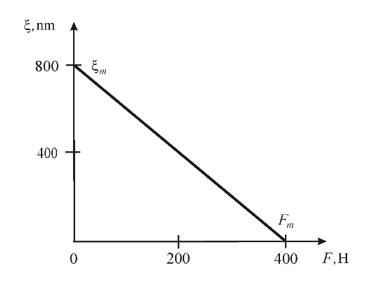
Figure 1 Static characteristic multilayer longitudinal piezoactuator.
Dynamic analysis
The multilayer longitudinal piezoactuator on Figure 2 consists of piezolayers connected electrically in parallel and mechanically in series.
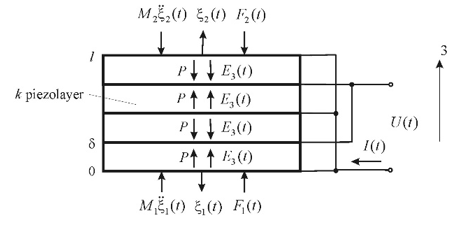
Figure 2 Scheme multilayer longitudinal piezoactuator.
Let us construct the structural model of the multilayer longitudinal piezoactuator. The Laplace transform of the force used for piezoelectric deformation has the form
(4)
Where F(p) - Laplace transform force, F(p) - Laplace transform electric field along axes 3, p- operator.
The circuit of the multilayer longitudinal piezoactuator on Figure 3 is compiled from the equivalent T-shaped quadripole for k and k+1 piezolayers
(5)
(6)
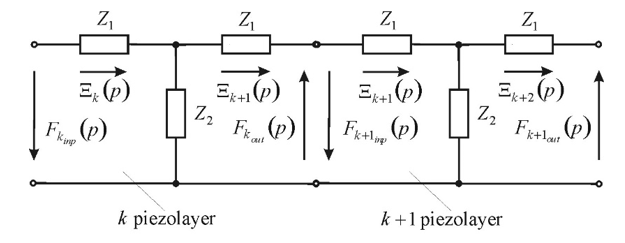
Figure 3 Circuit multilayer piezoactuator with quadripoles k and k+1 piezolayers.
Where
,
are the resistance of the equivalent quadripole of k piezolayer, d is the thickness of k piezolayer,
is the coefficient of wave propagation, p is the operator,
is the speed of sound in the piezoceramics at,
,
is the attenuation coefficient,
,
are the Laplace transform of the forces at the input and output ends of k piezolayer,
,
are the Laplace transforms of the displacements at input and output ends of k piezolayer.
Then we have the Laplace transforms the system of the equations for k piezolayer on Figure 3 in the form
(7)
(8)
The matrix equation for k piezolayer
(9)
And the matrix [M] in the form
(10)
Where
(11)
(12)
,
. (13)
For the multilayer longitudinal piezoactuator of the Laplace transform the displacement
and the force ,
acting on the output face of k piezolayer on Figure 3, are corresponded to Laplace transforms of displacement and force, acting on the input face of k + 1 piezolayer.
The force on the output face for k piezolayer is equal in amplitude and opposite in direction to the force on the input face for k + 1 piezolayer
(14)
The matrix equation for n piezolayers of the of k piezolayer has the form:
(15)
With the matrix multilayer longitudinal piezoactuator Figure 3 in the form
(16)
Equations of the forces on two faces of the multilayer longitudinal piezoactuator have the form
at
,
(17)
at
,
(18)
Where
,
are the Laplace transforms of mechanical stresses on two faces of the multilayer longitudinal piezoactuator,
is the cross sectional area.
The structural model and the structural scheme on Figure 4 of the multilayer longitudinal piezoactuator at voltage control with R = 0 external circuit resistance and
length actuator are obtained from the equation reverse piezoeffect, the forces on two faces and the system of the equations for the equivalent quadripole of the multilayer longitudinal piezoactuator in the form
(19)
(20)
Where
.(21)

Figure 4 Structural scheme multilayer longitudinal piezoactuator at voltage control.
Transfer functions
Then at the voltage controlled the the multilayer longitudinal piezoactuator we have the transfer functions
(22)
(23)
(24)
(25)
(26)
(27)
For the voltage controlled multilayer longitudinal piezoactuator and the step input voltage Um its faces displacements at the inertial load at m<<M1, m<<M2 and F1(t)=F2(t)=0 have the form
(28)
(29)
Where Um is the amplitude of the voltage, m is the mass of the multilayer longitudinal piezoactuator, M1, M2 are the load masses. For the PZT multilayer longitudinal piezoactuator at d33 = 4∙10-10 m/V, n = 8, Um = 50 V, M1 = 0.5 .kg and M2 = 2.5 kg we obtain the displacements its modules of the faces
= 128 nm,
= 32 nm,
= 160 nm with error 10%.
Dynamic characteristic multilayer longitudinal piezoactuator at one fixed face
The dynamic characteristics of the multilayer longitudinal piezoactuator at one fixed face on Figure 5 are calculated based on the joint solution of the reverse piezoeffect equation and the differential equation.
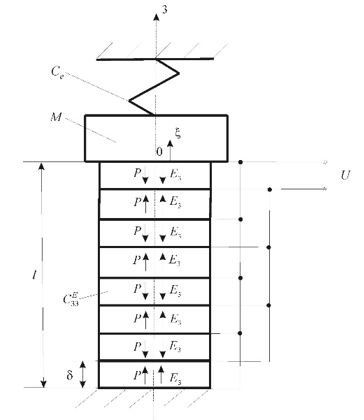
Figure 5 Scheme multilayer longitudinal piezoactuator at one fixed face and the elastic inertial load.
The equation of forces at the second end on Figure 5 has the form
(30)
Then from the equation reverse piezoeffect and the equation of forces at the second end we have the equations
(31)
Then from the differentional equation we have equation
(32)
Then the transfer function for multilayer longitudinal piezoactuator at one fixed face and the elastic inertial load has form
(33)
After expanding the hyperbolic cotangent into a series, taking into account two terms of the series, we obtain the transfer function in the form
(34)
(35)
Where
, U(p) are the Laplace transforms the displacement face and the voltage, Tt,
are the time constant and the damping coefficient,
is the rigidity load,
is the rigidity multilayer longitudinal piezoactuator at E=const.
Therefore, its amplitude displacement has the form
(36)
Where
the amplitude displacement and Um is the amplitude of the voltage.
In dynamic the expression for the transient response at the voltage control the multilayer longitudinal piezoactuator is determined in the form
(37)
,
(38)
For the voltage control the PZT multilayer longitudinal piezoactuator at one fixed face d33 = 0.4∙10-9 m/V, n = 8, Um = 50 V,
= 4 kg,
= 2.3∙107 N/m,
= 0.2∙107 N/m, values the steady state value of displacement face
= 147.2 nm and the time constant Tt = 0.4∙10-3 s are obtained with error 10%.