Journal of
eISSN: 2574-8114


Research Article Volume 11 Issue 6
 Ovijit Paul,2 Afroza Akter Rita,1 Moni Jafar Pingki,3 Jannatul Ferdoush Diba2
1Department of Fashion Design & Technology, BGMEA University of Fashion & Technology (BUFT), Bangladesh
2Department of Fashion Design, Tagore University of Creative Arts, Bangladesh
3Department of Fashion Studies, BGMEA University of Fashion & Technology (BUFT), Bangladesh
Correspondence: Md Moniruzzaman, Department of Fashion Design & Technology, BGMEA University of Fashion & Technology (BUFT), Dhaka, Bangladesh
Received: November 08, 2025 | Published: November 27, 2025
Citation: Moniruzzaman, Paul O, Rita AA, et al. The integration of High-end fashion into the ready-made garment industry of Bangladesh: prospects and challenges to enhance the growth of exports to the international market. J Textile Eng Fashion Technol. 2025;11(6):311-315. DOI: 10.15406/jteft.2025.11.00438
This research attempts to identify the high-valued and high-quality product range of the second-largest apparel export country in the world to carry the growth forward and interest of their market. The ultimate purpose is to explore necessary advancement and limitation of existing practice including training, knowledge, technology, research and strategies in terms of production and export of high end fashion. This study used a secondary research approach to collect and examine information from the manufacturing industry, buying houses, trade associations, news outlets and scholarly publications to identify the underlying dynamics of production, export market, worth and prospects. Authors analyzed two types of products (Woven, Knit) industry of Bangladesh to evaluate the pattern of the high-end fashion category. The findings indicated that in contrast with China and Vietnam, in Bangladesh (a) the emergence of production and export high valued products abroad for greater interest. More Advanced Production of Fabric and Apparel stage, (b) the industry can establish the latest technology, layout and skilled manpower to meet the desired product range through research and development. Internationalization (c) of the national brand's product range could play a vital role in enhancing competitiveness besides the basic apparel export. The number of destinations for apparel products could change the ranking of Bangladesh. Findings indicate that Bangladesh exports basic apparel products (90%) to the global brand and stood second position in the world ranking. Therefore, manufacturers are advised to consider the business strategies of close competitors and develop their own pricing and merchandising strategies to maintain their supremacy as high-end product producers in the international market. This study addressed the scope of development for the industry for high-end production. The results revealed some unique aspects of merchandising strategies.
Keywords: apparel industry, basic item, export, garments, high-end product
High-end fashion pertains to the creation and sale of garments, accessories, and related fashion articles known for their exceptional quality, skillful craftsmanship, and exclusivity.1 Within the domain of high-end fashion, there is a focus on utilizing premium materials, elaborate designs, and precise craftsmanship. Items falling into this category are frequently associated with renowned luxury brands recognized for their commitment to excellence and refinement. Luxury emanates from abstract ideas, primarily influenced by societal perceptions of what is trendy and esteemed, although it's also assessed through intangible measures. Nonetheless, luxury goods manifest in the tangible world, adhering to specific standards and possessing common attributes.2 However, it's worth highlighting that individual brands prioritize different aspects among those outlined below Table 1:
|
Categories |
Identification |
Ref. |
|
Quality materials |
High-end fashion pieces are meticulously fashioned from top-tier materials, encompassing lavish textiles, authentic leather, and premium metals. |
3 |
|
Craftsmanship |
High-end fashion items are characterized by meticulous attention to detail and expert craftsmanship. Numerous items in this category may require manual labor and elaborate techniques |
3–5 |
|
Innovative design |
High-end fashion is recognized for its inclination to explore innovative design territories, frequently showcasing cutting-edge and pioneering styles. Esteemed designers typically spearhead the creative direction. |
1 |
|
Exclusivity |
Numerous high-end fashion items are manufactured in restricted numbers, enhancing their exclusivity. Limited availability boosts their allure and perceived worth. |
3 |
|
Brand prestige |
Brand reputation holds considerable weight in the realm of high-end fashion. Well-established luxury brands carry inherent prestige and are linked with a dedication to both quality and style. |
6 |
|
High price point |
High-end fashion items usually command a premium price in contrast to mainstream or mass-produced fashion. This higher cost is warranted by the utilization of top-notch materials, skilled craftsmanship, and the brand's esteemed reputation. |
1 |
Table 1 Key features of high-end fashion include
The ready-made garment (RMG) sector is said to be Bangladesh's economy's strongest economic pillar. It began in the early 1980s and has grown to become one of Bangladesh's main export revenue sources.7 Bangladesh's ready‐made garments (RMG) sector contributes more than 80% of the country's total export earnings and the worth of this apparel industry has been around 42 billion US dollars in recent days.8 According to the Bangladesh Garment Manufacturers & Exporters Association (BGMEA) in the month of January 2024, Bangladesh has exported goods worth 5.72 billion US dollars which is the highest-ever record in its history. The main export products of Bangladesh were knitwear 45% (CAGR 36.8%) and woven garments 37% (CAGR 33.8%)(Annual Report, EPB, 2023). Bangladesh's apparel exports will reach $56 billion by the end of 2026 and will witness a CAGR of 5.3% throughout this period(Saddam Hossain, 2023).9,10 Approximately 4.5 million individuals are directly employed, while over 15 million are indirectly dependent on the RMG industry for their livelihoods.11 Bangladesh has a comparative advantage in primary and labor-intensive manufacturing products; primary product competitiveness has declined while labor-intensive product competitiveness has increased.12 Shifting for comparative advantage to capital-intensive high-end garments would involve investing in high-tech machinery and human resource development.13
Bangladesh, economy has changed a lot in 30 years. On an average, Its GDP is growing by 7% a year with a booming garment industry, which now ranks second, in exports.14 Despite being the second-biggest exporter, Bangladesh lags significantly behind China in every aspect of this industry, including export revenue and market share. While China has a third of the global apparel market, Bangladesh only exports 7.9 % of its clothes worldwide, but its 82 percent share of export revenues serves as a lifeline for the country's economy.15,16 Bangladesh has the potential to achieve more success in this industry by continuing to develop its product diversification to include high-quality, upscale products beyond its current exports of basic goods. According to BGMEA Bangladesh’s apparel exports to the world are around 46991.61 million US dollars, whereas the basic items including trousers, t-shirts & knitted shirts, sweaters, shirts & blouses and underwear are 37,778.4 million US dollars 81% of the total amount. The rest of the 19% export items are home textiles, accessories and high-end fashion(BGMEA Annual Report,2023). The total amount of high-end fashion or luxurious items for the brand can be approximately less than 5% in china which is over 20%. Hence Luxury fashion brands are turning to Bangladesh as a reliable supplier and are increasingly sourcing from the country even amidst global supply chain disruption induced by the Covid pandemic and the Russia-Ukraine war. A number of Bangladeshi textile mills are now producing high-value fabrics for some luxury brands aiming to reduce import dependency and lead time as well.17
Business growth and challenges
In terms of employment and foreign exchange earnings, the ready-made garments (RMG) sector has more promise than any other sector in Bangladesh. It is the largest exporting industry that has experienced tremendous growth during the last 25 years.18 We are expecting more tangible growth of this sector through diversification of the product as well as market paradigm high-end fashion product rather than the fad or fast fashion. This sector is also facing plenty of challenges for instance limited production method, technology advancement, unskilled or semi-skilled workforce, infrastructure, occupational crisis and marketing tactics. Figure 1 shows the export scenario of apparel products from Bangladesh to the world calendar year basis, whereas the growth is marginal and progressive.19
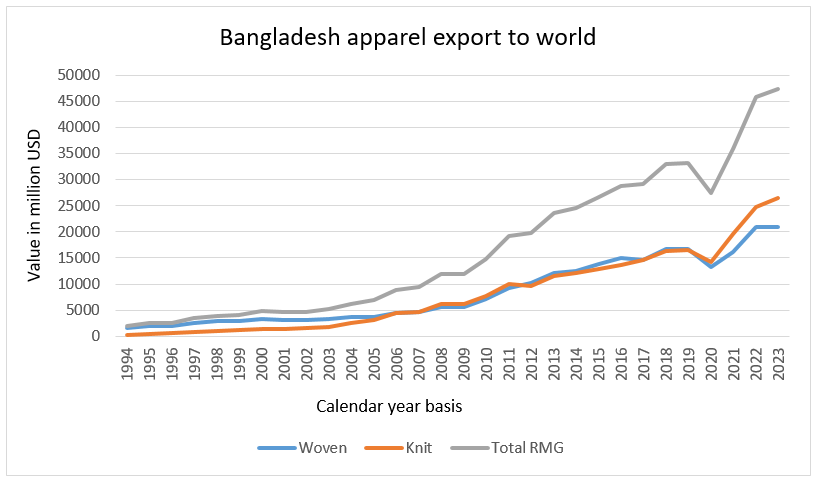
Figure 1 Bangladesh apparel export to world calendar year basis (Bangladesh’s Apparel Export to World).
Bangladesh yet exported seven major products to the world which are considered the basic but 90% of the total export quantity. The average SMV of that items are below 30 minutes and less priced compare to the fancy items. Table 2 depicts the trouser items are in the top in terms of export. Based on data from the International Trade Center (ITC), BGMEA reports that the worldwide market imports pants valued at about $84 billion a year. About 15% comes from Bangladesh's export-oriented clothing manufacturing.20 Underwear and shirts items are in the last of the list.
|
Year |
Apparel product |
||||
|
Trousers |
T-Shirts & Knitted shirts |
Sweaters |
Shirts & Blouses |
Underwear |
|
|
2015-2016 |
10167.31 |
6892.8 |
3182.47 |
3076.36 |
1172.74 |
|
2016-2017 |
9943.09 |
6650.51 |
3361.53 |
2918.97 |
1328.5 |
|
20217-2018 |
10833.83 |
7153.84 |
3674.7 |
2927.34 |
1410.7 |
|
2018-2019 |
11754.86 |
7902.27 |
4255.91 |
3190.23 |
1640.36 |
|
2019-2020 |
9362.64 |
6273.77 |
3597.68 |
2449.65 |
1358.72 |
|
2020-2021 |
10681.52 |
7239.74 |
4051.83 |
2048.4 |
1789.7 |
|
2021-2022 |
14507.5 |
9857.54 |
5640.45 |
2765.91 |
2343.56 |
|
2022-2023 |
14953.3 |
10,862.52 |
5,942.47 |
3,650.12 |
2369.99 |
Table 2 Main apparel items exported from Bangladesh value in million USD (Fiscal Year Basis)
Bangladeshi traditional export markets are considered only 30 countries out of 195 countries of the world including partial EU, USA, UK & Canada. The non-traditional markets are almost 15 countries although we are exporting very few in some other countries. Figure 2 illustrate the growth rates of traditional market for last 3 years respectively.
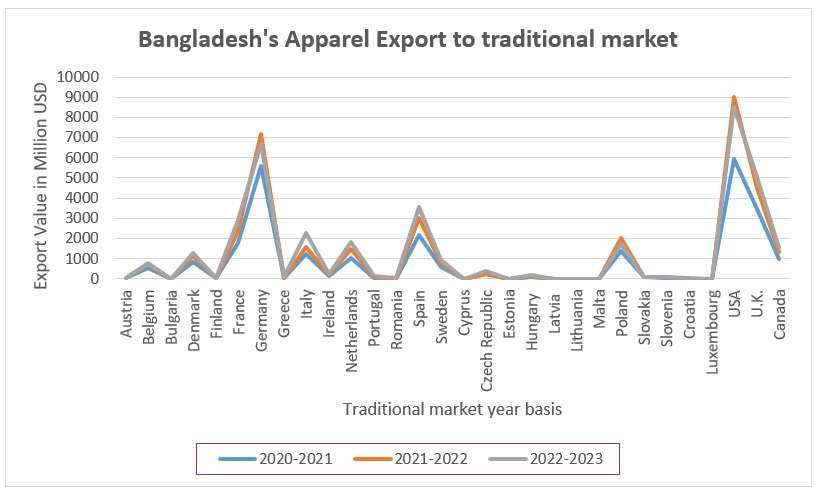
Figure 2 Bangladesh apparel export to the traditional market of the world calendar year basis (Bangladesh’s Apparel Export to World).
Data were gathered from secondary sources, including journals, research articles, papers, the Export Promotion Bureau, and the Bangladesh Garment Manufacturers and Exporters Association (BGMEA). In our study, a descriptive technique was used to analyze and display the acquired data. To present the condition and opportunities of Bangladesh, information published in the different newspapers and websites have been also studied and analyzed. Information over the last thirty years from 1994 to 2023 has been gathered to analyze the growth of market and development on clothing export earnings as Market Diversification entails both Market as well as Product Developments. Information is given in tabular style and displayed by various graphs, including line diagrams and bar diagrams. Regression analysis are also utilized to determine the contribution of RMG exports to GDP.
Findings
High-end fashion represents the premium segment of the fashion industry, distinctly different from mass-market fashion in terms of quality, expertise, and production complexity. Based on the analysis of high-end fashion products in Bangladesh, the following findings highlight the unique characteristics of high-end fashion production (Figure 3):
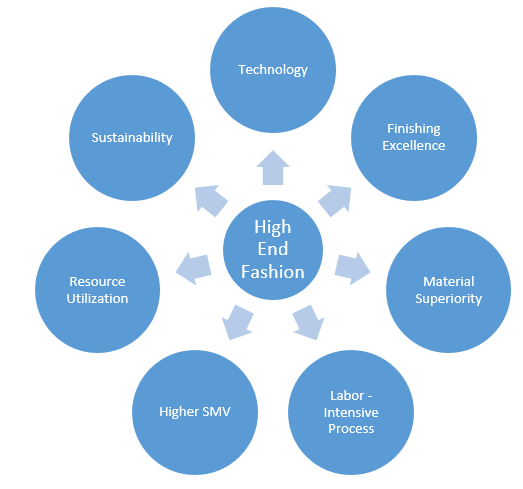
Figure 3 high end fashion parameter.
High-end fashion production is a sophisticated and multi-dimensional process involving a careful balance of design innovation, material excellence, skilled craftsmanship, and sustainable practices. The increased consumption of resources, higher SMV, and focus on quality finishing distinguish it from basic garment production, justifying its premium market positioning.
High-end fashion is a premium segment of the fashion industry, defined by superior quality, exclusive designs, and exceptional craftsmanship. It differs from mass-market fashion through factors such as product pricing, material selection, intricate embellishments, sustainability practices, and advanced technology integration. Skilled artisans, precise fabric finishing, and superior construction techniques further elevate its value. From a production perspective, high-end fashion involves efficient material consumption, the use of specialized machines, and a higher Standard Minute Value (SMV), indicating greater complexity in production. Stringent quality control measures, including laser cutting, hand finishing, and bespoke tailoring, ensure exceptional standards. By incorporating sustainability, innovation, and craftsmanship, high-end fashion maintains its exclusivity and distinction from mainstream fashion.
Skills development
Competitiveness in the global apparel trade is primarily challenged by a lack of scale in garment manufacturing due to workers’ skill sets. Then comes seasonality (manufacturing only certain product categories), inadequate capability in the synthetic value chain, a limited number of preferential trade agreements, etc. Coming to Bangladesh, the garment export industry is seasonality driven, leading to full capacities for season-specific production and evidently, competing nations have different skill regimes to suit their local, cultural and commercial factors. The workers in the garment industry are generally classified as unskilled, semi-skilled, skilled and highly skilled. Usually, a skilled and highly skilled workforce at a factory floor performs critical operations such as collar attachment, sleeve placket attachment, etc., which require a certain set of expertise and know-how.21
Without the right set of skills, these operations cannot be performed and if performed wrongly, it would result in rejections and wastages. Without the requisite workforce to perform these operations, factories would have faced delivery delays, quality issues and bottlenecks at the production floor. So it is of utmost importance for a factory to have workers across different skill levels right from unskilled to highly skilled workforce to ensure smooth operations, quality and timely delivery. By developing certain skill levels to match the product categories they manufacture. The clients place orders for certain product categories with these countries to match the existing skill levels of the workforce in these countries. India owing to its relatively higher skill levels has catered to value-added products which are low to medium quality with a certain level of value addition. In the case of Bangladesh and Vietnam, the skill levels have been developed over the last 1-2 decades and these countries predominantly cater to basic products (Table 3).
|
Key findings on skilling initiatives of other sourcing destinations |
||||
|
Well Structured Vocational Education System to suit the Countries’ Skill needs. |
Decentralization of vocational training. |
Participation of Local Enterprises in Skill Development. |
Participation of Brands/Retailers in Skilling Initiatives |
Introduce new component in existing programs for training at High School level within/around Garment Clusters |
|
Example: |
Example: |
Example: |
Example: |
Example: |
|
China’s VET system aims at strengthening the manufacturing sector of the country by relocating the workers from other sectors, primarily agricultural sector to the manufacturing sector. |
Vietnam is providing Bilateral Government Training with the goal of developing a modernized industrial set-up in Vietnam by 2020. |
In Sri Lanka training institutes are operating under different ministries and several private institutions. |
The government of Vietnam conducts training and skill development at regular intervals with brands/retailers. |
Few secondary pieces of evidence suggest that China is considering to establish training centers adjacent to RMG clusters. |
Table 3 Key findings on skilling initiatives of other sourcing destinations
Product diversification
When new competitors enter the market with superior trade agreements or geographic advantages, Bangladesh's comparative advantage in labor costs is steadily eroding. Bangladesh can adjust to maintain its place in the increasingly saturated market for necessities. Bangladesh may be able to manage these changing dynamics by investigating new export prospects in the global clothing market through intra-RMG diversification (Figure 4).
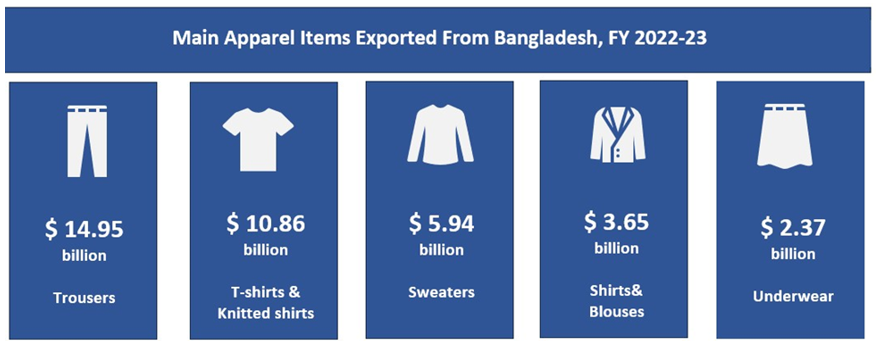
Figure 4 Top five apparel export from Bangladesh.
Currently, Bangladesh is exporting low-cost items to the world whereas its peer nation, Vietnam has expanded its production line to add high-value RMG products. The heavy reliance on exporting low-cost items poses a potential obstacle to sustaining its market share in the global RMG industry. Particularly following its graduation from the LDC status, Bangladesh may face increased difficulty in boosting its RMG export rates with these low-cost items. In order to maintain its place in the RMG global export market, the revised Export Policy for 2021–2024 calls for the addition of more high-value commodities such denim items, suits, men's and women's blazers, waterproof clothing, leather jackets, and MMF products.22
Occupational composition
The fashion industry is swiftly evolving, with increasing imposition for high-end, entangled apparel designs while the demand for basic garments declines. However, Bangladesh, despite being a most influential player in the ready-made garment (RMG) sector, has been slow in shifting to high-end apparel production, in contrast with competitors such as India, China, Vietnam, and Turkey (Financial Express, 2024). Only 20% of Bangladesh's clothing exports are currently classified as high-end, with only a small percentage costing more than $35 per kilogram. The country primarily produces upper-middle-segment products for brands like Burberry and Tommy Hilfiger but struggles to enter the luxury market due to several challenges (The Business Standard, 2020).
Key challenges hindering high-end apparel production:
Bangladesh has to increase supply chain efficiency, invest in digital design technologies like CLO 3D, better product development, and train its people to overcome these obstacles. The nation can establish a competitive position in the international market for luxury clothing if the appropriate tactics are implemented.
Female employment prospects
The most employment source of women in Bangladesh is the garments sector where around 82% of workers are women. Despite being a large workforce they are mostly illiterate or dropout from the secondary level education system.26,27 In order to developing female workers in Bangladesh's high-end fashion sector requires a multifaceted approach focused on skill development, training, education, workplace environment, industry infrastructure, and policy support. Specialized training programs in fashion design, craftsmanship, textile technology, and continuous learning opportunities are essential to equip women with the necessary expertise. Creating safe, inclusive, and flexible workplaces, along with leadership and mentorship programs, will support women in advancing their careers. Access to quality resources, market exposure, and collaboration with global brands can elevate their skills and connect them with international markets. Additionally, promoting digital literacy, innovation, and community engagement will empower women to thrive in this industry, contributing to both their personal growth and the broader economic development of Bangladesh.28 By integrating these practices through local resources, Bangladesh can create a robust framework to empower female workers in the high-end fashion sector, fostering individual growth and contributing to the broader economic development of the country.
Integrating high-end fashion into Bangladesh’s garment production is both a major challenge and a transformative opportunity. While constraints such as limited diversification, resource shortages, and insufficient technological capability continue to slow progress, the sector has immense potential for value-added growth. The characterization of High-end fashion depends on several parameters including production technique, materials, design, technology, functionality and aesthetics. Limited product diversification and lack of resources are the main reasons for the slow progression globally in apparel export. Technology integration, production method advancement, education, training, and research are greatly essential to mobilize the interest of this industry. Well-structured vocational training and knowledge can be adopted after assenting the industry's need like as China. Local entrepreneurs or brands should take part in skilling initiatives provided by the BGMEA, EPB or NGO. The government can establish separate institutions for short training centers adjacent to RMG clusters. Marketing and merchandising strategies need to be competitive to explore new markets or destinies for high-quality and high-value products respectively. Government should step up in terms of financial concession through tax incentives, research funding, and design incubation programs in the same vein collaboration between government, industry bodies, and academia must be institutionalized. In case of backward linkage industry Sustainable material innovation (recycling, bio-based fibers, and circular design) can position Bangladesh as a responsible high-end producer.
The authors thank BGMEA University of Fashion and Technology (BUFT) in Dhaka, Bangladesh, for providing all laboratory facilities.
None.
No potential conflict of interest was reported by the authors.

©2025 Moniruzzaman,, et al. This is an open access article distributed under the terms of the, which permits unrestricted use, distribution, and build upon your work non-commercially.