Journal of
eISSN: 2574-8114


Opinion Volume 12 Issue 2
 Marjo Määttänen
VTT Technical Research Centre of Finland Ltd, Finland
Correspondence: Ali Harlin,VTT Technical, Research Centre of Finland Ltd., P.O. BOX 1000, FI-02044,VTT, Finland
Received: April 15, 2026 | Published: April 30, 2026
Citation: Harlin A, Määttänen M. Architecture and solutions for efficient textile consumption. J Textile Eng Fashion Technol. 2026;12(2):130-132. DOI: 10.15406/jteft.2026.12.00458
Textile recycling is advancing rapidly, yet large-scale implementation is constrained by feedstock variability, limited sorting capacity, pretreatment burdens (dyes/finishes), and weak market pull for recycled fibres and polymers. This review connects unit operations—collection, automated identification and sorting, disassembly, pretreatment, mechanical and thermo-mechanical recycling, and chemical routes for cellulosics and polyester—with system enablers such as design-for-circularity, digital product passports, and extended producer responsibility. We highlight practical decision points for industry: (i) high-value outcomes require high-quality sorted fractions; (ii) pretreatment and quality assurance often dominate costs; and (iii) mechanical and chemical recycling should be deployed as complementary steps in a reuse-first cascade. Finally, we outline an architecture for textile circulation that links reverse logistics, staged recycling pathways, and demand creation for recycled outputs.
Keywords: textile recycling, circular economy; sorting, digital product passport, design for disassembly, cellulosic recycling, PET recycling, EP
This work reflects the work done in last decade (2015-2025) applying open public industry databases using web search with only public, citable sources (journal + trade press), policy safe sources (EU Commission, JRC, EURATEX, EDANA) and VTT published scientific project reports.
The textile and fashion sector has a large environmental footprint driven by high material throughput, fossil-based synthetic fibres, water- and chemical-intensive wet processing, and short product lifetimes. Fast fashion (FF) has further increased production volumes and shortened use phases, amplifying emissions, water demand, and microfibre release.1
Textile-to-textile recycling has not yet reached broad economic scale. Key barriers include inconsistent collection volumes, limited high-throughput sorting to defined specifications, complex multi-material garments that hinder disassembly, and weak demand when virgin materials remain cost-advantaged.2
FF also shapes end-of-life realities: low prices discourage durability, repair, and end-of-life design features, increasing the share of mixed and contaminated waste streams.3
Upstream unit operations—collection, sorting, disassembly, and pretreatment—often dominate both the cost and the achievable quality of recycling outputs. Automated sorting and selective separation are progressing but remain a scale-up priority, particularly for blends and treated textiles.4
Mechanical recycling is mature and high-throughput but typically reduces fibre quality. Chemical recycling can restore quality (notably for cellulosics and PET) but requires tighter feedstock specifications and integrated pretreatment, making blends and additive packages challenging.5
Across routes, there is a trade-off between feedstock tolerance and output quality: higher-quality outputs generally require cleaner, better-characterized inputs and more intensive pretreatment.
A reuse-first cascade is therefore recommended: prioritize reuse/repair, then fibre recycling for degraded items, and use polymer/monomer recycling when material quality must be restored. Delivering this cascade requires reverse logistics, reliable sorting, and incentives that do not reward mass recycling at the expense of higher-value loops (Figure 1).
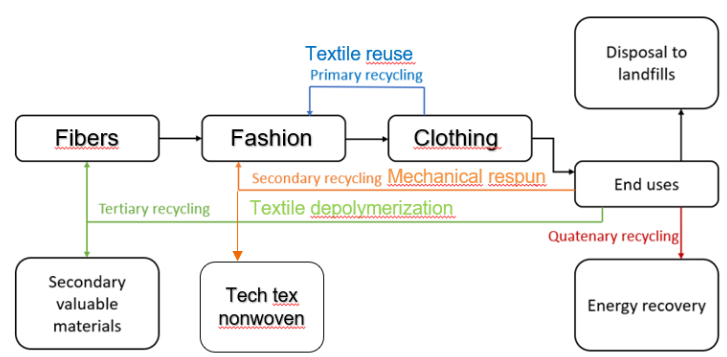
Figure 1 Flow chart of textile reuse.
Textile waste arises from both manufacturing (e.g., cutting waste, off-spec materials) and consumption (worn-out or discarded garments). Pre-consumer streams are often cleaner and compositionally known, while post-consumer streams dominate volumes and exhibit higher variability and contamination.7
Unsold or damaged goods can provide early feedstocks for recycling because composition is typically known, but they are not sufficient to meet circularity targets that focus on post-consumer textiles.8
The EU Waste Framework Directive (WFD) requires separate collection for used textiles by 2025, increasing capture rates but potentially reducing average quality if quality management and sorting do not scale in parallel.
Collection design affects reuse potential: indoor take-back often yields higher-quality items, while outdoor bring points are more exposed to contamination. As systems scale, protecting reuse through handling, grading, and routing is critical because reuse generally outperforms recycling environmentally.
Sorting efficiency sets downstream economics by determining feedstock cost and specification. Analyses suggest substantial value retention if higher shares are routed to reuse and high-value applications, but this requires investment in infrastructure and market development.9
Digitalization (traceability, identifiers, and product passports) can reduce uncertainty in sorting and routing, support compliance, and enable circular services such as repair, resale, and take-back. For recycling, machine-readable composition and chemical information is particularly valuable for preventing contamination and stabilizing feedstock quality.10
Disassembly and design-for-disassembly
Disassembly is a bottleneck because garments are rarely designed for selective removal of zippers, buttons, coatings, and multi-material panels. Design for disassembly (DfD) and mono-material strategies can reduce downstream separation costs and improve recyclability.
Fibre identification and automated sorting
Automated sorting depends on rapid identification of fibre type, blend ratios, and (increasingly) quality attributes relevant to recycling. Scalable approaches include NIR/FT-IR spectroscopy and hyperspectral imaging, potentially complemented by digital identifiers (e.g., RFID and product passports). Industrial robustness remains challenging due to garment complexity, additives, and contamination; ML models are widely used to improve classification and enable continuous learning.11
Reported sorting accuracies vary with sensors, models, and—critically—dataset representativeness. For scale-up, calibration transfer, contamination tolerance, and continuous quality monitoring are as important as headline classification performance in controlled tests.12
Pretreatment is often the cost and sustainability hotspot because it removes dirt, non-textile components, problematic finishes, inorganic impurities, and—in many cases—colour before recycling. The required intensity depends on the target process (e.g., fibre reuse vs. dissolution-based regeneration).
For cotton-rich waste, reported sequences include alkaline and oxidative steps with targeted washing to manage impurities and dyes prior to regeneration. Dye chemistry strongly influences achievable brightness and chemical demand.13
To reduce chemical and water demand, advanced approaches are being explored, including advanced oxidation, enzymatic methods, and supercritical CO2-based extraction. While promising, scale-up depends on equipment cost, energy integration, and managing extracted fractions (Table 1).14
Recycling pathways differ by transformation depth: fibre recycling (mechanical), polymer recycling (melting/dissolution), and monomer recycling (depolymerization and repolymerization). Deeper transformation can restore quality but typically increases complexity and cost.15
Mechanical recycling
Mechanical recycling (shredding/opening, cleaning, and optional blending) is commercially established and can handle heterogeneous streams, but fibre shortening limits high-quality re-spinning and often drives applications toward nonwovens and technical products unless blended with virgin fibres.
Thermo-mechanical routes to composites
Thermo-mechanical routes can valorize mixed streams by using thermoplastics as a matrix to form composites with textile fibres. These pathways can be attractive when textile-grade fibre regeneration is impractical and when markets exist for technical components.16
Nonwoven sheet forming (air-laid and foam-laid)
Nonwoven sheet forming (air-laid/foam-laid) can convert recovered fibres and plastics into bonded structures for packaging, filtration, and construction-related applications. For industry, the key variabl
Cellulosic textile recycling
Cellulosic chemical recycling is among the most advanced textile-to-textile options because cellulose can be dissolved and regenerated into new man-made cellulosic fibres. Industrial viability depends on reliable cellulose-rich feedstocks from sorting and on integrated pretreatment and solvent recovery to control contaminants and cost.
Polyester (PET) depolymerization and repolymerization
For polyester (PET), chemical recycling can produce virgin-like output by depolymerizing to monomers/oligomers and repolymerizing. Glycolysis to BHET is a key route, with ongoing work focused on lower-temperature catalysts and improving robustness to textile-specific additives and contaminants (Table 2).17
Reuse and lifetime extension
Reuse and lifetime extension typically outperform recycling because they preserve the embedded impacts of manufacturing. For industry, the enabling requirements are quality-preserving collection, fast grading, and scalable business models for repair, refurbishment, and resale.
Design-for-circularity and digital product passports can reduce friction by improving repairability and routing decisions between reuse and recycling. Policy instruments such as EPR should be structured to protect reuse-first cascades rather than incentivizing mass recycling alone.
In France 2007 was implemented mandatory EPR covering clothing, footwear and household linen, managed by a single Producer Responsibility Organization (PRO) Refashion. Eco-modulation fees adjusted based on durability, recyclability, recycled content and (since 2020) repairability under the AGEC law. Separate collection rate ~31% of textiles placed on the market was achieved (2022 data) of sorted textiles ~60% classified as reusable.18
In Netherlands the Textile EPR Decree has been in force since July 2023, where the producers must meet binding reuse and recycling targets: ≥50% reuse + recycling by 2025 and ≥75% by 2030. This is organized by collective compliance via PROs where fee modulation is applied.19
Systemic innovations and circular architecture
A circular textile architecture links design choices (materials, chemical management, DfD), quality-preserving collection and reverse logistics, sorting into defined fractions, and a cascade of reuse, mechanical recycling, and chemical recycling. In practice, recycling plants depend on upstream information and infrastructure that stabilizes feedstock properties and on downstream markets that can absorb outputs at acceptable quality and price.
Market acceptance and economic boundary conditions
Market acceptance is driven by cost, quality, and risk perception. Local value chains can improve transparency and supply security, but may face higher labour and energy costs than global virgin-material systems.
Under EPR, the central industry question is cost allocation for collection, sorting, and pretreatment—and whether incentives reward higher-quality fractions and reuse-first outcomes. Automation can improve productivity, but only if identification is reliable and end-markets value the improved quality.20
Textile recycling scale-up is constrained less by individual technologies than by feedstock quality, sorting capability, pretreatment intensity, and end-market demand. Industry roadmaps should therefore invest first in collection systems that protect reuse, and in sorting that can deliver specification-defined fractions. Mechanical recycling provides robust, high-throughput valorization for heterogeneous streams, while chemical recycling is best targeted to well-characterized cellulose-rich and PET fractions where quality restoration justifies complexity. Digital product passports and DfD reduce information and separation costs, and EPR can align incentives—provided it rewards reuse-first cascades and high-quality recycling outputs rather than mass diversion alone.
This research was supported by the Ministerium of Economy and Employment of Finland through a Governmental Grant.
VTT Technical Research Centre of Finland.
The author declares no conflict of interest.

©2026 Harlin, et al. This is an open access article distributed under the terms of the, which permits unrestricted use, distribution, and build upon your work non-commercially.