Journal of
eISSN: 2373-633X


Case Report Volume 16 Issue 5
 Peter B Dean,2 Li-Sheng Chen,3 Olga Puchkova,4 Amy Ming-Fang Yen,3 Hsiu-Hsi Chen,5 F Lee Tucker,6 Robert A Smith,7 Katalin Ormándi,8 András Vörös,9 Renáta Bozó,10 Orsolya Oláh- Németh,9 Zoltán Veréb10
1Falun Central Hospital, Sweden
10Department of Dermatology and Allergology, Albert Szent-Györgyi Medical School, University of Szeged,
2University of Turku, Finland
3Taipei Medical University, Taiwan
4Il’inskaya Hospital, Russia
5National Taiwan University, Taiwan
6Virginia Biomedical Laboratories, USA
7American Cancer Society, USA
8Department of Radiology, University of Szeged, Hungary
9Department of Pathology, University of Szeged, Hungary
Correspondence: László Tabár, Falun Central Hospital, Lasarettsvägen, 10, 791 82 Falun, Sweden
Received: October 23, 2025 | Published: November 5, 2025
Citation: Tabár L, Dean PB, Li-Sheng C, et al, . Why are we failing to cure so many cases of invasive lobular breast cancer? J Cancer Prev Curr Res. 2025;16(5):130‒132. DOI: 10.15406/jcpcr.2025.16.00590
Review evidence for the site of origin of diffuse invasive lobular carcinoma (ILC), supported by cell culture results. Describe two distinct forms of classic ILC, which have vastly different long-term outcomes. Recognition of the hybrid (stem) cell origin of classic ILC could foster improvement of its currently inadequate management
Key words: breast cancer, invasive lobular carcinoma, imaging biomarkers, molecular biomarkers, long-term outcome.
The long-term survival of approximately 60% for women with classic invasive lobular carcinoma (ILC) is dismal and has not improved significantly over the past three decades (Figure 1). Improvements in diagnosis and therapy have failed to control this disease because it does not appear to originate from the epithelial cells of the breast lobule,1,2 contrary to the theory of Foote and Stewart from 1941.3 The authors have provided evidence from cell culture studies that ILC originates from the mesenchymal hybrid stem cells,2 accounting for the discordant clinical picture, imaging features, histopathologic characteristics and poor patient outcome despite the use of modern therapeutic regimens and suggest an entirely new approach to control this disease.
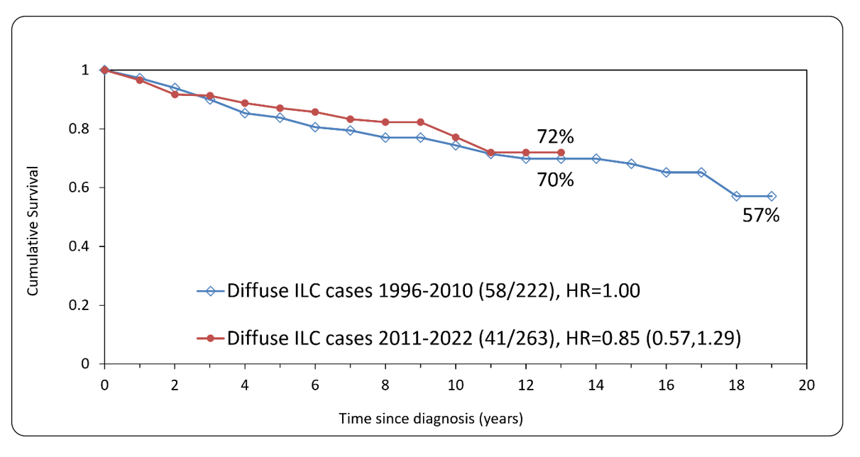
Figure 1 Cumulative survival of all women diagnosed with diffuse invasive lobular carcinoma (ILC) during two consecutive time periods, 1996-2010 and 2011-2022, in Dalarna County, Sweden, and followed up to the end of 2023.
Appreciating the mesenchymal stem cell origin of this malignancy could facilitate research efforts toward finding effective therapeutic agents for this disease subgroup that is largely resistant to current therapeutic regimens.
Foote and Stewart considered lobular carcinoma in situ (LCIS) to be the precursor of ILC, and that “the mass eruption of tumor cells” occurred through “some lytic action of the tumor cells, naturally not to be detected by anatomic study.”3 These authors considered this malignancy to have originated in the breast lobules, while admitting that they did not have the evidence necessary to prove it.4 Ackerman and Del Regato accepted this assumption, concluding that ILC arises from the acinar epithelium of the breast lobule.5 Despite the absence of clear evidence, these speculations were accepted as established fact more than 75 years ago. An inconvenient observation, the lack of E-cadherin staining, is generally considered to result from a “loss” of that protein during tumour development.6
The only IHC biomarker supporting the mesenchymal stem cell origin is negative E-cadherin staining. The most reliable biomarker is the imaging biomarker, the non-calcified architectural distortion.
Evidence was provided by cell culture studies from typical diffuse ILC cases that this breast malignancy originates from the hybrid stem cells of the extralobular mesenchyme through the process of mesenchymal-epithelial transition (MET).2,7 This also provides an explanation for the lack of E-cadherin staining, since mesenchymal stem cells also lack E-cadherin. The authors have suggested using the term “breast cancer of mesenchymal origin (BCMO)” to describe this highly fatal malignancy.1 Use of this terminology would alert clinicians to the unusual and poorly controllable nature of this breast malignancy, and explain why current therapeutic regimens, which are designed to treat breast cancers of epithelial cell origin, have limited effectiveness on BCMO due to its mesenchymal hybrid stem cell origin.1 For this same reason, the individual immunohistochemical biomarkers, the molecular and Luminal A and B biomarkers, are poor predictors of long-term patient outcome, since they predict a misleadingly favourable outcome for BCMO cases. On the other hand, the imaging biomarker, architectural distortion on the mammogram, is an effective predictor of the poor long-term patient outcome.
The extensive form of classic ILC originates from the hybrid stem cells of the extralobular mesenchyme. This malignancy has a macroscopic structure unlike breast cancers of epithelial origin. It spreads freely throughout the fibrous connective tissue of the breast without forming an easily detectable tumour mass and is eventually recognizable on the mammogram as non-calcified architectural distortion, its imaging biomarker (Figure 2). The deceptively favourable molecular biomarkers of diffusely infiltrating classic invasive lobular carcinoma are at odds with the frequently poor outcome of this disease,8 as this case demonstrates.
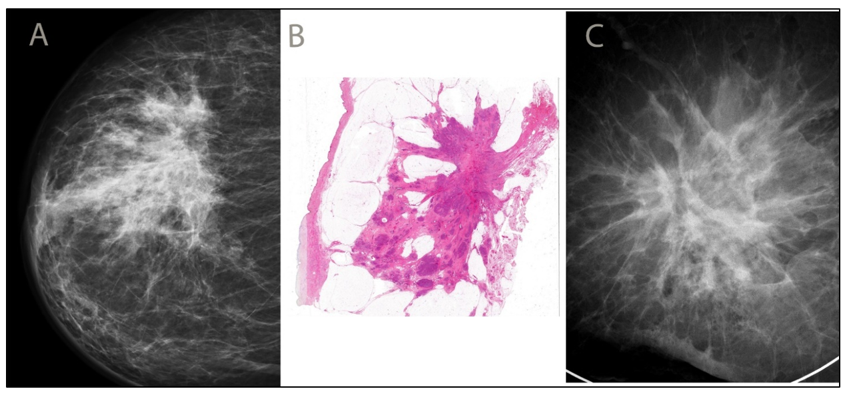
Figure 2 The molecular biomarkers in this case were: ER/PR positive, HER-2 negative, and Ki67 10%, predicting a favourable outcome. However, the patient died from this 8.5 × 6.0 cm moderately differentiated diffusely infiltrating, “classic invasive lobular carcinoma” 23 months following diagnosis and initiation of treatment. In contrast, the imaging biomarker, the extensive architectural distortion on the mammogram (A), specimen radiograph (C), the large format low-power histopathology image (B) and 11/11 metastatic axillary lymph nodes predicted the unfavourable outcome.
While the extensive form of classic, diffusely infiltrating “ILC” (BCMO) originates within the extralobular mesenchyme, there is a histologically similar disease entity also termed classic ILC, but with distinctively different clinical, imaging and long-term survival characteristics. This entity appears to evolve from the hybrid stem cells of the intralobular mesenchyme of the breast, forming multiple small colonies. The BCMO cancer cells surround the acini and terminal ducts within the terminal ductal lobular unit (TDLU), which invariably have normal, non-malignant epithelium.8 This intralobular BCMO also has different imaging biomarkers, spiculated and circular/oval tumour masses, easily detected at mammography (Figure 3).
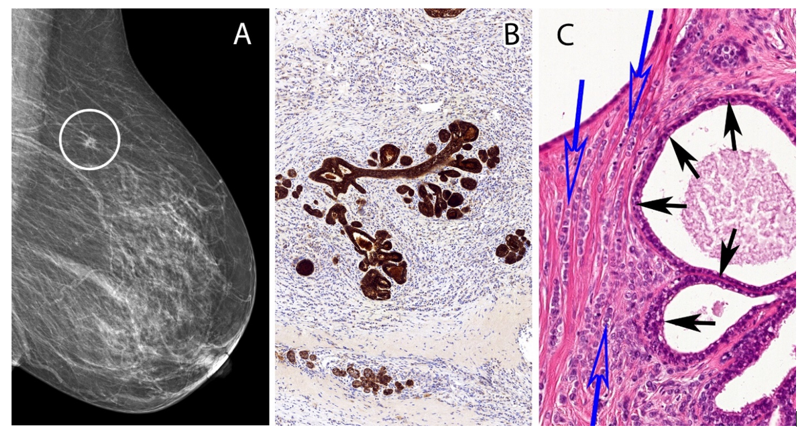
Figure 3 Mammogram of the left breast (A) shows a <10 mm solitary stellate/spiculated tumour mass with no associated calcifications. E-cadherin staining is positive in the normal epithelial cells of the terminal duct and acini (dark brown), but it is negative in the surrounding BCMO cancer cells (B). High power histopathology image (C) shows normal epithelial cells in the acini of the involved TDLU (solid arrows) adjacent to the intralobular BCMO cancer cells (blue arrows).
The large section histopathology images provide excellent correlation with the mammographic and breast MRI findings and assist in differentiating these two subtypes, while this differentiation is difficult using the limited field of view offered by the conventional, small section, 1x3 inch glass slides.9 This translational research is consistent with new directions in precision medicine.
The authors have examined 329 consecutive, microscopically proven diffuse form of ILC cases and 231 consecutive 1-19 mm intralobular cases diagnosed in Dalarna County, Sweden, during 1996-2019 with follow-up to the end of 2021. Large section (8x10 cm) histopathology slides were correlated with multimodality imaging biomarkers and long-term patient outcome. The 56% 19-year survival of extralobular BCMO was significantly poorer than the 84% 19-year survival of the intralobular BCMO cases (Figure 4).
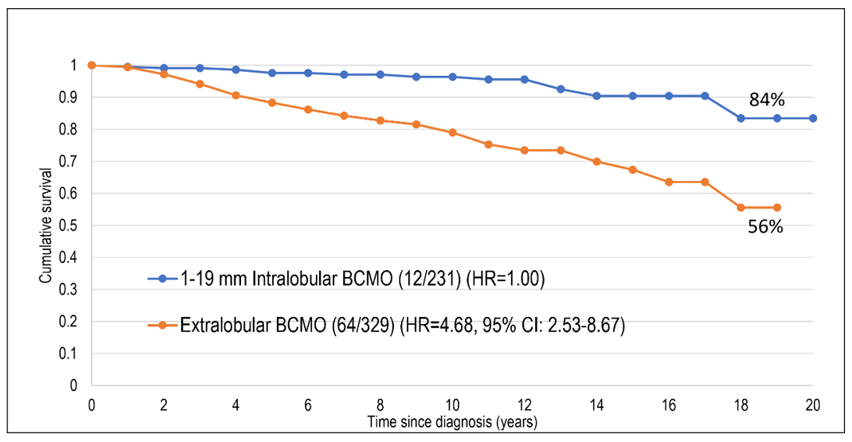
Figure 4 Survival of women diagnosed with 1-19 mm intralobular BCMO compared with the survival of women with extralobular BCMO. Cases diagnosed in Dalarna County, Sweden from 1996-2019 and followed up to Dec 31, 2021.
The accepted terminology and assumptions of the origin of diffuse and extensive classic ILC must be reconsidered if we are to improve the poor survival rate of this misunderstood malignancy. Therapeutic methods, such as radiotherapy and chemotherapy, with documented effectiveness in treating breast cancers of epithelial cell origin, have limited efficacy in treating classic ILC, possibly due to its stem cell origin.1,2 Likewise, the immunohistochemical biomarkers are less predictive of prognosis in classic ILC for the same reason. Further, surgical removal of this diffuse malignancy is often incomplete as the full disease extent is difficult to evaluate by any imaging technique. It is important to differentiate the intra- and extralobular forms of BCMO from each other, since they require entirely different approaches to management. As long as these two unusual breast malignancies are both termed “classic invasive lobular carcinoma,” implying that they have their origin in the acinar cells of the TDLUs, we are unlikely to achieve any real progress in our efforts to control the extralobular BCMO. Appreciation of their mesenchymal stem cell origin offers a radically new approach to research and treatment.1,2,10
None.
The author declares that he has no competing interests.

©2025 Tabár, et al. This is an open access article distributed under the terms of the, which permits unrestricted use, distribution, and build upon your work non-commercially.