Journal of
eISSN: 2373-633X


Case Series Volume 16 Issue 6
1Radiologist, Fellow in Abdominal Radiology, Department of Radiology and Diagnostic Imaging, Hospital A Beneficência Portuguesa de São Paulo, Brazil
2Radiologist, Fellow in Oncologic Radiology, Department of Radiology and Diagnostic Imaging, Hospital A Beneficência Portuguesa de São Paulo, Brazil.
3Radiologist, Collaborating Physician in the Abdominal Imaging Section, Department of Radiology and Diagnostic Imaging, Hospital A Beneficência Portuguesa de São Paulo, Brazil
4Radiologist, Head of the Oncologic Radiology Section, Department of Radiology and Diagnostic Imaging, Hospital A Beneficência Portuguesa de São Paulo, Brazil
Correspondence: Bianca de Moraes Coimbra, Radiologist, Fellow in Abdominal Radiology, Department of Radiology and Diagnostic Imaging, Hospital A Beneficência Portuguesa de São Paulo, Brazil
Received: December 08, 2025 | Published: December 31, 2025
Citation: Coimbra BM, Glória LFP, Abud CP, et al. Main liver changes in patients with chemotherapy for colorectal cancer. J Cancer Prev Curr Res. 2025;16(6):161‒163. DOI: 10.15406/jcpcr.2025.16.00597
Introduction: The chemotherapy treatment used in patients diagnosed with colorectal cancer may have side effects related to the development of different liver lesions, and the differential diagnosis of these lesions should include entities ranging from benign liver lesions to metastases. As a common side effect of these medications, hepatic fat deposition may occur, which in some cases can progress to steatohepatitis. Sinusoidal obstruction syndrome (SOS) and focal nodular hyperplasia–like (FNH-like) lesions should also be included among the adverse effects, being generally associated with the use of oxaliplatin, the most commonly used chemotherapy drug with excellent results in the treatment of colorectal cancer nowadays. Although chemotherapy-related liver toxicity is well described, the novelty of this pictorial case series lies in the comprehensive, side-by-side radiological characterization of different oxaliplatin-induced hepatic injuries and their major differential diagnoses, highlighting imaging pitfalls that may lead to misinterpretation as metastatic disease.
Case report: In this pictorial essay, we selected illustrative examples of the hepatic findings observed in patients after oxaliplatin therapy and their differential diagnoses.
Conclusion: The evaluation of these imaging findings in association with clinical data is essential for definitive diagnosis and early treatment of these conditions.
Keywords: hepatic veno-occlusive disease; antineoplastic agents; rectal neoplasms.
In the current epidemiological context, neoplasms remain among the leading causes of morbidity and mortality worldwide. Nevertheless, in recent years, significant advances in oncologic therapies have been achieved, resulting in improved survival rates and, in some cases, definitive cure of the disease.1
Among these advances, multimodal treatment strategies routinely applied in patients with colorectal cancer deserve special attention, as they have substantially improved disease prognosis.2 According to the Brazilian National Cancer Institute (INCA),3 colorectal cancer is the third leading cause of cancer-related mortality in Brazil. Over the next three years, an estimated incidence of approximately 19.64 new cases per 100,000 men and 19.03 per 100,000 women is expected. Furthermore, approximately 30% to 50% of patients with colorectal cancer will develop hepatic metastases, of whom only about 50% are considered potentially curable.2
In contemporary colorectal cancer management, the most commonly used and effective chemotherapy regimens include the combination of oxaliplatin, 5-fluorouracil (5-FU), and leucovorin (FOLFOX), as well as irinotecan, 5-fluorouracil, and leucovorin (FOLFIRI). Despite their therapeutic benefits, these cytotoxic agents are not devoid of adverse effects and may induce hepatic toxicity, impairing hepatocellular function and liver regenerative capacity.2,4,5 Therefore, treatment planning should be multidisciplinary, aiming to optimize oncologic outcomes while minimizing treatment-related adverse effects.2
In this case series, we present illustrative examples of patients followed at our institution who developed hepatic complications after exposure to chemotherapy agents, particularly oxaliplatin, during the treatment of rectal cancer.
(Figure 1) A 74-year-old female patient presenting laboratory abnormalities, including elevated gamma-glutamyltransferase (GGT) and liver enzymes (AST and ALT).
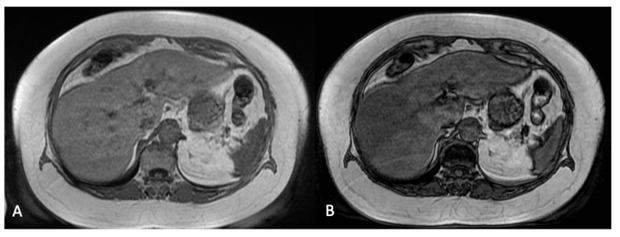
Figure 1 .
A/B: Axial in-phase and out-of-phase T1-weighted MRI images demonstrating areas of signal loss on out-of-phase sequences, consistent with moderate hepatic steatosis (estimated hepatic fat fraction of 16%), without evidence of focal hepatic parenchymal lesions.
(Figure 2) A 44-year-old male patient undergoing adjuvant chemotherapy with 5-fluorouracil, leucovorin, and oxaliplatin (FOLFOX) for rectal adenocarcinoma, who developed a focal nodular hyperplasia–like lesion.
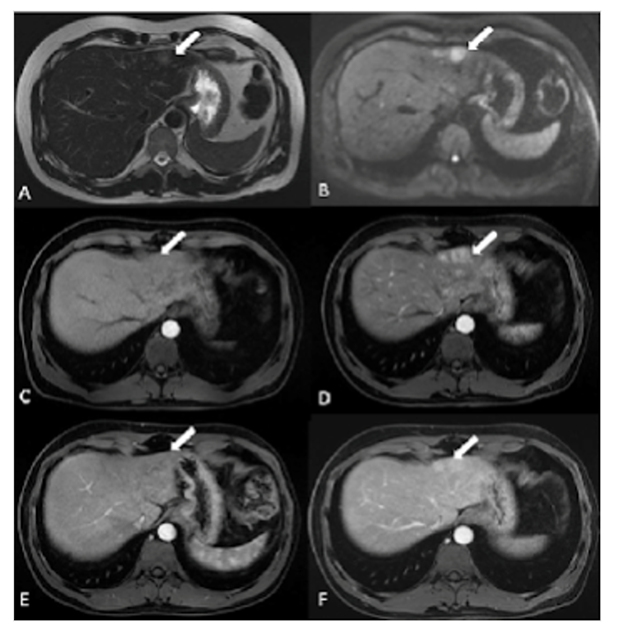
Figure 2 .
A/B: Axial T2-weighted and diffusion-weighted MRI images showing a nodular lesion located at the periphery of hepatic segment II, exhibiting mild hyperintensity and diffusion restriction, confirmed on the ADC map (arrows).
C: Axial pre-contrast T1-weighted MRI demonstrating a hypointense hepatic lesion (arrow).
D/E/F: Axial post-gadolinium MRI images (early arterial, late arterial, and portal venous phases, respectively) demonstrating hypervascular enhancement of the nodular lesion (arrows).
(Figure 3) A 47-year-old female patient who underwent rectosigmoidectomy followed by adjuvant FOLFOX chemotherapy.
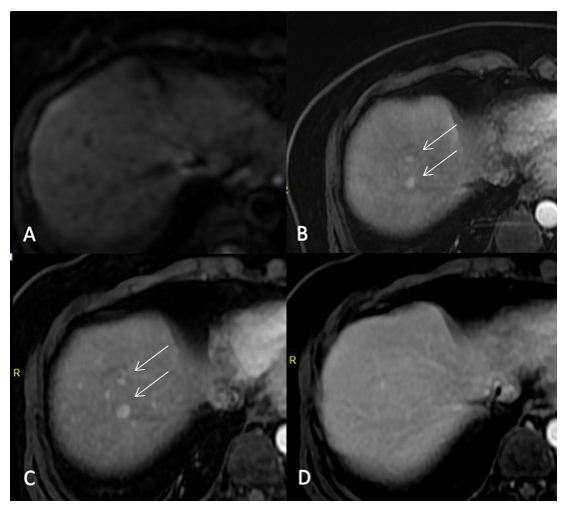
Figure 3 .
A: Axial diffusion-weighted MRI.
B/C/D: Axial post-gadolinium MRI images (early arterial, late arterial, and portal venous phases, respectively) demonstrating the development of multiple hypervascular hepatic nodules at the hepatic dome (arrows), consistent with focal nodular hyperplasia–like lesions associated with oxaliplatin exposure.
(Figure 4) A 44-year-old female patient undergoing neoadjuvant chemotherapy with 5-fluorouracil, leucovorin, and oxaliplatin (FOLFOX) for rectal adenocarcinoma, who subsequently developed sinusoidal obstruction syndrome.
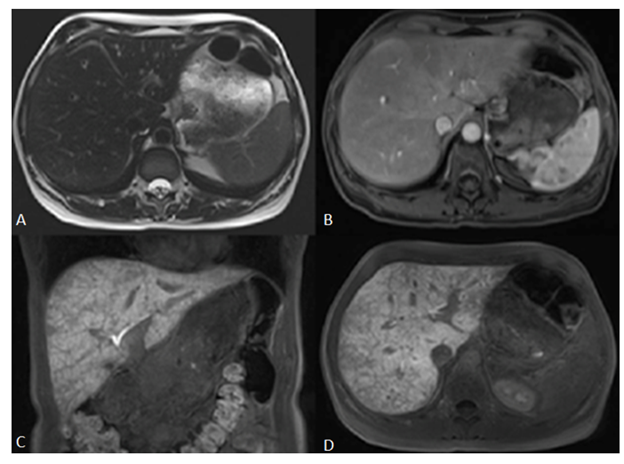
Figure 4 .
A: Axial T2-weighted MRI showing the liver with preserved morphology and homogeneous signal intensity.
B: Axial arterial-phase MRI demonstrating mild perfusion abnormalities of the hepatic parenchyma.
C/D: Coronal and axial hepatobiliary-phase MRI images showing heterogeneous, reticular contrast enhancement of the hepatic parenchyma, with reduced peripheral contrast uptake.
With the widespread adoption of chemotherapy in the treatment of colorectal cancer, therapy-related hepatic complications have become increasingly frequent, and a broad spectrum of liver abnormalities has been described. Commonly reported changes include steatosis and steatohepatitis caused by lipid accumulation within hepatocytes, which are considered early manifestations of nonalcoholic fatty liver disease (NAFLD/NASH) and may progress to cirrhosis and liver failure.4 These alterations are clinically relevant, as they can influence chemotherapy tolerance, surgical planning, postoperative morbidity, and long-term outcomes.
Among patients treated with oxaliplatin-based regimens, two hepatic entities deserve particular attention: sinusoidal obstruction syndrome (SOS) and focal nodular hyperplasia–like (FNH-like) lesions. Sinusoidal obstruction syndrome, previously referred to as veno-occlusive disease, results from toxic injury to the endothelial cells lining the hepatic sinusoids and is regarded as a potentially life-threatening condition.6,7 Clinically, patients may present with hyperbilirubinemia, hepatomegaly, jaundice, ascites, and, in severe cases, liver failure.4,6,7 Diagnosis is primarily clinical and based on established criteria, including the Baltimore criteria, modified Seattle criteria, and those proposed by the European Society for Blood and Marrow Transplantation (EBMT). However, these criteria lack specificity for differential diagnosis, reinforcing the importance of noninvasive imaging modalities in routine clinical practice.6
Imaging findings of SOS vary according to the modality used. Ultrasound may demonstrate indirect signs of portal hypertension, such as hepatosplenomegaly, ascites, increased portal vein diameter (>12 mm), narrowing of hepatic veins (<3 mm), and altered hepatic blood flow on color Doppler imaging. On CT and MRI, additional findings include geographic heterogeneity of the hepatic parenchyma and increased enhancement surrounding the hepatic veins, reflecting a prominent vascular channel network. More recently, PET-CT studies have shown increased hepatic radiotracer uptake related to congestive changes in patients with SOS.6 Although uncommon, SOS has been described in association with several conditions and medications, including high-dose chemotherapy following stem cell transplantation, herbal products, azathioprine, dacarbazine, actinomycin D, cytarabine, thioguanine, terbinafine, urethane, and anti-CD33 calicheamicin.6,7 Differential diagnoses include graft-versus-host disease and other causes of hepatic venous outflow obstruction, such as Budd–Chiari syndrome.6
Focal nodular hyperplasia (FNH) represents a benign proliferation of hepatocytes and accounts for approximately 8% of primary hepatic nodules encountered in routine radiological practice. The term FNH-like lesion refers to nodules with imaging characteristics similar to FNH that develop during chemotherapy treatment.8 Approximately 15% of patients receiving oxaliplatin are reported to develop nodules suggestive of FNH-like lesions.9 The underlying pathophysiology remains incompletely understood; however, proposed mechanisms include alterations in intrahepatic blood flow secondary to sinusoidal injury and portal hypertension. These changes may result in imaging appearances that closely mimic atypical hepatocellular carcinoma or metastatic disease, posing a significant diagnostic challenge.9 Notably, FNH-like lesions typically persist even after discontinuation of chemotherapy. Imaging diagnosis relies on CT or MRI findings, including well-defined, lobulated lesions with arterial-phase hyperenhancement and absence of FDG uptake on PET-CT.9
The present case illustrates an atypical imaging presentation of chemotherapy-related liver injury that closely simulated metastatic disease. The focal and heterogeneous distribution of hepatic findings highlights the importance of recognizing less typical manifestations of oxaliplatin-induced liver toxicity. In this context, imaging played a pivotal role in raising suspicion of treatment-related hepatic injury, prompting careful reassessment of the patient’s oncologic management and preventing premature diagnostic conclusions that could have led to inappropriate treatment escalation.
Beyond diagnosis, imaging is essential in guiding strategies aimed at preventing and reducing chemotherapy-related liver toxicity. A multidisciplinary and multimodal approach is strongly recommended. In addition to imaging follow-up, preventive and management strategies include careful selection and adjustment of chemotherapy regimens, limitation of cumulative oxaliplatin dose, avoidance of unnecessary prolonged exposure, temporary interruption of treatment in cases of significant hepatic injury, and close monitoring of liver function tests. Optimization of metabolic risk factors, such as obesity, diabetes, and dyslipidemia, may also reduce susceptibility to chemotherapy-induced liver injury.
The use of hepatoprotective agents has been explored, although robust evidence supporting their routine use remains limited. Additionally, antiangiogenic agents such as bevacizumab have been investigated for their potential protective effect against oxaliplatin-induced sinusoidal injury through inhibition of vascular endothelial growth factor. Some studies suggest a reduced incidence of SOS and FNH-like lesions in patients receiving bevacizumab; however, results remain conflicting, and its protective role has not yet been definitively established.2,9
In the current context, significant advances in chemotherapy have improved survival in cancer patients and, in some cases, enabled definitive cure. Nevertheless, these therapies may induce hepatic toxicity with potentially severe consequences. Therefore, early recognition of imaging findings suggestive of chemotherapy-related liver injury, combined with clinical and laboratory evaluation, allows timely intervention, individualized treatment adjustment, and may prevent progression to severe or irreversible liver damage.
In the current context, significant advances in chemotherapy have improved survival in cancer patients and, in some cases, enabled definitive cure. However, these medications may induce hepatic toxicity and lead to fatal conditions such as sinusoidal obstruction syndrome. Therefore, combined evaluation of clinical findings and noninvasive imaging studies is essential for accurate diagnosis and early treatment of these conditions.
None.
The author declares that he has no competing interests.

©2025 Coimbra, et al. This is an open access article distributed under the terms of the, which permits unrestricted use, distribution, and build upon your work non-commercially.