Journal of
eISSN: 2373-633X


Research Article Volume 16 Issue 4
 Jonathan Saju BSc,2 Thelma Wright MD, JD, MBA, FASA1
1Department of Anesthesiology, University of Maryland Medical Center, Baltimore, USA
2Osteopathic Medicine, Jerry M. Wallace School of Osteopathic Medicine, Buies Creek, USA
Correspondence: Roy Sebastian MD, Dept of Anesthesiology (Pain Medicine), 22 S Greene St, Baltimore, MD, USA
Received: August 25, 2025 | Published: September 9, 2025
Citation: Sebastian R, Saju J, Wright T. Innovative chronic pain management through voltage-gated sodium channel modulation or review. J Cancer Prev Curr Res. 2025;16(4):97‒100. DOI: 10.15406/jcpcr.2025.16.00585
Chronic pain affects approximately 20% of the American population, with significant effects on quality of life and an enormous economic burden in terms of lost productivity. While advances have been made, treatments are still constrained by addiction liability, tolerance, and reduced efficacy, especially for neuropathic pain. Voltage-gated sodium channels (VGSCs), most importantly the NaV-1.7, NaV-1.8, and NaV-1.9 subtypes that are present on nociceptors, have emerged as promising therapeutic targets for selective chronic pain treatment. These channels play a significant role in neuronal stimulation and pain conduction. Activation of these specific VGSC subtypes may grant selective analgesia without the undesirable side effects of more diffusely acting pain modulation. Meanwhile, novel advances in gene therapies, including antisense oligonucleotides, CRISPR-based epigenetic control, small interfering RNAs, and nanomedicine delivery devices, have enabled novel prospects for treating chronic pain at the molecular genesis level. This review is focused on novel VGSC-targeted therapeutic approaches that are emerging, and we evaluate traditional pharmacologic regimens, gene-based methods, and natural products that affect VGSC function. The role of new delivery systems and long-term pain modulation by gene expression alteration in dorsal root ganglia is also discussed. By integrating data from both preclinical and clinical studies, this review assesses efficacy, mechanism of actions, and safety profiles of the treatments with considerations of translational matters such as bioavailability, long-term safety, and regulatory hurdles. Lastly, this review shows the potential of VGSC-targeted treatments in revolutionizing chronic pain management, with optimistic new options to opioid treatments.
Keywords: chronic pain, voltage-gated sodium channels, modulation, pharmacogenetics, CRISPR, quercitin
Chronic pain affects approximately 20% of the United States population, impacting quality of life, hampering daily functioning, and producing a significant economic burden.1,2 Such chronic pain often debilitates patients, limiting their work activities and contributing to the value of lost productivity from pain of more than $300 billion in the United States.>1,3 The current regimen of pharmacologic options for pain management provides limited relief, with its limitations stemming from issues with addiction potential, tolerance, and lack of efficacy with neuropathic pain.4–6 These limitations have sparked an investigation into more efficacious and safer therapeutics that can modulate pain signaling pathways with precision.
Voltage-gated sodium channels (VGSCs) are the most important ion channels for neuronal cell excitation and the execution of normal physiological functions.7 The structural subunits of voltage-gated sodium channels (VGSCs) include the large α-subunit and the small auxiliary β-subunits, play key roles in regulating and defining channel function.8 While the α-subunit alone is sufficient to form a functional ion-conducting pore, the β-subunits are necessary for optimal modulation, trafficking, and cellular interaction in native physiological environments.9 The sodium channel subtypes of NaV-1.7, 1.8, and 1.9 are found on nociceptors, indicating their potential for selective modulation of pain.10 These voltage-gated sodium channels are a promising therapeutic target for the precise management of chronic pain.11 and blocking these specific sodium channel subtypes offers the potential of side-effect-free analgesia.12 Concurrently, the rapid developments in gene therapies offer a novel approach to effectively treating chronic pain at the source of primary sensory neurons.13Advancements in techniques like antisense oligonucleotides, chemogenetics, CRISPR, optogenetics, and small interfering RNA have been made to target pain-related conditions, bringing new frontiers to pain management.14 Furthermore, modification of dorsal root ganglia gene expression can afford long-lasting modulation of pain pathways with only a single administration of therapy.15–18
This review will explore the current knowledge of VGSC-targeted therapies for the treatment of chronic pain, with particular emphasis on the Nav1.7, Nav1.8, and Nav1.9 subtypes that are expressed in nociceptor. Traditional pharmacological approaches and genetic approaches, like antisense oligonucleotides, CRISPR-based epigenetic modulation, small-molecule subtype-selective blockers, small interfering RNAs, and emerging delivery platforms such as nanomedicine will be evaluated. Additionally, natural compounds with the ability to modulate VGSCs will also be discussed as complementary or alternative therapies. Furthermore, the review will utilize evidence from both preclinical models and clinical studies to evaluate the efficacy, mechanisms of action, and safety of these novel therapeutics. In particular, translational challenges like bioavailability, long-term safety, regulatory hurdles, and subtype selectivity will be explored. Through comparison of VGSC-specific pharmacological interventions with natural compounds and gene-based therapies, this review will highlight the advances, future directions, and limitations in the development of targeted, non-opioid analgesics to revolutionize the current landscape of chronic pain management.
Data sources and search strategy
Using the database PubMed, a structured literature review was conducted for publications from January 2020 to May 2025. Search terms included were: “chronic pain” and “sodium channels”.
Study selection and extraction
Observational studies, randomized controlled trials (RCTs), relevant preclinical reports, and systematic reviews were included. The articles were required to be in English. They were screened for relevance to human or translational pain models. Two reviewers were responsible for independently extracting and synthesizing the data using thematic analysis. From our initial clause of search terms, we found 254 articles. This was narrowed down to 52 articles after our stated guidelines for selection based on article type and language.
Role of VGSCs in pain signaling
VGSCs are integral in the initiation and propagation of actional potentials in sensory neurons.19 Nav1.7 (SCN9A), Nav1.8 (SCN10A), and Nav1.9 (SCN11A), among the nine known isoforms of VGSCs, are particularly expressed in nociceptors of the dorsal root ganglia.20 As such, they are essential to the modulation of pain signaling. Nav1.7(SCN9A) - a nociceptor central voltage-gated sodium channel functions as a central threshold channel to initiate and sustain action potentials to painful stimuli.21 Its central function in human pain perception is further underscored by genetic disease: loss-of-function Nav1.7 mutations produce congenital insensitivity to pain (CIP), while gain-of-function mutations underlie painful conditions like erythromelalgia (EM) and paroxysmal extreme pain disorder (PEPD).22 Besides its role in acute nociception, Nav1.7 plays a role in inflammatory pain as gene deletion in specific sensory neurons leads to diminished pain responses in inflammatory models (Figure 1).23
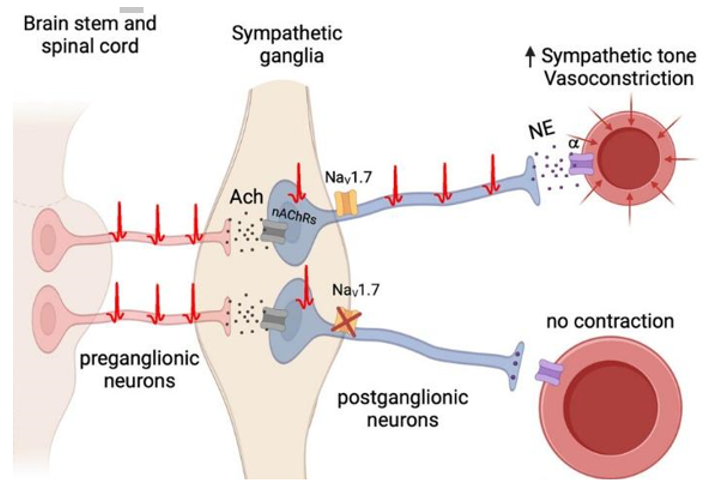
Figure 1 Nav1.7 VGSC in DRG.
https://physoc.onlinelibrary.wiley.com/doi/abs/10.1113/JP286538
Nav1.8 (SCN10A), makes contributions to neuropathic and inflammatory pain by modulating the setting of the action potential threshold and enabling thermal hyperalgesia development.24 Nav1.9 (SCN11A), contributes to cold pain as well as to small fiber neuropathy.24 These subtypes, while functionally specialized, have overlapping functions with Nav1.7, thus constituting a more general system of redundancy that ensures pathway robustness of pain signaling.25 This functional redundancy, or "functional degeneracy," is the principal obstacle to the development of selective pain therapeutics.26 Because nociceptors can interchangeably substitute the function of one sodium channel for another, drugs that inhibit one Nav subtype are generally powerless to provide consistent results in the clinical setting. Future pain management may entail combination therapies blocking multiple Nav channels simultaneously to provide useful analgesia with no addiction liabilities on opioids. Overcoming issues such as drug selectivity, target binding, and side-effect profiles will be critical to the development of safe, non-opioid medications for chronic and acute pain disorders.
Goodwin & McMahon indicated the important contributions of Nav subtypes in pain signaling, highlighting how effective inhibitors of pain signaling must be able to penetrate the brain to effectively outline the phenotype of congenital insensitivity to pain.27 Moreover, an additional study has demonstrated how post-translational modifications like phosphorylation of Nav1.7 mutations like I848T can increase the excitability of nociceptors by altering voltage sensitivity.28
In addition, Nav1.8 and Nav1.9 are also involved in the maintenance of chronic pain states. Modulation or overexpression of regulators like collapsin response mediator protein 2 (CRMP2) and fibroblast growth factor 13 (FGF13) is responsible for alteration of channel expression and neuronal excitability.29,30 Moreover, investigation of microRNA-mediated regulation of VGSCs has shown that miR-3584-5p and miR-6954-3p are integral in the modulation of Nav1.8 and SCN2B expression, respectively, thus indicating the presence of novel epigenetic mechanisms in chronic pain.31,32
Innovative pharmacological and non-pharmacological agents targeting the VGSC
Nav1.7, Nav1.8, and Nav1.9 have become critical targets in the development of pain therapeutics secondary to their role in pain transmission. Several studies have shown the potential of selectively targeting these voltage-gated sodium channels to effectively manage both acute and chronic pain conditions. Findings from Wood et al. and Goodwin & McMahon have both indicated the role of Nav1.7 as a promising target for analgesia, especially with the management of chronic pain, which is marred by the ineffectiveness of traditional opioid management and its harmful side effects.>27,33
Recently, inhibitors specifically targeting Nav1.8 have come out as promising advancements in acute pain management. In particular, VX-548, a Nav1.8-specific inhibitor, has been well-tolerated in clinical trials and shown to significantly reduce pain following surgical procedures.34 Of note, it was not superior to the hydrocodone bitartrate-acetaminophen used as a comparison in the same study. Studies of Kong et al. and McDougall & O’Brien have indicated Nav1.8’s role in chronic pain conditions, especially of inflammatory and neuropathic natures.11,34 While Nav1.7 is the prime target for many pain studies, the aforementioned studies suggest that Nav1.8 channel inhibitors offer significant promise for broader applications in pain management.
Furthermore, the role of genetic modulation and natural products in pain management has also been recognized through novel therapeutics. The use of CRISPR-based epigenetic engineering to inhibit Nav1.7 has been demonstrated to provide long-lasting pain relief without any impact on motor function.35 VGSC-targeting gene therapies aim to reduce pain through suppression of expression or function of some VGSC isoforms, notably NaV1.7, whose central role in transmitting pain signals peripherally is well established.36 The therapies primarily work by preventing nociceptors, specialized neurons responsible for pain perception, from being excited so as to prevent pain transmission to the brain.37 Large strategies include epigenetic inhibition of the SCN9A gene, which encodes NaV1.7, using methods like engineered zinc finger repressors (ZFRs) and CRISPR interference (CRISPRi).38 Both approaches reduce the levels of NaV1.7 protein without irreversibly altering the DNA sequence. Manipulation of protein-protein interactions, such as blocking the interaction between CRMP2 and NaV1.7 by a decoy peptide gene therapy, reduces the availability of the channel on the surface of the neuron and diminishes its activity.39
Other approaches utilize RNA-based methods-RNA interference (RNAi) and antisense oligonucleotides (ASOs)-to degrade or block the mRNA that codes for VGSCs, thereby blocking protein synthesis.40 Regardless of the specific method, all of these gene therapies have the ultimate goal of reducing the influx of sodium ions through channels like NaV1.7 and NaV1.8, raising the amount needed to stimulate pain signaling.24 This results in reduced neuronal excitability and blocked pain signal transmission from the periphery to the brain. Importantly, through the preferential blocking of sodium channel isoforms that are most frequently found in nociceptors, such treatments can attempt to avoid off-target side effects in non-pain-related tissue, for example, the heart or central nervous system. In parallel, quercitin, an active compound derived from Moutan Cortex, has been indicated to provide natural-based relief for chronic pain by inhibiting NaV channels and reducing proinflammatory cytokines.41 Through leveraging cutting-edge genetic tools and natural products, respectively, CRISPR-based epigenetic engineering and quercetin reflect the interest in diversifying the landscape of pain management beyond the conventional pharmacological treatments traditionally offered in clinics.
Nonetheless, obstacles remain in the development of effective and safe Nav channel-targeting therapeutics. To avoid off-target effects and minimize harmful side effects, selectivity in targeting the specific isoforms of the Nav channels is crucial. Although VX-548 and CRISPR-based strategies have been proven to be safe in clinical trials with short-term use, there is still much to be uncovered about the long-term effects of these treatments. In addition, nanomedicine and miRNA-based therapies also offer promising avenues for improved drug delivery and enhancement of treatment specificity, with the potential to transform the current landscape of chronic pain management.31,41 As these therapies continue to advance, they bring the promise of more effective, safer, and targeted alternatives to opioid-focused pain relief.
Limitations in translating to clinical practice
Although therapeutics targeting VGSCs have featured promising results from the preclinical studies, there remain significant hurdles with these treatments being translated into clinical practice. One particular difficulty is the complexity behind the selective targeting of specific Nav channel isoforms without tampering with other related channels that are essential to normal neuronal function; this challenge of selectivity brings concerns of off-target effects, potential side effects, and safety issues in the long term.27,33,42 In addition, while therapies like CRISPR-based approaches have proven their efficacy with animal models, translation into human treatments will require addressing issues on bioavailability, pharmacokinetics, and the ability to achieve sustained therapeutic effects in vivo without toxicity.38 Moreover, regulatory measures surrounding novel therapies that require rigorous clinical testing to show efficacy and safety will take years, thereby delaying their development.>11,33 Despite their promise of revolutionized pain management, these innovative pain treatments will remain in the research phase until all of these challenges are adequately addressed. The concerns regarding the long-term safety of these therapies for chronic use must be addressed for widespread clinical adoption.
Voltage-gated sodium channels, particularly the Nav1.7, Nav1.8, and Nav1.9 isoforms, are promising targets for novel pain therapies. However, significant challenges hamper the translation of these findings into clinical practice. Ensuring long-term safety, selectively targeting specific sodium channel subtypes, and overcoming the pharmacological and regulatory barriers is necessary for further development and implementation of these therapies into clinical practice. Strides continue to be made toward safer, more effective pain management with research into genetic engineering, novel compounds, and non-opioid approaches to analgesia. Furthermore, with the advances in gene therapy, nanomedicine, and natural compounds, there is optimism that these agents will bridge the gap between preclinical success and clinical application. As VGSCs continue to be investigated, addressing the aforementioned challenges will provide patients who are debilitated by chronic pain an efficacious and safer alternative to the traditional opioid-dominated treatments
None.
No ethical approval was necessary for this literature-based review. No human or animal subjects were involved.
The authors declare no conflict of interest in relation to this study. No financial support, funding, or personal relationships have influenced the design, execution, or interpretation of the research presented in this abstract. All findings and conclusions are solely based on the data reviewed and do not reflect any external biases or influences.
No promotional content of a commercial entity is included.
There are no copyrighted figures, images, or content in my manuscript.

©2025 Sebastian, et al. This is an open access article distributed under the terms of the, which permits unrestricted use, distribution, and build upon your work non-commercially.