Journal of
eISSN: 2373-633X


Case Report Volume 16 Issue 4
 Fayyaz F, Girardi F, Fernandez L, Ramirez L
General Surgeon, Mastologist, Uruguay
Correspondence: Guarneri Carolina, General Surgeon, Mastologist, Calle 20 y 1b, Atlántida. Canelones, Uruguay
Received: August 13, 2025 | Published: August 28, 2025
Citation: Fayyaz F, Girardi F, Fernandez L, et al. Hydatid cyst with unusual topography. A case report. J Cancer Prev Curr Res. 2025;16(4):93‒95 DOI: 10.15406/jcpcr.2025.16.00584
Hydatidosis or cystic echinococcosis is a zoonosis caused by the larval stage of the cestode Echinococcus granulosus. This disease is endemic in agricultural and livestock-raising countries in Africa, South America, Australia, the Middle East, and Asia. Although it is a notifiable disease in Uruguay, there is significant underreporting, with a reported prevalence of 4.2 per 100,000 inhabitants.
The life cycle of the disease requires a definitive host (domestic and wild dogs) where the adult stage develops, and an intermediate host (sheep, goats, etc.) where the larval or cystic stage develops, with humans being an accidental host. The intermediate host ingests the eggs from the definitive host, developing into the cystic or larval stage. The cycle is completed after ingestion of viscera contaminated with the larval stage.
Most of the time it presents in a solitary form and in a third of the cases it is multiple, and it can settle in various organs, the most frequent topographic sites being the liver (50%), lung (34%), spleen (8%), kidney (2.5%-4.1%), leaving the pancreas as an exceptional location.
The diagnosis of HPQ remains a challenge given its pausymptomatic presentation and the complexity of differentiating it from other pancreatic cystic lesions.
This report aims to discuss the diagnostic algorithm and therapeutic approach to this entity through a case of QHP.
A 48-year-old female patient from a rural area was obese with a body mass index of 39. She was hypertensive and had non-insulin-requiring diabetes. She had no prior biliary history.
She presented with severe pain in the upper abdomen that had been present for 1 year, accompanied by nausea and vomiting, and symptoms suggestive of gastroduodenal stenosis. There were no signs of icterus-pigmentary syndrome. She also had a fever of 38°C, for which she was admitted for evaluation.
To the Exam:Good general condition. Globular abdomen, asymmetrical due to a palpable 12 cm tumor in the epigastrium, deep, firm-elastic, with regular edges, slightly painful.
The paraclinical tests showed normal leukocytosis, elevated eosinophils, CRP of 200 mg/L, liver function tests and normal amylasemia.
CT scan of the abdomen and pelvis with intravenous contrast (Figure 1) which shows a voluminous supramesocolic cyst measuring 15 x 13 cm that makes wide caudal contact with the body of the pancreas from which it emerges. It makes contact, without infiltrating, with the left hepatic lobe, the posterior wall of the antrum-pylorus and the first portion of the duodenum, which it displaces anteriorly, narrowing its lumen. The presence of an air bubble inside is notable.
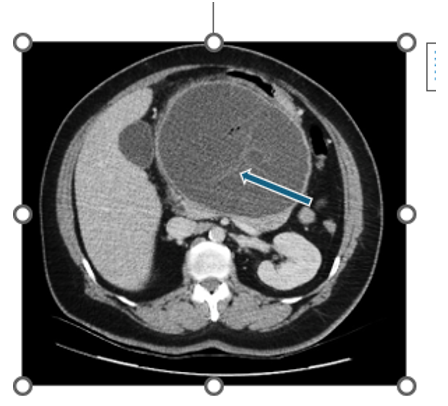
Figure 1 Tomography of the abdomen and pelvis: cystic lesion with fine septa (arrow) and air bubbles inside, at the level of the pancreas measuring 179 mm L x 159 mm T x 141 mm AP.
Given these findings, antibiotic therapy was empirically initiated with a good response and an assessment was completed.
Given the doubts regarding the nature of the injury, a nuclear magnetic resonance is requested (Figure 2) It reports the presence of a simple, unilocular cystic lesion that does not restrict diffusion,of pancreatic origin, without communication with the Wirsung with the possibility of a pancreatic pseudocyst or mucinous cystadenoma.
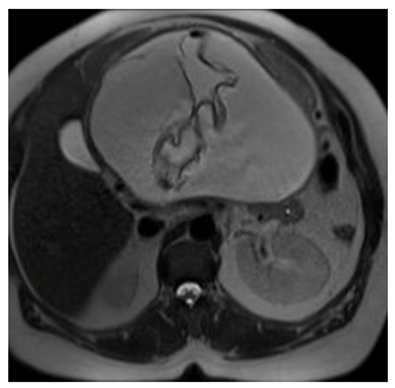
Figure 2 MRI: Voluminous cystic tumor emerging from the anterior sector of the body of the pancreas, it is well defined, without contrast enhancement, with membranes inside, displacing the left lobe of the liver and the stomach anteriorly.
To advance in the etiological diagnosis, an endoscopic ultrasound was requested, which reported a large cystic lesion of pancreatic origin, which was drained with a 19G EUS-FNA fine needle. 1300 cc of citrine fluid was obtained. The filancia test was negative and glucose was 0.84 by glucometer, which ruled out the diagnosis of a mucinous lesion. The pathological evaluation reported the presence of prolific capsules with two rows of Echinococcus granulosus hooks, confirming the diagnosis of pancreatic hydatidosis. The bacteriological study did not develop germs.
The patient was discussed in a multidisciplinary forum where a surgical resolution was proposed. Since the patient did not accept, an endoscopic cysto-gastric bypass was performed. This was performed without incident by means of a needle-knife cut, with the observation of abundant purulent contents and remnants of adventitia. Once inThe cavity is aspirated, approximately 2,500 cc of purulent contents are aspirated, and abundant intracystic hypertonic saline is instilled, and adventitia remnants are removed. A nasocystic tube is left fixed in the gastric wall. Two weeks later, the cystogastric fistulous orifice is dilated endoscopically, and two pigtail drains are inserted to continuously drain the cyst into the gastric cavity (Figure 3).
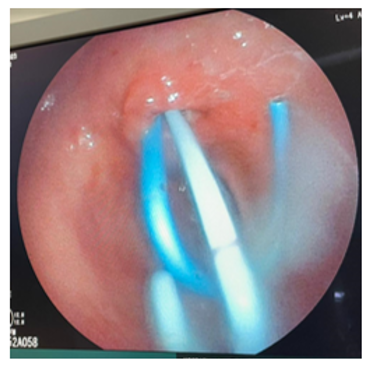
Figure 3 8.5fr and 10fr pigtail drains placed in the pancreatico-gastric fistula.
Favorable progress followed, completing 6 months of albendazole therapy. A follow-up CT scan (Figure 4) revealed a small, well-demarcated, rounded, hypodense lesion of fluid density and thick walls up to 8 mm at the level of the lesser omentum, which appeared to be a previously known hydatid cyst with a fistulous tract connected to the lesser curvature of the stomach.
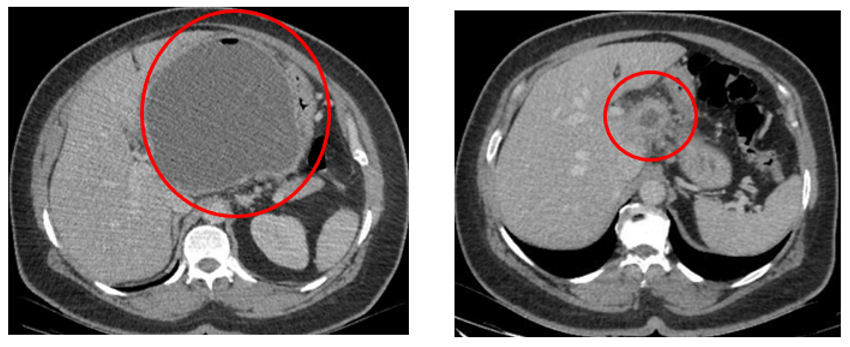
Figure 4 Shows a CT scan of the patient before and after drainage of the pancreatic hydatid cyst.
Knowledge of this condition has led to improved prophylaxis of the condition and its complications. This has led to a decreasing incidence of HPC, especially in South American countries. Similarly, the reporting and management of less common HPC topographies is limited in the literature. Fewer than 70 cases of HPC have been published in the international surgical literature, most of them from countries in Asia, Central Europe, North Africa, and South America.1
Pancreatic QH (QHP) is a rare entity with an incidence ranging from 0.14 to 2% (2). They are usually solitary (91%) and are most frequently topographed at the cephalo-pancreatic level (50%-58%) followed by the body of the pancreas (24-34%) and tail (16-19%).
The hypothesis of hematogenous dissemination to the pancreas is the most accepted, with other possible dissemination routes being biliary or lymphatic from the intestinal mucosa through direct passage to the pancreatic veins.2,3
Clinical manifestations depend on the location of the HB. In the pancreas, their intra-abdominal location means they are mostly oligosymptomatic. They usually grow slowly (0.3-2 cm/year). Those located in the cephalopancreatic region may present with obstructive jaundice secondary to extrinsic compression of the main bile duct and may even pose a differential diagnosis with a choledochal cyst.
Cysts located in the body and tail of the pancreas are usually asymptomatic until their volume manifests as a palpable abdominal mass. They can also present with symptoms secondary to compression of adjacent organs, even causing gastroduodenal stenosis syndrome, as our patient demonstrated. Cysts located caudally are entirely asymptomatic and can rarely manifest with splenomegaly and portal hypertension.
Complications such as infection, acute pancreatitis, spontaneous or traumatic rupture into the peritoneal cavity, and mesenteric thrombosis have been described in PHC. In this case, the presence of fever and air within the cyst retrospectively suggested the presence of PHC superinfection as an associated complication.
Complications such as cholangitis, opening and evacuation in the main biliary tract or peritoneal cavity, pancreatic fistula and abscesses are the most frequent in liver topography lesions.4,5
In general terms, the diagnosis of QH is based on five fundamental pillars: clinical, epidemiological, imaging, immunological and pathological confirmation.
From a clinical-epidemiological point of view, we highlight that this is a patient from an endemic area for QH (Uruguay, rural environment), with nonspecific symptoms where the rest of the pillars have greater diagnostic value.
Regarding imaging assessment, abdominal ultrasound (US), computed tomography (CT) and magnetic resonance imaging (MRI) are commonly used.
Ultrasound examination is a noninvasive, technique-dependent tool with limited sensitivity for the pancreas. However, in experienced hands, it can reveal typical features of QH in larger lesions, such as the presence of a floating or folded membrane, hydatid sand, and multivesicular or multiseptate lesions (endovesiculation).
CT and MRI can diagnose HPC by assessing pathognomonic elements, such as the presence of wall calcification, the presence of internal septa, internal membrane detachment, and the presence of daughter vesicles. They also assess the relationship with neighboring structures, allowing for the determination of surgical approach.
MRI is more valuable in cases with negative serology and diagnostic uncertainty regarding the nature of the lesion, allowing differentiation of IPMN type lesions.(Intraductal Mucinous Neoplasia of the Pancreas).
In this patient with negative serology, the CT scan was inconclusive and the MRI failed to clarify the nature of the lesion, leaving doubts between PHC and a pancreatic mucinous lesion. In such cases, endoscopic ultrasound (EUS) is indicated as a useful diagnostic tool.
EUS-guided aspiration of cystic contents and its cytological and biochemical analysis are essential for definitive diagnosis. In this case, it not only confirmed the possibility of HPC but also ruled out IPMN and pseudopancreatic cysts.
Immunological diagnosis requires antigenic stimulation determined by contact of the hydatid fluid with the host's immune system, which only occurs in the presence of microfissures in the germ cell. The double diffusion 5 technique identifies antibodies against antigen 5 with a high specificity close to 100%, becomes negative 24 months after treatment and is accepted with the combination of another technique such as ELISA with HAI (indirect hemagglutination) with high sensitivity.6-8 Serology as a diagnostic confirmation of a PHC is less sensitive than in hepatic or pulmonary hydatid cyst, being positive in 54% to 62% of cases (1); this fact supports the negative serology in our patient, which does not exclude the diagnostic framework.
Regarding the pathological basis, this can be definitive after evaluation of the surgical resection specimen or by minimally invasive methods. Cytological study using fine needle aspiration, either percutaneous or by EUS, can contribute to the diagnosis. In these patients, prophylactic treatment with antihistamines (albendazole) should always be initiated to avoid a possible anaphylactic reaction and peritoneal dissemination in the event of cyst perforation or cyst content leakage.1
Treatment relies on a multidisciplinary approach encompassing adjuvant or exclusive medical and pharmacological management, surgical and/or minimally invasive, and is always tailored to each patient.
Medical treatment can be performed not only prophylactically, as mentioned above, but also as an alternative or adjuvant to surgery, depending on the case. As an adjuvant, it minimizes the risk of seeding due to manipulation and reduces seeding in the event of rupture in patients undergoing surgical resolution. Albendazole 10 mg/kg/day is administered divided into 3 doses, 20 days before surgery and up to 2 months after, with a 15-day break between the first and second month. Liver function and enzymogram monitoring are required, as well as monthly complete blood counts due to the increased SGOT, SGPT, AP, and neutropenia that they may cause. Evaluation of the response to treatment is performed through clinical, imaging, and serological monitoring. A complete response rate of between 10 and 30% is described.8
There are different therapeutic options depending on the location and size of the cyst, its relationship to adjacent structures, existing symptoms or complications, and the patient's surgical risk. In general, surgical treatment is the only treatment that is supposedly curative and can be performed using a conventional or video-assisted approach. Tactical options include: MABIT (partial adventitisectomy), which consists of resecting the hydatid with the emerging adventitia, without resecting any adventitia that may be in contact with vasculobiliary structures. Radical surgery (extended MABIT), which involves resection of more than 80% of the adventitia. Total cystectomy with complete resection of the cyst and adventitia.9–10
In PHP of the body and tail, the most accepted strategy is splenic-preserving distal pancreatectomy. In cysts larger than 5 cm and in patients with high surgical risk or who refuse surgery, percutaneous PAIR drainage (puncture, injection of hypertonic saline, and re-aspiration of cyst contents) with albendazole prophylaxis has been described to reduce the risk of anaphylaxis.3
In this case, given the patient's refusal of surgical treatment, endoscopic cystogastric diversion was chosen, with good results and no associated complications. There is a wealth of literature supporting the resolution of pancreatic cysts using endoscopic cystogastric diversion, with comparable results with surgical treatment and even lower associated morbidity. While its use can be extrapolated to the surgical resolution of PPCs, the literature on the subject is very limited or scarce.
Long-term results are evaluated based on clinical, imaging and serology11 as was done in this case.
QHP is a very rare pathological condition. The primary location in the tail of the pancreas confuses the diagnosis with a mucinous cystic tumor if the patient's epidemiological history associated with a high index of suspicion and the necessary radiological and laboratory studies are not taken into account. Although surgical treatment for HPC is the gold standard, cystogastric bypass is a valid therapeutic option.
None.
No funding support was received from any organization.
No conflict of interest was declared by the authors.

©2025 Fayyaz, et al. This is an open access article distributed under the terms of the, which permits unrestricted use, distribution, and build upon your work non-commercially.