Journal of
eISSN: 2373-633X


Case Report Volume 16 Issue 6
1`Department of Mammography, Falun Central Hospital, Sweden
2Department of Diagnostic Radiology, Faculty of Medicine, University of Turku, Finland
3Department of Clinical Pathology and Cytology,Falun Central Hospital, Sweden
Correspondence: László Tabár, Department of Mammography, Falun Central Hospital,791 82 Falun, Sweden, Falun, Sweden
Received: December 24, 2025 | Published: December 31, 2025
Citation: Tabár L, Dean PB, Tarján M. A specific subgroup of DCIS of the breast cannot be an in situ disease when its structure dominates the distant metastases: a case report. J Cancer Prev Curr Res. 2025;16(6):157‒159. DOI: 10.15406/jcpcr.2026.16.00596
Background: Although the term ductal carcinoma in situ, DCIS, implies that breast cancer is confined within preexisting ducts, some breast cancers diagnosed as DCIS can be fatal, In this case the liver metastases had a structure identical to the primary breast tumour which had been diagnosed as DCIS.
Case presentation: The screening mammograms of this asymptomatic 57-year-old woman showed a non-palpable solitary 18 mm circular tumour mass associated with extensive fragmented casting type calcifications. The histopathologic diagnosis was 80 mm ductal carcinoma in situ (DCIS) associated with an 18x16 mm solitary basal-like invasive carcinoma. Two years after two surgical resections followed by mastectomy and chemotherapy, the patient developed liver metastases and died one year later from the disease.
Conclusion: The specific subgroup of “DCIS” cases represented by fragmented casting type calcifications on the mammograms is a duct-forming invasive carcinoma and is not an in situ disease, since it can spread to distant organs. The authors have proposed that that this invasive process be termed neoductgenesis. The widespread assumption that it is a non-invasive disease continues to promote an inadequate therapeutic approach. Recognition of the invasive nature of neoductgenesis is a prerequisite for adequate surgical and oncologic treatment planning.
Key words: Breast cancer metastases, DCIS, neoductgenesis, fragmented casting type calcifications, case report
DCIS, ductal carcinoma in situ
In situ carcinoma of the breast can develop either from the epithelial cells of the lobular acini or from the epithelial cells lining the major lactiferous ducts, resulting in distinct subgroups, all of which are currently termed ductal carcinoma in situ (DCIS). Each of these has several well-defined imaging biomarkers, which reflect a diverse underlying histopathology. The in situ process developing within the major ducts and occult at mammography progresses to the invasive carcinogenic process of neoductgenesis (Figure 1A), resulting in the imaging biomarker, fragmented casting type calcifications on the mammogram (Figure 1B). Identification of neoductgenesis as an in situ carcinoma (DCIS) is erroneous since it can and does behave as an invasive, metastatic and fatal breast cancer.1–5 Calling attention to the invasive nature of neoductgenesis has considerable implications for histopathologic terminology, surgery and oncology by helping to reduce underdiagnosis and undertreatment of these cases.6–7 In this case report we present an example of neoductgenesis in the primary tumour and in metastasis to a vital organ. The imaging biomarker, fragmented casting type calcifications on the mammogram, can alert the management team to the potentially harmful nature of this breast cancer subgroup.
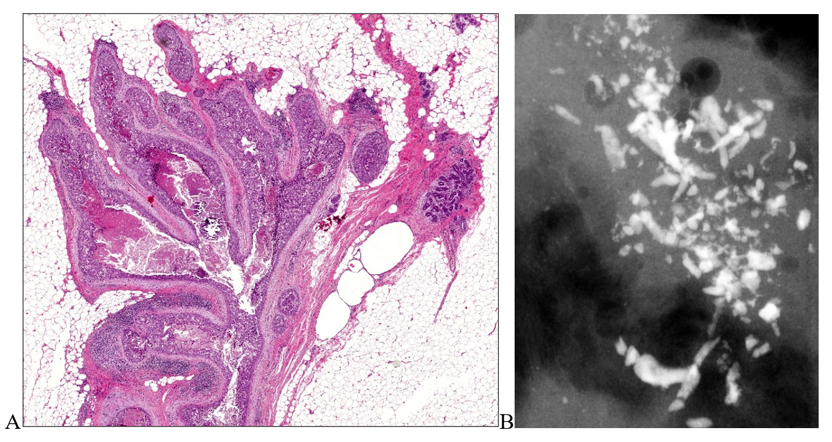
Figure 1 Large format histopathologic illustration of distorted, massive neoducts in neoductgenesis (A). Example of fragmented casting type calcifications on the mammogram (B).
This 57-year-old asymptomatic woman was called back from mammography screening for assessment of a non-palpable solitary, de novo spherical tumour mass with extensive casting type calcifications 14 months after a normal screening mammogram. The histopathologic report described the findings as an invasive, 18x16 mm poorly differentiated, unifocal, basal-like breast cancer associated with Grade 3 ductal carcinoma in situ (DCIS) spread over a region measuring 80 mm. Figures 2A-I show the imaging, histopathologic and immunohistochemical presentations of the primary breast cancer. No lymph node metastases were reported. Twenty-four months after diagnosis and two incomplete resections, followed by mastectomy, chemotherapy and nearly two years of tamoxifen therapy, the patient developed liver metastases showing the same duct-like, DCIS-type structure as seen in the primary breast tumour. The patient died from breast cancer three years after diagnosis and initiation of therapy.
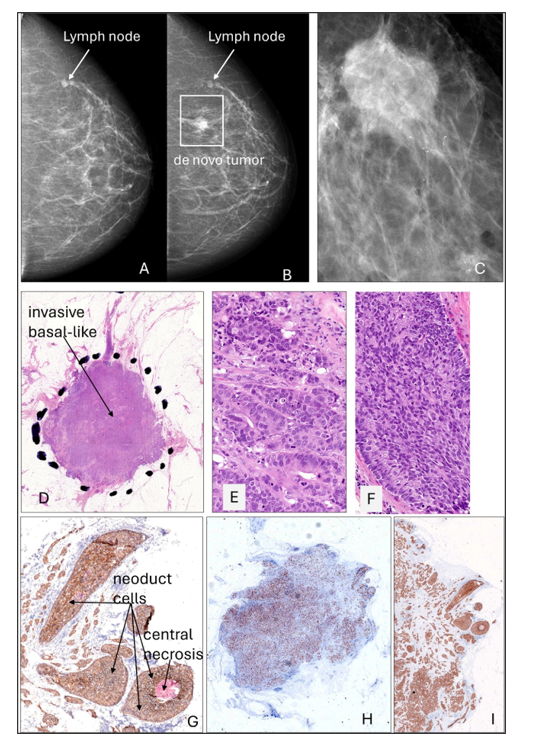
Figure 2 Left breast, cranio-caudal projection (A) 14 months before diagnosis of the solitary, ill-defined tumour mass (B). Microfocus magnification of the surgical specimen (C): the ill-defined spherical tumour mass is surrounded by fragmented casting type calcifications. Low-power histopathology of the tumour mass, H&E staining (D). High power histopathology image of the poorly differentiated invasive carcinoma (E) and an associated neoduct (F). Immunohistochemical biomarkers: HER2 positive tumour (G), high proliferation index (Ki67 37%) (H), E-cadherin positive tumour (I).
Figures 3A-F demonstrate the H&E and immunohistochemical staining of the liver metastases.
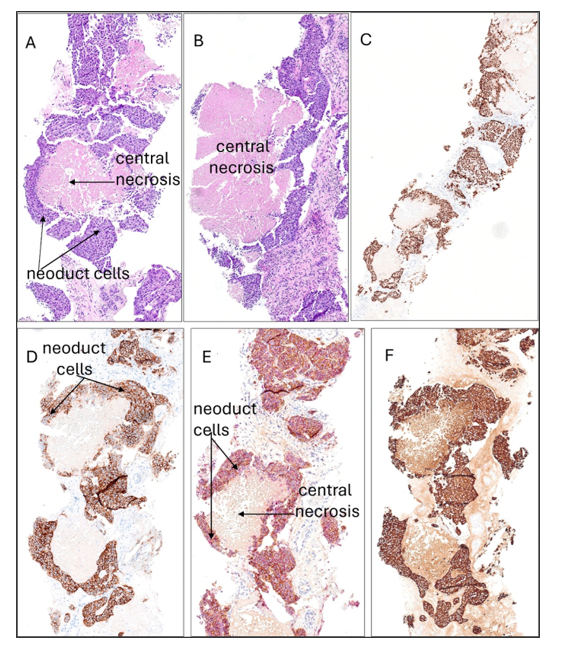
Figure 2 Low power 14G core biopsy histopathology images (H&E) of the liver metastases (A,B). Positive GATA3 staining indicates that the metastases originate from the primary breast cancer (C). E-cadherin staining (D), HER2 staining (E) and CK7 staining (F).
In the 5th edition of the WHO Classification of Tumours, the volume Breast Tumours states the following: “Our understanding of the natural history of DCIS is poor and largely based on histological review of small numbers of cases initially interpreted as benign.”.8 This case report and the cited literature add to our current understanding of the pitfalls associated with the assumption that DCIS is truly in situ.
The imaging biomarker, the presence of fragmented casting type calcifications on the mammogram, is a reliable marker for a deceptive, fatal breast cancer subtype, erroneously termed DCIS. Our reported case is an example of the invasive propensity of neoductgenesis originating from the in situ process of major lactiferous ducts, demonstrating that neoducts formed by neoductgenesis are not in situ but are duct forming invasive carcinomas. The refined analysis of the cause of death showed that the liver metastases were dominated by neoducts identical to the neoducts in the primary breast tumour which had been termed “DCIS”, and not by the expected “invasive component”.
Finding “DCIS-like” lesions in the axillary lymph nodes and even more importantly, in the distant metastases in various organs such as the liver, the lungs, the brain and skeleton provide proof that the breast cancer originating from the major ducts, termed DCIS, is a duct forming invasive disease, for which we have proposed the term neoductgenesis.6 This subgroup of breast cancers, identifiable by fragmented casting type calcifications on the mammogram, is truly “ductal” in origin, but not in situ since it is capable of metastasizing to the axillary lymph nodes and distant organs.1–7
Statistical evidence and imaging-histopathologic findings indicate that a specific subgroup of breast malignancy termed “DCIS”, represented by fragmented casting type calcification on the mammograms, is an invasive, metastatic and potentially fatal breast cancer since the truly in situ carcinoma in the major ducts has evolved to duct forming invasive carcinoma through neoductgenesis by the time of detection. The implication for histopathologic terminology is to recognize this subgroup as a duct-forming invasive carcinoma instead of an in situ disease, since it can spread to the axilla and to distant organs. Recognition of the invasive nature of neoductgenesis is a prerequisite for adequate surgical and oncologic treatment planning. The term “in situ” gives clinicians’ false reassurance and leads to underdiagnosis and undertreatment. The medical community needs to reconsider this misleading nomenclature in the light of recent evidence.
The authors are grateful to Ms. Helena Hermelin for scanning the histopathology glasses.
The author declares that he has no competing interests.

©2025 Tabár, et al. This is an open access article distributed under the terms of the, which permits unrestricted use, distribution, and build upon your work non-commercially.