International Journal of
eISSN: 2574-8084


Research Article Volume 12 Issue 6

National Coalition of Independent Scholars, USA
Correspondence: Marco Ruggiero, MD, PhD, National Coalition of Independent Scholars. 125 Putney Rd Brattleboro, VT 05301, United States of America
Received: December 02, 2025 | Published: December 17, 2025
Citation: Ruggiero M. Biological adjuvants in radiation oncology: a multi-omics approach leveraging phage-derived DNA repair, plasmid-mediated detoxification, and endogenous immunotherapy. Int J Radiol Radiat Ther. 2025;12(6):176-180. DOI: 10.15406/ijrrt.2025.12.00443
Radiation therapy (RT) remains a cornerstone of oncological treatment, yet its efficacy is often limited by toxicity to healthy tissues, radio-resistance of hypoxic tumors, and systemic immunosuppression (lymphopenia). This paper explores the potential of a novel nutritional approach using a specialized Multi-Component Fermented Colostrum Complex (MCFCC). Unlike standard probiotics, this product is characterized by an extreme biodiversity comprising specific Siphoviridae bacteriophages, natural plasmids, and Bifidobacteriaceae. The molecular mechanisms through which this complex may synergize with RT are analyzed. Specifically, it is discussed: 1) The radioprotective role of the phage protein Sak, a homolog of the human DNA repair protein RAD52; 2) The management of oxidative stress via plasmid-encoded "electron sinks"; 3) The endogenous production of Gc protein-derived Macrophage Activating Factor (GcMAF) and the activation of Chondroitin Sulfate, which target C-C motif chemokine receptor 1 (CCR1) receptor to reverse immunosuppression; and 4) The induction of Nitric Oxide (NO) to re-oxygenate hypoxic tumor microenvironments, thereby enhancing radiosensitivity. Clinical case reports are reviewed to demonstrate the translational potential of this integrated biological approach in improving healthy life expectancy and modulating oncogene expression (e.g., HER2) in cancer patients.
Keywords: radiation oncology, immunotherapy, GcMAF, bacteriophages, DNA repair, radioprotection
The evolution of Radiation Therapy (RT) has been marked by a constant pursuit of precision that is delivering maximum cytotoxicity to the tumor while sparing the surrounding healthy parenchyma. Despite advances in delivery technologies - including External Beam Radiation Therapy (EBRT), Intensity-Modulated Radiation Therapy (IMRT), Stereotactic Body Radiation Therapy (SBRT), Image-Guided Radiation Therapy (IGRT), and Brachytherapy - the biological response of the host remains a critical variable. Ionizing radiation functions primarily by inducing DNA double-strand breaks (DSBs) and generating Reactive Oxygen Species (ROS). It is well established that uncorrected double-strand breaks lead to chromosomal aberrations and cell death; while this is the intended goal for cancer cells, significant changes in human DNA in healthy tissues must be prevented or repaired to avoid severe toxicity.
However, the therapeutic index is often narrowed by the systemic inflammation and lymphopenia that accompany treatment. Furthermore, radiation-induced damage to the rapidly dividing epithelial cells of the gastrointestinal tract frequently results in mucositis and diarrhea, further compromising the patient's nutritional status and quality of life. Paradoxically, immunosuppression can hamper the immune system's ability to clear senescent or apoptotic tumor cells - a phenomenon required for the "abscopal effect”.1,2
Current supportive care in RT often focuses on symptom management. However, there is an emerging paradigm of "Functional Oncology Nutrition" that seeks to intervene at the genomic and immunologic levels. In this context, fermented milk and colostrum products have historically been recognized for health benefits. Recent multi-omics analyses, however, have revealed that specific fermentation processes involving kefir grains and bovine colostrum generate a biological complexity far exceeding that of standard probiotics. This paper analyzes a specific Multi-Component Fermented Colostrum Complex (MCFCC), investigating its unique genetic and enzymatic assets - from bacteriophages to plasmids - and their specific utility in the setting of Radiation Oncology.3
One of the most significant challenges in RT is mitigating DNA damage in non-target tissues. Analysis of the MCFCC using high-throughput microarray technology (Axiom Microbiome Array) has revealed the presence of a vast population of bacteriophages, specifically belonging to the Siphoviridae family.3
While phages are typically viewed as antibacterial agents, their contribution to eukaryotic health is increasingly appreciated. Of particular relevance to Radiation Oncology is the identification of Lactococcus phage ul36 within the MCFCC. This phage encodes a protein known as Sak. Sequence alignment studies have demonstrated that Sak is a homolog of the human recombination protein RAD52.4
RAD52 plays a crucial role in DNA repair, genome stability, and the prevention of carcinogenesis. It facilitates the annealing of single-stranded DNA, a critical step in Homologous Recombination (HR) repair of DSBs caused by ionizing radiation. The presence of Sak implies that the MCFCC provides an exogenous source of "repair tools" that share structural and functional homology with human DNA repair mechanisms. It has been hypothesized that Sak may self-assemble into toroidal structures, potentially interacting with DNA through non-chemical signaling or quantum entanglement phenomena, thereby stabilizing the genome against radiogenic insult.3
Furthermore, the product contains Lactococcus phage TUC2009, associated with the detoxification of carcinogenic metals like cadmium via the cadA gene.3. By reducing the body's burden of accumulated environmental heavy metals (electropositive toxic metals), which are known radiosensitizers of healthy tissue and contributors to oxidative stress, the phage component of MCFCC establishes a "genomic shield" that supports the organism's resilience during RT. This aligns with broader research indicating that metal-binding proteins in bacteria can mitigate heavy metal toxicity in the host.5
Radiation therapy kills cancer cells largely through the generation of ROS (Reactive Oxygen Species). However, chronic oxidative stress in healthy tissues leads to fibrosis and long-term toxicity. The microbial analysis of MCFCC identified 48 unique natural plasmids.6. Unlike chromosomal DNA, plasmids are mobile genetic elements that allow for the horizontal transfer of advantageous traits, such as resistance to environmental stressors.
A key finding is the presence of the plasmid pSK11B from Lactococcus lactis subsp. cremoris. This plasmid carries the aldC gene, which codes for alpha-acetolactate decarboxylase. This enzyme is involved in the production of acetoin and, crucially, in the regulation of pyruvate metabolism. It has been postulated that the overexpression of the aldC gene contributes to the formation of "deep electron sinks”.6,7
In the context of RT, electron sinks are vital. They provide a metabolic pathway to safely dissipate the excess energy and free radicals generated by ionizing radiation, effectively acting as a biological antioxidant system. Additionally, plasmids like LBPp2 from Lactobacillus plantarum encode topoisomerases capable of forming toroidal DNA structures.6. These molecular toroidal structures can chelate electropositive toxic metals (e.g., aluminum, mercury) within their electronegative backbone, offering a further layer of detoxification and protection for the patient undergoing cytotoxic treatments.
While protecting healthy tissue is paramount, the ultimate goal of RT is tumor eradication. This requires a robust immune system. The MCFCC distinguishes itself by acting as a bioreactor for the endogenous production of Gc protein-derived Macrophage Activating Factor (GcMAF).
The product is rich in Bifidobacteriaceae with 28 unique targets identified.8 Genomic analysis confirms that these Bifidobacteria possess genes encoding beta-galactosidase and sialidase enzymes that share striking functional similarity with their human counterparts. During the fermentation of the colostrum (which is naturally rich in Vitamin D-binding protein, or Gc protein), these bacterial enzymes strip the Gc protein of its sugar moieties, exposing the N-acetylgalactosamine (GalNAc) residue and converting it into active GcMAF. This enzymatic conversion mechanism is well-supported by studies on the role of bacterial glycosidases in immune modulation.9 During the radiation process, GcMAF plays a critical role by activating macrophages to clear the necrotic cellular debris generated by radiation-induced cell death, thereby reducing inflammation and exposing tumor antigens to the adaptive immune system.
Superior potency via chondroitin sulfate: Standard GcMAF therapy relies on purified molecules. However, in vitro studies comparing MCFCC to purified GcMAF revealed a startling difference: the fermented complex exhibited a Nagalase-binding activity (a proxy for macrophage activation potential) more than 100-fold higher than the purified benchmark.10
This superior potency is attributed to the presence of Chondroitin Sulfate (CS) in the colostrum matrix. Under the acidic and proteolytic conditions of fermentation, CS is "activated," unmasking its GalNAc (N-acetylgalactosamine) moieties. Unlike GcMAF, which has a single active site, a molecule of CS possesses 50-100 repeating GalNAc units, each capable of interacting with macrophage receptors. This creates a "multi-valent" immunostimulant that provides sustained activation compared to the transient effect of isolated molecules.10
To understand how these molecules mediate their effects in a radiotherapy context, we must look at the receptor level. Recent work.1 has identified the first extracellular domain of the C-C motif chemokine receptor 1 (CCR1) receptor (residues 1-34) as the specific binding site for GcMAF and GcMAF-like molecules.
CCR1 is expressed on monocytes and over 160 other cell types. The binding specificity relies on the amino acid sequence TTEDYDTTT, which constitutes a masterpiece of natural molecular engineering designed to function as a specific docking site characterized by a central electronegative core flanked by a stabilizing neutral scaffold. The heart of this sequence, represented by the Glutamic Acid and Aspartic Acid residues, generates a concentrated negative charge that acts as a powerful electrostatic magnet to attract the positively charged Lysine 420 of the Gc2 variant or to interact with the polar GalNAc sugar of GcMAF, effectively capturing the activating molecule.
Crucially positioned within this charged pocket is a Tyrosine residue that serves as a molecular anchor, utilizing its aromatic ring to establish stable stacking interactions and hydrogen bonds that physically lock the ligand in place once captured. This functional core is elegantly framed by multiple Threonine residues at both the N- and C-termini which, being polar but electrically neutral, create a flexible cage of hydrogen bonds that stabilizes the tertiary structure of the receptor loop on the cell membrane, ensuring the binding pocket remains permanently open and accessible. By targeting this sophisticated docking site on CCR1, the MCFCC-derived molecules trigger the differentiation of macrophages from the non-inflammatory phenotype to the active, phagocytic M1 phenotype. This is critical in the post-radiation microenvironment to clear necrotic debris and present tumor antigens to T-cells, thereby enhancing the systemic anti-tumor immune response.
The integration of MCFCC into the management of cancer patients offers a dual advantage: sensitizing the tumor to radiation while protecting the host.
Radiosensitization via Nitric Oxide (NO): Hypoxia is a well-known cause of radio-resistance in solid tumors. Activated macrophages release Nitric Oxide (NO). In a clinical study involving patients with advanced cancer, the administration of GcMAF-based protocols resulted in a rapid decrease in blood pressure and a significant increase in splenic blood flow, interpreted as NO-mediated vasodilation.11
By inducing vasodilation within the tumor vasculature, NO improves oxygenation, thereby "fixing" the DNA damage caused by radiation and making the tumor more susceptible to cell death. This suggests a potent synergistic effect: the probiotic complex "primes" the tumor physiology to be more responsive to RT. The role of NO as a radiosensitizer in hypoxic tumors is widely acknowledged in oncological literature.12
Reversing Lymphopenia via MALT: Radiotherapy often devastates the lymphocyte population. Previous research compared injectable GcMAF with the oral fermented product in immunodeficient patients.13 The oral product induced a dramatic recovery of CD4 T-cells and normalized the CD4/CD8 ratio in just three weeks. This is attributed to the direct activation of the Mucosa-Associated Lymphoid Tissue (MALT), the body's largest immune reservoir. For the RT patient, maintaining a robust lymphocyte count is the single most important predictor of survival and distant control (abscopal effect).
Modulation of oncogene expression (HER2): In a remarkable case report of recurrent breast cancer, a patient utilizing a protocol including the fermented colostrum product (rich in natural GcMAF and Vitamin D) achieved a complete negativization of HER2 expression (from score 2+ to 0) prior to surgery.14 This suggests that the bioactive components of the product can induce phenotypic reprogramming of tumor cells, potentially driving them towards differentiation or apoptosis and reducing their aggressiveness. This aligns with studies suggesting that Vitamin D signaling can downregulate HER2 expression.15
Reduction of systemic inflammation: Finally, chronic inflammation drives cachexia and poor outcomes in oncology. A case study monitored markers of inflammation in a subject consuming the MCFCC. The results showed a collapse of C-Reactive Protein (CRP) to <1 mg/L and a reduction of serum Nagalase activity to 0.40 nMol/mL/min (below the minimum reference range), indicating the eradication of immunosuppressive factors.10
The integration of advanced biological therapies with standard of care represents the new frontier in Radiation Oncology. While technological advances in delivery systems, such as IMRT and SBRT, have significantly improved the precision of physical targeting, the biological response of the host - specifically the immune system and the genomic stability of healthy tissues - remains a critical determinant of clinical outcomes.
The emerging field of "Oncobiomics" suggests that the human microbiome is not merely a bystander but an active "radiomodulator." While traditional probiotics have been employed to manage localized side effects like mucositis or radiation-induced diarrhea (often resulting from epithelial damage), the data presented in this review point towards a far more profound potential. We are moving beyond the era of simple gut colonization towards the utilization of complex biological systems capable of functional modulation at the systemic level.
The specific MCFCC analyzed here serves as a paradigm for this next generation of biological adjuvants. Its significance lies not in any single ingredient, but in its multi-omics architecture as summarized in Figure 1:
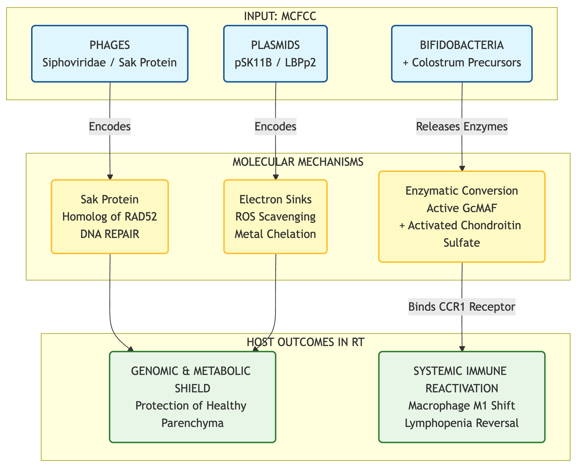
Figure 1 Schematic representation of the multi-omics mechanism of action of the Multi-Component Fermented Colostrum Complex (MCFCC). The diagram illustrates the three distinct biological adjuvant streams provided by the complex: (Left Stream): Bacteriophages belonging to the Siphoviridae family contribute viral proteins, such as Sak, which share homology with the human DNA repair protein RAD52, thereby supporting Homologous Recombination (HR) repair of radiation-induced DNA breaks. (Center Stream): Natural plasmids encode for enzymes (e.g., aldC) that regulate pyruvate metabolism to create metabolic "electron sinks" and toroidal DNA traps, essential for neutralizing Reactive Oxygen Species (ROS) and chelating toxic metals. (Right Stream): Specific Bifidobacteriaceae release beta-galactosidase and sialidase enzymes that convert colostrum precursors (Gc Protein) into active GcMAF and activate Chondroitin Sulfate. These molecules bind to the CCR1 receptor, triggering the shift of macrophages towards the M1 phenotype and reversing systemic lymphopenia.
The genomic level: The identification of specific bacteriophages, such as those encoding the Sak protein (a homolog of the human DNA repair protein RAD52), suggests that nutritional interventions can provide exogenous tools to support endogenous DNA repair mechanisms. This offers a novel strategy to widen the therapeutic window by protecting healthy parenchyma from radiation-induced double-strand breaks.
The metabolic level: The presence of natural plasmids encoding for enzymes capable of creating "deep electron sinks" introduces the possibility of biological buffering against the oxidative stress storm generated by ionizing radiation. This mechanism is distinct from standard antioxidant supplementation, as it relies on adaptive microbial metabolism rather than stoichiometric chemical neutralization.
The Immunological Level: Perhaps most critically, the capability of specific Bifidobacteriaceae to enzymatically convert colostrum precursors into active GcMAF and activated Chondroitin Sulfate transforms the patient’s microbiome into an endogenous immunotherapy factory. The demonstrated interaction of these molecules with the CCR1 receptor and the subsequent macrophage activation provide the necessary immunological drive to clear tumor debris and facilitate the abscopal effect, reversing the lymphopenia that often plagues radiotherapy patients.
Clinical observations indicating the potential for phenotype reversal in oncogene expression (e.g., HER2) and the dramatic reduction of systemic inflammatory markers (CRP and Nagalase) further validate the hypothesis that targeting the host's biological terrain is as crucial as targeting the tumor itself.
In summary, the transition from conventional probiotics to biologically active, fermented multi-molecular complexes represents a shift from supportive care to active therapeutic synergy. Future randomized clinical trials should aim to integrate such "super-biotic" complexes into radiotherapy protocols, viewing them not as supplements, but as essential biological adjuvants designed to maximize the efficacy of radiation while preserving the integrity of the human host (Figure 2) This holistic integration of physics and biology holds the promise of transforming cancer care, improving not only survival rates but, fundamentally, the healthy life expectancy of patients.
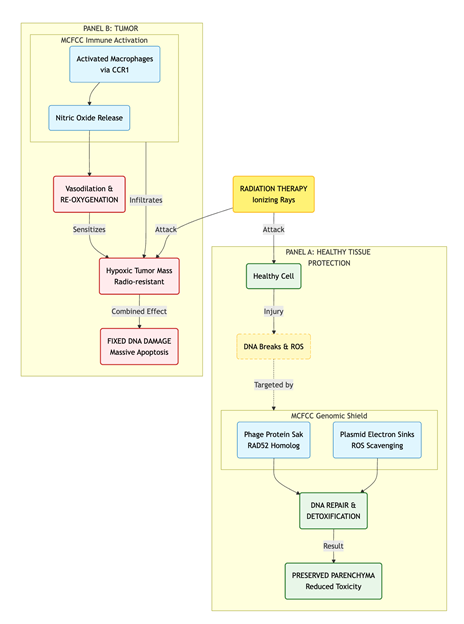
Figure 2 Dual synergistic action of MCFCC in the radiotherapy microenvironment. The biological adjuvant exerts a differential effect on healthy versus malignant tissue exposed to ionizing radiation. (Panel A - Radioprotection): In healthy parenchyma, the "Genomic and Metabolic Shield" provided by phage-derived repair proteins (Sak) and plasmid-mediated electron sinks mitigates radiation-induced DNA damage (DSBs) and oxidative stress, preserving tissue integrity and reducing fibrosis. (Panel B - Radiosensitization): In the tumor microenvironment, MCFCC-activated macrophages infiltrate the hypoxic core and release Nitric Oxide (NO). This induces local vasodilation and re-oxygenation. The restored oxygen levels "fix" radiation-induced DNA damage in cancer cells (oxygen enhancement effect), significantly enhancing tumor cell kill (apoptosis) and potentially facilitating the systemic abscopal effect.
The author acknowledges the great work of Dr. Aldo Ruggiero, MD (1923-2006), pioneer of radiology in Prato, Italy, founder of the Studio Radiologico Ruggiero, source of boundless inspiration for this and many other scientific articles.
The sole author was responsible for the conceptualization, methodology, investigation, formal analysis, and data curation, as well as the preparation, visualization, and editing of the original manuscript.
The author is the founder of Silver Spring Sagl, the Swiss company producing the fermented probiotic described in this paper. He served as CEO of the company until his retirement in 2020 and is the inventor of the product formulation. It is hereby declared that this article relies exclusively on data present in the scientific literature and in the public domain.

©2025 Ruggiero. This is an open access article distributed under the terms of the, which permits unrestricted use, distribution, and build upon your work non-commercially.