MOJ
eISSN: 2574-8130


Research Article Volume 10 Issue 1
Regret for the inconvenience: we are taking measures to prevent fraudulent form submissions by extractors and page crawlers. Please type the correct Captcha word to see email ID.
1Medical student, University of Rio Verde/ UniRV, Brazil
2Professor, PhD in Health Sciences, University of Rio Verde/ UniRV, Brazil
3Professor, PhD in Public Health, University of Rio Verde/ UniRV, Brazil
Correspondence: Heloísa Silva Guerra, University of Rio Verde, Rua S-3 qd. S-6 lts. 8/13 – Setor Bela Vista, Goiânia, Goiás, Brazil
Received: March 17, 2025 | Published: March 4, 2025
Citation: Afonso AJR, Rezende NDQ, Vieira MSN, et al. Exogenous intoxication in the elderly : a look at suicide attempts. MOJ Gerontol Ger. 2025;10(1):10‒14. DOI: 10.15406/mojgg.2025.10.00332
Objective: To describe the epidemiological characteristics of elderly individuals who attempted suicide by exogenous intoxication in the Central-West Region of Brazil between 2020 and 2024. Method: A quantitative and retrospective epidemiological study on suicide attempts by exogenous intoxication in the elderly. Data were obtained from the Notifiable Diseases Information System, considering records of exogenous intoxication and their characteristics to obtain the profile. The data were analyzed using descriptive statistics. Results: There were 798 cases of suicide attempts by exogenous intoxication among the elderly population during the analyzed period, with the highest number of records in 2023 (29.0%) and in the State of Goiás (43.0%). The majority of victims were female (62.1%), aged 60-69 years (68.0%), mixed-race (47.5%), and with low education levels (29.0%). Medications were the most common method of choice (63.3%), and 1.9% of cases resulted in death. Conclusion: The findings may contribute to the formulation of specific interventions based on the identified profile, enhancing prevention strategies.
Keywords: intoxication, medications, epidemiology, elderly
Suicide is considered a major public health problem, with the World Health Organization (WHO) reporting approximately 703,000 cases per year.1 The percentage of deaths from this cause exceeds deaths from malaria, HIV/AIDS, and breast cancer;2 it is the fifth leading cause of death among people aged 65 years or older.3
Data from a multicenter study involving 13 European countries demonstrated that the suicide attempt rate among elderly individuals over 65 years old was 61.4 per 100,000.4 In Brazil, according to the Epidemiological Bulletin on Suicide Attempts and Deaths, the average suicide rate among the elderly is 8.9 deaths per 100,000 inhabitants, surpassing the national average of 5.5 deaths for the general population.5
Elderly individuals are considered a high-risk group for suicide worldwide, which can be explained by the combination of both extrinsic and intrinsic factors that permeate this stage of life and increase the vulnerability of this population.6 The aging process may be accompanied by a higher incidence of chronic diseases, which is related to increased medication use, self-medication, the need for follow-up with various medical specialties, and polypharmacy.7,8
Exogenous intoxications, characterized by the manifestation of signs and symptoms resulting from the interaction of a chemical substance with the living organism, constitute a major health problem, being one of the three main methods of choice for suicide cases in the general population.9,10
Usually, any substance ingested in large quantities can be toxic, and this intoxication can occur accidentally or deliberately, such as in suicide or homicide attempts. Data from the National Toxicological and Pharmacological Information System from 2017 showed that 27.11% of the intoxications registered in Brazil were due to medications,11 which raises concerns regarding the elderly population.
The study of suicide attempts by exogenous drug intoxication is of utmost importance, as it represents a significant public health issue with both individual and social impacts. Drug intoxication is one of the most common methods of attempted suicide, especially among vulnerable populations, such as the elderly. Understanding the characteristics of the victims and patterns of substance use can contribute to the development of more effective interventions, as well as improve clinical approaches and the psychosocial support provided to patients.
Considering the importance of research on the topic of suicide, aimed at expanding knowledge and serving as a basis for developing prevention strategies, the objective of this study was to describe the epidemiological characteristics of elderly individuals who attempted suicide by exogenous intoxication in the Central-West Region of Brazil between 2020 and 2024.
A descriptive study with a quantitative approach on secondary data of suicide attempts by exogenous intoxication in the elderly in the Central-West Region of Brazil, from 2020 to 2024.
The Central-West region of Brazil is composed of the states of Goiás, Mato Grosso, Mato Grosso do Sul, and the Federal District, with a population of 16,289,538 inhabitants distributed across 467 municipalities. This region occupies about 19% of the Brazilian territory and is prominent in the primary sector of the economy, with a predominance of agricultural and livestock activities.12
The information was collected via the data tabulator from the Department of Informatics of the Unified Health System (DATASUS), in the section "Epidemiology and Morbidity" and the group "Notifiable Diseases and Conditions," which includes data from the Notifiable Diseases Information System (SINAN). The data collection took place in January 2025, and suicide attempts by exogenous intoxication in the elderly population were included over a five-year period.
For the analysis of the epidemiological profile, the following criteria from SINAN were used: location (Central-West Region); year (2020 to 2024); sex (male/female); age group (60-69 years, 70-79 years, and over 80 years); education level (illiterate, incomplete/completed elementary school, incomplete/completed high school, incomplete/completed higher education); race (white, mixed-race, black, yellow, indigenous); circumstances of intoxication occurrence (suicide attempt); type of exposure (acute-single, acute-repeated, acute on chronic); confirmation criteria (clinical-laboratory, clinical-epidemiological, clinical); final classification (confirmed intoxication, exposure only, adverse reaction, other diagnosis, withdrawal syndrome); outcome (recovery without sequelae, recovery with sequelae, death from exogenous intoxication, loss of follow-up); and toxic agent (medications, pesticides, rodenticides, chemicals, metals, veterinary products, household products, cosmetics, drugs of abuse, food or drink, and others). The exposure type classified as "chronic" was not included, as it does not characterize a suicide attempt.
Suicide attempts are often associated with various factors, including mental disorders, sociodemographic and psychological aspects, and certain clinical conditions. Although the SINAN does not encompass all of these elements, the inclusion of variables such as sex, age group, ethnicity, and education level helps identify more vulnerable groups, assess social inequalities in access to treatment, and track case outcomes. Meanwhile, the categorization of the occurrence circumstance (suicide attempt), type of exposure, and other criteria contributes to understanding behavior patterns and event recurrence.
The data were tabulated and analyzed using Microsoft Office Excel 2016, employing descriptive statistics by calculating the absolute and relative frequencies of medication-related intoxications according to the analyzed variables.
From an ethical standpoint, the provisions of Resolution No. 510, dated April 7, 2016, were considered, particularly the aspect that addresses the non-obligation of submission to the Research Ethics Committee (CEP), as this study used only secondary public domain data, with aggregated information, and no possibility of identifying the subjects.
Between 2020 and 2024, there were 41,025 suicide attempts by exogenous intoxication in the Central-West Region of Brazil, with 798 cases in the population over 60 years old, representing 1.94% of the notifications. Figure 1 shows the distribution of occurrences in the elderly, broken down by year and sex. The year 2023 had the highest number of notifications, accounting for 28.9% of the total, while 2024 had the lowest number, corresponding to 14.9% of the records.
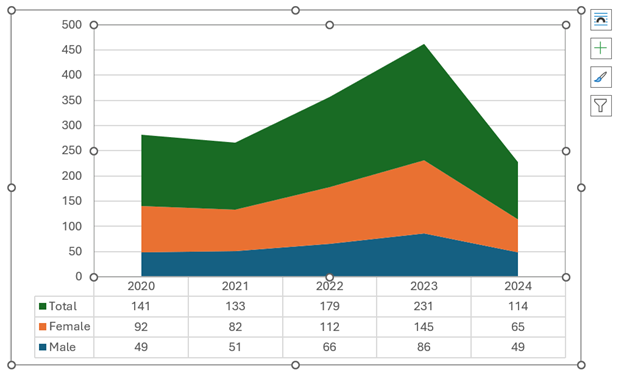
Figure 1 Suicide attempts by exogenous intoxication in the elderly in the Central-West Region of Brazil by year of occurrence and sex.
Source: Ministry of Health/SVS – Notifiable Diseases Information System – Sinan Net, 2025.
Table 1 presents the sociodemographic data of elderly individuals who attempted suicide by exogenous intoxication in the Central-West Region, considering both the total and the distribution by age group. The majority of the victims were female (62.1%), illiterate or with at most completed elementary education (29.0%), and of mixed-race (47.5%). The state of Goiás recorded the highest number of cases among the Central-West states, with 43.0% of the occurrences, followed by the Federal District with 30.3%.
|
Variables |
60-69 |
70-79 |
80 + |
Total |
||||
|
n |
% |
n |
% |
n |
% |
n |
% |
|
|
Sex |
||||||||
|
Male |
178 |
59,1 |
87 |
28,9 |
36 |
12,0 |
301 |
37,7 |
|
Female |
364 |
73,4 |
103 |
20,8 |
29 |
5,8 |
496 |
62,1 |
|
Ignored |
1 |
100 |
-- |
-- |
-- |
-- |
1 |
0,2 |
|
Education |
||||||||
|
Illiterate |
11 |
55,0 |
5 |
25,0 |
4 |
20,0 |
20 |
2,5 |
|
Incomplete elementary |
107 |
64,5 |
43 |
25,9 |
16 |
9,6 |
166 |
20,8 |
|
Complete elementary |
34 |
73,9 |
7 |
15,2 |
5 |
10,9 |
46 |
5,7 |
|
Incomplete high school |
27 |
90,0 |
3 |
10,0 |
-- |
-- |
30 |
0,4 |
|
Complete high school |
37 |
78,7 |
10 |
21,3 |
-- |
-- |
47 |
5,9 |
|
Incomplete higher education |
1 |
50,0 |
1 |
50,0 |
-- |
-- |
2 |
0,2 |
|
Complete higher education |
16 |
69,5 |
6 |
26,1 |
1 |
4,4 |
23 |
2,9 |
|
Ignored |
310 |
66,8 |
115 |
24,8 |
39 |
8,4 |
464 |
58,1 |
|
Race |
||||||||
|
White |
144 |
61,0 |
64 |
27,1 |
28 |
11,9 |
236 |
29,6 |
|
Black |
17 |
73,9 |
4 |
17,4 |
2 |
8,7 |
23 |
2,9 |
|
Yellow |
4 |
44,4 |
5 |
55,6 |
-- |
-- |
9 |
1,1 |
|
Mixed-race |
269 |
71,0 |
81 |
21,4 |
29 |
7,6 |
379 |
47,5 |
|
Indigenous |
2 |
66,6 |
1 |
33,4 |
-- |
-- |
3 |
0,4 |
|
Ignored |
107 |
72,3 |
35 |
23,6 |
6 |
4,1 |
148 |
18,5 |
|
Notification State |
||||||||
|
Federal District |
160 |
66,1 |
70 |
28,9 |
12 |
5,0 |
242 |
30,3 |
|
Goiás |
232 |
67,6 |
78 |
22,7 |
33 |
9,6 |
343 |
43,0 |
|
Mato Grosso |
37 |
68,5 |
10 |
18,5 |
7 |
13,0 |
54 |
6,8 |
|
Mato Grosso do Sul |
114 |
71,7 |
32 |
20,1 |
13 |
8,2 |
159 |
19,9 |
|
Total |
798 |
100 |
||||||
Table 1 Sociodemographic data of elderly suicide attempt victims by exogenous intoxication in the Central-West Region, Brazil, 2020-2024
Source: Ministry of Health/SVS – Notifiable Diseases Information System – Sinan Net, 2025.
The age group of 60 to 69 years predominated among the suicide attempt victims, accounting for 68.0% of the notifications. Elderly individuals aged 70 to 79 years and the group aged 80 or more were responsible for 23.8% and 8.2% of the cases, respectively.
Regarding the toxic agent used by the elderly in suicide attempts, medications were the method of choice in 63.3% of the cases across all age groups, followed by rodenticides with 13.1% (Table 2).
|
Toxic agent |
60-69 |
70-79 |
80 + |
Total |
% |
|
Medicine |
362 |
104 |
39 |
505 |
63,3 |
|
Agricultural pesticide |
16 |
6 |
3 |
25 |
3,1 |
|
Domestic pesticide |
12 |
7 |
4 |
23 |
2,9 |
|
Public health pesticide |
2 |
1 |
-- |
3 |
0,4 |
|
Rodenticide |
60 |
38 |
7 |
105 |
13,1 |
|
Veterinary product |
11 |
6 |
2 |
19 |
2,4 |
|
Home use product |
15 |
6 |
3 |
24 |
3,0 |
|
Cosmetic |
-- |
-- |
-- |
-- |
-- |
|
Chemical product |
9 |
2 |
3 |
14 |
1,7 |
|
Metal |
2 |
-- |
-- |
2 |
0,2 |
|
Drugs of abuse |
5 |
2 |
1 |
8 |
1,0 |
|
Food or drink |
1 |
-- |
-- |
1 |
0,1 |
|
Other |
12 |
2 |
1 |
15 |
1,9 |
|
Ignored |
37 |
15 |
2 |
54 |
6,7 |
|
Total |
798 |
100 |
Table 2 Toxic agents used in suicide attempts by exogenous intoxication in the elderly in the Central-West Region of Brazil, 2020-2024
Source Ministry of Health/SVS – Notifiable Diseases Information System – Sinan Net, 2025.
Regarding the characteristics of the suicide attempt cases, we present the distribution in Table 3. Acute-single exposure occurred in 60.5% of the cases. Regarding the confirmation criterion for exogenous intoxication, 70.8% were confirmed clinically, with 68.8% of the intoxications being confirmed in the final classification. Although 64.0% evolved to recovery without sequelae, it is important to note that 1.9% of the elderly individuals died from the intoxication.
|
Variables |
N |
% |
|
Type of exposure |
||
|
Acute-single |
483 |
60,5 |
|
Acute-repeated |
157 |
19,7 |
|
Acute on chronic |
3 |
0,4 |
|
Ignored |
149 |
18,7 |
|
Confirmation criteria |
||
|
Clinical-laboratory |
30 |
3,8 |
|
Clinical-epidemiological |
129 |
16,2 |
|
Clinical |
565 |
70,8 |
|
Ignored |
74 |
9,2 |
|
Final classification |
||
|
Confirmed poisoning |
549 |
68,8 |
|
Exposure only |
112 |
14,0 |
|
Adverse reaction |
10 |
1,2 |
|
Other diagnosis |
9 |
1,1 |
|
Withdrawal syndrome |
1 |
0,1 |
|
Ignored |
117 |
14,6 |
|
Evolution |
||
|
Cure without sequelae |
510 |
64,0 |
|
Cura with sequelae |
15 |
1,9 |
|
Death due to exogenous poisoning |
23 |
1,9 |
|
Death due to other causes |
9 |
1,1 |
|
Loss to follow-up |
27 |
3,4 |
|
Ignored |
214 |
26,9 |
|
TOTAL |
798 |
100 |
Table 3 Distribution of suicide attempt notifications by exogenous intoxication in the elderly in the Central-West Region of Brazil according to case data, 2020-2024.
Source Ministry of Health/SVS – Notifiable Diseases Information System – Sinan Net, 2025.
The analysis of suicide attempts among the elderly in the Central-West Region of Brazil revealed some important characteristics of the victims' profile, which can help in understanding this complex phenomenon. Suicide has occurred categorically worldwide, constituting a major public health problem, with the WHO reporting approximately 703,000 suicides annually.1 In general, suicide rates tend to increase with age,13 and suicide attempts are more successful in the population over 65 years old when compared to populations below this age group.14
Several risk factors can influence the occurrence of suicide, including socioeconomic, clinical factors, and a history of previous attempts. Among the socioeconomic factors, income, age, low education, marital status, and ethnicity stand out. Among the clinical factors, anxiety disorders, the use of psychiatric medications, and substances such as alcohol, cocaine, and opioids may be associated.15
It is believed that elderly individuals are more vulnerable to suicide due to the changes that occur in their bodies as a result of the aging process. The loss of autonomy can lead to feelings of uselessness and frustration, which, in turn, negatively impact quality of life, causing suffering and leading the elderly to consider self-extermination as an option.16,17
Suicide attempts among the elderly in the Central-West Region during the analyzed period showed fluctuation, partially diverging from the Brazilian profile. There was a decline in the number of records between 2020 and 2021, with an increase in 2022 and even more in 2023, then declining again in 2024. A survey on suicide attempt notifications in Brazil between 2011 and 2018 demonstrated a gradual increase in the number of notifications of self-inflicted violence, specifically a 497.5% increase during this period.18
The highest prevalence of suicide attempts in 2023 may be related to the emotional and psychological effects left by the Covid-19 pandemic, with the worsening of mental disorders such as depression, anxiety, and post-traumatic stress. After the most intense phase of the pandemic, older adults may have faced a worsening of their psychological conditions, still feeling unsupported or isolated.19 Another factor could involve the social and economic changes that occurred, which also reflected on the mental state of the population, as well as increased awareness of the importance of reporting, since during the health crisis, all diseases and health conditions suffered from underreporting.
Regarding sex, women constituted the majority of the victims, which supports other studies on this same topic.18,20-22 When comparing the differences between sexes, the literature indicates that women have a higher tendency toward suicide attempts, while men are more likely to succeed in completing the act.23,24
Further discussing gender differences, the higher vulnerability of women to suicide attempts may be related to the presence of psychosocial stressors, gender inequality, domestic violence, and greater exposure to sexual abuse during childhood.25 Studies indicate that women have a higher prevalence of mental disorders, such as depression and anxiety disorders, which are important risk factors for suicide attempts.26
The low educational level highlighted in this study is another factor that stands out in the genesis of suicide, as it, combined with low income, can result in unfavourable situations that harm the elderly's quality of life, influencing their decision to attempt to take their own life.24,27 These stress factors can contribute to feelings of hopelessness and helplessness, elements frequently observed in individuals who attempt suicide. The lack of a social support network, isolation, low self-esteem, and reduced social interactions are more common among individuals with lower levels of education, which can further worsen their mental condition.28
In the Central-West Region, the state of Goiás recorded the highest number of cases, followed by the Federal District. The differences found between locations within the same region suggest that an approach centered on the profile of the local community is crucial for preventing suicide among the elderly.29
Medications were the most commonly used toxic agent among the elderly who attempted suicide by exogenous intoxication in this study. This finding aligns with other studies, which identify this agent as the most used by the general population.30 Since 1994, medications have been the leading cause of human intoxication in Brazil, with benzodiazepines, cold medications, antidepressants, and anti-inflammatory drugs being the main contributors to these intoxications.31
This aspect draws attention, especially regarding access to these substances and the promotion of their rational use. Between 2009 and 2018, there were 85,811 hospitalizations due to medication poisoning, with 97% of these cases involving prescribed medications.32 Polypharmacy is a common condition in the elderly, as they have a higher prevalence of chronic diseases and, consequently, greater medication needs. A population-based study conducted with elderly individuals in Florianópolis – SC found a polypharmacy prevalence of 32%, with the following associated factors: being female, being 80 years of age or older, self-reporting negative health status, having had a medical consultation in the last three months, and hospitalization in the last six months.33
Regarding the characteristics of the cases of poisoning, the highest prevalence was for the acute-single exposure type, with a clinical confirmation criterion of exogenous poisoning and confirmation in the final classification. These characteristics were similar to those pointed out by another Brazilian study that analyzed exogenous poisonings occurring in the national territory between 2007 and 2017.30
Although most of the cases evolved to recovery without sequelae, 1.9% of the elderly in this study died from poisoning. Worldwide, in suicide cases, the elderly tend to choose more lethal methods, especially men, who use more violent alternatives such as firearms and hanging. However, women opt for gentler methods and many die from drug overdoses or poisoning.34 A failed suicide attempt is considered a risk factor for future occurrences, making it crucial for healthcare services to focus on elderly individuals who have experienced this situation, as these cases could be prevented.
Suicide prevention is a global commitment and a public health priority.35 Among the many Sustainable Development Goals (SDGs), there is a target to reduce suicide incidence by 33% by 2030;36 and the WHO has been providing support to countries to implement evidence-based approaches focused on the causality and risks of suicide.
Dealing with the topic of suicide is challenging due to its complex and multifactorial nature. Some approaches suggest dynamic interventions targeting the determinants of suicide risk, such as: stricter legislation and restrictions on access to firearms and medications; expanding access to treatment and improving the management of depression and other mental disorders; establishing multiprofessional programs focused on chronic diseases and disabilities, maximizing quality of life; proposing tools to increase connection and interaction among people, building support networks, and preventing social isolation; investing in a longitudinal care model with an emphasis on identifying risk and protective factors for suicide in older adults.37
Healthcare professionals should be aware of the differences among elderly individuals who attempt suicide by exogenous poisoning. The ease of access to medications in Brazil is another critical issue and requires stricter regulatory measures from authorities. Addressing aspects of pharmacovigilance and educating users about the risks of self-medication, discontinuation, and switching of prescribed medications are necessary components of any preventive strategy.
In the context of Primary Care, encouraging directly observed treatment, with a healthcare professional or family member supervising the administration of medication in older adults, would be another important alternative with an impact on preventing self-poisoning.
Our study revealed a significant portion of overlooked data present in the SINAN, suggesting the need for training and continuous education aimed at professionals directly involved with diseases and compulsory notification health conditions. In this way, with proper data entry, the scenario can be more aligned with reality, and preventive strategies can be better directed.
Between 2020 and 2024, there were 798 cases of suicide attempts by exogenous poisoning among the elderly population in the Central-West region of Brazil, highlighting a profile predominantly female, between 60 and 69 years old, with brown skin color and low education. The state of Goiás concentrated the largest number of notifications, and medications were the method of choice for most of the victims. The acute-single exposure, clinical confirmation criteria, and progression to recovery without sequelae were other aspects revealed.
Identifying specific profiles can help formulate more precise and effective interventions. The challenge is finding ways to address health inequalities while promoting the physical and mental well-being of the elderly population. Public policies focused on strengthening the psychosocial care network; developing awareness and prevention campaigns; expanding counseling and social support programs; integrating health and education actions in schools and universities; monitoring access to medications; fostering family and community support networks; promoting mental health in the workplace; and investing in research can contribute to the creation of an integrated suicide prevention system.
It is suggested that more studies be conducted on this topic, which will expand knowledge in the field and provide more grounds for preventive strategies.
None.
None.
The authors have no conflicts of interest.

©2025 Afonso, et al. This is an open access article distributed under the terms of the, which permits unrestricted use, distribution, and build upon your work non-commercially.