MOJ
eISSN: 2574-8130


Mini Review Volume 10 Issue 1

Regret for the inconvenience: we are taking measures to prevent fraudulent form submissions by extractors and page crawlers. Please type the correct Captcha word to see email ID.
Age.Comm, Department of School of Education IPCB, Polytechnic University of Castelo Branco, Portugal
Correspondence: Henrique Gil, Department of School of Education IPCB, Age.Comm Polytechnic University of Castelo Branco, Av. Pedro Álvares Cabral, 6000 Castelo Branco, Portugal
Received: March 11, 2025 | Published: March 18, 2025
Citation: Gil H. Digital ecosystems 5.0 for elderly people. MOJ Gerontol Ger. 2025;10(1):16‒19. DOI: 10.15406/mojgg.2025.10.00333
The rapid evolution of digital technologies has given rise to Digital Ecosystems 5.0, which integrates advanced Human-Computer Interaction (HCI), Ambient Assisted Living (AAL) solutions, and the Internet of Things (IoT). These ecosystems have the potential to transform ageing by fostering active and healthy lifestyles while ensuring safety, autonomy, and full citizenship for older adults. HCI is crucial in designing intuitive and accessible interfaces, allowing elderly users to interact seamlessly with digital systems. AAL technologies, including smart home automation, wearable sensors, and AI-driven health monitoring, create adaptive environments that enhance comfort and security. Meanwhile, IoT enables real-time data exchange between interconnected devices, facilitating personalized assistance and remote support from caregivers and healthcare professionals. By leveraging these technologies, Digital Ecosystems 5.0 contributes to independent living, empowering older adults to perform daily activities with greater ease. They also promote social inclusion by enabling digital participation and engagement in community life. Furthermore, these ecosystems address challenges related to aging, such as mobility limitations and cognitive decline, by offering proactive and context-aware interventions. This paper explores the potential of Digital Ecosystems 5.0 in redefining ageing experiences, ensuring that older individuals can lead autonomous and dignified lives. It also discusses the ethical, technological, and societal implications of integrating these innovations, highlighting the need for inclusive and human-centred design approaches. By bridging the gap between ageing and technology, Digital Ecosystems 5.0 paves the way for a future where older adults can age safely, independently, and actively, supported by intelligent and responsive environments.
Keywords: digital ecosystems 5.0; human-computer-interaction, ambient assisted living, internet of things, elderly
Emerging technologies, especially the Internet of Things (IoT), Ambient Assisted Living (AAL) and Human-Computer Interaction (HCI), within the field of Artificial Intelligence (AI), are transforming the way we interact with the digital world. This new ecosystem requires access, understanding, conscious use and appropriate contextualization, guaranteeing its dynamic balance. In this context, digital literacy and digital citizenship have become fundamental pillars. In other words, achieving a truly inclusive society depends on high levels of info-inclusion, enabling the development of a new digital homeostasis. The search for balance in ecosystems has always been a major challenge for ecologists, even more evident in the face of climate change, which radically impacts our planet. Similarly, it is essential to train specialists, educators, and carers capable of dealing with the challenges of current and future digital ecosystems, ensuring that the elderly population is included and can fully exercise their civic rights and duties. Only through this effective digital inclusion will it be possible to ensure equal opportunities and equity, promoting a fairer, more supportive, and democratic society.
It is essential to emphasize that all the concepts mentioned develop in the context of reciprocal interaction, which is inherent in any ecosystem, whether ecological or digital. In this new digital ecosystem, there is an exponential convergence between Information and Communication Technologies (ICT), real-time data processing - made possible by Big Data and the Internet of Things (IoT) - and Artificial Intelligence (AI).
This integration bridges the physical world (objects) and digital technologies, as1 point out. Furthermore, as Manoj and Thyagaraju2 point out, the IoT is one of the most promising technologies due to its versatility and accessibility and can be used ‘anywhere, at any time, by anything and anyone’ (p. 463).
Analyzing the demographic trend in the EU-27 is essential to better understanding this concern and its relevance to promoting a more appropriate ageing process within ‘digital ecosystems 5.0’.
Figure 1 illustrates the population pyramid, comparing 2019 data with the projection for 2050 in the context of the EU-27.
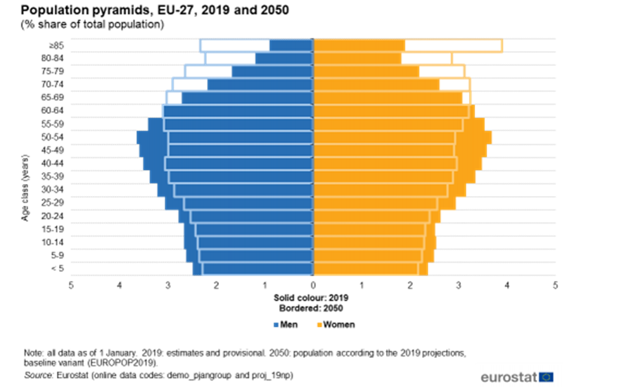
Figure 1 Age pyramid with 2019 data and projections for 2050 within the EU-27. Source: EU (2024).
As can easily be seen, the trend towards an ageing EU-27 is quite marked, with an estimated 500,000 centenarians by the year 2050.3 Figure 2 provides a clearer picture of this gradual aging process.
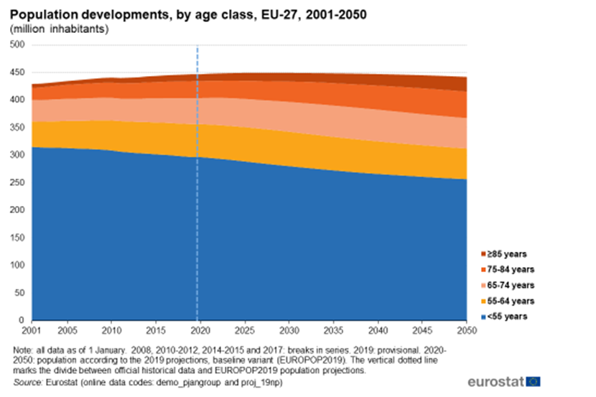
Figure 2 Evolution of the ageing process within the EU-27 by age group. Source: European Union (2024).
As is well known, health care becomes more necessary with advancing age. We therefore sought to gather information and data on the impact of ageing on health and its economic and social implications. To this end, indicators such as the dependency ratio were analyzed, comparing the reality of the EU-27 with that of Portugal, as well as the percentage of the Portuguese population that allocates resources to health - an expenditure that, as expected, is more significant among the elderly. However, in addition to this predictable data, it was found that health expenditure is even more expensive for the elderly who live alone, a group that represents a significant portion of the Portuguese population. In short, the interconnection of these factors shows that ageing has a direct impact on Portugal's GDP, increasing health spending and putting pressure on social security, which can lead to a greater risk of impoverishment and loss of quality of life. Given this scenario, adopting measures and initiatives that prioritize disease prevention and promote healthy and active ageing is essential. As Cylus and Al Tayara4 point out, creating policies that encourage the continued participation of the elderly population in society can mitigate the negative impacts of ageing on economic growth.
Assisted Living Environments (AAL) use Internet of Things (IoT) devices and resources to remotely monitor and intervene in the daily routines of the elderly. This monitoring aims to offer highly personalized solutions, promoting greater independence and, consequently, more autonomy for this population.
Cicirelli et al.5 highlight that AALs make environments intelligent by acquiring data from multiple sensors, allowing for a more detailed understanding of users' activities and behaviors. This makes it possible to implement proactive and systematic actions that generate significant improvements in quality of life. In addition,6 emphasize that this monitoring also helps to track the progress of health problems.
Guerra et al.7 reinforces this perspective by stating that ‘the main objective of AAL is to provide greater independence, autonomy and safety to individuals by integrating technological solutions into their environments’ (p. 1). As well as ensuring greater safety, Stodczyk8 points out that AAL can also favor social interaction between the elderly. This is especially relevant because, as Mudrazija et al.9 observed, social isolation in this age group is directly associated with a higher risk of health problems, making older people more vulnerable and without the necessary support.
Although there is a wide variety of sensors and digital devices, their effective implementation depends on several factors, as highlighted by Cicirelli et al.5 These include cost, the level of intrusion, the need to adapt environments (such as introducing smart furniture), security and privacy issues regarding the data collected and, possibly most crucially, the willingness of the elderly to accept the presence and installation of these devices. In this context, it is essential to strengthen human-computer interaction, ensuring that the human-centered approach is applied. Only with the active involvement of the elderly at all stages of the process will it be possible to develop solutions aligned with their real needs and expectations, with special attention to usability.1 It's important to point out that much of the research carried out takes place in laboratory environments, which limits the reproduction of the real dynamics of everyday life. What's more, the elderly, like everyone else, undergo constant changes in their expectations, abilities, mobility, health and, consequently, their goals and routines. It is, therefore, essential that sensors and devices can adapt to these changes. However, there is still a long way to go in this area, requiring effort, dedication and the collaboration of multidisciplinary teams. In this context, the participation of gerontologists will be increasingly necessary to guarantee effective solutions that meet the needs of this population.
The evolution of Assisted Living Environments (AAL) is moving towards offering personalized responses to the individual needs of each user, ensuring that both they and their carers play an active role in this process, adopting a proactive approach.10 As highlighted by Cicirelli et al.5 AAL systems cannot be conceived as static since the habits, routines, goals, and needs of users - especially the elderly - are constantly changing, influenced by the motor and cognitive losses associated with aging. In this sense, we align our perspective with the vision of the future presented by White and Miller11 “Ambient smart technology is technology that has disappeared from view, fully embedded into the material environment. (…) the system precedes the user, both pragmatically in that the system acts before it has to be told to, and epistemically, in that it can identify relevant patterns in data that might be, in some sense, opaque or unknowable to the human As pointed out by Ghorbani et al.12 the biggest challenge in implementing digital technologies for the elderly lies in their acceptance. Lack of familiarity with these technologies often leads to low tolerance, as they tend to perceive them as complex and unhelpful because they have not mastered them. Given this scenario, it is essential that gerontologists and carers are trained with the necessary knowledge and skills to overcome these barriers. However, as Ahmad et al.13 warn, this preparation is not always guaranteed: ‘On the other hand, few informal carers have adequate training and can provide care services in a professional manner’ (p. 56097)”
Ahmad et al.13 emphasize that emerging technologies are opening new possibilities and opportunities to offer safer healthcare and services to citizens in remote locations by enabling connectivity with various infrastructures related to AI and IoT systems. It is precisely this access to large amounts of data that creates the opportunity to provide higher quality support.14
Although the potential and benefits of AAL are widely recognized, it is essential to adopt a critical and reflective stance. This is because AALs are primarily aimed at the elderly population, and only those with adequate levels of digital literacy will be able to take full advantage of these benefits.
Despite the positive sentiment regarding the impact and importance of AAL, HCI, by complementing the perspective of finding solutions and proposals to promote better active and healthy aging, also acknowledges that some obstacles still exist for its full success. In these digital ecosystems, IoT must be viewed as an element that could contribute to finding even more beneficial proposals for older citizens. However, the concern remains in informing and educating experts in gerontology/geotechnology and caregivers so that they can make more informed decisions. In this context, IoT is seen as a digital environment that can transform this space into a more comprehensive and eclectic dimension, functioning as a true digital ecosystem, as noted by Deepika and Vijayakumar:15 "The Internet of Things (IoT) is a concept that includes anybody, everything, at any time, in any place, with any service, and connected to any network" (p. 573). Reinforcing this viewpoint,16 further state that "IoT is a wide-ranging technology which represents 6Cs: convergence, communication, connectivity, computing, collections, and content to allow people to connect with anyone or anything, anytime, anywhere, through any network and any services" (p. 835).
As Matayong et al.17 state, IoT can collect vast amounts of data from sensors and "things" through the internet, allowing for a better understanding of the users of these devices. This real-time knowledge enables timely and faster responses to the needs of older adults in their daily routines. In this regard, Gulati and Kaur18 believe that: "By integrating IoT technologies into daily routines, the elderly can receive timely reminders, guidance, and assistance to maintain their well-being and independence" (p. 121).
In general terms, IoT is viewed to ensure a safer lifestyle, especially for elderly individuals who live alone or in more isolated situations, as it allows for continuous monitoring of their health parameters. As Matayong et al.17 further mention, IoT can combine data on health monitoring and behavior monitoring of older adults, providing a more holistic approach to their well-being.
The relationship between AAL, HCI, and IoT has consistently been seen as a promoter of active and healthy aging, aiming to ensure higher levels of safety and better health for older adults. However, as noted by Semary et al.19 there is another dimension that could be equally or more important: the promotion of inclusion. Inclusion provides a sense of belonging, as emphasized by Lopes:20 "This highlights the importance of integrating assistive IoT technologies to enhance independence and social involvement" (p. 4). In this way, more guarantees can be made to ensure the full exercise of citizenship and equal opportunities, democratic values that all citizens should have access to and practice. According to Moucha,21 the dimension of inclusion and a sense of belonging, as mentioned earlier, substantially improves the quality of life for older adults, addressing higher-order needs. As further stated by Moucha,21 it is not only the elderly who benefit, but society as a whole, as they can continue to rely on citizens with unparalleled life experience gained throughout their entire life journey. To achieve this, from Haller et al.22 perspective, it is necessary to overcome potential challenges: "However, self-management is a significant challenge, requiring self-configuration, self-healing, self-optimization, and self-protection to ensure an inclusive experience" (p. 19). To this end, Semary et al.19 and Hosseinzadeh et al.23 propose [demand] that IoT must be adapted to the real needs of its users through flexible interfaces and resources, ensuring that usability guidelines are considered, with systems that guarantee security and address ethical concerns, are accessible, energy-efficient, and, above all, involve older adults in all phases and decision-making processes.
Considering the different opinions and respective critical reflections on the proposals and visions presented, there is a sense that we are facing many challenges and obstacles. However, there is a strong belief that the potential and advantages of the digital ecosystem, which includes and intertwines HCI, AAL, and IoT, foster synergies and a determination to continue fighting in a resilient, confident, and, above all, sustained manner to find more innovative and creative solutions. As previously mentioned, any ecosystem, regardless of its type, can only survive if diversity is present and if the maintenance of input and output flows is constant… in order to achieve the so-called dynamic balance. For this reason, teams must be multidisciplinary so that their different viewpoints translate into differentiated actions that seek common guiding principles and can adapt with great flexibility while ensuring strong mutual support and collaboration.
In a world where digital ecosystems 5.0 are redefining the way we live and interact, the digital inclusion of older adults must not be an exception but a priority. The fusion of artificial intelligence, more intuitive interfaces and platforms, and more humanized technologies is opening doors and opportunities for a society where the digital world should not exclude but bring people closer. That’s why we believe in and invest in digital ecosystems 5.0, where technology must be more than innovative; it must be humanizing. To this end, we aim to create an environment in which virtual assistants can understand and interpret the language of older adults, with adaptable platforms designed to eliminate cognitive barriers, where technology must learn from its users, not the other way around.
None.
None.
The authors have no conflicts of interest.

©2025 Gil. This is an open access article distributed under the terms of the, which permits unrestricted use, distribution, and build upon your work non-commercially.