eISSN: 2377-4304


Mini Review Volume 13 Issue 1
Gynaecologist, Statistician and Epidemiologist, Rochester House Clinic, United Kingdom
Correspondence: Joseph Loze Onwude MBBS MSc, DLSH&TM; FRCOG, Independent Gynaecologist, Statistician and Epidemiologist, The Croft, Warley Road, Brentwood CM13 3HT, United Kingdom
Received: December 30, 2021 | Published: February 11, 2022
Citation: Onwude JL. What is the association between estrogen and breast cancer? Obstet Gynecol Int J. 2022;13(1):50‒56. DOI: 10.15406/ogij.2022.13.00625
Aim: There is a historical acceptance about the causal relationship between Estrogens and Breast cancer which has either affected the incidence rate or mortality rate of breast cancer, or could have influenced the uptake or continuation of Estrogen in Hormone Replacement Therapy (HRT). Estrogens are useful either as Estrogen-only HRT (ERT) or as combined Estrogen and Progestogen HRT. There is now a need to clearly differentiate between ERT and HRT in their consequences with regard to breast cancer.
This review documents the basis of the historical causal connection and the current situation
Methodology: The literature was searched with the following key words:
Estrogen, Breast cancer, Estrogen receptors and Menopause;.
Results: The relationship between Estrogen & Breast Cancer with regard to incidence and mortality requires a rigorous scrutiny because:
The relationship between Estrogen alone for peri-menopause and menopause shows that it does not increase the risk of breast cancer or the mortality from breast cancer.
Conclusion: Estrogen alone does not increase the risk and the mortality of breast cancer. The combination of ERT with a progestogen can increase the risk of breast cancer.
It is now known that the risk profile of combined Hormone Replacement Therapy (HRT) is significantly different from that of unopposed HRT or Estrogen replacement therapy (ERT).1 Similarly, there should be no confusion that the risk profile for HRT or ERT depends on whether tablets on the one hand are used or whether transdermal or subcutaneous or intrauterine Progestogen is utilized. In brief, the risks related to thrombosis, such as venous thrombosis, pulmonary embolism or thrombotic strokes are exclusively related to oral Estrogen. The risks related to breast cancer have always been attributed to Estrogen of any method. This is no longer justified.
This article argues that Estrogen does not harm the breasts and might protect the breasts against cancer, and that the responsible factor in HRT is oral Progestogen of HRT.2 It has long been accepted that women who have no uterus and only require ERT are not at increased risk of breast cancer.
Traditional knowledge
The concept that Estrogen of HRT increases the risk of breast cancer has followed from two main events: that the breasts contain estrogen receptors and that Estrogen can aggravate Estrogen receptor positive breast cancer. This was always a weak concept because the breasts are just one of many organs that are suffused with Estrogen receptors, including the hippocampus, the eyes, the hair, the nails, the skin, fatty tissues, muscles, cartilage, bones and blood vessels, and there is no corresponding concern about Estrogen related cancer in these organs. The second reason is that some women have been diagnosed with breast cancer soon after they start HRT. However, the mortality from breast cancer is actually very low in this situation, suggesting that Estrogen might show the cancer earlier.3 It appears that HRT might promote a more rapid tumour growth, when the tumour is already present. While no woman would want to develop breast cancer, it appears that when breast cancer occurs in women using HRT, the tumour is smaller, less clinically advanced, better differentiated, has a lower rate of positive lymph nodes, and of a more favourable histological type. Indeed it is clear from studies that have looked at the relationship between HRT use and mortality from breast cancer, that the mortality is reduced.4,5
Knowledge-based change of practice
A conundrum that has been known for some time is that the incidence of breast cancer is highest in menopausal women who have none or minimal Estrogen compared to the pubertal, menstruating, pregnant and peri-menopausal woman.
Instead of the widely held belief that Estrogen of HRT caused breast cancer, we promote the alternative plausible hypothesis that Estrogen of HRT does not increase the risk of breast cancer in peri-menopausal women or in fact decreases the risk.1 If ERT is given through this period, there are two potential benefits. Firstly, we can diagnose more breast cancers which would not have been seen or felt. Secondly, we can diagnose these breast cancers earlier.
We must assume, cogently, that we cannot stop breast cancers in women, because there are theories that suggest that the predisposition might occur prenatally.6
Growth rate of breast cancer cell
The actual time it takes for breast cancer to grow from a single cancer cell to a cancerous tumor is unknown. Part of the reason is that estimates based on doubling time assume that the rate stays constant at all times as the tumor grows. If this were true, cancer with a doubling time of 200 days would take 20 years to develop into a detectable tumor. A doubling time of 100 days would take 10 years to be found on examination. In contrast, a breast tumor with a doubling time of 20 days would take only 2 years to develop. Most studies have found the average doubling time to be between 50 days and 200 days. This means it's possible that breast cancers diagnosed now began at least 5 years earlier, but again, this assumes the growth rate is constant. It is not.7
Peak age of breast cancer
In 2007, a mini-symposium of the Breast Surgical International addressed the question of whether breast cancer is the same disease in Asian and Western countries. They concluded that there was a striking difference in the peak ages for breast cancer, being between 40 and 50 years in the Asian countries whereas the peak age in the Western countries was between 60 and 70 years. Also, the incidence of breast cancer in Asia was rising and was associated with increased mortality. In the West, although the incidence was increasing, the mortality rate was definitely decreasing. The symposium hoped that a future prospective data collection from Asian and Western countries might provide further interesting epidemiological and outcome data regarding the outcome of women with breast cancer from Asian and Western countries.8
Sung et al.9 used Age-period cohorts from 1920, 1944, and 1970 birth cohorts in a prospective cohort study of Registry data for invasive female breast cancer (1988-2009) from cancer registries in China, Hong Kong, South Korea, Taiwan, Singapore, and the United States. Age-period-cohort models were used to extrapolate longitudinal age-specific incidence rates for the 1920, 1944, and 1970 birth cohorts.
In a cross-sectional age-specific analysis, Sung et al.9 found that age-specific incidence rates rose continuously until age 80 years among US white women, but plateaued or decreased after age 50years among Asian women. In contrast, longitudinal age-specific rates were proportional among all Asian countries and the United States with incidence rates rising continuously until age 80years.
Prenatal influences on breast carcinogenesis: limits on a ‘cause (estrogen) and effect (breast cancer)’ relationship
Unlike autocrine and paracrine hormone systems where their hormones act on the cells that produce it or on cells in the immediate vicinity respectively, endocrine systems are complex. When sex steroids like oestrogens which are produced in the ovaries but circulate throughout the body and exert many long-range impacts on a wide variety of tissues that express the hormones receptors that mediate their effects, they serve as virtually global signalling molecules.10 As a result, oestrogens have myriad effects not only on reproduction but also cell proliferation, cell differentiation and cell development in many tissues, as well as on metabolism, immunity and cognition.11,12
Conversely, exogenous substances, whether natural, in estrogenic flavonoids in Soy or manufactured in pesticides such as Dichlorodiphenyltrichloroethane, commonly known as DDT, plus various chemicals in plastics, plasticisers, antioxidants, and detergents can have hormonal effects because of their interactions with hormone receptors.13–18 These interactions can result in endocrine disruptions at the Estrogen receptors.14,17,18
A wide variety of synthetic substances have endocrine disrupting properties, including Xenoestrogens, which have oestrogenic effects, and are present in the combined contraceptive pill, skin care products, foods preservatives, industrial products and plastics, building products and insecticides like DDT which has been banned.14,17,18
Hormonal pharmaceuticals like HRT are thus one class of drugs that can affect the endocrine systems of humans. The biological consequences of exposure to endogenous and exogenous hormones depend on both the dose and timing and can therefore be difficult to predict.19,20 For example, in utero exposure to Estrogens causes lifelong structural and functional changes in genital tract organs and the breasts, and can lead to a 20-fold to 25-fold increase in the proportion of Estrogen receptor positive cells in the uterine epithelial lining. For women, it has been shown that the breasts are especially vulnerable to the effects of sex steroids during prenatal development and also at puberty and perimenopause.6,21,22
These influences suggest that the impact of HRT on carcinogenesis of breast cancer and uterine cancer, for example, is not straight forward and thus needs to be coupled with investigation of the impact of exposure to Xenoestrogens across the life course, starting with conception – if not before, giving possible effects on germ cells and gametes.23
Although it will be difficult to measure the exact timing and dose of HRT exposure, recording and quantifying exposure to myriad hormonally active substances in the food supply, air, water, and consumer products is even more challenging. Relevant exposures may extend back to in utero and making long term tracking complicated, only some Xenohormones persist within the body whereas others are quickly metabolised and excreted.24,25,26
In summary, this complexity of human endocrinology which is characterised by feedback and feed forward dynamics, pleiotropy, plasticity and combinatorial effects defies simple ‘cause and effect’ predictions. Therefore the ‘cause and effect’ adverse effects reported in non-randomised controlled trials have to be paraded with caution.
Time related sequence for breast cancer
Breast cancer incidence
Breast cancer incidence increases as a woman ages, with the highest incidence being in older people. About 90% of women diagnosed with breast cancer each year are ages 45 or older, and about 43% are ages 65 or above. In the United Kingdom (UK), in 2016-2018, on average, each year, around a quarter of new cases (24%) were in people aged 75 and over. Age-specific incidence rates rise steadily from age 25-29, more steeply from age 35-39 in females. The highest rates are in the 90+ age group for females (Table 1).
|
Age range |
Female cases |
Female rates |
|
0 to 14 |
0 |
0 |
|
15 to 19 |
2 |
0.1 |
|
20 to 24 |
33 |
1.6 |
|
25 to 29 |
257 |
11.5 |
|
30 to 34 |
693 |
31.2 |
|
35 to 39 |
1,418 |
65.8 |
|
40 to 44 |
2,559 |
124.6 |
|
45 to 49 |
4,974 |
214.8 |
|
50 to 54 |
6,616 |
279.8 |
|
55 to 59 |
6,052 |
285.5 |
|
60 to 64 |
6,209 |
337.9 |
|
65 to 69 |
7,443 |
412.3 |
|
70 to 74 |
5,977 |
372.7 |
|
75 to 79 |
4,762 |
403 |
|
80 to 84 |
3,987 |
430.4 |
|
85 to 89 |
2,769 |
447.7 |
|
90+ |
1,796 |
448.4 |
|
All Ages |
55,545 |
169 |
Table 1 Breast cancer incidence statistics
Average number of new cases per year and age-specific incidence rates per 100,000 female population, UK
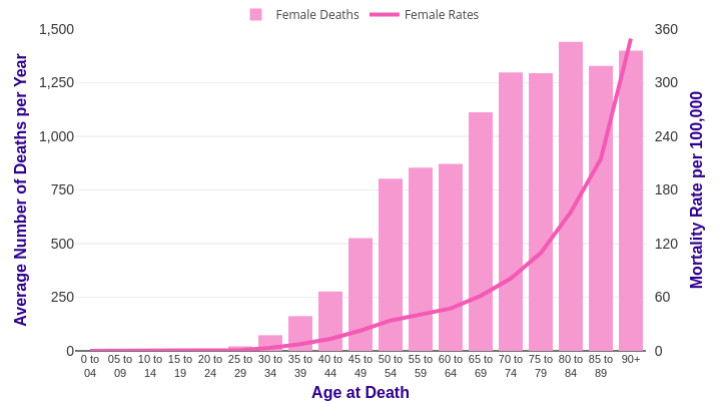
Graph 1 Breast cancer Mortality and Female Age.
Breast Cancer: Average Number of Deaths per Year and Age-Specific Mortality Rates per 100,000 Female Population, UK, 2016-2018.
The lifetime incidence of breast cancer in women in the UK is 1 in 7 (15%) for women born after 1960 [Cancer Research UK: www.breastcanceruk.org.uk]. In the United States, the lifetime chance of a woman to develop breast cancer sometime in her life is about 1 in 8 (13%) [Breastcancer.org: www.breastcancer.org].
Breast Cancer Mortality and Female Age
Breast cancer mortality is also strongly related to age, with the highest mortality rates being in older people (Graph 1). In a multivariate analysis, Derks et al.27 reported that after a median follow-up of 9.8 years (interquartile range 8.0–10.3), cumulative incidence of breast cancer mortality increased with increasing age (age <65 years, 11.7% [95% confidence interval {CI}: 10.2–13.2]; 65–74years, 12.7% (11.2–14.2) and ≥75years, 15.6% (13.1–18.0)). Ten years after diagnosis, older age at diagnosis is associated with increasing breast cancer mortality in univariate analysis, but it did not reach significance in multivariable analysis.
Breast cancer and puberty
Breast cancer is rare before puberty.28 During puberty, the connection between the ovaries and the breasts gets established. Through Estrogen and Progesterone receptors, ovarian estradiol and progesterone grow the breast. Fat in the connective tissue starts to collect. This causes the breasts to enlarge. The duct system also starts to grow. Often these breast changes happen at the same time that pubic hair and armpit hair appear. When there are no ovaries, or when the ovaries are atretic, for example, in 77% of mosaic Turners syndrome (XO/XX), the breasts do not develop. The combined pill makes breast tissue grow if there are breast buds.
Women who develop breast cancer while on the contraceptive pill
Women who develop breast cancer while on the combined contraceptive pill had a significant 24% modest increased risk while taking the combined oral contraceptives [Relative risk (RR) 1.24, 95% CI: 1.15-1.33]. However the risk gradually drops and 10 years after stopping, there is only a 1% slight and insignificant increase in relative risk of having breast cancer (RR 1.01, 95% CI: 0.96-1.05].29 In addition, the breast cancers diagnosed in women who had used combined oral contraceptives were less advanced clinically than those diagnosed in women who had never used these contraceptives. Furthermore, for ever-users compared with never-users, the relative risk for tumours that had spread beyond the breast compared with localised tumours was 0.88 (95%CI: 0.81-0.95),29 a beneficial result.
There was no pronounced variation in the results for recency of use between women with different background risks of breast cancer, including women from different countries and ethnic groups, women with different reproductive histories, and those with or without a family history of breast cancer. The studies included in this collaboration represent about 90 percent of the epidemiological information on the topic, and what is known about the other studies suggests that their omission has not materially affected the main conclusions. Other features of hormonal contraceptive use such as duration of use, age at first use, and the dose and type of hormone within the contraceptives had little additional effect on breast cancer risk, once recency of use had been taken into account.29
The progestin, a synthetic progesterone-only pill (“mini-pill”) does not seem to be associated with an increased breast cancer risk30 and is commonly prescribed to women who experienced side effects from combination oral contraceptives (OCs) or those with thrombotic risk, such as smokers or those with sickle cell disease.
Women who develop breast cancer while pregnant
Breast cancer during pregnancy is rare. It is reported in 1 in every 3,000 pregnancies. Most women are between 32 and 38years old at diagnosis. Most are able to carry on with their pregnancy. The prevalence of pregnancy-associated breast cancer may be increasing owing to delayed childbearing, and despite its low incidence, breast cancer is the second most common cancer in pregnant women.
The concurrent incidence of breast cancer and pregnancy is complicated from the view of diagnosis as breast cancer is more difficult to find, and treatment options like chemotherapy are difficult to execute during pregnancy.
The best available evidence suggests that pregnancy after breast cancer increases the risk of recurrence. The birth outcome in women with a history of breast cancer is no different from that in the normal female population; however, increased risks of delivery complications have been reported in the literature.31
Evidence based change of practice
Estrogen and breast cancer incidence and mortality: evidence of a cause and effect relationship
The best evidence for a ‘cause and effect’ relationship between Estrogen and breast cancer incidence can only logically follow successful randomized placebo trials.1 A prospective cohort study5 is the next level of evidence for this cause and effect relationship between Estrogen and breast cancer, but it has other requirements such as strength of association, biologic plausibility, biologic credibility among different studies.1 Retrospective observational studies are less useful to prove the cause and effect relationship.
Evidence from observational studies
The Collaborative Re-analysis (CR) of data from 51 epidemiological studies of 52,705 women with breast cancer and 108,411 women without breast cancer32 concluded that HRT caused breast cancer. This re-analysis of observational studies included retrospective and prospective studies. Shapiro et al.33 tested the re-analysis on the basis of standard criteria when an observational study asserts causality. The findings in the CR did not adequately satisfy the criteria of time order, bias, confounding, statistical stability and strength of association, dose/duration-response, internal consistency, external consistency or biological plausibility. Shapiro et al.33 concluded that HRT may or may not increase the risk of breast cancer, but the CR did not establish that it does.
The Million Women’s Study (MWS) was a prospective cohort of UK women aged between 50-64 years who underwent screening mammography at 3-yearly intervals.34 Among 828,923 postmenopausal women who were current users of HRT and followed for an average of 2.6 years, the study concluded that HRT caused breast cancer. This prospective study had many defects and the most cogent were that the study did not exclude breast cancers that appeared within one year, as they were most likely to have been present at baseline. Shapiro S et al.35 tested the MWS on the basis of standard criteria when an observational study asserts causality similar to their assessment of the Collaborative Re-analysis when they examined the following factors: time order, bias, confounding, statistical stability, strength of association, dose-duration response, internal and external consistency and biologic plausibility. It concluded that the causality link was unreliable because of defects in quality of design, execution, analysis and interpretation. They commented that sample size alone did not guarantee that the findings are reliable.
Evidence from randomized controlled trials (RCTs): combined estrogen and progesterone versus placebo
This Women’s Health Initiative study (WHI) reported five times.5,36–39 In the last report, Chlebowski et al.,5 assessed the long-term association between menopausal Hormone Therapy with Breast cancer incidence and mortality during long-term follow-up of the Women’s Health Initiative Randomized Clinical Trials to assess the association of prior randomized use of Estrogen plus Progestin or prior randomized use of Estrogen alone with breast cancer incidence and mortality in the Women’s Health Initiative Studies.
After 20years follow-up, women who took HRT (Conjugated Equine Estrogens (CEE) plus Medroxyprogesterone Acetate (MPA) compared with placebo among 16,608 women with a uterus was associated with statistically significant higher breast cancer incidence with 584 cases (annualized rate, 0.45%) vs 447 cases (annualized rate, 0.36%); Hazard Ratio [HR]1.28, 95%CI, 1.13-1.45; P < .001) and no significant difference in breast cancer mortality with 71 deaths (annualized mortality rate, 0.045%) vs 53 deaths (annualized mortality rate, 0.035%; HR, 1.35; 95% CI, 0.94-1.95; P= .11).5
The earlier report of the WHI group by Rossouw et al.37 focused more on women who developed breast cancer after an average of 5.2 years in the WHI randomized controlled trial.37 Shapiro et al.40 highlighted that there was a degree of contamination with 331 women in the concurrent Estrogen replacement trial who still had a uterus, who were unblinded and added to the combined Estrogen + Progesterone (E + P) group versus placebo trial. Nevertheless, for all breast cancers the Hazard ratio was 1.24 [95% CI 1.02 to 1.50] when 8507 women aged 50-79 years who received.
E + P were compared to 8102 similar women who received placebo. Shapiro et al.40 concluded that, HRT with Estrogen plus Progestogen may or may not increase the risk of breast cancer, but that WHI did not establish that it does.
However, based on the WHI randomized controlled trials only and excluding the report with contamination by 331 women with uterus who were initially assigned to Estrogen alone and re-assigned to E + P group,37 E+P versus placebo showed a causal link between E + P and incidence of breast cancer.
Evidence from randomized controlled trials: unopposed estrogen versus placebo
This Women’s Health Initiative study (WHI) also reported five times.5,41–44 Shapiro et al.45 held that the first report5 was held to be valid because apart from similar baseline characteristics, there were similar proportions of unblinding, similar discontinuation rates, and similar proportions who were prescribed ERT by their own doctors.
In the WHI trial involving 10,739 women with prior hysterectomy, 5310 were randomized to receive 0.625mg/d of CEE alone and 5429, placebo. The CEE-only trial was stopped in 2004 after 7.2years’ median intervention duration.
Breast cancer incidence and mortality associated with estrogen-only replacement therapy
The incidence of breast cancer with ERT when the WHI used the same oral Estrogen alone measured direct evidence of cause and effect. After 20years follow-up, women who took Estrogen alone (Conjugated Equine Estrogens (CEE) compared with placebo among 10,739 women with a prior hysterectomy was associated with statistically significantly lower breast cancer incidence with 238 cases (annualized rate, 0.30%) vs 296 cases (annualized rate, 0.37%; hazard ratio [HR] 0.78, 95% CI. 0.65-0.93; P = .005) and was associated with statistically significantly lower breast cancer mortality with 30 deaths (annualized mortality rate, 0.031%) vs 46 deaths (annualized mortality rate, 0.046%; HR, 0.60; 95% CI, 0.37-0.97; P = .04).5
An earlier report focused more on women who developed invasive breast cancer after an average of 7.1years in the randomized controlled trial.41 The relative risk (RR) of invasive breast cancer for women assigned to estrogen was 0.77 in an ‘intention-to-treat’ analysis (95% CI 0.59–1.01) and 0.67 (95% CI 0.47–0.97) in an ‘as treated’ analysis. After 10.7 years, the risk reduction persisted. Time order was correctly specified; detection bias was minimal; in the ‘as treated’ analysis confounding was unlikely; duration-response and internal consistency could be evaluated only to a limited extent because of scanty data. Shapiro et al.45 concluded that the evidence from the clinical trial suggests that unopposed estrogen does not increase the risk of breast cancer, and may even reduce it. The latter possibility, however, is based on statistically borderline evidence.
Based on the WHI randomized controlled trial only and not the fourth report37 which was contaminated, the WHI studies of unopposed Estrogen versus placebo show that Estrogens do not increase the risk of breast cancer.
Biologic plausibility: basic facts about estradiol in the woman
It is basic knowledge and teaching that women experience high levels of ovarian estrogens (estradiol) during reproductive age on a sequential basis, that is, for prolonged sequential period from age 13-45. Similarly, women experience high levels of estrogens (ethinyl estradiol) during their reproductive age on a sequential basis during combined contraceptive pill usage. It is uncontestable knowledge that women experience high levels of estrogens (estriol) during their reproductive age on a continuous basis for up to 9 months at a time for as many pregnancies.
The first query is whether the Estrogen of the E + P combination is the causative element of breast cancer. The second query is whether the Progestogen component of the E + P combination is the causative element. Thirdly, whether the combination, Estrogen followed by the Progestogen component together is the causative duo.
In summary, both in short term38 analysis and long term analysis,5 the WHI randomized controlled trials showed in studies that are primed to validly investigate the relationship between causation (use of estrogen alone) and effect (the incidence and death from breast cancer), that Estrogen alone versus placebo in women who have had a hysterectomy does not conclude that Estrogen-only treatment compared to placebo has a valid causation effect.
Is the additional progestogen in women who need uterine protection the causative element of HRT and breast cancer? While estrogens increase glandular tissue, it is the Progestogens that cause mitosis of breast tissue. Breast cancer can be seen as uncontrolled mitosis.
Biologic plausibility: relationship between estrogens and breast biology
The most prominent estrogen secreted by the mammalian ovary is estradiol. During the time from early puberty through the onset of menopause, estradiol levels fluctuate regularly over the course of the menstrual cycle, reaching a peak just prior to ovulation. After ovulation, estradiol, in conjunction with progesterone, alters the uterine endometrium in anticipation of implantation of a fertilized egg. During pregnancy, ovarian estradiol is replaced by placental estriol.
During puberty, estradiol promotes the growth and development of the mammary gland and surrounding breast tissue. During adolescence and adulthood, estradiol enhances normal mammary (breast) cell proliferation and also increases the rate of cell division of mammary tumor cells when they are present.46–49 Early exposure to estradiol or estradiol-mimicking hormones influences the development of the primitive fetal mammary structures in ways that may predispose the breast tissue to later development of cancer.
Like other estrogens, estradiol exerts its effects on cellular activity mainly by binding to nuclear estrogen receptors (called ERα and ERβ), leading to changes in the expression of many genes involved in cell proliferation and cell-signal transduction, and inhibition of programmed cell death (apoptosis). In addition, recent studies indicate that estradiol can exert more rapid, non-genomic effects on cellular signalling pathways by interacting with membrane-associated receptors on the cell and mitochondral membranes (Yager & Davidson).50 These multiple mechanisms and sites of action for various hormones, like estradiol, and their disruptors may help explain the complex biological consequences of exposures to these compounds.
Endocrine-disrupting compounds
Breast development is a process guided by naturally occurring hormones, minuscule amounts of which exert striking effects in breast tissue at the critical stages of prenatal development, puberty and pregnancy. These two features of naturally occurring hormones - that they exert extreme effects in small amounts and that they have the strongest effects at specific developmental stages—also characterize endocrine-disrupting compounds.
A particularly extensive literature supports the hypothesis that early developmental exposures to Endocrine-disrupting Compounds including but not limited to diethylstilbestrol, bisphenol A, phthalates, atrazine and other pesticides and herbicides, and heavy metals including cadmium can increase risk for later development of breast cancer.
The breasts are especially vulnerable to the effects of sex steroids like oestrogens during prenatal development.6 The breasts are also vulnerable to the effects of sex steroids during puberty and peri-menopause.21,22
There is no valid association between Estrogen-only HRT and breast cancer. Despite the possibilities of association by traditional knowledge, logical time sequence and observational studies, the only valid studies that have validly looked at the cause and effect relationship in the short and long-term between Estrogen-only HRT and Breast cancer have shown no relationship, and even possibly, a protection.
Manyonda et al.2 have postulated that oral Progestogen of HRT needs to be re-appraised because it might not be necessary in the protection of the endometrium against endometrial cancer because there are other modes of application, like an intrauterine device loaded with a Progestogen. There is even a suggestion that the continuous intramuscular Progestogens do not increase the risks associated with oral progestogens.
There is a paradigm with how significant results are interpreted. There are three scenarios: Firstly, when the relative risks (RR) are >1.0 with 95% Confidence intervals that do not include 1.0, it declares a significant risk in the treatment group compared to the placebo group. We then look for biologic plausibility to explain the causal relationship between treatment and disease, particularly if the quantum of the RR is large.
Secondly, when the relative risks (RR) are >1.0 with 95% Confidence intervals that include 1.0, it declares a non-significant risk or reduction in the treatment group compared to the placebo group. We say that the intervention does not cause the disease.
Thirdly, when the relative risks (RR) are <1.0 with 95% Confidence intervals that do not include 1.0, it declares a significant reduced risk in the treatment group compared to the placebo group. If this is so, why do we interpret this result as in the second category. Why do we not say that the treatment prevents the disease?
With regards to unopposed Estrogen, the WHI randomized placebo controlled study was robust in concluding that Estrogen does not increase the risk of breast cancer. The bolder message that estrogen protects against breast cancer was described as fragile because it was totally unexpected. But after that unexpected finding, did it have biologic plausibility? Yes, it does because there are many possibilities.
Breast cancer mortality statistics, Cancer Research UK
www.cancerresearchuk.org/health-professional/cancer-statistics
Breast cancer mortality statistics, Cancer Research UK
https://www.cancerresearchuk.org/health-professional/cancer-statistics/statistics-by-cancer-type/breast-cancer/mortality.
None.
None.
The authors report no conflict of interest.

©2022 Onwude. This is an open access article distributed under the terms of the, which permits unrestricted use, distribution, and build upon your work non-commercially.