Open Access Journal of
eISSN: 2575-9086


Research Article Volume 9 Issue 1
 Alexandre Azenha Alves de Rezende
Federal University of Uberlândia, Institute of Exact and Natural Sciences of Pontal, Brazil
Correspondence: Alexandre Azenha Alves de Rezende, Federal University of Uberlândia, Institute of Exact and Natural Sciences of Pontal, Brazil
Received: April 07, 2026 | Published: April 28, 2026
Citation: Brunozi JI, Rezende AAA. Evaluation of pregabalin toxicity in Drosophila melanogaster. Open Access J Sci. 2026;9(1):170-172. DOI: 10.15406/oajs.2026.09.00301
Pregabalin (PB) is an anticonvulsant widely used to treat epilepsy, neuropathic pain, fibromyalgia, and anxiety, functioning by binding to calcium channels to decrease neuronal excitability. Although it is considered safe for humans, featuring a short half-life and a lack of cytochrome P450 (CYP450) interactions, literature has reported potential hepatotoxicity, DNA interactions, and developmental toxicity in certain scenarios. Consequently, this study aimed to evaluate the toxicity of PB in Drosophila melanogaster larvae using the Somatic Mutation and Recombination Test (SMART) to clarify the potential involvement of CYP450 enzyme systems in influencing toxic and genotoxic effects. To achieve this, third-instar larvae from two distinct metabolic crosses—a standard cross (ST) and a high bioactivation cross (HB) characterized by naturally elevated CYP450 expression—were exposed to various PB concentrations ranging from 18.75 to 600 µg/mL. Following exposure (about 48h), adult survival rates were evaluated and compared to negative (distilled water) and positive (urethane) controls using the chi-square test. The findings demonstrated that PB was not toxic at the tested concentrations in either metabolic cross. However, a minor reduction in survival was observed at higher concentrations within the HB cross, which could be attributed to the elevated CYP450 expression potentially leading to the formation of harmful metabolites. In conclusion, PB exhibited no significant toxicity under the tested experimental conditions. The subsequent step for this research involves the preparation and analysis of slides to thoroughly evaluate the drug's mutagenic and recombinogenic effects.
Keywords: mutation, SMART, toxicity, anticonvulsant
Pregabalin (PB) or (3S)-3-(aminomethyl)-5-methylhexanoic acid, is an anticonvulsant used in the treatment of epilepsy, neuropathic pain conditions, fibromyalgia, and anxiety. This drug acts on the central nervous system by binding to calcium channels in peripheral nerves, reducing pain signal transmission and decreasing neuronal excitability (Figure 1).1
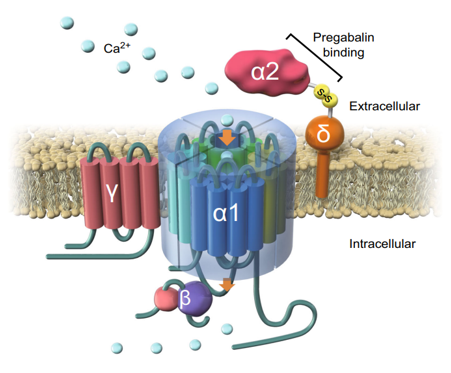
Figure 1 Structure of the voltage-gated L-type calcium channel (Source: Ninomiya et al., 20202).
PB is considered safe for humans, being rapidly absorbed and excreted within approximately 6 hours after ingestion.3 It is characterized by a short half-life, absence of active metabolites, and lack of interactions with the CYP450 enzymatic system.3 Studies indicate that PB may cause hepatic and cardiac toxicity, especially in cases of overdose, in addition to presenting potential for abuse and dependence, particularly in individuals with a history of psychoactive substance use.4
Some studies investigating the interaction of PB with DNA, using spectroscopic and computational approaches, have demonstrated that the drug interacts with CT-DNA through a groove-binding mode.5,6 On the other hand, both in vitro and in vivo studies using bacterial and mammalian cells have shown that PB does not exhibit genotoxic or clastogenic effects.7 In addition, in silico analyses have also demonstrated the absence of mutagenic effects.5
In a study conducted with mice treated with PB, an increase in liver tumors was observed, suggesting a carcinogenic effect.8 In mice, PB was neither teratogenic nor toxic at systemic exposures up to 30-fold higher than those observed in humans. However, in rabbits, PB showed evidence of developmental toxicity, including reduced fetal weight, delayed ossification, and intrauterine growth retardation.9
PB may cause lesions in the brain and liver of rats after a single toxic dose, including degenerative alterations in the central nervous system and hepatotoxicity. These effects are associated with its action on calcium channels and its interaction with DNA and may occur even in the absence of significant hepatic metabolism.10
In humans, the major CYP450 enzymes responsible for xenobiotic metabolism (CYP1A2, CYP2A6, CYP2C9, CYP2C19, CYP2D6, CYP2E1, and CYP3A4) are neither inhibited nor induced by PB. Furthermore, even at concentrations equal to or higher than those observed at therapeutic doses, PB has been shown not to induce the expression of CYP3A4 and CYP1A2 enzymes in vitro.11
There is a global effort to reduce the use of mammals in toxicological studies, highlighting Drosophila melanogaster as an alternative model. This organism allows the evaluation of toxicity, mutagenicity, and recombinogenicity of different xenobiotics.12 Its application in scientific research presents several advantages, such as a short life cycle, ease and low cost of maintenance, a simple genome, and genetic homology with higher organisms.
Among the assays performed with this species, the Somatic Mutation and Recombination Test (SMART) stands out, being considered the “gold standard” for the aforementioned purposes. This test was developed by Graf et al.12 and is based on the detection of loss of heterozygosity in marker genes that alter the phenotype of wing hairs in the fly. Thus, it is possible to visually identify somatic mutations and genetic recombination events that have occurred.12 Thus, despite this scenario, further studies are necessary, employing different methodologies to evaluate the toxic and mutagenic potential of PB.
Objectives
Our objective is to assess the toxicity of PB in D. melanogaster larvae by comparing two distinct metabolic crosses through the SMART assay, aiming to clarify the potential involvement of the cytochrome P450 (CYP450) enzyme systems in influencing genotoxic and toxic effects.
Three distinct mutant strains of *Drosophila melanogaster*—multiple wing hairs (*mwh*), flare-3 (*flr³*), and ORR; flare-3—were utilized in the study. The latter strain exhibits increased expression levels of cytochrome P450 (CYP450) enzymes, granting natural resistance to DDT. Larvae for the assessment were obtained through two types of crosses: the standard cross (ST), involving *mwh* males mating with *flr³* females, and the high bioactivation cross (HB), involving *mwh* males and ORR; *flr³* females (Figure 2).
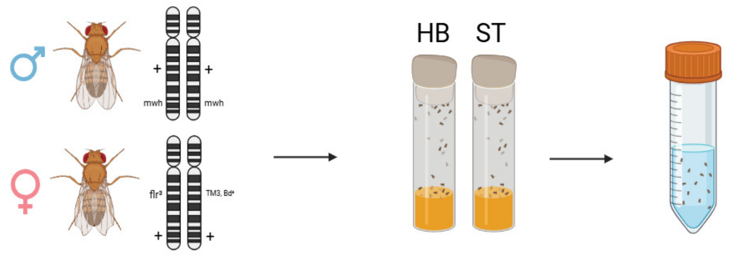
Figure 2 The diagram illustrates the D. melanogaster strains employed, along with the specific treatments administered, to assess toxicity levels as part of the conducted evaluation.
To evaluate PB toxicity, 20 third-instar13 larvae were transferred into vials containing 1.5 g of an alternative culture substrate, hydrated with 5 mL of different PB concentrations (600, 300, 150, 75, 37.5, and 18.75 μg/mL). A mixture of Tween (1%) and ethanol (3%) was used as the solvent, with distilled water representing the negative control (Figure 3). The larvae fed for the remainder of their larval life (∼48 h), pupated and hatched as adult flies. All treatments were conducted in duplicate, and adult survival rates were statistically compared to the negative control using the chi-square test (Χ²). The survival rates, average, standard deviation (SD) and standard error (SE) were calculated using Microsoft Excel.
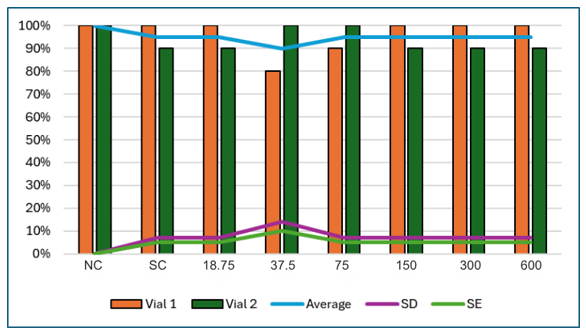
Figure 3 The colored bar graph illustrates survival rates frequencies in the ST cross upon exposure to varying concentrations of PB compared to control groups (destiled water and solvent control) in the wing Somatic Mutation and Recombination Test conducted on Drosophila melanogaster. The blue line depicts the average among surviving, and the purple line means the standard deviation and the green the standard error.
The graphs below (Figure 3, 4) represents the surviving adult count across various concentrations, drawing comparisons between metabolic crosses and prior studies,14 all of which utilized the same method of survival assessment. The results indicated that under the experimental conditions applied, PB did not exhibit toxicity at the concentrations tested, irrespective of the specific cross. However, a slight decrease in survival was observed at higher concentrations in the HB cross. This reduction (Figure 4) might be linked to the heightened CYP450 expression, a characteristic feature of the ORR strain employed in this cross. A likely explanation could be that the interaction between PB and CYP450 enzymes in D. melanogaster (Cyp6A2) potentially generates harmful metabolites, which may contribute to the observed decline in survival rates.
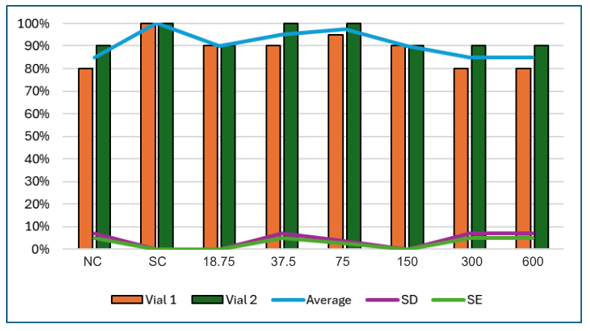
Figure 4 The colored bar graph illustrates survival rates frequencies in the HB cross upon exposure to varying concentrations of PB compared to control groups (destiled water and solvent control) in the wing Somatic Mutation and Recombination Test conducted on Drosophila melanogaster. The blue line depicts the average among surviving, and the purple line means the standard deviation and the green the standard error.
The findings revealed that, within the experimental parameters used, PB did not display toxicity at the tested concentrations, regardless of the specific cross involved. Nonetheless, a minor reduction in survival was noted at higher concentrations in the HB cross. This decline could potentially be associated with the increased expression of CYP450 enzymes, a distinct characteristic of the ORR strain utilized in this cross. One plausible explanation for this observation is that, in D. melanogaster (Cyp6A2), the interaction between PB and CYP450 enzymes may produce harmful metabolites, which might account for the decrease in survival rates.
None.
The author declares there is no conflict of interest.

©2026 Brunozi, et al. This is an open access article distributed under the terms of the, which permits unrestricted use, distribution, and build upon your work non-commercially.