MOJ
eISSN: 2573-2919


Case Report Volume 11 Issue 3

Jehovah Nogueira Júnior, Geologist and holder of a Master’s degree from the Institute of Geosciences at the University of São Paulo, Brazil
Correspondence: Jehovah Nogueira Júnior, Geologist and holder of a Master’s degree from the Institute of Geosciences at the University of São Paulo, Brazil
Received: June 30, 2026 | Published: July 24, 2026
Citation: Júnior JN. Simple measures for the environmental restoration of areas degraded by mining – case report. MOJ Eco Environ Sci. 2026;11(3):109-110. DOI: 10.15406/mojes.2026.11.00389
Keywords: environmental degradation, nature, mining, environmental restoration
Mining activities are generally in constant conflict with nature and cause environmental degradation from the initial stages of mineral exploration when vegetation is cut through to create access paths and preliminary investigations are conducted, to the actual extraction and processing of mineral resources.1 However, these activities are of fundamental importance to our social and technological development, and it is possible to coexist harmoniously with them by preserving the environment and either rehabilitating the land or compensating for the degradation caused, which is almost always inevitable.
Opening a mine creates a wound in the pristine, healthy fabric of the Earth's surface one that spreads insidiously and inexorably affecting both the physical and biotic environments. Precious resources such as soil, water, flora and fauna suffer profound impacts to varying degrees, certainly, but always with great damages of humanity, which relies directly upon them. Road construction, the removal of vegetation and topsoil, blasting, erosion, the siltation of rivers and streams, reduced water flow and the drying up of springs, air and water pollution, and impacts on the landscape are the principal negative consequences of mining activities.
For economic reasons, quarries begin operations near consumer centers to supply the construction industry with materials such as stone, crushed rock, and sand; however, as the urban area expands, they become relatively closer to residential zones, and the disturbances caused by blasting and the movement of machinery and trucks intensify. Compounding these issues are risks to the health and safety of people and property, as well as the visual impact of environmental degradation: overburden of the deposit is removed, service roads are built, and spoil heaps and material stockpiles are created, while the inhospitable rock face at the excavation front exacerbates the harshness of the landscape and instills a sense of apprehension and danger.
However, areas degraded by quarries and other mining or industrial activities can be rehabilitated and reintegrated into the landscape, even under adverse environmental conditions—such as shallow soil, high susceptibility to erosion, and extensive rock outcrops—typical of mining sites. This is the case with the environmental restoration of a hillside spanning approximately 35 hectares adjacent to a construction-aggregate quarry located at kilometer 32 of the Castello Branco Highway in Barueri, São Paulo, Brazil, which was covered by dense forest vegetation and was completely degraded by the construction of access roads, movement of machinery and equipment, and the disposal of spoil and overburden from the quarrying activities.
Restoring the hillside required surface treatments aimed at rehabilitating terrain devastated by erosion, controlling erosive processes through protection and drainage measures, and removing loose blocks, thereby enabling revegetation and perfect pairing with the local landscape.2
The treatments were determined based on the availability of materials on the hillside itself, such as rock blocks and residual soil, as well as granular materials obtainable from the quarry and easily sourced vegetation. In addition to ensuring compatibility with the hillside's environmental context, the project employed simple construction techniques requiring little to no mechanization and eliminating the need for service roads, materials disposal areas, material stockpiles, and others. The adopted treatments were also applied in areas where erosive processes were either in their early stages or where to install.
Hydraulic barriers made of granular materials and plant matter were constructed along with embankments to cover overburden piles, surface drainage systems, and small erosion-control dikes; measures such as manual or mechanized filling of erosion gullies and site restoration were also implemented, as well as the grading of soil slopes via manual excavation and the manual or mechanical removal of rock blocks. The treated areas were revegetated using grass, plant-fiber mat to erosion control blankets, native species, pines and eucalyptus.2
To gradually mitigate the siltation processes occurring at the base of the slope by controlling erosion and reducing instability risks, remediation measures began at the top, extended across the mid-slope, and finally addressed the lower hillside. By implementing restoration and drainage works starting from the headwaters of the drainage channels, it was also possible to control downstream erosion processes, thereby reducing the number and scale of the remaining interventions.
The revegetation of the hillside was based on the principles of ecological restoration; in other words, it did not simply involve planting native trees. A set of strategies was implemented to initiate the restoration of vegetation cover and pave the way for forest succession, taking into account soil permeability and fertility, wind intensity, solar exposure, terrain slope, soil moisture, and the prevalence of large rock blocks and outcrops.1,3
The following Google Earth images allow for a comparison of the hillside's condition before and after the environmental restoration was carried out.
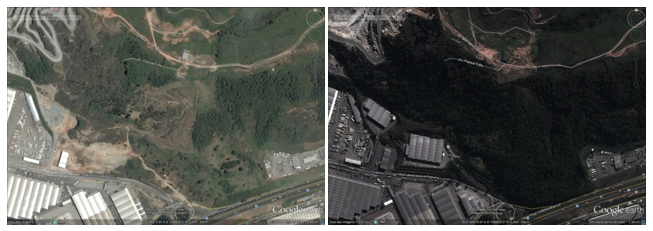
Hillside in December 2005 and July 2012 following the recovery.
Following the completion of the hillside restoration works, monitoring began to assess the efficiency and preservation of the measures implemented and to identify any emerging erosion or siltation processes, enabling the application of corrective and preventive measures. Vegetation management involved brush clearing and pruning; species selection; planting new seedlings with cuttings; ant control; and firebreak maintenance.4
Monitoring of the physical environment and vegetation management were maintained for 12 years, until a natural balance was established between the physical and biotic environments. During this period, the regeneration of local fauna was observed as a result of recreating a natural habitat where animals could live, reproduce, and contribute to seed dispersal and the maintenance of ecological balance.5,6
This experience, marked by simple, creative and innovative solutions that were monitored and evaluated over a 12-year period demonstrates that simple environmental restoration measures are applicable to various degradation scenarios involving common, recurring issues such as erosion, siltation and slope instability. It represents a contribution to the concepts and practices regarding the restoration and preservation of hillsides and the environment as a whole, and can be adopted by mining projects, industries, and other enterprises facing similar challenges.
Comercial, Agrícola e Administradora MORIANO Ltda., which funded the work, and SARP Extração de Areia Ltda., the quarry owner.
The authors declare no conflict of interest.
None.

©2026 Júnior. This is an open access article distributed under the terms of the, which permits unrestricted use, distribution, and build upon your work non-commercially.
