MOJ
eISSN: 2573-2919


Review Article Volume 11 Issue 3
 Wesley Mendes da Silva
Department of accounting finance and control, FGV EAESP - Getulio Vargas Foundation - São Paulo School of Business Administration, Brazil
Correspondence: Flavio Geraldo Nogueira, Department of accounting finance and control, FGV EAESP - Getulio Vargas Foundation - São Paulo School of Business Administration, Brazil
Received: June 25, 2026 | Published: July 7, 2026
Citation: Nogueira FG, Silva WM. Mapping the landscape of renewable energy certificate reviews: an umbrella review. MOJ Eco Environ Sci. 2026;11(3):71-80. DOI: 10.15406/mojes.2026.11.00385
This article synthesizes review-level scholarship on renewable energy certificates (RECs) and adjacent energy-attribute instruments as a preliminary stage of a broader systematic literature review (SLR) focused on I-RECs and related certificate markets. The corpus was drawn from review records identified during the screening workflow of a wider REC-centered SLR protocol, aligned with PRISMA 2020 guidelines. Following deduplication and relevance screening, twelve substantive reviews were retained for synthesis. These reviews were classified into three analytical groups: comprehensive reviews, single-topic reviews, and tracking-technology reviews.
The article addresses six research questions: (RQ1) the mechanisms employed to develop RECs; (RQ2) whether RECs contribute to investment in renewable generation and storage; (RQ3) how regulatory frameworks and policy designs shape certificate effectiveness; (RQ4) which technologies are used to prevent double counting; (RQ5) which business models and market actors generate RECs; and (RQ6) what principal gaps remain in the review literature.
The findings reveal that the review field is heterogeneous and remains conceptually fragmented. A recurring pattern is that certificate systems do not function in isolation; rather, they are typically embedded in broader policy mixes that include renewable portfolio standards, feed-in tariffs, carbon markets, green power trading, disclosure systems, and corporate accounting standards. Evidence on investment effects is suggestive but uneven and tends to be strongest when certificates are tied to scarcity, clear retirement rules, credible registries, and demand from compliance obligations or premium voluntary buyers. The literature further indicates that double-counting prevention depends less on the certificate label itself than on governance architecture—encompassing registry design, issuance controls, retirement procedures, residual-mix treatment, and, increasingly, digital traceability infrastructure. Brazil is represented in the review literature as a rapidly maturing voluntary market, particularly through the articulation between I-REC/I-TRACK architecture, REC Brazil sustainability attributes, and more recent institutional innovations such as the CCEE certification platform. Significant gaps nonetheless persist, most notably with respect to causal evidence on additionality, storage incentives, and cross-country comparability. The article concludes that this review clarifies the conceptual terrain, refines the coding logic for the forthcoming SLR, and identifies a more rigorous agenda for future research.
Keywords: renewable energy certificates, I-REC, guarantees of origin; systematic literature review, tracking systems, energy attribute certificates
Renewable energy certificates rank among the most widely used yet least conceptually settled instruments in the energy transition literature. In some jurisdictions the prevailing term is Renewable Energy Certificate (REC) or Renewable Energy Credit, particularly in North American practice (U.S. Environmental Protection Agency [EPA],1 elsewhere one encounters Tradable Green Certificates (TGCs) in quota-linked and compliance-oriented debates,2,3 Guarantees of Origin (GOs) within the European disclosure framework,4 green labels or selos verdes in Brazilian discussions,5 and the umbrella term energy attribute certificates (EACs) in corporate accounting guidance.6 At first glance, these labels appear interchangeable, since all of them seek to separate and document the environmental attributes of renewable electricity. Yet the equivalence is only partial. Each terminology is embedded in a distinct legal architecture, market boundary, and claims framework—and that distinction matters, because the value of a certificate is not merely semantic. It depends on whether the certificate is recognized for regulatory compliance, disclosure, scope 2 accounting, consumer claims, corporate procurement, or project financing.
This article examines how review studies have represented that fragmented landscape. Rather than synthesizing primary empirical studies directly, it maps the review literature itself. The purpose is both practical and theoretical. During the screening stage of a broader structured literature review on I-RECs, RECs, guarantees of origin, and related energy-attribute instruments, a subset of review articles emerged that could not simply be incorporated into the main evidence synthesis without distorting the unit of analysis. In the main SLR, the intended analytical unit is the primary study; review papers were therefore excluded from the core article-level synthesis even though they contained valuable information on terminology, policy design, and gap identification. That methodological inconvenience became an opportunity: the excluded review subset could be reassembled into the present review-of-reviews. This decision is consistent with structured review practice.
The broader SLR methodology incorporated a scoping stage and PRISMA-based screening procedures, as formally documented in the SLR research protocol (Annex I). The present article draws on that layer and treats it as a distinct object of inquiry. In other words, this review is not a digression from the main project but its conceptual front end: it tests the vocabulary of the field, refines coding dimensions, and reveals where review authors already converge or diverge before the primary-study SLR proceeds.
Three additional considerations justify the exercise. First, the REC field has become increasingly hybrid. The literature now connects certificate schemes not only to renewable portfolio standards and disclosure systems,7 but also to carbon markets and power-sector liberalization,2,8 corporate climate targets and residual-mix accounting,6 and digital registries and blockchain-enabled traceability.9,10 A review-of-reviews is useful precisely because no single primary-study sample captures all of these interactions simultaneously. Second, the policy salience of certificates has grown. Under market-based scope 2 accounting, contractual instruments such as RECs and other EACs remain central to corporate renewable electricity claims,6 even as criticism has intensified around additionality, temporal matching, residual-mix integrity, and greenwashing.11 Review papers are one of the main venues in which these conceptual disputes are organized. Third, the Brazilian case has become increasingly relevant. Brazil combines a highly renewable electricity mix,12 with a fast-growing voluntary certification ecosystem, the domestic REC Brazil sustainability label,13 and new institutional efforts to strengthen traceability and prevent double counting.9,14
The REC literature itself is heterogeneous. Some papers discuss RECs only as one instrument within a broad decarbonization toolkit that also includes carbon pricing, feed-in tariffs (FITs), auctions, renewable portfolio standards (RPSs), emissions trading, and public attitudes toward clean energy. Others focus on a single certificate market—India's REC mechanism, Taiwan's RPS design, solar carve-outs in North Carolina, or conceptual distinctions between I-REC and carbon-credit logic. A third cluster centers on digital traceability, especially distributed ledger technologies and blockchain-based registries for metering, billing, certificate issuance, and retirement. These differences are substantive enough that a flat synthesis would obscure more than it reveals. Accordingly, this article classifies the review corpus into three types: comprehensive reviews, single-topic reviews, and tracking-technology reviews.
The research questions are as follows:
Across all six questions, one theme recurs: certificates function credibly only when market design, governance, and traceability are aligned. This is why terminology cannot be decoupled from policy analysis, nor policy analysis from the examination of traceability technologies.
A REC is not merely a certificate; it is the end product of a chain that begins with metered generation, passes through a registry, and concludes with retirement and claim-making under a specific regulatory logic.
Throughout the article, the following labels are used analytically rather than interchangeably: REC denotes the broad North American category; GO the European disclosure-based instrument; TGC quota-linked compliance certificates; I-REC the internationally transferable tracking standard used in markets that lack a comparably recognised domestic system; and REC Brazil a differentiated sustainability layer applied in the Brazilian context.5,9,15 Some authors also juxtapose certificates with carbon credits; however, the two rest on different accounting logics and should not be conflated.5,6
A final introductory note concerns net metering. In many policy debates, net metering is not formally a certificate mechanism, but it interacts with certificate markets by affecting metering boundaries, ownership of attributes, prosumer incentives, and the commercial separation between physical electricity and environmental attributes. In the digital traceability literature, metering and billing architectures are frequently treated as part of the same ecosystem that supports certificate issuance and retirement.10,16 For this reason, net metering is discussed in the final section as a complementary institutional design rather than as a certificate type per se.
The remainder of this article is structured as follows. Section 2 presents the methodological approach, positioning this umbrella review as a preliminary stage of a broader systematic literature review (SLR) and detailing the selection, classification, and analytical framework of the review corpus. Section 3 develops the main results, first examining the typology of REC systems and their institutional diversity, and then analyzing traceability infrastructures and mechanisms to prevent double counting, followed by a discussion of economic and environmental implications. Section 4 addresses the research questions through an integrative discussion grounded in the review evidence, highlighting key patterns, conditional effects, and remaining gaps. Finally, Section 5 concludes by synthesizing the main findings and outlining directions for the subsequent SLR and future research.
Data availability statement: The data, methodological protocol, figures, and tables supporting this study are publicly available in the Harvard Dataverse repository at https://doi.org/10.7910/DVN/MP4DMB.
This study adopts an umbrella review design explicitly positioned as a preliminary stage of a broader systematic literature review (SLR) on renewable energy certificates (RECs) and related energy-attribute instruments. Rather than functioning as a standalone synthesis, this review operates as a preparatory analytical layer within a cumulative research design, aimed at refining conceptual boundaries, testing classification criteria, and identifying patterns in the review-level literature before proceeding to primary-study analysis.
Following Booth et al.,17 an umbrella review provides a high-level synthesis of existing reviews, enabling structured comparison of findings across studies that have already undergone some degree of evidence aggregation. In this research, logic is applied in a nested manner: the umbrella review draws on the subset of review articles identified during the screening process of the broader SLR, which is itself aligned with PRISMA 2020 guidelines.18 This approach ensures methodological consistency while preserving the distinction between review-level evidence and primary-study synthesis.
The corpus analyzed here was not obtained through an independent search for review articles but emerged from the structured screening workflow of the parent SLR. During that process, review papers were identified, screened, and subsequently excluded from the main SLR dataset because of their different units of analysis. While the SLR focuses on primary empirical studies, the review articles were retained separately and repurposed as the empirical basis for the present umbrella review. This decision is methodologically consistent with structured review practice, enabling the research to leverage existing syntheses without conflating levels of analysis.
A second-stage relevance screening was conducted to ensure alignment with the research questions. This step excluded commentaries, purely methodological contributions not centered on certificate systems, bibliometric studies lacking substantive synthesis, and papers with only indirect connections to RECs or energy-attribute markets. The resulting analytical corpus comprises twelve substantive review articles. Table 1 presents the retained reviews and their classification according to the analytical categories adopted in this study.
|
Review |
Type |
Underlying studies reported |
|
Burke & Do19 |
Comprehensive |
NR |
|
Polzin20 |
Comprehensive |
NR |
|
Qazi et al.21 |
Comprehensive |
42 |
|
Liu et al.2 |
Comprehensive |
NR |
|
Shrimali & Tirumalachetty3 |
Single-topic |
NR |
|
Gao et al.22 |
Single-topic |
NR |
|
Gaul & Carley7 |
Single-topic |
NR |
|
Li8 |
Single-topic |
NR |
|
Matos5 |
Single-topic |
15 |
|
Langer et al.11 |
Single-topic |
13 |
|
Malode & Singh23 |
Single-topic |
NR |
|
Andoni et al.16 |
Tracking-technology |
NR |
Table 1 Retained reviews and classification categories
Note: NR = not transparently reported in a way that made extraction reliable from the review text. The table is intentionally analogous to the study-count summary used by Zhao et al.10 but adapted to the more uneven reporting practices of the REC review corpus.
Four analytical dimensions were coded for each retained review. First, the geographic focus or regional orientation of each review was recorded. Second, the presence and scale of quota mechanisms were noted, distinguishing between national, subnational, large-user, or absent obligation structures. Third, the certificate nomenclature employed by each review was recorded, including references to REC, I-REC, GO, TGC, SREC, and related energy-attribute terminology. Fourth, the primary regulatory mechanisms and traceability infrastructures were identified, ranging from conventional registries to digital and blockchain-based systems. These dimensions and their respective coding results are summarized in Table 2.
|
Review |
Region |
Type |
Quota/target scale |
Certificate types |
Regulatory mechanism |
Traceability technology |
|
Burke & Do19 |
Asia |
Comprehensive |
National/regional climate and energy targets |
Green certificate schemes in a broader policy mix |
Carbon pricing, reverse auctions, RPS |
Not specified |
|
Polzin20 |
Global |
Comprehensive |
Not central |
Not REC-specific, adjacent finance context |
Public finance, subsidies, risk-sharing |
|
|
Qazi et al.21 |
Global |
Comprehensive |
Not central |
Not certificate-specific: renewable policy context |
Broad renewable-energy policy mix |
|
|
Liu et al.2 |
China |
Comprehensive |
National and provincial responsibility mechanisms |
Green power and green certificates |
Green power trading, green certificates, carbon market |
Digital platforms implied |
|
Shrimali & Tirumalachetty3 |
India |
Single-topic |
National target and state RPOs |
REC: solar REC |
REC market linked to renewable purchase obligations |
Registry/market platform |
|
Gao et al.22 |
Taiwan |
Single-topic |
Large-user obligation |
RECS in RPS compliance logic |
RPS, FIT, surcharge, self-generation options |
Administrative compliance tracking |
|
Gaul & Carley7 |
USA |
Single-topic |
State solar set-asides |
SRECS |
RPS with solar carve-out |
State tracking systems |
|
Li8 |
China |
Single-topic |
Provincial consumption quotas |
RECS |
Dispatch reform, REC trading, grid-access |
Registry/administrative tracking |
|
Matos5 |
Global/ Brazil |
Single-topic |
Varies by country |
REC, I-REC, REC Brazil, green seals |
Voluntary markets and cap-and-trade contexts |
I-REC platform/ Instituto Totum |
|
Langer et al.11 |
Global |
Single-topic |
Not central |
Voluntary RECs/EACs |
Voluntary procurement and market-based accounting |
Retirement systems and quality criteria |
|
Malode & Singh23 |
India |
Single-topic |
National climate targets and sector schemes |
REC within broader ETS transition |
PAT, REC mechanism, emerging Indian carbon market |
Registries not central |
|
Andoni et al.16 |
Global |
Tracking-technology |
Not central |
Green certificate registries, energy attributes |
DLT-enabled registry and market design |
Blockchain/distributed ledger |
Table 2 Analytical characteristics of the retained reviews
Note: Comprehensive reviews treat RECs as one instrument within a broader renewable-energy or decarbonizations policy mix. Single-topic reviews focus on one jurisdiction, one mechanism, or one sharply bounded certificate question. Tracking-technology reviews focus on metering, registry, and digital-traceability infrastructures.
The synthesis is qualitative and configurational rather than statistical. Given the heterogeneity of the review corpus and the prevalence of narrative and conceptual analyses, a meta-analytical approach would be inappropriate. The analysis therefore proceeds through thematic aggregation aligned with the research questions. Particular attention is given to three cross-cutting issues that recur across the literature:
Within this framework, the incorporation of the recent study by Yao et al. (2026) serves a strategic role. As the most up-to-date global review of REC systems, it provides a structured comparative perspective that consolidates findings from the earlier literature and enhances cross-regional consistency in the analysis. Its inclusion strengthens the robustness of this umbrella review while preserving its function as a preparatory stage for the subsequent SLR.
In summary, the methodology adopted here reflects a nested and sequential research design in which the umbrella review serves as a conceptual and analytical foundation for a more granular synthesis of primary studies. By clarifying terminology, identifying convergence and divergence across review-level evidence, and refining the coding framework, this stage contributes directly to improving the rigor and coherence of the forthcoming SLR.
Types of RECs and traceability technologies
Types of RECs
The first finding of this review is that "REC" is best understood as a family-resemblance concept rather than a single, well-defined instrument. Review papers consistently describe certificates as market devices that unbundle the environmental attributes of renewable electricity from the underlying physical power flow, yet they also show that what is being unbundled, who may claim it, and under which legal conditions vary substantially across jurisdictions.5,15
In the North American literature, REC remains the dominant label. Review studies link it to renewable portfolio standards, voluntary green power procurement, and state-level tracking systems, while institutional definitions describe the certificate as the environmental or non-power attributes associated with one megawatt-hour of renewable generation.1,7,15 Within this family, subtypes such as solar renewable energy certificates (SRECs) emerge where policymakers introduce technology-specific carve-outs to accelerate the deployment of specific sources, notably solar photovoltaics. The North Carolina case illustrates how such carve-outs can generate differentiated certificate markets with stronger price signals for specific technologies, while simultaneously introducing risks related to transparency, utility self-dealing, and thin market liquidity.7
In Europe, the dominant expression is Guarantee of Origin. Although the review corpus analyzed here is not Europe-heavy, the broader review literature and current institutional practice make the GO indispensable to any classification exercise. Yao et al.15 identify the European Union's GO system as a harmonized, disclosure-oriented framework coordinated through the Association of Issuing Bodies (n.d.), with standardized issuance, transfer, and cancellation procedures. In this respect, the European experience makes explicit what other jurisdictions sometimes leave implicit: energy-attribute instruments are credible only when their issuance and cancellation are tied to a recognized tracking architecture.15
In Asian policy discussions, particularly those centered on China and Taiwan, terminology tends to shift toward Tradable Green Certificates or simply green certificates. These instruments appear more explicitly embedded in quota or responsibility schemes. In China, reviews discuss green certificates alongside renewable power trading, carbon markets, dispatch reform, and provincial responsibility mechanisms.2,8,15 In Taiwan, certificate logic is tied to a large-user RPS design in which obligated actors may fulfil requirements through self-generation, procurement, or payment alternatives, making the certificate a compliance token within a broader policy mix rather than solely a disclosure instrument.22
I-REC occupies a distinct conceptual position. It is especially relevant in markets that lack a mature domestic attribute-tracking regime with strong international recognition. The I-TRACK Foundation standard provides a governance framework for attribute tracking, including issuance, verification, transfer, and retirement functions.9 In the Brazilian review literature, I-REC is presented as the internationally recognized backbone used to certify renewable electricity attributes in the country, while REC Brazil adds a domestic sustainability layer incorporating criteria related to additionality and broader social, environmental, and community dimensions.5,13
This last point warrants emphasis. The review literature suggests that the REC field is moving toward attribute differentiation. A certificate is no longer merely generic proof that renewable electricity was generated; in practice, buyers may demand certificates tied to specific sources (wind, solar, hydro, or biomass), specific vintages, specific geographies, or specific co-benefits such as social sustainability, local community engagement, or carbon-related claims. Brazilian institutional materials explicitly note that retirement documentation can specify the generating plant, country of origin, energy source, production period, and the presence of additional sustainability seals such as REC Brazil, thereby creating a more granular market while also imposing a more demanding governance burden.5,9,13
A second finding concerns the blurred boundary between RECs and carbon credits. Several reviews treat certificates as part of a broader low-carbon policy architecture that also includes cap-and-trade, offsets, emissions trading, or wider carbon-market reform.5,2,19,23 The Brazilian conceptual review is explicit that some countries employ certificate-like instruments in carbon-compensation settings, whereas renewable traceability certificates in the scope 2 context serve a different function.5 The GHG Protocol's Scope 2 Guidance reinforces this distinction by treating contractual instruments such as RECs and other EACs as relevant to market-based scope 2 accounting while clarifying that they are not carbon offsets.6 The review literature is not always precise on this point, and such conceptual slippage constitutes one of the field's recurrent weaknesses.
Taken together, the typology that emerges from the review corpus includes at least five analytically meaningful categories: generic voluntary RECs; compliance RECs or TGCs tied to quotas; technology-specific certificates such as SRECs; internationally standardized certificates within I-REC/I-TRACK systems; and premium or layered certificates such as REC Brazil that add source-specific or sustainability-specific attributes. This taxonomy has direct implications for the forthcoming SLR, since it suggests that "certificate effectiveness" cannot be assessed as a single undifferentiated outcome.
This broader international comparison reinforces the need to treat REC systems as institutionally embedded market architecture rather than interchangeable certificate labels. The comparative framework proposed by Yao et al.15 demonstrates that REC systems differ in legal basis, market openness, technology differentiation, issuing bodies, trading mechanisms, and price formation—differences that help explain why similar certificate units (commonly standardized as one MWh) may produce distinct investment incentives, liquidity patterns, and environmental-integrity outcomes across jurisdictions. Figure 1 illustrates the conceptual structure of REC systems in the Brazilian case.
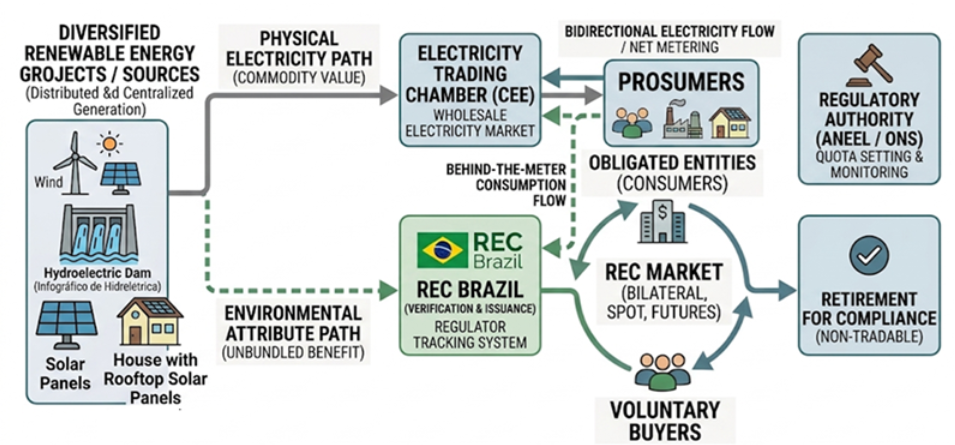
Figure 1 Conceptual mechanism of the Renewable Energy Certificate (REC) system. Source: Figure generated by the author using AI-assisted visualization based on Yao et al.15
The mechanisms for price formation and technology differentiation vary markedly across REC markets. Mature systems such as those of the European Union and Australia rely on supply-and-demand dynamics, which tend to enhance efficiency. Emerging markets such as China and India employ policy-driven pricing—including price floors and ceilings—to stabilize investments. While the EU and China adopt generic certificates (1 MWh = 1 unit), India and Australia differentiate by technology (e.g., solar versus non-solar), reflecting targeted policy objectives.15 REC Brazil adds a domestic sustainability layer to this picture.5,13 These mechanisms are synthesized in Table 3.
|
Dimension |
United States (REC) |
European Union (GO) |
China (GEC) |
India (REC) |
Australia (LGC/STC) |
|
Policy objective |
Compliance (RPS) + voluntary |
Compliance (RED) + voluntary |
Compliance (non-hydro quota) + voluntary |
Mainly compliance (RPO) |
Compliance (RET) + voluntary |
|
Legal basis |
State RPS laws; no unified federal law |
EU Renewable Energy Directive + national laws |
NEA/NDRC regulations |
CERC regulations |
Renewable Energy (Electricity) Act 2000 |
|
Certificate type |
REC; some states use SREC/WREC |
GO (Guarantee of Origin) |
Green Electricity Certificate |
REC (solar/non-solar) |
LGC (large-scale) / STC (small-scale) |
|
Unit |
1 REC = 1 MWh |
1 GO = 1 MWh |
1 certificate = 1 MWh |
1 REC = 1 MWh |
1 LGC/STC = 1 MWh |
|
Energy-type differentiation |
Some states distinguish sources |
Not distinguished, but source labelled |
Not generally distinguished |
Distinguishes solar/non-solar |
Distinguishes large/small scale |
|
Issuing body |
State registries (e.g., PJM-GATS, M-RETS) |
National AIB member registries |
National Renewable Energy Information Center |
CERC + national/regional registries |
Clean Energy Regulator |
|
Registry / retirement |
State registries; no federal registry |
AIB standard + national registries |
National green-certificate platform |
CERC REC Registry |
REC Registry |
|
Trading mechanisms |
State exchanges, OTC, SREC platforms |
EEX, Nord Pool, OTC, bilateral |
National trading platform |
Power exchanges (IEX, PXIL), OTC |
REC Registry, OTC, long-term contracts |
|
Price formation |
Market-based, with some policy pricing |
Market-based, supply-demand driven |
Policy-based + some market bidding |
Policy-based, with some premium |
LGC market-based; STC policy-based |
|
Scope of circulation |
Mostly in-state; limited interstate fungibility |
EU/AIB member states; cross-border recognition |
Nationwide; not cross-border |
Nationwide; not cross-border |
Nationwide; not cross-border |
|
Regulator |
State energy agencies; EPA (voluntary market) |
National regulators + AIB coordination |
NEA/NDRC |
CERC |
Clean Energy Regulator |
Table 3 Comparative features of major international REC systems, adapted from Yao et al. (2026)
*Significant (P≤0.05); NSNot significant (P>0.05)
The comparative features summarized in Table 3 can also be enriched considering the ongoing debate on temporal and locational refinement in scope 2 accounting. Recently, the GHG Protocol opened a public consultation on the revision of the Scope 2 Guidance, including proposals for hourly matching and deliverability to strengthen the integrity of market-based renewable electricity claims.6 Hourly matching requires electricity consumption to be matched with renewable generation in the same hour, while deliverability requires the procured electricity or attribute to be associated with a geographically relevant electricity system. This debate responds directly to concerns identified in the literature: Langer et al.11 show that annual matching through voluntary RECs may produce limited emissions reductions unless certificate purchases are linked to additional, temporally relevant, and locally meaningful renewable generation; similarly, Scholta and Blaschke24 argue that stricter temporal matching can improve the credibility of green electricity claims by reducing the mismatch between when renewable electricity is generated and when consumption actually occurs.
The REC systems compared in Table 3 are unevenly prepared for hourly matching and deliverability. The European Union’s GO system appears comparatively better positioned for deliverability because it operates through harmonized national registries and already supports cross-border recognition within a defined institutional architecture; however, full hourly matching would still require more granular issuance, transfer, and cancellation data. The United States REC system also has relatively mature registry infrastructure and strong regional market experience, although its fragmented state-based architecture may complicate national standardization of hourly and deliverability rules. Australia’s LGC/STC framework benefits from a centralized national registry and strong compliance discipline, yet its present design differentiates mainly by project scale rather than temporal or locational granularity. China’s GEC system has potential because of its national platform and policy-guided architecture, but stronger market liquidity, clearer regional deliverability rules, and more granular tracking would be needed. India’s REC system appears less prepared, as persistent challenges related to policy enforcement, regulatory uncertainty, and market liquidity weaken the institutional basis required for granular matching. Although the voluntary I-REC/REC Brazil market already operates with robust digital registries, certificate issuance, and retirement procedures, the current framework is still based on annual accounting and does not yet support temporal or locational matching.
Overall, the systems best positioned for hourly matching and deliverability are those with mature registries, credible retirement rules, high data granularity, and clear regional electricity-market boundaries. On these criteria, the EU and the United States appear more advanced; Australia occupies an intermediate position; Brazil is also intermediate but still closer to a voluntary annual-accounting model; and China and India would require more substantial institutional and data-infrastructure upgrades.
Figure 2 intends to represent the maturity of RECs globally. The figure is interpretive rather than econometric. Europe and the United States are placed at the mature end because review studies and institutional sources point to long-established tracking systems, standardized retirement practices, and close integration with disclosure or compliance architectures. Asia is coded as intermediate given the rapid policy development evident in the review corpus alongside greater jurisdictional heterogeneity. Brazil is coded as ascending rather than mature because its voluntary market has strengthened considerably through I-REC/REC Brazil and the CCEE platform, though the literature still describes the institutional architecture as consolidating.
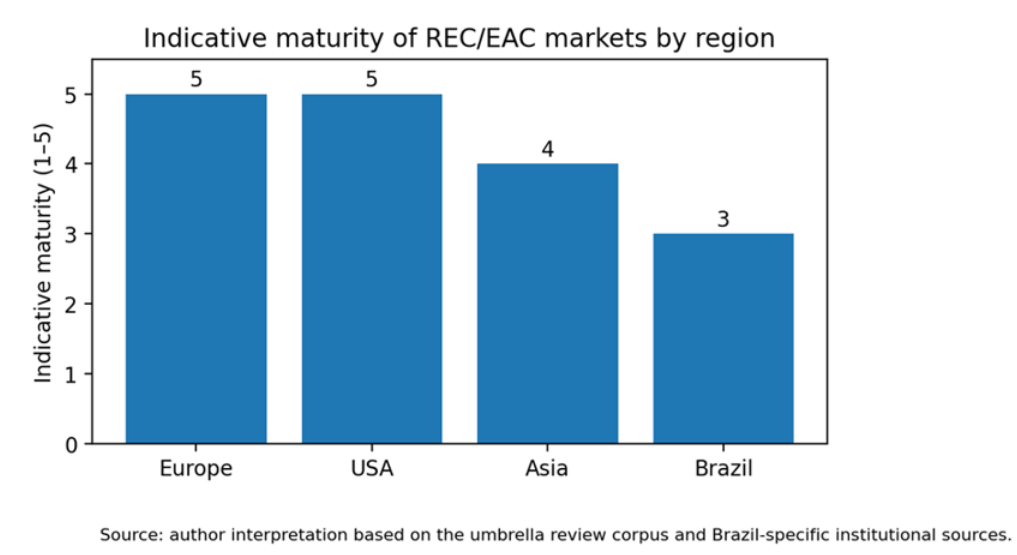
Figure 2 Indicative maturity of REC/EAC markets by region
Traceability technologies and double-counting prevention
If certificate nomenclature is diverse, the logic of traceability is even more decisive. Across the retained reviews, the prevention of double counting emerges as the most load-bearing condition for certificate credibility. Yet double counting is not a single problem but several: double issuance, double use, double claiming, and the failure to adjust residual mixes after certificate claims have been made. The literature consistently shows that avoiding these failures depends on institutional design, data governance, and, increasingly, digital infrastructure.5,9,10,25
At the most basic level, certificate systems rely on meter-based verification, registry issuance, transfer records, and retirement or cancellation procedures. A generation facility must be eligible, renewable, legally connected, and uniquely identified; the amount of electricity generated must be metered; a corresponding certificate must be issued only once; and once used for disclosure or target fulfilment, the certificate must be retired so that it cannot be claimed again. Instituto Totum's description of the Brazilian I-REC process follows precisely this sequence—from registrant eligibility to evidence submission, issuance, transfer, and retirement—and explicitly recognizes the need to recalculate the residual grid mix once certificates have been allocated to specific consumers.
Global standards documents reinforce the same logic. The I-TRACK Foundation describes its standard as a framework designed to prevent double counting, double certificate issuance, and double attribute claims, while the GHG Protocol frames high-quality contractual instruments as those meeting quality criteria for reliable market-based scope 2 accounting.6,9 These institutional rules are not peripheral; they are precisely what makes a certificate usable for credible claims. A certificate without retirement discipline is, in effect, an invitation to greenwashing.
The technology-focused reviews add a further dimension by examining whether digital ledger architectures can strengthen governance functions. Zhao et al.10 offer a particularly useful contribution by distinguishing metering and billing applications from certificate and carbon-credit trading applications. In their synthesis, blockchain-based metering and billing can reduce manual steps, improve transparency, and support tokenized settlement among generators, prosumers, consumers, metering operators, and distribution-system operators. In the adjacent certificate space, blockchain platforms are described as infrastructures for trading carbon credits and connecting renewable generation with green power demand; smart meters can feed data into the system to generate certificates as proof that electricity originated from renewable sources.
The promise is intuitive. A distributed ledger could create tamper-evident records of generation, certificate issuance, transfer, and retirement; reduce reconciliation frictions across actors; and improve auditability. Tracking-technology reviews frequently connect these functions to peer-to-peer markets, smart contracts, prosumer ecosystems, and decentralised renewable systems. In principle, net-metering environments are particularly fertile ground for such architectures, since they already require granular measurement of bidirectional flows between prosumers and the grid. Once metering becomes more granular and digital, certificate attribution can become more automated.
However, the review literature is less convincing on whether blockchain is strictly necessary. Zhao et al.10 caution that many smart-grid reviews overstate blockchain's advantages or treat all forms of distributed ledger as equivalent to tamper-proof immutability. Their analysis suggests that conventional registry design, centralized or consortium governance, and digital standardization may resolve many certificate-tracking problems without requiring fully decentralized architectures. This is a crucial insight for certificate markets.
From the perspective of this review, the traceability literature points toward a layered conclusion. The core safeguards against double counting remain governance rules: unique issuance, eligibility checks, transfer logs, retirement, and residual-mix adjustment. Digital technologies can improve these processes—especially in highly distributed and prosumer-rich systems—but they do not substitute for institutional clarity.10,25 Metering technology matters; billing architecture matters; and net metering matters, because all three define the boundaries of who generated what, when, and for whom. Without enforceable registry rules, however, technological sophistication alone cannot create credibility.
Economic and environmental benefits of RECs
Recent global evidence reinforces that REC systems function as hybrid policy instruments combining market flexibility with regulatory enforcement. Comparative analysis across jurisdictions indicates that their effectiveness depends on the interaction among quota obligations, market liquidity, governance architecture, and credible retirement procedures. In compliance-driven systems, RECs can represent a substantial share of project revenues when scarcity and enforceable obligations coexist, whereas in voluntary markets their role is more closely linked to corporate ESG strategies, renewable procurement claims, and scope 2 accounting. This distinction is central to interpreting the economic and environmental benefits of RECs, because accounting usability does not automatically imply incremental renewable investment or system-wide emissions reduction.15
The Brazilian case is particularly useful for illustrating how certification infrastructure interacts with wholesale electricity markets, obligated entities, voluntary buyers, prosumers, and retirement procedures. The analytical distinction between the physical electricity path—which follows commodity-market logic—and the environmental attribute path—which depends on verification, issuance, tracking, trading, and retirement—supports the article's broader argument that REC effectiveness depends less on the certificate label than on the quality of the surrounding governance system.
The reviews converge on the view that RECs can generate both economic and environmental benefits, but they disagree on the strength and directness of those effects. The most robust conclusion is not that certificates automatically stimulate new renewable investment, but rather that they can do so under specific conditions.2,3,11
From an economic standpoint, certificates create an additional revenue stream for renewable generators. In compliance markets, this revenue may be essential because obligated buyers must acquire certificates to satisfy quotas. In voluntary markets, certificates allow generators to monetize environmental attributes separately from energy sales, often through unbundled transactions. Instituto Totum notes explicitly that many global transactions involve unbundled RECs sold independently of the energy contract itself. For generators, this can improve project economics at the margin, enhance bankability, or create reputational benefits; for buyers, certificates can represent a lower-cost route to renewable electricity claims than direct physical procurement from a dedicated plant.3,5,7,22
The literature also shows that differentiated certificate products can alter incentives. Solar carve-outs and SRECs, for example, concentrate support on a particular technology and can accelerate market formation where generic RECs would be too diluted to shift investment. Similarly, premium products such as REC Brazil are designed to appeal to buyers who care not only about renewable generation in the abstract but also about new build, sustainability co-benefits, or social legitimacy. In this sense, the certificate market is evolving from a homogeneous commodity toward a segmented one in which product differentiation may strengthen willingness to pay.5,7,13
The environmental question is more difficult to resolve. Langer et al.11 review of studies quantifying the impact of voluntary REC purchases is especially instructive, as it moves beyond generic assertions to ask under what conditions voluntary certificate demand can actually reduce system-wide emissions. Their synthesis of thirteen studies suggests that the effect depends on market conditions, namely additionality, temporal matching, marginal grid effects, and whether the purchase actually changes investment or dispatch decisions. This is a more demanding standard than simple market-based scope 2 accounting. A firm may credibly make a procurement claim under accounting rules while still exerting only modest system-level influence on renewable expansion. The distinction is not a flaw in the certificate instrument; it is a reminder that accounting validity and consequential additionality are different analytical questions.6,11
The review corpus also indicates that policy context shapes investment effects. In India, the REC mechanism was introduced as a market-based instrument to meet ambitious renewable targets, but early performance revealed a gap between technical potential and actual certificate demand. In North Carolina, solar set-asides and SREC markets were more effective when paired with transparency and clear market rules. In Taiwan, the design challenge centered on combining large-user obligations with self-generation, procurement, and surcharge payment options. In China, certificate systems are consistently discussed alongside broader market reforms, dispatch rules, green power trading, and carbon-market coordination. These cases converge on the conclusion that RECs are rarely strong enough to transform investment incentives on their own; they are most effective as components of a coherent policy package.2,3,7,22
On storage, the evidence is thinner. Reviews discuss energy storage mainly in integrated energy system or smart-grid contexts rather than in mature certificate-market studies. This is itself a notable finding: storage remains conceptually adjacent to RECs but empirically underdeveloped in the review literature. One reason is that certificates traditionally reward renewable generation attributes rather than flexibility services. Unless certificate systems or green-power markets explicitly value storage-enabled delivery, time-matching, or balancing functions, storage may benefit only indirectly from REC demand. This gap should be treated as a priority topic for the forthcoming SLR.2,10
RQ1 asked what mechanisms are used to develop RECs. This review identifies at least four. The first is quota-based compliance, particularly RPS or renewable purchase obligation schemes in which certificates provide flexibility for obligated entities.3,7,22 The second is voluntary attribute markets responding to corporate procurement, ESG signaling, disclosure needs, and scope 2 accounting.6,11,15 The third is hybrid development, in which certificates coexist with carbon markets, green power trading, or dispatch reforms.2,8,23 The fourth is product layering, whereby a basic certificate is overlaid with source-specific or sustainability-specific attributes, as in REC Brazil.5,13 The literature thus rejects any single-origin account of RECs, pointing instead to their emergence from the interaction between market flexibility, accounting needs, and environmental differentiation.
RQ2 asked whether RECs contribute to increased investment in renewable generation and storage. The answer is qualified. Reviews suggest that RECs can support renewable investment by adding monetizable attributes to clean generation, by creating demand through compliance obligations, and by enabling premium voluntary procurement.3,11,22 However, investment effects are contingent on scarcity, credible retirement, enforceable quotas, and policy stability. Evidence for direct storage effects remains sparse: in practice, storage appears more often in smart-grid and integrated energy system reviews than in certificate-market reviews. This suggests that the investment literature has not yet fully integrated certificate design with flexibility markets and time-sensitive clean energy procurement.2,10
RQ3 asked how regulatory frameworks and policy designs influence REC effectiveness. This is where the literature is strongest. A certificate's effectiveness depends less on its label than on a set of design variables: quota stringency, banking rules, penalty levels, eligibility criteria, interaction with FITs or auctions, treatment of legacy plants, import and export rules, and the relationship between compliance and voluntary claims.3,7,15,22 Evidence from India, Taiwan, North Carolina, and China consistently reinforces this point.2,3,8,22 Weak demand obligations produce illiquid markets; overlapping instruments can either reinforce certificates or suppress their price signal; and poorly defined access or dispatch arrangements can prevent renewable generators from capturing certificate value. The Brazilian case adds a further design lesson: voluntary markets can grow rapidly when institutional trust, international standardization, and recognizable domestic labels are combined.5,14
RQ4 asked which technologies are used to prevent double counting in emissions reductions and energy claims. This review identifies three levels of response. At the foundational level, conventional registry systems, issuance controls, and retirement procedures remain indispensable. At the accounting level, residual-mix calculation and market-based scope 2 quality criteria are central to preventing over-claiming. At the emerging digital level, smart meters, automated metering and billing systems, distributed-ledger technologies, and blockchain-based certificate platforms may increase transparency and auditability.6,9,10,25 Net metering enters this discussion because it sharpens measurement of bidirectional flows and clarifies ownership questions in prosumer environments. Nonetheless, the reviews do not support technological solutionism: sound governance is a prerequisite for effective technology, not the reverse.
RQ5 asked which business models and market actors generate RECs. The answer is broader than the straightforward claim that renewable generators sell certificates. The literature identifies multiple actors: generation asset owners and registrants; traders and market participants; utilities and load-serving entities; obligated buyers under quota systems; voluntary corporate buyers; metering operators; distribution-system operators; registry administrators; standard-setting bodies; and, increasingly, digital platform providers. Business models range from bundled energy-plus-attributes contracts to unbundled REC sales, brokered secondary trades, premium sustainability labels, and platform-based retirement services.5,7,15,25 Prosumers and community energy actors appear more prominently in the technology literature, particularly where smart-grid and blockchain applications make granular metering and peer-to-peer settlement feasible.10,25
RQ6 asked what the principal literature gaps are. Three are especially prominent. First, there is a shortage of causal evidence on additionality and emissions impact, particularly outside a limited set of modelling exercises and impact-quantification studies on voluntary renewable energy certificates.11 Second, storage is underrepresented relative to its growing importance in clean power systems; when it does appear, it is typically discussed in broader smart-grid or integrated-energy-system reviews rather than in REC-focused analyses, suggesting that the certificate literature has yet to adequately incorporate flexibility, balancing, and time-sensitive clean energy procurement.2,10 Third, cross-jurisdictional comparisons remain difficult because the literature employs overlapping but inconsistent terminology for instruments that differ substantially in legal meaning, market design, and claims architecture—including REC, TGC, GO, I-REC, and related labels.3,5 A fourth gap of increasing importance concerns the interaction between certificate systems and new procurement paradigms such as temporal or hourly matching, which challenge conventional annualized market-based accounting claims and raise new questions about the relationship between contractual instruments and system-level decarbonization outcomes.6,11 A fifth gap concerns developing-country contexts, where voluntary systems may expand faster than formal compliance markets and where questions of market maturity, institutional trust, registry integrity, and traceability infrastructure are especially salient for certificate credibility and transferability.5,9
One practical synthesis emerges from these research questions: certificates are best understood as governance devices for allocating renewable attributes, not as self-executing drivers of decarbonization. They can support decarbonization, but only when embedded in credible market architecture. This is why the review literature returns repeatedly to the same building blocks: metering, registry integrity, retirement discipline, policy stringency, and claim consistency.
Taken together, these findings reinforce three cross-cutting conclusions. First, the distinction between compliance and voluntary markets is not merely classificatory; it fundamentally shapes demand stability, price formation, and the strategic use of certificates. Second, the link between RECs and investment is conditional: certificates contribute to renewable deployment only when supported by credible scarcity, enforceable obligations, and policy coherence, and not when they serve solely as accounting instruments. Third, governance remains the cornerstone of system credibility: robust registries, clear issuance and retirement rules, and reliable traceability mechanisms are indispensable for preventing double issuance, double counting, and double claims. Ultimately, the effectiveness of REC systems depends less on their labels or technologies and more on the integrity of the institutional architecture in which they are embedded.26–28
This article set out to map the landscape of renewable energy certificate reviews through a review-of-reviews explicitly positioned as a preliminary step toward a broader SLR of I-RECs and related instruments. Those positioning matters. The contribution of this paper is not to replace primary-study synthesis, but to clarify the conceptual and methodological terrain before that next step is taken.
Five broad conclusions follow. First, the review literature is conceptually fragmented but not chaotic. A workable taxonomy can be constructed by distinguishing comprehensive reviews, single-topic reviews, and tracking-technology reviews, and by treating REC, GO, TGC, I-REC, SREC, and premium labels such as REC Brazil as distinct but related instruments within a wider family of energy-attribute certificates. Second, certificate effectiveness is inseparable from policy design: quotas, compliance obligations, voluntary demand, product differentiation, and interaction with other instruments shape market outcomes more decisively than the certificate label alone. Third, the strongest recurring theme in the literature is traceability: registry design, retirement, residual-mix treatment, and anti-double-counting safeguards constitute the real foundations of credibility. Fourth, the evidence on investment effects is promising but conditional: certificates can add revenue, support claims, and reinforce renewable procurement, but their causal contribution to new build—and especially to storage deployment—remains underdeveloped in the literature. Fifth, Brazil is emerging as a strategically important case by virtue of its large renewable electricity base, internationally recognized I-REC infrastructure, a domestic premium sustainability label in REC Brazil, and recent institutional innovations aimed at strengthening traceability and preventing double counting.
The article also offers practical guidance for the forthcoming SLR. It identifies coding dimensions that should be retained at the primary-study level: certificate type, quota structure, market regime, traceability architecture, actor configuration, and evidence strength with respect to investment and emissions effects. It also flags where caution is warranted, particularly in separating scope 2 accounting validity from consequential additionality and in distinguishing energy-attribute certificates from carbon offsets.
The literature gaps are sufficiently clear to guide future work. The next stage should prioritize primary studies that examine whether and under what conditions certificate purchases lead to incremental renewable capacity, lower emissions, or stronger storage deployment. It should also test how institutional innovations—improved registries, smart metering, digital tracking, and source-differentiated labels—modify market behavior. In this sense, the present review is not an endpoint; it is the map drawn before entering the terrain.
A unique further contribution of this article is to extend the REC debate beyond conventional typological comparison by assessing the readiness of different certificate systems to respond to emerging temporal and locational requirements in scope 2 accounting. By comparing different certificates frameworks this article shows that certificate systems differ not only in terminology or legal basis, but also in their capacity to support future requirements for hourly matching and deliverability under the evolving GHG Protocol framework. This readiness depends on registry maturity, retirement discipline, data granularity, regional electricity-market boundaries, and the institutional capacity to link renewable generation attributes to consumption in time and space.
In addition, the article identifies a set of analytical dimensions—certificate type, quota structure, market regime, traceability architecture, and actor configuration—that can be operationalized in the subsequent SLR as coding variables for quantitative analysis to access RECs contribution to increased investment in renewable energy generation and energy storage technologies.
None.
None.
The authors declare no competing interests.

©2026 Nogueira, et al. This is an open access article distributed under the terms of the, which permits unrestricted use, distribution, and build upon your work non-commercially.
