MOJ
eISSN: 2573-2919


Review Article Volume 10 Issue 4

Public Administration, Getúlio Vargas Foundation, Brazil
Correspondence: Master Erivaldo Pereira de Paula, Public Administration, Getúlio Vargas Foundation, Brazil, Tel 55(21)98783-4308
Received: June 28, 2025 | Published: July 9, 2025
Citation: Paula MEP. Digital transformation in the municipality of rio de janeiro applications of new public management and digital governance. MOJ Eco Environ Sci. 2025;10(4):129-133. DOI: 10.15406/mojes.2025.10.00356
The article “Digital Transformation in the Municipality of Rio de Janeiro” analyzes the evolution of public administration in Brazil, from the patrimonialist model to the digital model, highlighting the incorporation of New Public Management (NGP) and Digital Governance. The study presents as a practical example the 1746 application, from the City of Rio de Janeiro, created to centralize and facilitate the population's access to public services. The text demonstrates that 1746 represents a concrete application of the NGP principles, focus on the citizen, efficiency and performance evaluation, combined with the transparency and participation provided by digital technologies. The case study highlights positive impacts such as agility in service, increased transparency and digital inclusion. The conclusion reinforces that digital transformation is essential for a more efficient, accessible State that is connected to the demands of society, promoting greater institutional trust and active citizenship.
Keywords: public management, digital governance, digital transformation, citizenship, 1746 application
NPM, new public management; DASP, administrative department of public service; ICTs, communication technologies; Sos, social organizations; EGD, digital governance strategy
Public administration has undergone significant transformations in recent decades, driven both by advances in information technology and by changes in social expectations regarding the role of the State. In this scenario, the integration of New Public Management (NPM) principles and Digital Governance instruments emerges as a promising strategy for the modernization of public management, especially at the local level, where interactions between government and population are more frequent and immediate.
New Public Management, influenced by private sector practices, proposes a results-oriented public administration, focusing on citizens as customers of public services, in addition to valuing practices such as performance evaluation, decentralization and efficiency in resource allocation.1
In turn, Digital Governance expands on these ideas by incorporating the intensive use of digital technologies with the aim of promoting social participation, transparency and strengthening citizens' trust in democratic institutions.2 The convergence of these two paradigms offers a viable path to meet the demands of contemporary society, articulating efficient management with openness and active listening to the population.
The municipal environment, due to its proximity to citizens and the diversity of demands of everyday urban life, is a fertile field for the application of these approaches. City governments face daily challenges related to urban mobility, security, public cleaning, infrastructure maintenance, among others. At the same time, they are the ones that most directly suffer the pressure from the population for rapid responses and quality services. In this context, digital technologies can act as fundamental allies by facilitating direct contact with citizens, allowing real-time monitoring of services, and expanding channels for participation and social control.
This study addresses a case of innovation in Brazilian municipal public management: the 1746 App. According to the City of Rio de Janeiro,3 the service was created in 2011, initially as a centralized telephone channel for citizen service, and has been modernized over the years. Currently, the system has a digital interface that allows the registration and monitoring of requests for public services via smartphones, in addition to providing useful data and information to the population.
Central 1746 offers more than 1,500 types of services and information, organized into categories such as accessibility, animals, social assistance, conservation, culture, civil defense, outstanding debt, property tax, urban cleaning, among others.4 In this way, it constitutes a practical example of the integrated application of the principles of New Public Management and Digital Governance, with concrete results in urban management.
The relevance of the topic intensified with the COVID-19 pandemic, which accelerated the digitalization of public services and highlighted both the gaps and opportunities for more modern management. Discussing digital transformation in the public sector is, therefore, essential to thinking about a more effective, inclusive State that is connected to the demands of contemporary society.
Brazilian public administration has undergone several transformations throughout its history, influenced by different political, social and economic contexts. From the colonial period to the present day, the way in which the Brazilian State is organized and provides services to the population has been shaped by the interests, ideologies and specific needs of each era.
During the colonial period, the administration was extremely centralized and focused on the interests of the Portuguese metropolis. The administrative structures were precarious and directed almost exclusively at tax collection and social control.5 With independence in 1822 and, later, with the Proclamation of the Republic in 1889, new attempts to reorganize the public machine emerged, although they were still marked by practices such as clientelism, patrimonialism and an inefficient bureaucracy.
From 1930 onwards, Brazil began to make significant changes in the organization and administration of the State. With the rise of Getúlio Vargas to power, there was a break with the previous model, dominated by rural oligarchies, in favor of the construction of a more centralized and planned State. Recognizing the need to promote development and to keep up with economic and social transformations, the government sought to strengthen public administration. In this context, agencies such as the Ministry of Labor and the Administrative Department of Public Service (DASP) were created to organize competitions, train civil servants and standardize processes. This new model aimed at greater efficiency, professionalism and a more active presence of the State in the economy and in daily life, especially in rapidly growing urban areas.6
Between 1964 and 1985, during the military regime, public administration became even more centralized. A fundamental milestone of this period was Decree-Law No. 200 of 1967, which restructured the federal administration by clearly distinguishing between ministries (direct administration) and entities such as autonomous agencies, public companies and foundations (indirect administration). The proposal was to make the State more agile, with rules that would allow for better planning, coordination and control of public services.6
The redemocratization process, consolidated with the enactment of the 1988 Federal Constitution, represented an important turning point in the search for a more efficient, transparent and rights-oriented public administration. In this new scenario, management models inspired by international experiences began to gain ground, notably the so-called New Public Management (NPM), which proposes a management approach focused on results, quality and efficiency.1
With the advancement of information and communication technologies (ICTs), especially since the 2000s, the concept of digital governance has come to occupy a central position in discussions about the modernization of the public sector. Digital governance aims to promote a more open, collaborative and innovative government, using digital resources to increase transparency, social participation and the effectiveness of public policies.7
Understanding this historical trajectory is essential to contextualize the emergence and implementation of New Public Management and Digital Governance in Brazil. These models do not emerge in isolation, but as responses to social demands for a more efficient, democratic State adapted to the transformations of the 21st century.
Patrimonial model
The patrimonialist model of public administration is well described by the German sociologist Max Weber,8 one of the leading scholars of the organization of power and forms of government. According to the author, patrimonialism is characteristic of traditional societies, in which there is confusion between the State and the ruler. In this type of system, the government does not act as an impersonal entity focused on the common good, but rather as an extension of the leader's household or assets.
Weber8 explains that, in this model, power tends to be concentrated in the hands of charismatic or hereditary figures, that is, individuals who govern by birthright or because they have great personal influence over others. In such contexts, there are no impersonal rules that are valid for everyone, nor are there stable institutions that ensure the proper functioning of public administration.
This institutional arrangement creates a series of problems. First, it compromises the fairness and professionalization of the public service, since there are no technical or meritocratic criteria for appointing people to public office. Consequently, unprepared people end up making important decisions, which can result in inefficiency, waste of resources and neglect of essential services, such as health, education and infrastructure.
In addition, the absence of impersonal norms, that is, rules that treat all citizens equally, weakens the population's trust in state institutions. When society perceives that the government favors certain groups to the detriment of others, feelings of injustice and distance arise between the common citizen and the power structures.
Governments based on patrimonialism do not encourage transparency or the responsible use of public resources, making it difficult to strengthen solid and reliable institutions. The result is a system focused on preserving the privileges of the ruling elites, instead of meeting the needs of the majority of the population.
In Brazil, the patrimonialist model predominated from the colonial period until the first decades of the Republic. Public administration was characterized by the fusion of public and private interests, in which state resources were used as personal assets by the authorities. There was no clear separation between the assets of the state and the assets of the ruler.
According to Faoro,5 Brazilian patrimonialism has deep roots in the political system established by the Portuguese, who transplanted a centralized and authoritarian structure to Brazil. The state was conceived as the property of the king, and its representatives — such as governors, captains-major and other officials — exercised local power in a personalistic, authoritarian manner and often without being accountable to the population.
Public positions were filled through political appointments, favors and family relationships, rather than criteria based on competence or merit. As a result, the civil service became a space for privileges and maintenance of power, rather than service to society.
Bureaucratic model
With the transition to the Republic and, especially, from the 1930s onwards, Brazil began a process of administrative modernization based on the principles of the bureaucratic model. This model, as described by Weber (2000), is characterized by:
The culmination of this logic was the creation of the Public Service Administrative Department (DASP) in 1938, during the government of Getúlio Vargas, with the aim of professionalizing the civil service. The proposal aimed to build a rational, predictable and impersonal State, as opposed to the clientelism and favoritism characteristic of patrimonialism.6
Over time, however, the bureaucratic model became the target of criticism due to its rigidity, slowness and difficulty in responding quickly to the demands of contemporary society. This limitation opened the way for new approaches to public management guided by the search for efficiency and a focus on the citizen.
Management model
In the 1990s, in line with international administrative reform movements, Brazil began a new phase: the management reform of the State, inspired by the foundations of New Public Management (NPM). This transformation was formalized with the Master Plan for the Reform of the State Apparatus, led by the then Minister of Federal Administration and State Reform, Luiz Carlos Bresser-Pereira.1
The proposal breaks with the logic of excessive control of processes and adopts a results-oriented approach. The main principles of NPM include:
The management reform aimed to make the State more efficient, without giving up its social function. This transition represents an important milestone in the trajectory of Brazilian public administration, by proposing a strategic State, responsible for formulating public policies, as well as coordinating, regulating and monitoring their implementation.1
New Public Management, consolidated globally in the 1980s and 1990s, emerged in response to dissatisfaction with the rigidity and inefficiency of the traditional bureaucratic model. Inspired by management practices in the private sector, NGP proposes a State focused on results, quality of service and efficiency in the provision of services.
NGP originated in countries such as the United Kingdom, New Zealand, Australia and the United States, and was promoted by liberal governments. Its objective was to reduce the size and cost of the State, increase its efficiency and improve the perception of citizens, who were considered “clients” of public services.
In Brazil, NGP was implemented institutionally through the Master Plan for the Reform of the State Apparatus. This plan established four forms of state action1:
Based on this model, practices emerged such as:
Digital model
Digital Governance represents a contemporary model of public administration, based on the strategic use of information and communication technologies (ICTs) to improve the provision of services, increase citizen participation and promote greater transparency and efficiency in public management.
Unlike the simple digitization of documents or the creation of government websites, the digital model implies a change in the way the State is organized, makes decisions, provides services and interacts with society.
With the aim of institutionalizing this model, the federal government developed the Digital Governance Strategy (EGD), which established guidelines, objectives and goals aimed at the digital transformation of public administration.7
The following stand out among the principles of the EGD:
One of the pillars of Digital Governance is the recognition that the transformation of the State should not be conducted exclusively in a verticalized manner. The citizen must assume an active role in the modernization process. To this end, the EGD provides mechanisms for listening, collaboration and social participation, such as the Participa.br portal, collaborative workshops and public consultations of strategic documents.9
The integration between the principles of New Public Management (NGP) and Digital Governance has proven to be especially promising at the municipal level, where demands for agility, transparency, and proximity to citizens are more intense. This case study will analyze the experience of Central 1746, developed by the City of Rio de Janeiro.
In recent years, the use of digital technologies has expanded considerably in the public sector, creating opportunities for more efficient, transparent, and citizen-centered management. In this context, the City of Rio de Janeiro implemented Central 1746, a digital government initiative aimed at facilitating the population's access to public services and fostering citizen participation. The objective of this section is to analyze the experience of Central 1746 based on the Citizen's Handbook.10
What is 1746?
Created in 2011, the 1746 Call Center operates 24 hours a day, seven days a week, and provides more than 1,500 types of municipal services.10 Access to the Call Center is multichannel, available by telephone, smartphone app, online portal, WhatsApp, Facebook Messenger and in-person service.
According to the City of Rio de Janeiro,10 the 1746 app allows citizens to:
1746 is an instrument for active citizen participation, allowing requests and complaints to be sent, as well as monitoring protocols in real time. This enables the exercise of social control and strengthens public governance.
How does it work?
The app integrates more than 15 municipal agencies, allowing for quick screening and automatic forwarding of requests. It also has features such as geolocation, photo uploading and sending push notifications, making the process simple and accessible.
Example of a usage flow:
This operational logic reinforces the principles of NGP (such as citizen focus and performance evaluation) and Digital Governance (interactivity, real-time data and transparency).
According to the City of Rio de Janeiro,10 channel 1746 receives an average of 10,000 records per day. Since its creation, more than 30 million interactions have been carried out, with resolution rates above 80% in several services (Figure 1).
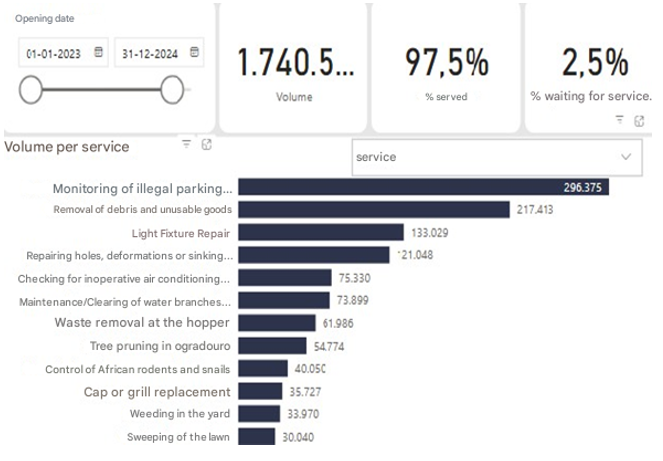
Figure 1 Results and impacts 1746.
Between 2023 and 2024, there were more than 1.7 million records, highlighting the scale and reach of the system. The main results observed include:
Central 1746 also promotes digital inclusion by offering multiple service channels, serving different population profiles.
The experience of 1746 demonstrates that digital transformation in municipal public management can be a viable path to address urban, social and administrative challenges, especially when based on the principles of NGP and Digital Governance.11
The adoption of digital technologies, combined with an organizational culture based on data, efficiency, and transparency, has the potential to profoundly transform the way the State acts in the lives of citizens. When used strategically and in an accessible manner, these tools bring government closer to society, making public administration more agile in solving problems and more open to listening to society.
The 1746 app, developed by the City of Rio de Janeiro, represents a concrete example of this transformation. The digital platform acts as a direct link between citizens and municipal public services, enabling requests — such as repairing potholes in public roads, changing light bulbs, or reporting accumulated trash — without the need to physically travel or face lines and bureaucracy.
The name of the application refers to the city hall's call center, but its digital interface expands the possibilities for interaction, offering practicality, real-time monitoring of demands and evaluation of the service provided.
The experience of Call Center 1746 shows that it is possible to innovate in public administration, even in complex contexts. The success of the tool lies in its simplicity of use, active listening to the population and transparency of processes. More than a service channel, 1746 strengthens the feeling of belonging and co-responsibility in building a better city.
It is therefore concluded that digital transformation in the public sector goes beyond the technological aspect. It is a cultural and structural change in the way the State is organized and relates to society. When combined with a citizen-centered approach, digital technologies can give rise to a new model of public administration: more agile, accessible and sensitive to the real needs of the population.
None.
None.
The author declares that there is no conflict of interests.
©2025 Paula. This is an open access article distributed under the terms of the, which permits unrestricted use, distribution, and build upon your work non-commercially.
