MOJ
eISSN: 2576-4519


Mini Review Volume 9 Issue 1
 Romero-Ángeles B, Martínez-Reyes J, Trejo-Enríquez A, Gallegos-Funes FJ, Rojas-Castrejon YY, Patiño-Ortiz J, Yparrea-Arreola RI, Rocha-Martínez MN
Instituto Politécnico Nacional, México
Correspondence: Guillermo Urriolagoitia Sosa, Instituto Politécnico Nacional, Escuela Superior de Ingeniería Mecánica y Eléctrica, Sección de Estudios de Posgrado e Investigación, Zacatenco, C.P. 07320, México
Received: September 08, 2025 | Published: September 23, 2025
Citation: Rodríguez-Granados EJ, Urriolagoitia-Sosa G, Romero-Ángeles B, et al. Finite element simulation of plantar loads in the initial heel-strike phase of human gait. MOJ App Bio Biomech. 2025;9(1):94-95. DOI: 10.15406/mojabb.2025.09.00231
The human gait cycle is a complex sequence of movements that generate varying loads on the foot structure. This paper presents a finite element analysis (FEA) of plantar loads during the heel-strike phase, which represents the first contact of the foot with the ground. Using a 3D bone model of the foot developed in previous work, numerical simulations were performed in ANSYS Workbench to evaluate displacements, strains, and stresses generated in this phase. Results indicate that heel strike produces localized maximum stresses of up to 1.49 MPa (Von Mises) and total displacements on the order of 0.0036 mm, which demonstrates the sensitivity of the foot to load transfer in early stance. The findings contribute to understanding biomechanical behavior under realistic conditions and provide a methodological basis for future gait analysis studies.
Keywords: biomodel, gait cycle, plantar loads, finite element method
Gait analysis provides valuable information about the musculoskeletal system under dynamic conditions and is widely applied in both clinical and sports contexts. One of the most critical instants is heel strike, when the heel first contacts the ground and body weight is abruptly transferred to a single limb. At this moment, plantar loads determine the mechanical response of the foot, influencing displacement, stress distribution, joint stability, and the potential risk of overuse injuries.
The finite element method (FEM) has become a powerful alternative for evaluating these conditions, allowing controlled simulations of biomechanical loads without invasive procedures. By combining anatomical models with physiological loading conditions, FEM makes it possible to reproduce the mechanical response of the foot during specific gait phases. This study focuses on the heel-strike phase to illustrate the usefulness of FEM in describing plantar mechanics and to provide a methodological basis for future gait analysis applications.
A 3D model of the human foot bones was previously reconstructed from medical imaging data and prepared for finite element analysis in ANSYS Workbench. The model included cortical and trabecular bone regions segmented from CT datasets, smoothed and meshed with tetrahedral elements to ensure adequate convergence and stability of the solution. Mesh quality was verified through element aspect ratio and orthogonality criteria to minimize numerical error.
Boundary conditions simulated heel-strike by applying a plantar load distribution at the calcaneus (Figure 1), consistent with experimental reports of pressure patterns during the initial stance. The superior articular surface of the tibia was constrained to replicate physiological support conditions, preventing rigid-body motion while allowing realistic stress propagation through the foot structure.
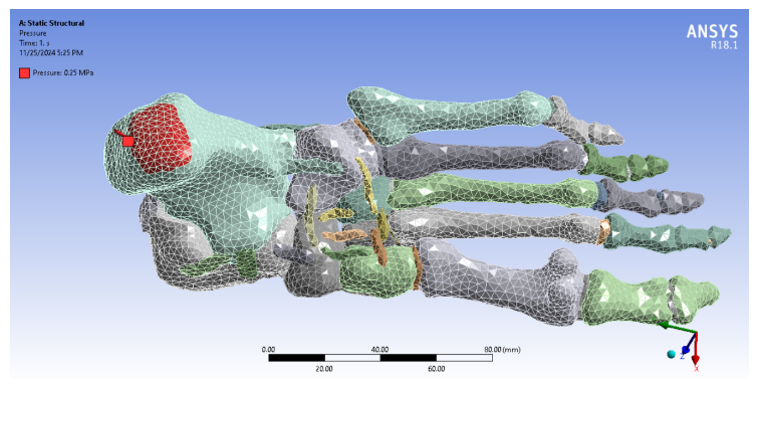
Figure 1 Simulation of the load pattern in the initial stage of the stance phase.
Material properties were assigned based on values reported in biomechanical literature: cortical bone with an elastic modulus of 7.3 GPa and Poisson’s ratio of 0.3, and trabecular bone with an elastic modulus of 1.1 GPa and Poisson’s ratio of 0.26, reflecting their mechanical heterogeneity. These values allowed the model to capture stiffness differences across bone tissues.1–3
The analysis was solved using a static structural module, assuming quasi-static loading at the instant of heel contact. The following outputs were computed and post-processed:
This setup provided a controlled numerical framework for evaluating the biomechanical behavior of the foot during the initial contact phase of gait.
The heel-strike phase generated localized stress concentrations at the posterior calcaneus, consistent with clinical expectations. Main findings include:
These values demonstrate that although the displacements are small, the stress magnitudes are significant given the repetitive nature of gait cycles. Figures 2 and 3 illustrate the displacement field and Von Mises distribution, respectively.
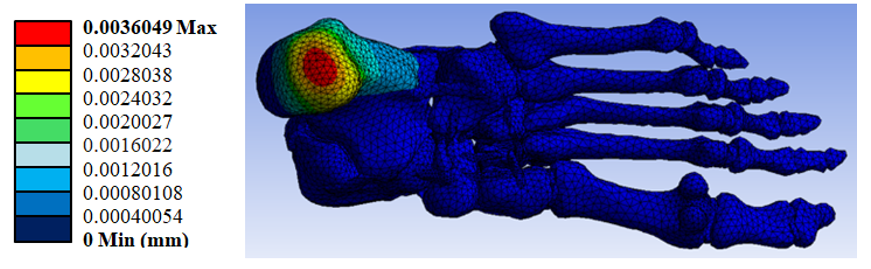
Figure 2 Total displacement (mm) evaluated in the initial stage of the stance phase.
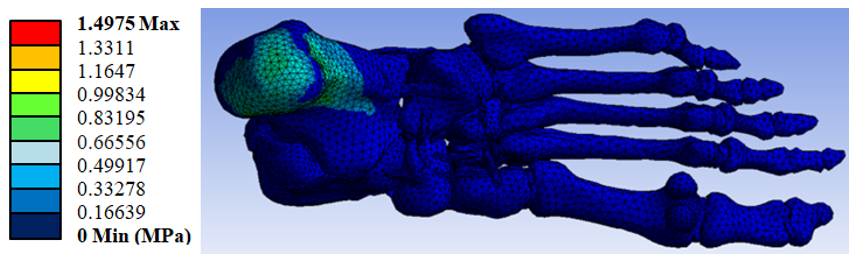
Figure 3 Von Mises stress (MPa) evaluated in the initial stage of the stance phase.
The finite element simulation of heel-strike confirmed the mechanical sensitivity of the foot during the first contact phase of gait. Stress peaks at the calcaneus highlight the importance of cushioning and footwear design for impact mitigation. This methodological approach will serve as the basis for extending the analysis to later stance phases and for integrating subject-specific experimental gait data.
authors gratefully acknowledge the financial support from the Mexican government by the Secretaría de Ciencia, Humanidades, Tecnología e Innovación and the Instituto Politécnico Nacional.
None.
The authors declare that there is no conflict of interest.

©2025 Rodríguez-Granados, et al. This is an open access article distributed under the terms of the, which permits unrestricted use, distribution, and build upon your work non-commercially.