MOJ
eISSN: 2576-4519


Mini Review Volume 9 Issue 1
 Romero-Ángeles B, Velázquez-Lozada E, Gallegos-Funes FJ, Martinez-Mondragon M, Mireles-Hernández J, Gomez-Niebla JA, Suarez-Hernandez M de la L, García-Laguna MA
Instituto Politécnico Nacional, México
Correspondence: Guillermo Urriolagoitia Sosa, Instituto Politécnico Nacional, Escuela Superior de Ingeniería Mecánica y Eléctrica, Sección de Estudios de Posgrado e Investigación, Zacatenco, C.P. 07320, México
Received: August 18, 2025 | Published: September 2, 2025
Citation: Guereca-Ibarra JR, Urriolagoitia-Sosa G, Romero-Ángeles B, et al. Biomechanical analysis applied into the wrist to understand the effects on the carpal tunnel. MOJ App Bio Biomech. 2025;9(1):87-88. DOI: 10.15406/mojabb.2025.09.00229
Understanding how the joints of the human body are affected has always been a topic of interest, and this has been reinforced by the arrival of new technologies that facilitate studies in this area, such as the implementation of the finite element method. The analysis of the human body from a mechanical perspective has been facilitated by the implementation of computer programs that allow the replication of body geometries and the simulation of how they can be affected by certain stresses or pressures. This paper presents the application of this method to the wrist joint and the nerve located in it (carpal nerve), together with the results that can be achieved when a load is applied.
Keywords: biomodels, carpal tunnel syndrome, nerve, wrist
The human body can be affected by multiple ailments that cause discomfort or damage to the extremities due to external factors. In this case, the focus is on the wrist and specifically on the nerves located in the hand region. One of the most common ailments is carpal tunnel syndrome (CTS), which can be caused by compression of the hand. CTS is characterized by compression of the median nerve where the tendons of the arms pinch the nerve. This compression may not be constant, as many of the reported cases are of people who performed repetitive tasks for a prolonged period of time. The consequences of this discomfort can lead to a decrease in the capabilities of the associated structures due to lack of oxygenation.
This case study focuses on the development of a biomodel of the wrist, forearm bones, and carpal nerve to perform an analysis using the finite element method to determine the points where the effects occur.
The biomodel developed for the wrist, radius, and ulna was constructed using the Materialise Mimics software, a specialized computer program that processes medical imaging data to generate anatomically accurate three-dimensional (3D) models (Figure 1). This software allows for the reconstruction of complex bone geometries from image-based datasets, enabling further biomechanical analysis. The modeling of the nerve was performed separately using the same methodology and later integrated with the bone structures once all geometries were finalized.
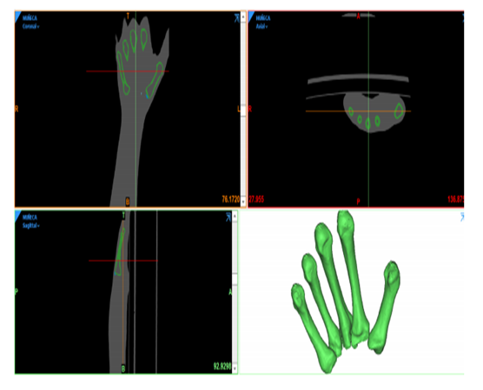
Figure 1 Segmentation and 3D model.
Following the segmentation and reconstruction processes, the surfaces of the anatomical structures were refined through smoothing techniques. This step is essential to reduce irregularities and improve the fidelity of the model, thereby enhancing the precision and reliability of subsequent simulations or analyses (Figure 2).
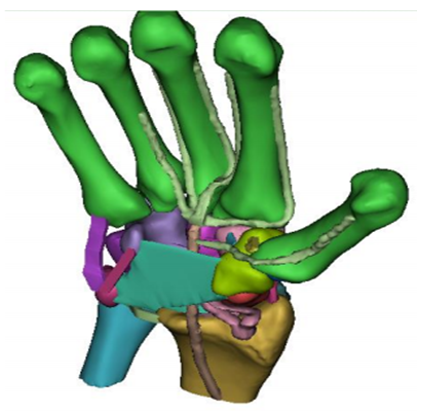
Figure 2 Smoothing of geometries.
The analyses to be performed consist of a load applied to the metacarpals. This load, when transmitted through the wrist, induces mechanical stress on the nerve, potentially leading to conditions such as nerve compression or inflammation—commonly associated with carpal tunnel syndrome. The magnitude of the applied load is based on the estimated maximum weight that an individual might typically carry during daily activities. To ensure consistent and realistic results, the hand is positioned horizontally during the simulation, allowing for a more accurate representation of how compressive forces impact the nerve structure under normal loading conditions.
The bones of the wrist are where the effects of the load are most concentrated (Figure 3), reaching a maximum peak of 45,435 MPa. Meanwhile, in the nerve, the effects are reflected in the branching of the nerves that protrude from the carpal nerve. It can be seen that these reach a maximum of 3,179 KPa (Figure 4).
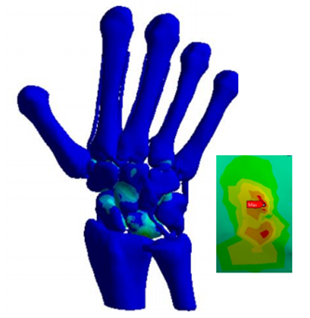
Figure 3 Posterior view results of Von Misses stress in wrist, radius, ulna and nerve.
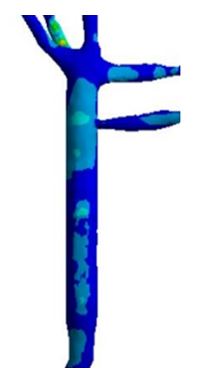
Figure 4 Nerve results of Von Misses stress in nerve.
In conclusion, the development of an anatomically accurate biomodel using advanced imaging software such as Materialise Mimics enables detailed analysis of biomechanical interactions within the wrist structure. By applying physiologically relevant loads to the metacarpals, the model allows for the assessment of stress transmission through the wrist and its potential impact on the median nerve. This approach provides valuable insight into the mechanisms that may lead to nerve compression or inflammation, thereby contributing to a better understanding of conditions such as carpal tunnel syndrome and supporting the development of preventative or therapeutic strategies.1–6
The authors gratefully acknowledge the financial support from the Mexican government by la Secretaría de Ciencia, Humanidades, Tecnología e Inovación and the Instituto Politécnico Nacional.
None.
The authors declare that there is no conflicts of interest.

©2025 Guereca-Ibarra, et al. This is an open access article distributed under the terms of the, which permits unrestricted use, distribution, and build upon your work non-commercially.