Journal of
eISSN: 2373-6410


Mini Review Volume 15 Issue 6
Pedagogical Sciences, Second-Degree Specialist in Internal Medicine, Cuba
Correspondence: Josefa Bell Castillo, PhD in Pedagogical Sciences. Second-Degree Specialist in Internal Medicine, Cuba
Received: October 12, 0025 | Published: November 28, 2025
Citation: Castillo JB. The praxiological appropriation of the diagnosis of cerebrovascular diseases. J Neurol Stroke. 2025;15(6):157-160. DOI: 10.15406/jnsk.2025.15.00640
Introduction: Cerebrovascular diseases show high rates of morbidity, mortality, and disability worldwide, despite scientific and technological advances that have improved medical care aimed at preventing and modifying the risk factors associated with these pathologies.
Objective: To update knowledge related to the praxiological appropriation of the diagnosis of cerebrovascular diseases.
Methods: A comprehensive bibliographic review was conducted, analysing medical articles published on reliable digital platforms, focusing on descriptive research of their scientific content. Various websites offering scientific and educational resources were consulted, including Dialnet, Scopus, Redalyc, Scielo, Google Scholar, Elsevier, and PubMed. This allowed access, theoretical processing of the information obtained, and presentation of the results.
Results: The review and assessment of the main theoretical frameworks revealed the importance of praxiological appropriation in the diagnosis of cerebrovascular diseases.
Conclusions: Praxiological appropriation in the diagnosis of cerebrovascular diseases strengthens and transcends professional scientific performance during medical practice, contributing to prevention, early diagnosis, timely treatment, and rehabilitation of affected patients.
Keywords: praxiological appropriation, cerebrovascular diseases, prevention and health promotion, morbidity, mortality
Cerebrovascular diseases are associated with high rates of morbidity, mortality, and disability worldwide, despite scientific and technological advances that have improved medical care, prevention and modification of risk factors associated with these conditions.1 More than 2,400 years ago, Hippocrates documented aspects related to cerebrovascular diseases, contributing to the scientific understanding of neurological processes. Currently,these diseases are associated with neuroanatomical events caused by reduced blood flow in a specific vascular region, or by the rupture of a cerebral vessel resulting in hemorrhage.2,3
The incidence of these morbid processes continue to rice among adults, young adults, and even adolescents. The reviewed literature identifies cerebrovascular disease as the second leading cause of death and the main cause of acquired disability in adults.3–6 Authors such as Yanez N, Useche JN, Bayona H, Porras A, and Carrasquilla G define cerebrovascular disease as a pathological process affecting an area of the brain, either temporarily or permanently, due to ischemia or hemorrhage, involving one or more cerebral blood vessels.
Praxiological appropriation of the diagnosis of cerebrovascular diseases addresses professionals epistemological shortcomings by interrelating standardized didactic categories in the definition, pathophysiology, classification, clinical manifestations, diagnosis, identification of risk factors, prevention of complications, timely treatment and patients rehabilitation. This raises a scientific problem regarding theoretical and methodological limitations during the clinical practice of cerebrovascular diseases. Therefore, situations in clinical settings require linking acquired knowledge with the realities of professional practice.
Textbooks present a general topic that cannot be applied to all patients. Therefore, it is necessary to contextualize the knowledge acquired in the classroom and the practical skills learned to treat patients with cerebrovascular disease.
On the other hand, From an epidemiological perspective, Europe exhibits incidence rates ranging from 95-290 per 100,000 inhabitants per year, with similar results observed in Spain. In Russia, Australia, and the United States, a significant increase in incidence has been reported among individuals over 35 years of age, specially those over 85.3–6 Other studies report mortality rates of 61.5 per 100,000 inhabitants in developed countries such as France, Germany, and Italy. In the Americas, Cuba diagnoses approximately 20,000 new cases of cerebrovascular accidents annually, with a crude mortality rate between 84.2 and 88.1 per 100,000 inhabitants, and an estimated 4.0 years of potential life lost.6,7
In Mexico, cerebrovascular disease (CVD) is among the leading causes of death and disability, with approximately 170,000 new cases per year. It is recognized as the seventh leading cause of death, responsible for 37,453 deaths, primarily among men over 65 years of age. Currently, the estimated prevalence is 118 cases per 100,000 inhabitants, representing a significant increase in the burden of this disease.5,6 This review was conducted to update knowledge regarding the importance of praxiological appropriation in the diagnosis of cerebrovascular diseases. This complex process represents a major global public health challenge, requiring effective strategies for prevention, health promotion, early diagnosis, and timely treatment, to reduce morbidity, mortality, and disability caused by these conditions.
A comprehensive bibliographic review was performed, analyzing relevant medical an educational literatura available on recognized academic platforms. The process included theoretical analysis, synthesis, and sistematization of the information obtained, to develop a descriptive and reflective review. The study aimed to update the knowledge on the praxiological appropriation of the diagnosis of cerebrovascular diseases, based on the analysis of medical articles published on reliable digital platforms and focused on descriptive research of their scientific content.
Various websites offering scientific and educational resources were consulted, including Dialnet, Scopus, Redalyc, Scielo, Google Scholar, Elsevier, and PubMed, which facilitated access, theoretical processing of the information obtained, and the publication of results.
Selection criteria
Sientific and professional practice is strengthhend by systematized practical-training,wich facilitates the development and improvement of scientific knowledge, and ensures quality processes, combined with transformative profesional growth.7,8,11
Cerebrovascular diseases as complex processes highlight, the need for this sistematization. Approximately one in three affected individuals experiences some degree of disability, such as paresis or paralysis involving facial muscle, speech difficulties, limb weakness or gait disturbances.9,10,15 These conditions require appropriate professional care to minimize consequences and enhance recovery potential. This underlines the importance of aligning profesional training with scientific research.
Professionals must develop knowledge and understanding related to these complex processes to intentionally achieve high- quality competence and performance through transcendent clinical judgment.8,11,12 Praxiological appropriation also enables the identification and classification of risk factors for cerebrovascular diseases. Modifiable risk factors,include hypertension, recent myocardial infarction, smoking, sickle cell anemia, previous transient ischemic attacks, asymptomatic carotid stenosis, hypercholesterolemia, alcohol consumption, physical inactivity, obesity, dietary factors, hyperinsulinemia, and insulin resistance.
Potentially modifiable risk factors include diabetes mellitus, hemocysteinemia, hypercoagulable states, left ventricular hypertrophy, infections, migraines, and subclinical processes.9,10,16
Non-modifiable risk factors include age, sex, hereditary factors, ethnicity, geographic location, and sociocultural level. Additional literature mentions les- documented risk factors such as heart diseases, use of oral contraceptives, and drug use. Seasonal and climatic factors are also considered non -modifiable.2,3,6 During scientific and professional practice, knowledge is transformed through meaningful learning within higher medical education, guided by practical and formative systematization.8,13,14
It is essential to transform professional training through sociocultural management and continuing education. Therefore, the diagnosis, comprehensive treatment, and prevention of complications from cerebrovascular diseases, must be defined as essential priorities. Authors such as Homero Fuentes emphasize that intentional and systematic professionals training is based on universal culture and advanced scientific research. This process fosters the universalization of scientific knowledge and its systematic development in contextualized practice.
Praxiological appropriation and understanding of cerebrovascular diseases reinforce the integrative approach to these pathologies. Stroke, for instance is a medical emergency, that progresses rapidly if not treated promptly, as the pathophysiological factors of cerebral ischemia or hemorrhage evolve quickly.
Prevention of neurological and systemic complications, including those related to mechanical ventilation and nutritional disorders, is crucial. Despite updated protocols for early diagnosis, acute -phase treatment, and rehabilitation .Cerebrovascular diseases continue to have a significant socioeconomic and public health impact.This undercores the need to ennhance specialized medical care through multidisciplinary and integrative approaches, leading to authentic professional training.7,8,11–14
Model for the praxiological appropriation of the diagnosis of cerebrovascular disease
The model for the praxiological appropriation of the diagnosis of cerebrovascular disease expresses the dynamics and intention of transforming the comprehensive training of professionals in the care of patients with these neurological conditions in different contexts. It provides the interaction of basic skills to form a professional committed to human beings.
This model, composed of interrelated configurations, provides the interpretation and theoretical foundation of the postulates of Higher Education Pedagogy, based on Fuentes' Scientific Conception of Configurational Holistics (2008, 2009) as a theoretical and methodological contribution, in addition to being based on the scientific and clinical method. Other studies by Fuentes González, Álvarez Valiente, Ortiz Sanchez, García Gascón, Querts Méndez and Bell Castillo concur in the modeling of the training dynamics and reveal the pedagogical, psychological, philosophical, educational, and other disciplinary principles that organize the teaching-learning process.
The model is composed of associated categories, antagonistic in origin, which simultaneously complement each other. These categories have logical, educational, dialectical, and philosophical foundations. They correlate, symbolizing an autonomous action that randomly predominates over its oppositions and vice versa.
Furthermore, a spontaneous and independent order is established, maintained in mutual association, generating essential balance and a contradictory effect.
As shown in Figure 1, the succession of movements is represented as an expression of the configurations and dimensions through which the praxiological appropriation of the diagnosis of cerebrovascular disease transits.
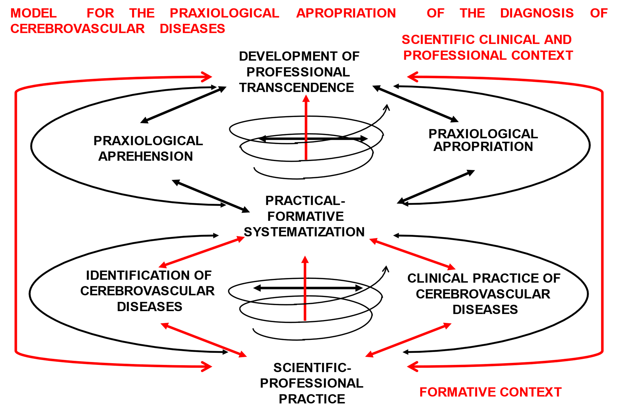
Figure 1 Model for the praxiologican appropriation of the diagnosis of cerebrovascular diseases.
This category is defined by the author as an intentional and integrative process that emerges from the essential relationship with praxiological understanding, leading to the development of professional transcendence during the formative systematization of the scientific-professional practice of cerebrovascular diseases.
This professional practice transforms competence and performance, describing a conscious, clinical, holistic and dialectical care in which participants are trained to improve preventive action, early diagnosis, timely treatment and rehabilitation of patients affected by cerebrovascular diseases. During the process of praxiological appropriation, clinical culture is associated with the orientation and application of the scientific, clinical, and epidemiological method, which improve autonomy, human behavior, and practical effectiveness.
This aspect supports the approaches of Alfonso, J.A.; Diaz Quiñones, J.A.; Sarasa, N.L.; Corona Martínez, L.; and Fonseca Hernández, M., who address the relevance of applying the clinical method in patient care with a pedagogical approach.
The author of this research considers that praxiological apprehension expresses a process of intellectual comprehension applied to the perception and conceptualization of cerebrovascular diseases, generating autonomous learning during the systematization of practical training. When interrelated with praxiological appropriation, a dialectical relationship is established that amplifies the teaching-learning process of cerebrovascular diseases.15–20
The training process for cerebrovascular diseases encompasses knowledge of these pathologies, and the acquisition of skills such as history taking, physical examination, correct prescription and interpretation of complementary tests, to make a definitive and differential diagnoses and to recognize complications, It also involves timely treatment, creative and teamwork. Part of this process includes the enhancement of professional responsibility, respect, and ethics, combined with the ability to resolve issues in context. This alings with the research of Rojas Baso A et al. who describe ethical-humanistic training as central to revitalizing teaching-learning content in medical education.
The systematization of practical training fosters the praxiological appropriation of cerebrovascular diseases and concretizes meaningful learning. It is revealed as an intermediate category between apprehension as a form of understanding and reflection on cerebrovascular diseases - and praxiological appropriation - as a process of dynamic application of acquired knowledge. Previous studies have explored various factors that enhance professional training in the medical sciences21–25
Professionals must make appropriate clinical judgments, supported by accurate patient observation, the application of semiological methods, and forms of reasoning that skills of analysis, synthesis, induction, deduction, abstraction, and concretion when faced with novel situations characteristic of hermeneutic practice.17–20
The author notes that these situations often involve patients with multipathological cerebrovascular diseases, including neurological, respiratory, cardiovascular, infectious, and other complications that require multidisciplinary management. The systematization of practical training as a pedagogical process of continuous improvement, reveals the scientific and investigative behavior of students.12–14 It allows for a holistic approach to cerebrovascular diseases, the development of diagnostic skills, and clinical decision-making.
The publications of Fernández Sacasas, J.A.clearly defend the pedagogical doctrine proposed by Professor Fidel Ilizástigui Dupuy within the context of Cuban medical sciences. They, emphasize workplace education as a way of organizing the teaching -learning process,highlighting the interaction of the student with the learning object in real-life healthcare contexts, and promoting the development of professional competencies under the supervision of the professor. This is consistent with the perspectives of Huapaya-Huertas et al., who addressed the relevance of clinical practice guidelines, considering their impact on health promotion and evidence-based management. They also emphasize the ongoing evaluation of these guidelines to improve the methodological quality of clinical practice as an essential component of professional training.26
These authors share a similar perspective, emphasizing that students should receive supervised instruction from a tutor and, at the same time, actively participate in the care of both healthy and sick individuals, contributing to health protection. The proposed model demonstrates the development of professional transcendence as the superior qualitative process resulting from the dialectical interrelationship between praxiological appropriation and understanding; it typifies the relevant and autonomous transformation of professionals, supported by educational, preventive, and rehabilitative actions that enhance the quality of medical care.
The authors of this research assert that the problem of a disease cannot be solved solely through drug therapy; rather, it requires the commitment, cooperation and integration of society. Therefore, it must be addressed comprehensively.
The mediation of the training context is observed during training systematization as a dynamic process that modifies the professional's capacity for integration and interpretation. This results from the application of the clinical method, based on an integrative orientation, education, instruction, teaching, and learning. The practical context is characterized as representing a process of generalizing of potential for the practice of cerebrovascular disease care, including the identification of risk factors, diagnostic guidance, comprehensive patient assessment, and timely treatment.
The essential relationships that drive the proposed model are found primarily in scientific-professional practice as a mediation between the identification and the clinical practice of cerebrovascular diseases.
The second essential relationship is established between the systematization of practical-training and its interrelation with praxiological appropriation and praxiological apprehension.
The authors of this research consider that the problem of a disease cannot be resolved solely with pharmacological intervention .It requires the active participation, cooperation, and integration of all sectors of society to achieve comprehensive and sustainable health outcomes (Figure 1).
Praxiological appropriation strengthens the professional performance of physicians in the diagnosis, treatment and rehabilitation of patients with cerebrovascular diseases. Systematic training based on scientific evidence improves preventive measures, early diagnoses, and timely interventions, reducing morbidity, mortality, and disability. Integration of theoretical knowledge and practical skills fosters holistic, critical and reflective clinical practice. The proposed model provides a framework to guide the development of professional competencies and ensure the continuity of quality care in patients with cerebrovascular diseases.
None.
The authors declare that there are no conflicts of interest.

©2025 Castillo. This is an open access article distributed under the terms of the, which permits unrestricted use, distribution, and build upon your work non-commercially.