Journal of
eISSN: 2373-6410


Research Article Volume 16 Issue 1
 Ana Carolina Ribeiro de Araujo e Araujo,2 Hiago Sousa Bastos,1 Ana Caroline Penha Castro Marques,3 Almir José Guimaraes Gouveia,1 Otto Mauro dos Santos Rosa,1 Juliana Fonseca Cavalcante,1 Maria Aparecida Costa,4 Adiláo Freitas Costa de Lima,1 Consuelo Penha Castro Marques1
1Department of Medicine, Federal University of Maranhão, Brazil
2Department of Medicine, State University of Maranhão, Brazil
3Department of Dentistry, Federal University of Maranhão, Brazil
Correspondence: Consuelo Penha Castro Marques, Department of Medicine, Federal University of Maranhão, Brazil
Received: January 16, 2026 | Published: February 27, 2026
Citation: Costa SPA, Araujo ACRA, Bastos HS, et al. Effects of late diagnosis of ASD on neural development and management of its difficulties by professionals and family members. J Neurol Stroke. 2026;16(1):48-57. DOI: 10.15406/jnsk.2026.16.00652
Introduction: Autism Spectrum Disorder (ASD) is characterized by atypical behavior, language, and social interaction, with a multifactorial etiology involving genetic and environmental factors. Late diagnosis of ASD significantly impacts neurological development, therapeutic management, and the quality of life of individuals and their families. In this context, this study seeks to describe neurological development and its influence on late diagnosis, as well as to identify the difficulties encountered by healthcare professionals in the early detection of ASD and the difficulties faced by families.
Objective: To investigate the effects of late diagnosis of ASD on neural development and the management of its difficulties by professionals and families.
Methodology: This is an integrative literature review, based on the following steps of the PRISMA protocol: identification of the theme and formulation of the research question; search and selection of scientific articles; data extraction from selected studies/categorization; critical appraisal of the studies included in the integrative review; synthesis of results and presentation of the review.
Results: Among the studies in the reviewed sample, prevalent themes were observed. The most frequently addressed themes were "Difficulties that Healthcare Professionals Encounter in the Early Detection of ASD and Family Difficulties" with 21 articles, "Early Identification as an Influence on the Acceptance of the Diagnosis by Families at Later Times" with 9 articles, and "Neural Development and the Influence of Late Diagnosis" with 2 articles.
Discussion: Delayed diagnosis not only compromises brain plasticity and executive functions but also exacerbates inclusion challenges, limiting the effectiveness of early interventions and affecting the quality of life of patients and their families. The lack of standardized protocols and the need for longitudinal studies that allow for monitoring this development in the face of different diagnostic and treatment methods are highlighted. Final consideration: The late diagnosis of ASD harms neurological development and family well-being, reinforcing the need for improvements in health actions aimed at accelerating diagnosis, making it urgent to strengthen early intervention policies.
Keywords: autism spectrum disorder, family relations, health personnel, neurodevelopmental disorders
Autism spectrum disorder (ASD) is a neurodevelopmental condition characterized by a delay and/or alteration in shared attention, language, and habitual behavioral patterns. Thus, the presence of atypicalities and stereotypies are recurrent in the disorder and are considered warning signs for early detection and diagnosis.1 Regarding etiological factors, it is understood, through clinical and observational studies, that ASD, as well as other neurodevelopmental conditions, such as attention deficit hyperactivity disorder (ADHD), are idiopathic in nature, the understanding of which involves the process of interaction between the environment and genetics and its clinical and physiological aspects, in a multifactorial way.2
In physiological neural development in children, chemical, structural, and functional changes occur, called neuronal pruning, which are responsible for refining synapses, making the brain more specialized and efficient by eliminating unused or underutilized brain connections. However, dysfunctions can occur in this process, leading to atypical connectivity in individuals with the disorder, which can impact information processing, communication, and social interaction skills, resulting in a more limited prognosis within therapeutic management.3
Historically, one of the first manifestations reported in the scientific literature on this disorder was made by the German psychiatrist Leo Kanner, who characterized children with autism as those who preferred solitude and manifested an intense desire for sameness, especially in his observational study entitled "Autistic Disturbances of Affective Contact," in which eleven children were evaluated and studied behaviorally by Kanner.4 Furthermore, in 20th-century Europe, the Englishwoman Lorna Wing, a doctor and mother of a girl with ASD, stood out. Through her dedication to research, she made it possible to broaden the concept of spectrum within the universe of autism studies.5
In the 21st century, according to data from the Centers for Disease Control and Prevention (CDC), 1 in 36 children worldwide is on the spectrum.6 However, despite the growing understanding and visibility of ASD, challenges are encountered in the early identification of the disorder and, consequently, in its treatment. Complex and multidimensional obstacles hinder this diagnosis, such as variations in the clinical manifestations of the disorder in each individual, the absence of standardized screening methods, and the limited knowledge of healthcare professionals about the initial signs of ASD. This can lead to delays in the implementation of essential interventions and late diagnosis, compromising the prognosis of affected children and making the management of the condition by the family even more challenging.7 Therefore, the objective of this study was to investigate the effects of late diagnosis of ASD on neural development and the management of its difficulties by professionals and families.
Study design
An exploratory study on Autism Spectrum Disorder was conducted through an integrative review of the scientific literature found in the main national and international databases. This type of study consists of grouping and synthesizing relevant research results on a given topic in a structured way, directed towards a well-defined question, constructed from the steps based on the PRISMA protocol:8 Identification of the topic and formulation of the research question; search and selection of scientific articles; data extraction from selected studies/categorization; critical appraisal of the studies included in the integrative review; synthesis of results and presentation of the review.
Research question
The following guiding question was formulated for the study: "How does late diagnosis of Autism Spectrum Disorder (ASD) impact the neural development of affected individuals, and what are the implications for the clinical and family management of their difficulties over time?"Database
The searches were conducted in bibliographic databases – PubMed, Virtual Health Library, and Google Scholar. Upon completion of the searches in each database, duplicate references were excluded.
Time and language limit
Articles published in the last 6 years, written in Portuguese and English, were selected.
Inclusion and exclusion criteria
All original articles published between January 1, 2019, and January 30, 2025, with experimental (clinical trials, randomized or not), descriptive, observational (case-control studies and cohort studies) designs, conducted in humans, and case reports were included. Publications already selected in searches in other databases and that did not answer the research question were excluded. Articles that deviated from the theme and duplicate articles in the databases were also excluded.
Strategy for selecting and analyzing articles
For the operationalization of the search, the following strategy was used: (“Early Diagnosis”) AND (“Autism Spectrum Disorder”) AND (“Family”) , (“Healthcare Professional”) AND (“Autism Spectrum Disorder”) AND (“Family”), “(Neurodevelopmental Disorders”) AND (“Autism Spectrum Disorder”) AND (“Early Diagnosis”) AND (“Healthcare Professional”) , (“Late Diagnosis”) AND (“Healthcare Personnel”) AND (“Family”) AND (“Case Reports”) AND (“Experimental”), (“Autism”) AND (“Late Diagnosis”) AND (“Neural Development”), (“Early diagnosis”) AND (“Autism Spectrum Disorder”) AND (“Family”) and (“Healthcare Professional”) AND (“Autism Spectrum Disorder”) AND (“Family”).
This selection is shown in the Table 1 below:
|
Search strategy (Descriptors and operators) |
Database |
Search date |
|
(“Early Diagnosis”) AND (“Autism Spectrum Disorder”) AND (“Family”) |
PubMed, BVS, Google Scholar |
Jan/2025 |
|
(“Healthcare professional”) AND (“Autism spectrum disorder”) AND (“Family”) |
PubMed, BVS, Google Scholar |
Jan/2025 |
|
(Neurodevelopmental disorders) AND (Autism spectrum disorder) AND (Early diagnosis) AND (Health professional) |
PubMed, BVS, Google Scholar |
Jan/2025 |
|
("Late Diagnosis") AND ("Health Personnel") AND ("Family") AND ("Case Reports") AND ("Experimental") |
PubMed, BVS, Google Scholar |
Jan/2025 |
|
(“Autism”) AND (“Late Diagnosis”) AND (“Neural Development”) |
PubMed, BVS, Google Scholar |
Jan/2025 |
|
("Early diagnosis") AND ("Autism spectrum disorder") AND ("Family") |
PubMed, BVS, Google Scholar |
Jan/2025 |
|
(“Healthcare Professional”) AND (“Autism Spectrum Disorder”) AND (“Family”) |
PubMed, BVS, Google Scholar |
Jan/2025 |
|
|
|
|
Table 1 Strategy for operationalizing the search for articles
Source: Prepared by the authors, 2025.
This strategy was adapted for each database considering its specific characteristics. Furthermore, the number of publications was identified, and studies were selected. This selection was done by reading the titles and excluding those that did not meet the selection criteria. Then, the abstracts were read, and those relevant to the research and related to the study objectives were selected for full-text reading.
Finally, the articles that were part of the study were selected. The collected references were included in a single library in the EXCEL program, from which a table was created encompassing the main items of the methods and results of each selected article (author, year, country of origin of the study, design, sample studied, results and pertinent observations), by two independent researchers, and also to be presented later through the Prisma Flow Diagram, used as a basis for searching and selecting the articles.
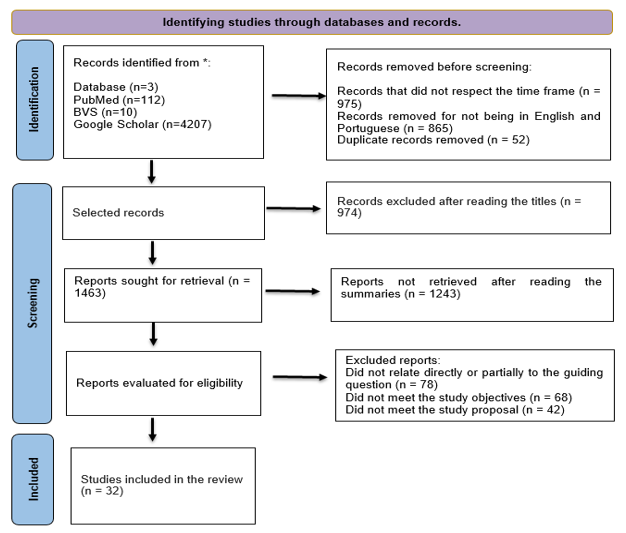
Using the Prism Flowchart, we initially identified n=4,332 records from four databases: PubMed (n=112), BVS (n=10), Google Scholar (n=4,207), and other sources (n=3). Before screening, n=1,840 records were removed: n=975 because they did not meet the established time frame, n=865 because they were in languages other than English and Portuguese, and n=974 studies that did not fit the scope of the research. In the subsequent screening phase, n=1,463 reports were retrieved for detailed abstract analysis, resulting in a subgroup evaluated for eligibility. During the full analysis, studies that did not answer the guiding question (n=78), that did not meet the objectives (n=68), or the study proposal (n=42) were excluded. At the end of the rigorous selection process, n=32 studies met all the inclusion requirements and were integrated into the final review for qualitative and descriptive data analysis.
PRISMA Flow diagram - search and selection of scientific articles
Source: Adapted by the author, based on Flow Diagram, according to Page MJ, Mckenzie JE, Bossuyt PM, et al. The Prisma 2020 statement: an updated guideline for reporting systematic reviews. BMJ. 2021;71(1):372.8
Ethical aspects
The data evaluation was conducted in a qualitative and descriptive manner, with the aim of recognizing recurring patterns and trends in the selected studies; that is, the databases did not use confidential information. Therefore, submission to the Ethics and Research Committee is not required due to the chosen type of study.
The initial search resulted in n=4329 publications, with n=10 in BVS, n=112 in PubMed, and n=4207 in Google Scholar. Articles published between 2019 and 2025 were filtered, and n=975 samples were excluded. Additionally, n=856 samples were removed for not being in English and/or Portuguese, and n=52 records were removed for having duplicates in the databases. After reading the titles and abstracts, n=220 records remained eligible. Of these, n=32 articles were included in the review, as those that did not relate to the guiding question, did not fit the objectives, or did not meet the study's proposal were removed. The analyzed articles are presented in Table 2 to facilitate visualization and understanding of the themes of each journal. The table presents a summary of the articles with authorship and year of publication; country of origin of the study, design, sample studied, results and pertinent observations, and main findings. It includes n=32 studies published between the years 2019 and 2025.]
|
Author(s) and Year (Country) |
Study design |
Sample studied |
Results |
Observations |
|
Raeisy et al.9 |
Experimental study |
41 children with ASD and 41 healthy children |
C1q/TNF may be an early biomarker |
Potential clinical application |
|
Wieckowski et al.10 |
Qualitative study |
Health professionals |
Differences in initial impressions significantly affect diagnosis |
Relevant for training healthcare professionals |
|
Lodônio ALX11 |
Narrative review |
Previous studies |
Highlights the effects of late diagnosis on neurodevelopment |
Academic, without empirical study |
|
Reder Brzezewska12 |
Qualitative study |
Children aged 2 to 17 diagnosed with ASD and other disorders |
Family environment influences diagnosis time |
Relevant for family support |
|
Erzurumluoğlu et al.13 |
Cross-sectional study |
Family doctors (specialists, residents, and general practitioners) |
Lack of training impacts early diagnosis |
Importance of increasing training and awareness among physicians about ASD, especially regarding monitoring and screening |
|
Almohri et al.14 |
Cross-sectional study |
Children screened for ASD |
Low parental awareness hinders outpatient follow-up. |
The study revealed a low prevalence of positive screening and confirmed cases of ASD |
|
Faulin et al.15 |
Qualitative study |
Healthcare professionals from São Paulo-SP |
Lack of knowledge about the Care Pathway and no specific training to work with ASD (Autism Spectrum Disorder). |
Relevant for public policy |
|
Almeida et al.16 |
Descriptive study |
Nurses (literature review) |
The importance of the nursing team in providing care, support, and assistance to children and their families. |
It emphasizes that this monitoring is essential for the early identification of ASD |
|
Mendes et al.17 |
Experience report |
Healthcare professionals |
Improvements in ASD screening after training |
Importance of educational programs |
|
Passos Kishimoto18 |
Descriptive study/literature review |
Families of children with ASD |
Late diagnosis increases parental stress. |
Important for psychological support. |
|
Bent Barbaro Dissanayake19 |
Qualitative study |
Parents of children with ASD |
Bureaucratic processes delay diagnosis |
Relevant for service improvement |
|
Pedruzzi; Pereira; Flavia20 |
Case study |
A teenager with ASD |
Challenges in school inclusion and the importance of family for the learning and development of individuals with ASD |
Applicable to educational policies |
|
Batista et al.21 |
Quantitative-qualitative study |
Mothers of autistic children associated with APAA |
Family support improves quality of life |
Important for early intervention |
|
Feitosa GG22 |
Qualitative study |
30 parents of children with ASD |
Parental expectations about ASD are complex constructs related to socioeconomic and psychosocial factors. |
The results of this study provide input for the development of possible instructional materials for families |
|
Araújo Oliveira Ferraz23 |
Qualitative study |
Mothers of children with ASD / Literature review |
Late diagnosis intensifies parental grief |
Suggestions for psychological support |
|
Rattaz et al.24 |
Cross-sectional study |
Children with ASD |
Inverse relationship between socioeconomic status and age at diagnosis of ASD |
Better screening for more subtle/less severe forms of autism spectrum disorder is needed |
|
Ghahari et al.25 |
Regional comparison |
Children with ASD |
Late diagnosis more common in rural areas |
Relevant for access policies |
|
Diguiseppi et al.26 |
Experimental study |
Children being screened for ASD |
Family navigation increases early diagnosis |
Applicable in public services |
|
AikateriniSousamli et al.27 |
Qualitative study |
517 mothers of children diagnosed with ASD |
Increased risk with perinatal factors |
A family history of neurological or psychiatric conditions has been shown to be protective |
|
Gabellone et al.28 |
Observational study |
Parents and healthcare professionals |
Telemedicine improves access, but raises concerns |
Relevant for digital implementation |
|
Alonso-Esteban et al.29 |
Systematic review |
Previous studies |
Sensitivity to autism detection is generally lower in the Spanish versions of the reviewed instruments |
Urgent need to develop reliable and valid instruments for the early detection of autism |
|
Yang et al.30 |
Case-control study |
Children with and without ASD |
Early identification and family support improve prognosis |
Includes comprehensive analysis of environmental risk factors and biochemical markers |
|
Negi et al.31 |
Case-control study |
Parents of children with ASD and parents of typically developing children |
Autism Spectrum Disorder (ASD) increases stress levels. |
Important for family support |
|
Al-Mazidi; Al-Ayadhi32 |
Cross-sectional study |
Parents of children with ASD |
Parents report difficulties accessing health services. |
Impact on family quality of life |
|
Deng et al.33 |
Observational study |
Children with ASD and caregivers |
Caregiver-child interaction can aid in ASD screening |
Evidence from EEG analysis |
|
Trevis et al.34 |
Genetic study |
Families with multiple cases of ASD |
Genetic traits help predict ASD in younger siblings |
Relevant for early diagnosis |
|
Sousa et al.35 |
Observational study |
Physicians and family medicine residents |
Low knowledge and skills for ASD diagnosis among professionals |
Suggestions for public policy |
|
Mata-Iturralde et al.36 |
Pilot study |
613 children aged 18 to 48 months |
ADEC tool may be useful for early screening in low-income populations |
Further replication studies needed |
|
Lucato et al.37 |
Systematic review |
Previous studies |
Identifying more effective tools for early diagnosis |
Relevant for healthcare professionals |
|
Singh et al.38 |
Cross-sectional study |
Children with ASD |
Early diagnosis of autism (<36 months of age) associated with increased severity of disabilities |
Key issues include socioeconomic inequalities in the country, lack of parental awareness, and cultural influences |
|
Falcão dos Reis da Silva et al.39 |
Systematic review |
Previous reviews |
Communication among the nursing team aids in early diagnosis |
Applicability in primary care |
|
Mesleh et al.40 |
Pilot study |
121 participants, 91 cases of ASD and 30 healthy controls. |
Two regulated routes were identified in the TEA (SNARE vehicular transport and ErbB signaling route) |
A validation cohort should be tested to confirm these findings |
Table 2 Main findings of the integrative literature review, including relevant methods and results
The studies presented the following countries of origin: Iran (2), Turkey (1), United States of America (3), Poland (1), Brazil (12), France (1), Spain (1), China (2), Ecuador (1), United Kingdom (1), Greece (1), Malaysia (1), Australia (1), Saudi Arabia (1), India (1), Qatar (1) and Bahrain (1). Regarding the type of methodology applied, they were qualitative studies (7), cross-sectional studies (5), observational studies (3), systematic reviews (3), experimental studies (2), narrative review (1), quantitative-qualitative study (1), descriptive studies (2), experience report (1), case study (1), regional comparative study (1), case-control studies (2), genetic study (1) and pilot study (2). Among the studies in the reviewed sample, prevalent themes were observed. The most frequently addressed themes were "Difficulties that Healthcare Professionals Encounter in the Early Detection of ASD and Family Difficulties" with 21 articles, "Early Identification as an Influence on the Acceptance of the Diagnosis by Families at Later Times" with 9 articles, and "Neural Development and the Influence of Late Diagnosis" with 2 articles.
Therefore, when considering the reviewed articles, the most predominant themes were:
Neural development and the influence of late diagnosis
Given this context, the reviewed studies by Lodônio11 and Pedruzzi, et al.20 make important contributions to understanding the impacts of late diagnosis of autism spectrum disorder (ASD) on neural development and on the social and educational inclusion of affected individuals. Therefore, both studies show that delays in identifying ASD are associated with significant impairments, although they use different methodological approaches and focuses.
In Lodônio's study,11 developed as a final course project, the author conducts a broad literature review to highlight the importance of early diagnosis, emphasizing that late detection compromises not only cognitive development and executive functions, but also interferes with neurobiological processes fundamental to child maturation. This theoretical study is based on experimental studies that argue that brain plasticity and the effectiveness of therapeutic interventions are impaired when diagnosis occurs late, which can subsequently negatively impact the child's academic performance and social skills.
The relevance of early diagnosis discussed by Lodônio11 is corroborated by the neurobiological mechanisms of glial regulation described by Starkey, Horstick, and Ackerman.41 According to the authors, the plasticity of the "critical period" is not a purely neuronal event, but a process orchestrated by glial cells that define the maturation time of the circuits. In Autism Spectrum Disorder (ASD), the evidence presented by the authors suggests an imbalance in astrocyte and microglia signaling, which can lead to premature closure of these plasticity windows through early consolidation of the extracellular matrix and myelination by oligodendrocytes. These components act as "structural brakes" that stabilize synapses, making the circuits less responsive to external stimuli. Therefore, the difficulties in adaptation and inclusion reported by Pedruzzi et al.20 can be understood as the clinical manifestation of a nervous system that, due to late diagnosis, has already passed its phases of greatest biological receptivity, hindering the functional reconfiguration necessary for the development of social and cognitive skills.
Furthermore, this urgency in diagnosis finds biological support in the evidence that the complement system is a critical mediator of synaptic plasticity. According to Magdalon et al.,42 proteins such as C1q and C3 orchestrate the refinement of neural circuits through the phagocytosis of less active synapses by microglia. In ASD, the dysregulation of this immune pathway compromises synaptic pruning, resulting in atypical neural connectivity. Therefore, late diagnosis, as discussed by Lodônio11 and exemplified by Pedruzzi et al.,20 represents the loss of a critical ontogenetic window in which early intervention could modulate this molecular signaling and attenuate the cognitive and sensory deficits consolidated by dysregulated biological maturation.
Furthermore, the convergence between the analyses of Lodônio11 and Pedruzzi et al.20 finds mechanistic support in the findings of Hanson et al.,43 who demonstrate how white matter maturation trajectories diverge in Autism Spectrum Disorder. While Lodônio11 emphasizes that synaptic plasticity is optimized in early developmental windows, Hanson et al.43 show that, in ASD, there is a failure in the pruning of small-caliber axons and a progressive deficit in myelination of the temporal lobe. Therefore, this phenomenon results in inefficient signaling, which impairs the functional specialization necessary for complex cognitive processes. From this perspective, the inclusion difficulties and adaptive challenges observed by Pedruzzi et al.20 are not merely psychosocial, but reflections of atypical neural signaling that consolidates with age. Therefore, late diagnosis represents the loss of a critical opportunity for intervention during the period of greatest structural malleability of the brain, hindering the mitigation of deficits in long-range connectivity and sensory integration.
In contrast, the study by Pedruzzi, et al.20 adopts a case study approach, centered on the experience of a mother who describes the challenges faced in the inclusion process of her adolescent son with ASD. In this work, the qualitative narrative highlights how late diagnosis translates into real and practical difficulties in adapting to the school environment, such as the teachers in the cited mainstream schools not having a welfare-oriented attitude towards the child with special needs, in addition to increasing the emotional challenges faced by both the adolescent and his family. Although the main focus is on school inclusion and psychosocial barriers, the authors acknowledge that these challenges are largely due to impairments in neural development associated with the late detection of ASD.
Thus, it is clear that both studies converge on the understanding that early identification is crucial to mitigate the adverse effects of late diagnosis. Lodônio11 emphasizes, based on a broad literature review, that interventions initiated early can preserve essential cognitive functions and promote more adequate neural development. Similarly, the report by Pedruzzi et al.20 reinforces that early diagnosis could have facilitated the adolescent's social and educational adaptation, contributing to more effective inclusion and reducing the stress faced by families.
However, the methodological differences are notable. While Lodônio11 presents a conceptual analysis based on empirical data from the literature, Pedruzzi, et al.20 provide a more individualized view, illustrating through a personal narrative the practical and emotional challenges arising from delayed diagnosis. This variation in approaches allows for a more comprehensive understanding of the topic, where theoretical foundations are integrated with experiential learning, highlighting the complexity of the impacts of late diagnosis. Therefore, both studies show that late diagnosis of ASD has profound consequences for both neural development and educational and social inclusion. Given this, this complementarity reinforces the urgency of public policies and clinical practices that prioritize the early detection of autism, in order to promote more effective interventions, reduce barriers to inclusion, and improve the quality of life of individuals with ASD and their families.
Early identification as an influence on families' acceptance of the diagnosis at later stages
Considering this, the aforementioned studies emphasize the relevance of tools, biomarkers, and strategies for early identification, which can promote better acceptance of the diagnosis by families and, consequently, better prognoses. The convergence of the results of these articles consistently demonstrates that early identification of autism spectrum disorder (ASD) plays a crucial role in forming a solid foundation for families to accept the diagnosis later.
Initially, studies with a biological and technical focus, such as those by Raeisy et al.9 and Mesleh et al.,40 demonstrate that the use of biomarkers – whether through the investigation of specific proteins, for example, C1q/TNF-related protein-1, or proteomic analyses in the blood – can provide objective indicators for early diagnosis. Furthermore, these findings offer a tangible and measurable explanation for the condition, which can make the diagnosis more understandable and acceptable for families, by reducing uncertainties and providing a "palpable" scientific basis that supports the need for early interventions.
Complementarily, Diguiseppi et al.26 and Lucato et al.37 expand on this perspective by emphasizing the fundamental role of screening and diagnostic instruments, and family navigation, in early identification. The study by Diguiseppi et al.26 demonstrates that the use of family navigation strategies to "link" parents to specialized services and assessments contributes to faster detection, thus promoting greater familiarization and, consequently, easier acceptance of the diagnosis. Lucato et al.,37 through a systematic review and meta-analysis, show that the validity and effectiveness of screening instruments not only improve diagnostic accuracy but also serve as an argument for families to understand and trust the diagnostic processes.
The approach of Yang et al.,30 through the China Multi-Center Preschool Autism Project, reinforces the importance of integrating methods for identifying clinical symptoms and biomarkers, which allows for multidimensional screening. This integration not only increases the sensitivity of early diagnosis but also provides parents with a more comprehensive view of their child's clinical picture, facilitating acceptance of the diagnosis due to the complete and evidence-based approach.
In parallel, Deng et al.33 investigate the effectiveness of caregiver-child interaction, using Electroencephalogram (EEG) analyses to identify patterns that indicate the presence of ASD. This approach, by associating neurophysiological aspects with observable behaviors, offers another layer of objectivity that can be particularly enlightening for parents, as it directly relates daily interactions between caregivers and children during free play, given that they can be quantified through behavioral indicators such as social engagement and response time, with measurable evidence of neurological dysfunction, such as EEG alterations with increased Power Spectral Density (PSD) values in the alpha and theta bands, indicating atypical neural activity during interactions. Furthermore, another important perspective is presented by Trevis et al.,34 who explore autistic traits in large families to identify endophenotypes associated with ASD. By mapping these characteristics in families that carry traits of the spectrum, the authors not only highlight the relevance of genetic predisposition, but also contribute to enabling parents of at-risk children to recognize early signs that might otherwise be interpreted as normal variations in development.
Furthermore, Mata-Iturralde et al.36 focus on the application of early screening tools in low-income populations, demonstrating that adapting diagnostic methods to specific contexts – such as the Spanish-speaking population of Guayaquil, Ecuador – is essential to ensure that the benefits of early detection reach historically marginalized groups, such as the aforementioned South American communities. Therefore, this cultural and socioeconomic adaptation of the instruments not only enables early identification but also promotes acceptance of the diagnosis, since parents see themselves included in a process that respects their specific needs.
On the other hand, the study conducted by Aikaterini et al.27 in which the focus is not on developing a screening instrument, but on identifying predictive elements that can inform both professionals and families about the likelihood of ASD manifestation, which brings to light an analysis of perinatal and demographic risk factors, highlighting that knowledge about predispositions and environmental influences can act as an early warning, allowing professionals to communicate to parents the importance of constant monitoring. By providing this contextual explanation, the study helps in understanding the mechanisms underlying ASD, which contributes to reducing stigma and to a more informed and conscious acceptance of the diagnosis.
In summary, although the methods and approaches used vary – with some studies prioritizing biomarkers and proteomic analyses, others emphasizing screening interventions and risk communication, and still others using neurophysiological approaches – they all converge on the idea that early identification not only improves diagnostic accuracy but also plays a decisive role in how families perceive and accept the condition later on. Thus, this convergence highlights the importance of a multidimensional and personalized approach that integrates biological, technical, and family support aspects, thereby promoting more effective acceptance and preparation for early interventions that can potentially improve the prognosis and quality of life of individuals with ASD.
Difficulties faced by healthcare professionals in the early detection of ASD and family challenges
Based on the analysis of studies that focused more on exemplifying the difficulties faced by healthcare professionals in the early detection of ASD and the challenges faced by families, a series of convergences and divergences are evident in both conceptual and methodological approaches, demonstrating the complexity of the proposed topic. From a conceptual point of view, there is a consensus that the lack of training among professionals and the insufficiency and/or inadequacy of screening instruments used in some services in an erroneous way compromise the early diagnosis of ASD. Thus, studies such as that of Wieckowski et al.,10 for example, which explore the "first five minutes" of a diagnostic assessment, show that the initial impressions of professionals – often marked by uncertainty and variability in clinical experience – can negatively influence the decision-making process, given that the time and standardization of screening become essential factors for a good clinical and psychological examination.
Similarly, the work of Erzurumluoğlu et al.13 demonstrates that, in countries such as Turkey, the gap in knowledge and intentional attitudes regarding ASD among family doctors and residents contributes to inconsistency in the early identification of ASD, since these professionals, for example, reported the belief that increased diagnosis would lead to greater discrimination. Therefore, both articles highlight the importance of professional training, demonstrating that mistaken initial impressions, sometimes through superficial analyses, and the absence of standardized protocols delay the recognition of early signs of autism. In parallel, other works, such as those by Almeida et al.16 and Mendes et al.,17 from the perspective of nursing professionals, emphasize that the implementation of educational programs, such as the distribution of informational leaflets and workshops on recognizing signs of ASD, and the improvement in communication, empathy, and socio-emotional intelligence among health professionals, especially primary care professionals, are essential to overcome these barriers to diagnosis.
Furthermore, other studies, such as those by Faulin et al.15 and Almohri et al.,14 show that the structure and organization of health systems – whether in the SUS (Brazilian Unified Health System) or in primary care centers in Bahrain, for example – often do not offer the necessary support to professionals for adequate screening. These studies, using quantitative and descriptive methods, show that the absence of a structured "care pathway" and the lack of internal communication directly impact the effectiveness of early detection. Therefore, conceptually, the researchers cited above agree on the need to improve the training of professionals and standardize the use of diagnostic and/or screening assessment tools.
From the families' perspective, there are qualitative reports and case studies that illustrate how late diagnosis causes emotional impacts and difficulties in adaptation. For example, Araújo, et al.23 discuss the issue of maternal grief resulting from an autism diagnosis, highlighting how the emotional process is complicated by uncertainty and a lack of concrete institutional support. Furthermore, Batista et al.21 reinforce the importance of active family participation in the child's care, suggesting that a lack of information about the functioning of the disorder and how appropriate support should be provided can deepen suffering and increase internal conflicts within the family unit.
Concomitantly, Passos and Kishimoto18 demonstrate, through descriptive analyses, that delayed diagnosis is directly associated with high levels of stress and deterioration of family relationships, which increases the possibility of suffering, feelings of wasted time, frustration, guilt, and also unrealistic expectations of the child's cure. The way the news is received is crucial for the child's development. They also cite that the lack of preparedness of healthcare professionals to identify and communicate the diagnosis is another factor that contributes to this delay and to the social stigma that exists in relation to mental health, delaying the search for help and hindering the acceptance process. Furthermore, Feitosa22 discusses the conceptions and expectations of parents in relation to the child. It addresses aspects such as expectations regarding school inclusion, future potential and/or comorbidities, and even doubts about the etiological aspects of ASD, highlighting how a lack of knowledge about ASD contributes to feelings of guilt and uncertainty within the family, since parents begin to look for the "culprit" for the genetics associated with the disorder.
Additionally, studies such as those by Bent, et al.19 and Rattaz et al.24 provide a perspective on how contextual factors – including the influence of the family environment, socioeconomic inequality, and institutional barriers – play a central role in the diagnostic journey. These studies show that both the actions of professionals and family difficulties are permeated by external factors, which can delay early identification and, consequently, the implementation of appropriate interventions. Another relevant aspect is the demand for greater integration between health services and the reality experienced by families. Studies such as those by Al-Mazidi & Al-Ayadhi32 and Gabellone et al.28 discuss caregivers' perspectives on the organization of services and the use of technologies, such as telemedicine, which can mitigate or, at times, exacerbate the difficulties faced in triaging and referring cases, highlighting benefits such as time savings, adjustments to family routines, and greater participation in care- including divorced parents. However, they also expressed concerns, such as the need for active supervision during sessions and changes in the child's behavior in the virtual environment.
On the other hand, healthcare professionals showed more concerns related to objective barriers: lack of equipment, low familiarity with technology, and unstable connections, in addition to the severity of ASD cases, which can limit the effectiveness of remote care. Gabellone et al.,28 for example, emphasize that although telemedicine can be an effective resource for reducing barriers, it also raises concerns about impersonality and the loss of direct contact, essential elements for ensuring empathetic care. Singh et al.38 complement this view by relating characteristics of the hospital environment and the family dynamics themselves to the age of diagnosis, suggesting that both deficiencies in the healthcare system and parental expectations and ability to recognize early signs interact in a complex way, making early diagnosis more difficult. Other studies also provide a perspective that integrates contextual and cultural variables in the difficulty of early diagnosis.
For example, Reder & Brzezewska12 highlight that both child development factors and the family environment – influenced by socioeconomic aspects – impact the diagnostic decision. Rattaz et al.24 and Ghahari et al.25 point out that, in contexts where there are social inequalities or marked differences between rural and urban areas, access to diagnostic services is even more compromised, which delays the identification of early signs and, consequently, hinders families' coping with the diagnosis. Furthermore, Singh et al.38 corroborate this view, showing that in precarious hospital environments in countries like Malaysia, the characteristics of the clinical environment and families significantly influence the age at which the diagnosis is made.
Furthermore, some studies, such as those by Reder & Brzezewska12 and Sousa et al.,35 highlight the importance of the family environment and institutional support for diagnostic decision-making, emphasizing that professionals' practices do not occur in isolation, but within a complex social and cultural context. This perspective reveals a convergence in recognizing that improving detection processes depends not only on technical training, but also on an integrated approach that considers family dynamics and socioeconomic determinants.
Therefore, some studies are dedicated to exploring caregivers' perceptions and expectations regarding the services offered. In parallel, Al-Mazidi & Al-Ayadhi32 present a national profile of caregivers, showing that when parents perceive failures in screening or communication from health services, this reinforces a negative view of the system and exacerbates the stress associated with the diagnosis. Alonso-Esteban et al.29 address the need for instruments adapted for Spanish-speaking communities, showing that the lack of culturally sensitive tools can lead to inaccurate diagnoses and, consequently, to a misunderstanding of the diagnosis by parents.
Finally, Sousa et al.35 and Silva et al.44 summarize many of these challenges by emphasizing that both institutional barriers and the fragility of support for families – from the lack of professional training to the absence of coherent public policies – hinder the early detection of ASD, impacting the quality of life of those affected and family well-being. Regarding methodological approaches, studies vary widely. Some adopt quantitative and cross-sectional methods, such as the works of Al-Mazidi & Al-Ayadhi,32 NeGI et al.31 and Singh et al.,38 which use questionnaires and statistical analyses to quantify difficulties and relate sociodemographic characteristics to the age at diagnosis. This quantitative profile allows for the identification of factors associated with delayed diagnosis, such as socioeconomic disparities and limitations in access to health services.
Furthermore, systematic reviews and meta-analyses, such as those developed by Alonso-Esteban et al.29 and Gabellone et al.,28 provide a robust synthesis of screening instruments and care practices, highlighting the variability of the methods used and pointing to the need for standardization. While quantitative studies emphasize measurable and statistical dimensions – for example, the correlation between rural-urban environment and age at diagnosis25 – qualitative studies focus more on the subjective account of the experience of parents and professionals, contributing to a holistic understanding of the problem. Therefore, this methodological divergence is enriching, as it allows both the technical and emotional aspects of early diagnosis to be addressed. However, this plurality also reveals gaps in data integration, suggesting the need for studies that adopt mixed methods to correlate objective data with subjective experiences.
Main limitations and future prospects
Among the above, it is noted that time and context are critical factors that influence the understanding of the effects of late diagnosis of Autism Spectrum Disorder (ASD) on neural development and the management of difficulties faced by professionals and families. On top of that, one of the main challenges related to time is the difficulty in capturing the long-term effects in individuals diagnosed late. In the panorama of reviewed studies, many research studies are cross-sectional in nature, which limits the ability to observe changes in development over time and how interventions can impact this trajectory. In addition, individual contexts, such as the family environment, support network, and life experiences, can vary widely, affecting how each person copes with ASD and the interventions they receive.
Methodological limitations also arise when we consider time and context. Studies that do not consider critical developmental periods, such as early childhood, may fail to capture how the lack of an early diagnosis affects neural development. For example, social and communication skills, which are fundamental during the first years of life, can be impaired when adequate support is not received. Furthermore, the cultural and social context in which an individual is embedded can influence access to health services and support, varying according to the region and available resources, making it difficult to generalize research findings.
Given these limitations, it is crucial to consider future perspectives that can enrich research and practice related to ASD. Therefore, a promising approach would be the production of longitudinal studies, which would allow observation of the developmental trajectories of individuals diagnosed late. These studies could offer valuable insights into the evolution of skills and the effectiveness of interventions over time, enabling a better understanding of the impacts of late diagnosis.
Furthermore, the development of personalized interventions that consider the individual characteristics of each child diagnosed late is fundamental. Healthcare professionals and educators could benefit from ongoing training that enables them to adapt their approaches to the specific needs of each child and their family. Awareness and education about the importance of early diagnosis are also essential, as they can help create a more favorable environment for identifying and supporting the difficulties associated with ASD. Finally, interdisciplinary collaboration between areas such as neurology, psychology, and pedagogy can promote a more comprehensive understanding of ASD and its consequences, resulting in more effective and integrated practices.
This research, through an integrative review based on the PRISMA protocol, evaluated the impacts of late diagnosis of ASD on both neural development and the management of difficulties experienced by professionals and families. The findings indicate that delayed diagnosis not only compromises brain plasticity and executive functions but also exacerbates inclusion challenges, limiting the effectiveness of early interventions and affecting the quality of life of patients and their families. The methodology used, which encompassed qualitative, quantitative, and experimental analyses of recent international and national publications, allowed for the integration of diverse data and offered a comprehensive view of the problem. The results confirm the initial hypotheses that late diagnosis results in neurological impairments and intensifies family stress, highlighting the need for earlier interventions. However, the research also revealed important limitations, such as the lack of longitudinal studies that monitor the evolution of symptoms and the lack of standardized protocols adaptable to the cultural and economic particularities of different contexts.
Additionally, the use of technologies such as telemedicine has emerged as a potential strategy to expand access to diagnosis; however, as demonstrated by Gabellone et al.,28 this approach sometimes presents technical challenges and the risk of reducing the quality of human contact, which can compromise empathetic care. Therefore, telemedicine should be seen as a complement to in-person care, contributing to the optimization of the diagnostic process without completely replacing it. In parallel, proteomic analysis, exemplified in the studies by Raeisy et al.9 and Mesleh et al.,40 has demonstrated its potential by identifying specific biomarkers – such as C1q/TNF-related protein-1 – and regulated pathways that point to biochemical alterations in ASD.
This approach allows for the objective measurement of pathophysiological alterations associated with autism, contributing to a more precise and objective diagnosis, to complement the already essential clinical and psychological examination. The convergence of these two techniques offers an innovative proposition: the possibility of sending locally collected biological samples for proteomic analysis, with the results being integrated into a remote clinical assessment. This synergy not only increases diagnostic accuracy but also reduces waiting times and expands access to early interventions, significantly improving the management of ASD and the quality of life for patients and their families.
Furthermore, the results of this review highlight the critical importance of establishing public policies and clinical practices aimed at the early identification of ASD, so that interventions can be applied at the ideal time and thus improve the prognosis and social inclusion of affected individuals. For future research, the adoption of mixed methods and longitudinal studies is recommended, allowing for the correlation of objective data with the subjective experiences of families and professionals, as well as the development of personalized interventions that consider the specificities of each case. Therefore, this work contributes both to the literature and to clinical practice, providing valuable insights for improving the care and support of children with ASD and their families.
None.
The authors declare that there are no conflicts of interest.

©2026 Costa, et al. This is an open access article distributed under the terms of the, which permits unrestricted use, distribution, and build upon your work non-commercially.