Journal of
eISSN: 2373-6410


Case Report Volume 15 Issue 4
 Hassan Maman Laouel,3,4 Maman Sani Ado Zakari,1,5 Assoumane Issa Ibrahim,1,6 IBN Halid Nana Rachida,1 Alzouma Haoua,1 Habi Nikiema,1 Aminath Kelani1,6
1Service de neurochirurgie, hospital National de Niamey, Niger
2Université Moderne de science de la santé (UM2S), Niger
3Faculté de science de la Santé, Université André Salifou de ZINDER, Niger
4Service de réanimation, Hôpital National de Zinder(HNZ), Niger
5Service de réanimation, Hôpital General de Référence de Niamey(HGR), Niger
6Faculté de science de la Santé, Université Abdou Moumouni de Niamey, Niger Service de neurochirurgie, hospital National de Niamey, Niger
Correspondence: Haboubacar Chaibou Sodé, Service de neurochirurgie, hospital National de Niamey, Niger
Received: September 15, 2025 | Published: October 14, 2025
Citation: Sodé HC, Laouel HM, Zakari MSA, et al. Congenital cerebral hemiatrophy: a case study and review of the literature. J Neurol Stroke. 2025;15(4):107-108. DOI: 10.15406/jnsk.2025.15.00632
Background: Congenital malformations of the central nervous system encompass a set of developmental anomalies. Cerebral hemiatrophy (CHA) is a rare radiological finding.
Case presentation: We report the case of a 3-year-old girl admitted for progressive right-sided hemiparesis, associated with psychomotor delay and seizures. Brain CT scan revealed severe right hemispheric atrophy with extensive parieto-temporal schizencephaly. Management consisted of antiepileptic therapy, motor rehabilitation, and regular neurological follow-up.
Conclusion: Congenital CHA, often related to late neuronal migration disorders, requires an etiological diagnosis to optimize management and prognosis.
Keywords: cerebral hemiatrophy, schizencephaly, congenital malformations, hemiparesis
Congenital malformations of the central nervous system (CNS) are a major cause of neurological morbidity in children. Cerebral hemiatrophy (CHA) is a radiological sign characterized by a loss of volume in one cerebral hemisphere, which may result from agenesis, perinatal destruction, or a cortical developmental disorder such as schizencephaly.1 We report a case of congenital HAC revealed by extensive schizencephaly and discuss the diagnostic and therapeutic aspects.
A 3-year-old girl from a consanguineous marriage was admitted for progressive motor deficit on the right side of her body. The pregnancy was not monitored, and delivery was at term by vaginal delivery after prolonged labor. Clinical examination revealed. The patient presented with contralateral spastic hemiparesis 4/5, predominantly affecting the upper limb, with pyramidal hypertonia, hyperreflexia, and a positive Babinski sign. Segmental amyotrophy of the contralateral upper limb was noted. Neuropsychological examination revealed moderate psychomotor delay and language impairment characterized by slowness and poverty of speech. Cranial nerve examination showed central facial palsy contralateral to the cerebral atrophy. She also experienced recurrent focal seizures, partially controlled by antiepileptic treatment (MRC). Paraclinical assessment: Brain MRI was not available due to limited resources, A brain scan showed right hemispheric atrophy, dilation of the right lateral ventricle communicating with the subarachnoid spaces, and a right parieto-temporal cortical cleft consistent with type II schizencephaly. In our patient the treatment consisted of medical management combining an antiepileptic drug to control seizures, a motor rehabilitation program, and regular neurological follow-up (Figure 1).
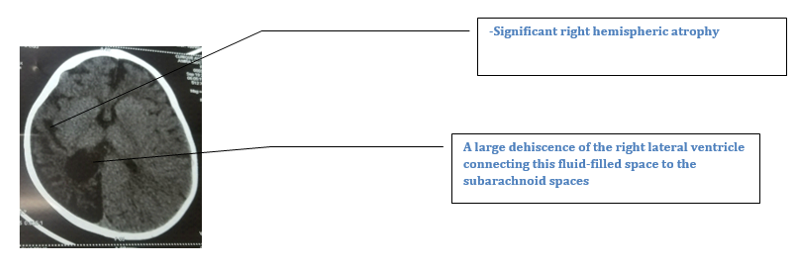
Figure 1 Axial CT scan showing morphological and structural changes in the cerebral parenchyma.
HAC can be congenital or acquired. Congenital forms are often linked to early neuronal migration disorders, including schizencephaly.2 Risk factors: genetic abnormalities, intrauterine infections, consanguinity.3 Diagnosis is based on brain imaging, with MRI being the gold standard.4 Treatment is symptomatic: antiepileptic drugs, motor rehabilitation, functional surgery in cases of refractory epilepsy.5,6 Differential diagnoses include Dyke-Davidoff-Masson syndrome (characterized by calvarial thickening and sinus hyperpneumatization), Rasmussen’s encephalitis (progressive unilateral hemispheric atrophy with drug-resistant epilepsy), sequelae of neonatal or infantile stroke, cortical malformations (schizencephaly, polymicrogyria), and post-infectious sequelae.7–9
In our observation, the therapeutic strategy was based on an exclusively medical approach. The introduction of appropriate antiepileptic treatment reduced the frequency of seizures. Early motor rehabilitation aimed to limit functional sequelae, in accordance with the recommendations reported in the African literature.10,11 Sow et al. 3 emphasize the importance of early multidisciplinary management to improve the functional prognosis of brain malformations. Similarly, Diop et al.6 stress the role of regular neurological follow-up in the detection and prevention of long-term complications. Management is mainly symptomatic: antiepileptic drugs, motor rehabilitation, and speech therapy. In severe or pharmacoresistant cases, functional neurosurgery such as hemispherectomy or hemispherotomy may be considered.12
Congenital HAC is rare but debilitating. Early diagnosis, appropriate symptomatic management, and rigorous prenatal monitoring are essential to improve prognosis.
None.
The authors declare that there are no conflicts of interest.

©2025 Sodé, et al. This is an open access article distributed under the terms of the, which permits unrestricted use, distribution, and build upon your work non-commercially.