Journal of
eISSN: 2373-6410

A 42-year-old female was admitted to the emergency department with pressure-type headache, weight loss, fever and night sweats. She had a history of smoking, around 27 years/pack. On Neurologic Examination, there were bilateral horizontal rotatory nystagmus, upbeat nystagmus, ataxic gait and dysarthria. Radiography and computed tomography (CT) of the chest revealed a large, superior right lobus lung mass. The cerebral spine fluid (CSF) presented pleocytosis, high protein and malignant cells. The brain MRI revealed a hyperintense suprasellar nodular lesion with intense contrast enhancement, highly suggestive of hypophyseal metastasis, along with diffuse leptomeningeal thickening over both brain and cerebellum. There was vasogenic edema on both temporal lobes with intense diffusion restriction, but without parenchymal metastasis. The patient died after 10 days. Meningeal carcinomatosis can occur in 9 to 25% of lung cancer patients,1,2 and parenchymal involvement may occur. Furthermore hypophysis metastasis are more frequently found in lung and breast cancers and in older patients with diffuse malignancy (Figure 1-4).
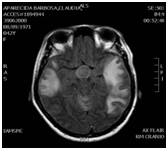
Figure 1 RM Axial Flair - There is vasogenico edema on both temporal lobes with intense diffusion restriction, but without parenchymal metastasis.
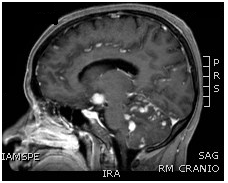
Figure 2 RM Sagital Pos GD –Hyperintense suprasellar nodular lesionwith intense contrast enhancement, highly suggestive of hypophyseal metastasis.
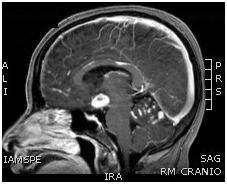
Figure 3 RM Sagital- along with diffuse leptomeningeal.
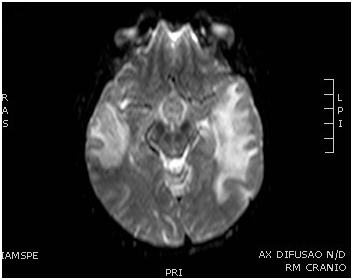
Figure 4 RM Axial T1- There is vasogenico edema on both temporal lobes with intense diffusion restriction, but without parenchymal metastasis.
None.
None.

© . This is an open access article distributed under the terms of the, which permits unrestricted use, distribution, and build upon your work non-commercially.