Journal of
eISSN: 2374-6947


Case Report Volume 6 Issue 2
1Tokushima University/Medical Research, Tokushima, Japan
2 Japan Low Carbohydrate Diet Promotion Association, Kyoto, Japan
3Kanaiso Hospital, Tokushima, Japan
Correspondence: Tokushima University/Medical Research, Japan
Received: February 19, 2019 | Published: March 7, 2019
Citation: Bando H, Kato Y, Kanazawa S, et al. Daily improvement of blood glucose profile by continuous glucose monitoring (CGM). J Diabetes Metab Disord Control. 2019;6(2):24-26. DOI: 10.15406/jdmdc.2019.06.00177
Background: The problem of glucose variability has been in focus for type 1 diabetes mellitus (T1DM) on insulin treatment. Daily profile of blood glucose was studied on Continuous Glucose Monitoring (CGM) using Free Style Libre.
Case presentation and results: Patient is 54 year-old T1DM female, with HbA1c 7.8%. The blood glucose variability was measured by Free Style Libre. Insulin therapy included multiple daily insulin injection (MDI) of Insulin Glargin and Aspart. The result revealed unstable blood glucose profile in day 1 and 2. After that, the level and fluctuation of blood glucose gradually decreased from day 3 to 14. Average blood glucose in a day was 174mg/dL, 159mg/dL, 138mg/dL, 125mg/dL and 110mg/dL, in day 2, 4, 7, 9, 11, respectively. There was a discrepancy of HbA1c between 7.8% by laboratory measurement and 6.3% presumed value by Free Style Libre.
Discussion and Conclusion: Free Style Libre showed satisfactory results as CGM. There was lower HbA1c value by presumed calculation, which would be possibly due to every 15minutes measurement and difficulty in checking abrupt glucose surges. CGM application would probably bring diabetic subjects behavioral change of life style, leading to better diabetic control. These results would become reference data in CGM study for future research.
Keywords: Continuous Glucose Monitoring (CGM), Free Style Libre, type 1 diabetes mellitus (T1DM), mean absolute relative difference (MARD), low carbohydrate diet (LCD), Japan LCD promotion association (JLCDPA)
As to diabetes mellitus, the adequate management and treatment has been one of the important medical problems worldwide.1 The prevalence of diabetes has been gradually increasing every year.2 For the diabetic treatment, diet therapy is the fundamental therapy, and various dietary therapies have been reported so far.3 There are variety kinds of diet, including low-carbohydrate diet (LCD), low-fat diet (calorie restriction, CR), vegetarian diet, high protein diet, Mediterranean dietary pattern, Paleolithic diet, low-glycemic index/load diet.
Among them, recent topic has been the clinical application of LCD.4 There were lots of papers about comparison between LCD and CR.5 CR has been prevalent for standard diabetic nutritional therapy before. After that, Bernstein and colleagues initiated LCD some decade’s ago.6 Consecutively, the efficacy of LCD has been reported by the investigators of Dietary Intervention Randomized Controlled Trial (DIRECT) Group and others.7 Consequently, the nutrition method of LCD has been prevalent in North American and European countries.8
In contrast, authors and colleagues have firstly reported LCD in medical practice in Japan.9 Furthermore; authors have continued various clinical researches concerning LCD for years. LCD has brought patients with gestational diabetes improved glucose variability and increased values of blood ketone bodies in fetuses, placenta, neonates, and mother, indicating the physiological role of ketone bodies.10 Moreover, we have reported the correlation between daily profile of blood glucose and M value.11 We have continued clinical research of LCD and given lectures about LCD through Japan LCD promotion association (JLCDPA).12
On the other hand, clinical application of continuous glucose monitoring (CGM) has recently started, which is FreeStyle Libre (Abbott).13 It automatically measures blood glucose every 15minutes. From clinical experiences, it has been evaluated to be simple and useful that can be available in the medical practice of.14
Using CGM, we have studied glucose variability in diabetic patients.15 Among them; we have several clinically impressive cases. A case with type 1 diabetes mellitus (T1DM) was presented studied by CGM in this report.
Present History: Subject enrolled was a female patient who was diagnosed as type 1 diabetes mellitus (T1DM) at the age of 44. She has continued to be treated with insulin for 10years. Currently, her diabetic control has been not so stable. HbA1c values for 1year have been about 7.5-8.8%. She is 54 years old treated with insulin therapy for 10years. The diabetic control was formerly stable, but it is rather unstable with HbA1c around 8% during half year. There are rather often hypoglycemic episodes when her daily life becomes rather unstable. Her blood glucose variety has ranged about from 50mg/dL to 380mg/dL.
Because of this unstable diabetic situation, it was advised that further evaluation of glucose variability would be necessary for better glucose control. Consequently, we have tried to investigate the detail profile of blood glucose using Free Style Libre.
Physical examination her consciousness is alert, and her physicals are unremarkable including pulse rate, blood pressure, body temperature and respiration rate. Her physicals were normal with lung, heart and abdomen. Neurologically, there are no remarkable findings. Her body mass index (BMI) was 21.4kg/m2.
Laboratory examination: Her results of laboratory examination on routine were in the following. The main data were: Hb 14.1 g/dL, WBC 6000/μL, Plt 31.4 x 10⁴/μL, AST 24U/mL, ALT 26U/mL, r-GT 23U/mL, Alb 4.2mg/dL, BUN 17mg/dL, Cre 0.7mg/dL, Uric Acid 5.5mg/dL, HDL 41mg/dL, LDL 103mg/dL, TG 146mg/dL. Laboratory data concerning diabetes include that HbA1c 8.2%, glucose 367mg/dL.
Treatment with insulin: The patient has been treated with 2kinds of insulin for years. The insulin administration method has been multiple daily insulin injection (MDI). It includes Insulin Glargin (Eli Lilly and Company) at night once a day and Novo rapid (Novo Nordisk) three times a day. The former is Insulin Glargin by BS injection kit FFP including 300units/mL and the latter is Insulin Aspart provided by pre–filled pen including 100units/mL. The schedule of the insulin therapy a day was that Glargin is given 13units on 2300h and Aspart is given 23, 23, 23units on 0800h, 1200h, 1700h.
Blood variability by CGM: The patient had the study of CGM by Free Style Libre (Abbott, USA) in January 2019. The profile of blood glucose for continuous 14days was investigated. During two weeks, there were no specific symptoms, signs or problems related to diabetes.
The glucose variability for day 2 to day 11 is revealed in Figure 1. The average glucose level a day was decreased from day 1 to day 14. Average blood glucose in a day was 174mg/dL, 159mg/dL, 138mg/dL, 125mg/dL and 110mg/dL, in day 2, 4, 7, 9, 11, respectively. In day 2 and 4there were rather larger fluctuation of daily glucose profile. In day 9 and 11, however, there was little fluctuation of daily glucose.
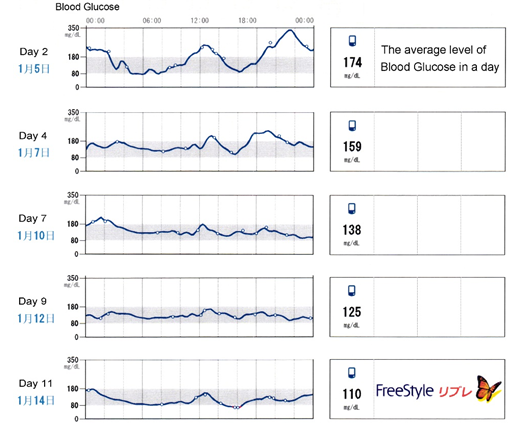
Figure 1 Blood Glucose variability by Free Style Libre from day 2 to day 11.
According to the results of Figure 1, the relationship between blood glucose value at any moment and symptom/sign can be studied. She felt a little thirsty at 2130h on day 2 with blood glucose 380mg/dL, and moderate hungry at 1600h on day 11 with blood glucose 70mg/dL. These episodes are beneficial for investigating the correlation between hyperglycemia / hypoglycemia and present symptom / sign in each patient.
Furthermore, Figure 1 showed the estimated HbA1c value which was 6.3% or 45mmol/mol. At that time, her HbA1c value was 7.8% on day 1. Thus, some discrepancy was found between the actual HbA1c value in the out clinic and that calculated by the FreeStyle Libre.
Continuous Glucose Monitoring (CGM)
Recently, Continuous Glucose Monitoring (CGM) system has been introduced in the medical practice as a sensor-based device for blood glucose monitoring.16 It is the Free Style Libre, which was produced by.16 From its continuous research and clinical trials for long years, it has been estimated to be simple and useful for detecting blood glucose variability. It is also beneficial for convenient and precise, as well as small size for actual clinical practice.17
This report presented 54year-old female with T1DM on multiple daily insulin injection (MDI). Her problem has been unstable blood glucose variability for several months. It included several factors, such as irregular lifestyle, persisting general malaise physiologically and various stressful situation psychologically.18
Using the useful Free Style Libre, blood variability in daily profile was studied for 14days. According to the data of CGM, blood glucose had gradually decreased. Not only the average glucose but also the fluctuation of the blood glucose was also decreased gradually.
There are some reasons why she could bring her blood glucose controlled in 10days. The possibilities were that i) her daily life became rather stable in diet, work and exercise, ii) psychological stressors were moderately reduced as to inter-personal communication, iii) the amount of carbohydrate such as bread, rice and noodles was a little decreased, iv) she can always grasp the current blood glucose variability for 24hours, just manipulating her Smartphone and v) changing levels of glucose can control her behaviors.19
As mentioned above, moving data of blood glucose calculated by CGM have definitely good opportunity to make the diabetic patient change the lifestyle. In other words, CGM can cause behavioral change for the patient, which would be greatly beneficial medically, physically and psychologically.
According to the description of CGM recommendations in the guideline-2019, it is to improve glycemic control without an increase in hypoglycemia or severe hypoglycemia.20 Its benefits will correlate with adherence to ongoing use of the device, which has the level of evidence as rank A
From the basic aspect of Free Style Libre, Updike et al. introduced the enzyme electrode method long ago.21 Consecutively, the electrodes were developed and various experiments were tried for CGM.22 The guideline of CGM has been shown and many research have continued about concerning international standardization, which are mean absolute relative deviation (MARD) and precision absolute relative difference (PARD).23,24
From clinical aspect of Free Style Libre, the beneficial point would be the easy measurement of blood glucose variability. On the other hand, there was the discrepancy between HbA1c value from the laboratory company and the estimated HbA1c value calculated by Free Style Libre from obtained blood glucose data. This phenomenon would be partly due to the fact that CGM would not detect occasional abrupt changes or spike-like elevation of blood glucose.25 There would be another reason that blood glucose is measured in every 15minutes for Free Style Libre. Consequently, further evaluation with various data accumulation would be necessary in the future.
In summary, blood glucose variability was monitored by Free Style Libre in a female patient withT1DM. Average and fluctuation of blood glucose were decreased during 2weeks. It is supposed that CGM application would bring the subject behavioral changes, leading to better diabetic control. These results are expected to be reference data in CGM study for future research.
None.
The authors declare that there is no conflict of interest regarding the publication of this article.

©2019 Bando, et al. This is an open access article distributed under the terms of the, which permits unrestricted use, distribution, and build upon your work non-commercially.