Journal of
eISSN: 2574-9943


Case Report Volume 9 Issue 3
 Ahlam Mohammad Alshami,2 Hadeel Mohammad Alshami,1 Reem Mohammad Lutf1
1Department of Dermatology, Faculty of Medicine and Medical Sciences, Sana’a University Yemen
2Department of Conservative Dentistry, Faculty of Dentistry, Sana’a University Yemen
Correspondence: Mohammad Ali Alshami, Department of Dermatology, Faculty of Medicine and Medical Sciences, Sana’a University, Sana’a 1064,Yemen, Tel 00967-733760082
Received: June 23, 2025 | Published: July 8, 2025
Citation: Alshami MA, Alshami AM, Alshami HM, et al. A case of kindler syndrome presenting with long cuticles and palmar pits in a young Yemeni girl. J Dermat Cosmetol. 2025;9(3):56-58. DOI: 10.15406/jdc.2025.09.00292
Kindler syndrome (KS), a subtype of epidermolysis bullosa, is a rare autosomal recessive genodermatosis characterized by photosensitivity, progressive poikiloderma, cutaneous atrophy, mucosal inflammation, and trauma-induced blistering. We report the case of a 3-year-old Yemeni girl who presented with bilateral atrophic skin on the dorsae of the hands, legs, and feet; oral erosions; atrophic scars; long, thick cuticles of the big toenails; and palmar pits. To date, only eight cases of KS with long and thick nail cuticles have been reported, and only one case with palmar pits has been documented.
Keywords: kindler syndrome, genodermatosis, epidermolysis bullosa, atrophic skin, long cuticle, palmar pit
KS: kindler syndrome
Kindler syndrome (KS) is a rare autosomal recessive subtype of epidermolysis bullosa (EB), with multiple cleft levels, in contrast to other EBs in which the cleft levels are defined. Since its initial description by Dr. Theresia Kindler in 1954, approximately 475 cases have been reported. These include 95 in Spain, 52 in Iran, 47 in Germany, 38 in USA, 36 in India, 36 in UK, 21 in Canada, 15 in Saudi Arabia, 15 in Japan, 14 in France, and 11 in Pakistan. It is caused by a mutation in FERMT1, which encodes the kindlin-1 protein expressed in the skin, periodontal tissue, and bowel. Clinically, acral blistering is the presenting feature in infancy and childhood, followed by photosensitivity, progressive poikiloderma, and cutaneous atrophy over time.1 Mucosal findings include mucositis, periodontal disease, labial leukokeratosis, premature tooth loss, ectropion, and urethral stenosis. Since Theresa Kindler first described the disease in 1954, approximately 250 cases have been reported.1 Herein, we report a case of KS in a 3-year-old Yemeni girl.
A 3-year-old Yemeni girl presented with a history of trauma-induced bullae on the hands and feet, followed by discoloration and thin wrinkling of the skin in these areas since birth, along with erosion of the oral mucosa. No history of similar complaints was found among family members.
Cutaneous examination revealed severely atrophic cigarette paper-like skin on the legs and dorsum of the hands and feet (Figure 1A–Figure 1D). Hyperpigmented atrophic scars mixed with hypo pigmented macules were observed in both upper arms (Figure 1D, Figure 2A). Atrophic scars were observed on the medial aspect of the left big toe and plantar surface (Figure 2B). Oral examination revealed gingival erosion and atrophic scarring on the left side of the lower lip (Figure 2D). The nails were thin, with long, thick enrolled cuticles (Figure 1C, Figure 2B). Additionally, a few pits were noted on the left palm (Figure 2C), which have not been previously reported. Based on the patient’s history and clinical findings, a diagnosis of KS was made.
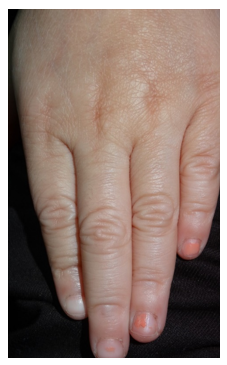
Figure 1A Wrinkled atrophic skin on the left hand.
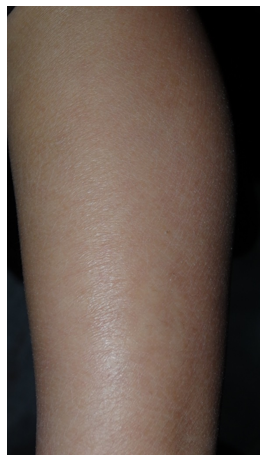
Figure 1B Wrinkled atrophic skin on the anterior surface of the left leg.
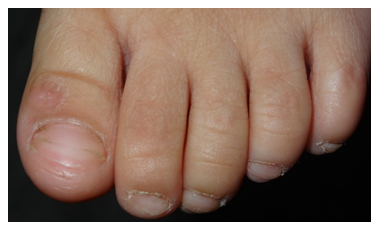
Figure 1C A pink atrophic scar on the medial aspect of the left big toe, another scar on the lateral part of the fifth toe along with atrophic cigarette paper-like skin on the dorsum of the left foot. A long cuticle is seen on the big toe along with a hyperkeratotic proximal nail fold.
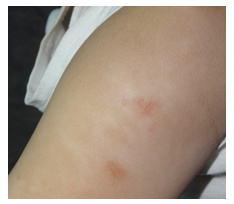
Figure 1D Lateral aspect of the left upper arm, hyperpigmented atrophic scars, and hypopigmented patches.
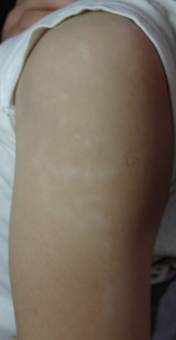
Figure 2A Hypopigmented macules and atrophic scars on the lateral aspect of the right upper arm.
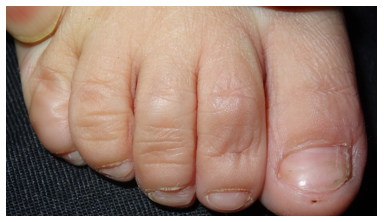
Figure 2B Wrinkled skin of the right foot, long cuticle of the large toenail, and proximally rolled hypertrophic proximal nail fold.
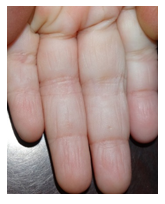
Figure 2C Palmar pit on the fourth finger of the right hand.
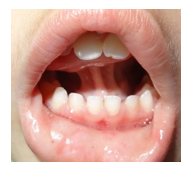
Figure 2D Erosion of mandibular gingiva and atrophic scars on right half of lower lip.
Nail involvement in KS is rare and most frequently manifests as nail dystrophy (83.6%), fragility, a thin atrophic nail plate, subungual hyperkeratosis, onycholysis, thickening and discoloration of the nail plate, yellow nails, onychodystrophy with Beau's lines, nail ridging, long thick cuticles (16.4%), and anonychia.2 Penagos et al., reported loss of the angle of the proximal nail fold.3 The presence of long cuticles in the nails has been reported in only eight cases (Table 1), whereas palmar pits have only been reported once.4
|
Year of Publication |
1st Author |
Title |
Journal |
Country |
Age/Sex |
Nr. |
Additional features |
|
2023 |
Edrees S |
Kindler syndrome. a rare case report from Syria |
Ann Med Surg (Lond) |
Syria |
13YM |
1 |
Long thick cuticle |
|
2002 |
Al Aboud K |
Kindler syndrome in a Saudi kindred |
Clin Exp Dermatol |
Saudi Arabia |
5M, 3F |
8 |
Long thick cuticle |
|
2009 |
Nath AK |
Long cuticle of the nail in Kindler's syndrome. is it more than an incidental finding |
Indian J Dermatol Venereol Leprol |
India |
31YM |
1 |
Long thick cuticle |
|
2011 |
Gupta V |
Kindler's syndrome with long thick cuticles and mottled hyperpigmentation |
Indian J Dermatol Venereol Leprol |
India |
4YF |
1 |
Long thick cuticle |
|
2018 |
Mendiratta V |
Kindler Syndrome |
Indian Pediatr |
India |
13YF, 8YM |
2 |
Long thick cuticle |
|
2023 |
Saaqib Y |
Clinical diagnosis of Kindler syndrome. a report of two cases from a district hospital in Gujranwala, Pakistan |
J Pak Assoc Dermatol |
Pakistan |
35YM, 40YF |
2 |
Long thick cuticle |
|
2024 |
Ahmed A |
Battling a rarity. A case of kindler syndrome from a Developing country |
SAGE Open Med Case Rep |
Pakistan |
33YM |
1 |
Long thick cuticle |
|
2025 |
Munawar H |
Kindler Syndrome. A case report from a Developing country |
Clin Case Rep |
Syria |
35YF |
1 |
Long thick cuticle |
|
Total |
17 |
||||||
|
Male |
10 |
||||||
|
Female |
7 |
Table 1 Reported cases of KS with long and thick nail cuticle
Changes in the nail cuticle have rarely been reported. Thomson et al., reported attenuated cuticles in a 37-year-old man with KS,5 while Aboud et al., reported long and thick cuticles in members of a Saudi Arabian pedigree with KS.6 The patient described in this report had thick cuticles that rolled onto the proximal nail fold in multiple toenails, which was unique to our case, in contrast to the findings described by Aboud et al., in which the nail plate was thin and lamellated. Van Osch et al., reported that the long cuticle of the nail (described as a high cuticle) had a smooth appearance in patients with keratosis follicular is spinulosa decalvans.7 The presence of long and thick nail cuticles in this case is consistent with findings in previous reports; however, the presence of palmar pits is extremely rare. Clinicians should be aware of such rare presentations to facilitate early diagnosis and management.
We present the first documented case of KS in Yemen, presenting with rare manifestations such as long, thick cuticles, and the extremely rare finding of palmar pits.
None.
The authors declare there is no conflict of interest.
None.

©2025 Alshami, et al. This is an open access article distributed under the terms of the, which permits unrestricted use, distribution, and build upon your work non-commercially.