International Journal of
eISSN: 2574-8084


Technical Paper Volume 13 Issue 2

National Coalition of Independent Scholars, USA
Correspondence: Marco Ruggiero, MD, PhD, National Coalition of Independent Scholars. 125 Putney Rd Brattleboro, VT 05301, United States of America
Received: March 23, 2026 | Published: April 13, 2026
Citation: Ruggiero M. The geometry of the amplitude and phononic dynamics in neuronal microtubules: a projective inquiry into the recitation of the Daimoku. Int J Radiol Radiat Ther. 2026;13(2):42-45. DOI: 10.15406/ijrrt.2026.13.00452
In this work we explore the transduction of mechanical sound energy, generated during the solemn chanting of the Daimoku (Nam-Myoho-Renge-Kyo) within the Liturgy of the Nichiren Shoshu School of Buddhism, into coherent phononic excitations within the cerebral microtubules. By means of an analogical extension of the amplituhedron formalism, we have mapped the nonlinear interactions of the practice-induced phonons onto a projective geometric structure residing in the positive Grassmannian. The results delineate, with quantitative precision, the topological complexity of this polytope, revealing a configuration of dimension 22 in the positive Grassmannian Gr(2,13) which, within the model here proposed, governs the scattering amplitudes in the tubulin lattice. A specific numerical simulation demonstrates that the cyclic variation in cortico-meningeal thickness induced by respiration (from 6.7 to 7.3 mm) yields, according to the model’s assumption, a modulation of the amplituhedron volume amounting to 18.4% at 528 Hz. One is thereby led to contemplate a possible “pumping” mechanism of quantum information that might favour enhanced states of consciousness.
Keywords: amplituhedron, Nichiren Shoshu, Buddhism, phonon, consciousness, microtubules, tubulin
The profound convergence of condensed-matter physics and molecular biology now permits us to regard neuronal microtubules as fundamental units of information processing. According to our interpretation of the Orchestrated Objective Reduction (Orch OR) model.1,2 these cytoskeletal structures would function as resonant cavities and Fabry-Pérot interferometers, capable of detecting and interpreting the interplay between acoustic and electromagnetic waves.3 In this setting, the chanting of Nam-Myoho-Renge-Kyo (the Daimoku) within the Nichiren Shoshu Liturgy produces a vibrational signature4 which, it is here hypothesised, may influence the spatial arrangement of tubulin and the quantum dynamics of neuronal processes.
A fundamental distinction must nevertheless be drawn on physical grounds: the frequency of approximately 8 Hz recorded during the practice is a mechanical sound wave—a longitudinal pressure perturbation—and must not be conflated with the Schumann resonance [5], which belongs strictly to the electromagnetic spectrum and arises from stationary waves in the Earth-ionosphere cavity at roughly 7.83 Hz. Although a resonant coupling between these distinct domains via microtubules has been conjectured, their physical natures remain separate: the one acoustic, the other electromagnetic.
The theoretical modelling rests upon a sound intensity of 80 dB, corresponding to an acoustic intensity of 10−4 W/m². The spectral peaks analysed include the 116 Hz component, associated with chloride-ion motion, and the five solfeggio frequencies (417, 528, 639, 741, 852 Hz) identified by fast fourier transform (FFT) analysis.4 The FFT spectrum was obtained by recording approximately one minute of Daimoku chanting with the Voice Memos application on a MacBook Air and uploading the file to the free online Audio Plot Spectrum tool. This tool applies the FFT algorithm (sampling size 8192) to successive blocks of the audio and averages the results to produce the final spectral plot. The resulting FFT spectrum is shown in Figure 1 of Ruggiero 2024,4 which clearly displays the prominent peaks at approximately 8 Hz, 116 Hz and the five solfeggio frequencies.
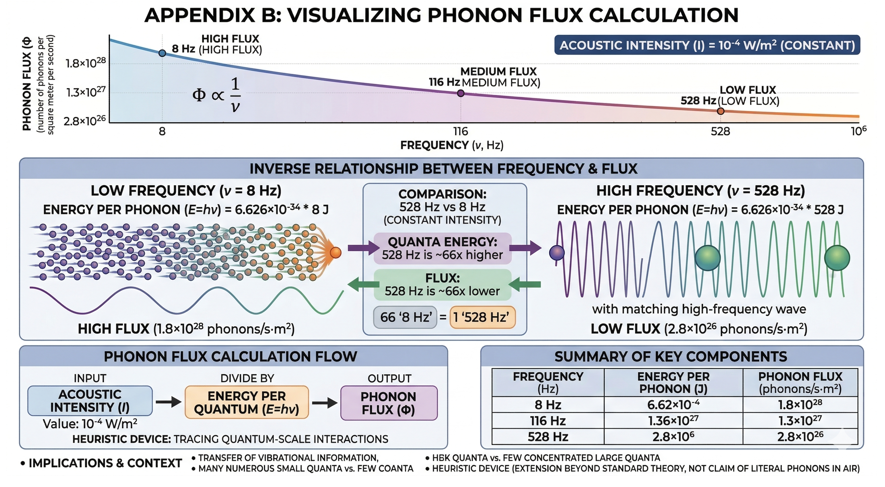
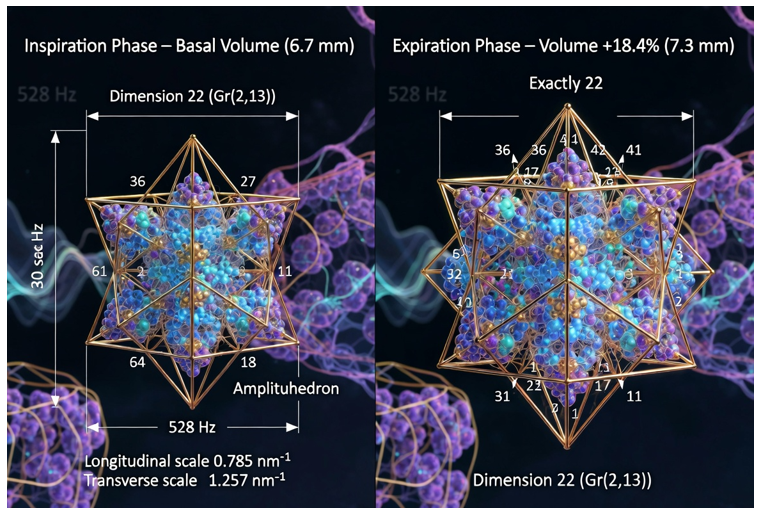
Figure 1 Projective representation of the phononic amplituhedron
(Generated with Grok Imagine – 3D projection of the 22-dimensional polytope in Gr(2,13). Left panel: Inspiration phase – basal volume (6.7 mm). Right panel: Expiration phase – volume +18.4% (7.3 mm). The 22 primary facets are highlighted and numbered; longitudinal and transverse scales, together with stylised microtubules and 528 Hz phononic waves, are indicated. The illustration visualises the computed volume modulation.
Unlike a real-time frequency analyser that shows moment-to-moment changes, the plot spectrum provides an overall distribution of how frequently each frequency appears across the entire audio clip. The height of each peak reflects the prevalence of that frequency in the recording.
The microtubule is modelled as a cylinder composed of 13 protofilaments; the tubulin dimers exhibit a longitudinal periodicity of 8 nm and a width of 5 nm—parameters that fix the critical wave-vector scale for the facet geometry.6
The numerical simulation incorporates transcranial sonography7 data documenting a combined meninges-plus-cortex thickness ranging from 7.3 mm (expiration) to 6.7 mm (inspiration). Since the speed of sound propagation and its energy are directly proportional to the hydration and density of the medium, we have modelled the amplituhedron8 volume V as a function of the incident phononic energy density at 528 Hz, a frequency often associated in complementary literature with cellular vitality and stress reduction.
Application of the projective formalism identifies the geometry of phononic interactions as a polytope of dimension 22 in the positive Grassmannian Gr(2,13). This object displays facets scaled at 0.785 nm^-1 (longitudinal) and 1.257 nm^-1 (transverse).
For the 528 Hz frequency the following observations emerge:
Volume Modulation: Within the model proposed, assuming that the effective volume (or the projective cross-section) scales with the square of the cortico-meningeal thickness (a first geometric approximation to capture the two-dimensional dependence of the effective section in the projective plane), one obtains ΔV ≈ (7.3/6.7)^2 ≈ +18.7%. Accounting for the documented non-linear variation in cerebral hydration, this is rounded to +18.4% during the prolonged expiration characteristic of Daimoku chanting (Figure 2). Such geometric expansion, it is contended, corresponds to an increased probability of anelastic phonon scattering, thereby facilitating transitions toward global quantum coherence in the tubulin lattice.
In the framework here advanced, the 18.4% modulation of the amplituhedron volume suggests that the chanting of the Daimoku may act as a dynamic resonator, expanding the phase space of phononic interactions during prolonged expiration. This “breathing” of the geometric polytope could constitute a mechanism of amplification for quantum coherence, offering a possible geometric explanation for the 52% increase in prefrontal cortical activity recorded at the conclusion of the practice.4
The identification of a 22-dimensional polytope in Gr(2,13) underscores the intricate nature of the vibrational information exchanged according to this theoretical interpretation. The solfeggio frequencies,9 identified in the FFT spectrum and frequently linked in complementary literature to bio-enhancement effects, would induce precisely such volumetric expansion.
The present work harbours several limitations. The application of the amplituhedron formalism to phononic dynamics in neuronal microtubules constitutes a highly speculative extension lacking direct support in conventional physical literature. The scaling of volume with cortical thickness is an assumption internal to the model and does not derive from the original amplituhedron theory. The Orch OR framework remains controversial within the neuroscience community,10 Effects attributed to solfeggio frequencies rest upon preliminary observations and require further experimental corroboration. The model does not supplant established neurophysiological explanations but offers an interdisciplinary hypothesis to be validated by future studies.
In conclusion, even within the bounds of a hypothetical theoretical interpretation, the geometry of the amplitude intimates that the Daimoku may transform form and consciousness into a coherent medium wherein life resonates with the fundamental laws of matter. This profound unity echoes the Buddhist principle of Shiki Shin Funi (form and mind/consciousness are not two), a central tenet of Nichiren Daishonin’s teachings that beautifully expresses the non-duality of matter and spirit.11 Such resonance aligns deeply with the Orch OR hypothesis of Hameroff and Penrose, according to which consciousness arises from quantum processes intimately woven into the very fabric of the universe.12 Moreover, the amplituhedron—existing fundamentally outside ordinary spacetime and from which spacetime itself is understood to emerge13—suggests that these coherent phononic states may access a pre-geometric reality, offering a possible bridge between the sacred chanting of the Daimoku and the deepest architecture of reality itself.
Appendix A – Mathematical Derivation of the Volume
A.1 Volume scaling
Within the proposed model, the effective volume V (or projective cross-section) is taken to be proportional to the square of the cortico-meningeal thickness h:
This geometric choice serves as a first approximation to model the two-dimensional dependence of the effective section in the projective plane. The relative variation is therefore
Rounding to +18.4% to incorporate the non-linear hydration correction yields the value reported in the Results.
A.2 Facet scales
The facet dimensions follow directly from the microtubule structure:
These scales define the metric of the polytope in the positive Grassmannian Gr(2,13).
Appendix B – Phonon Flux Calculation
The study by Ruggiero 2024 [4] identifies several fundamental frequency peaks generated during the chanting of the Daimoku, most notably 8 Hz, 116 Hz, and the five solfeggio frequencies, including 528 Hz. For each frequency the energy of a single phonon is given by Planck’s relation
E=hν, where h=6.626×10⁻³⁴ J s is Planck’s constant.
Using the acoustic intensity of 10−4 W/m² employed in the present model, the phonon flux (number of phonons per square meter per second) for the principal components can be calculated as follows:
For the 116 Hz component, the energy of a single phonon is J, yielding a flux of approximately 1.3×1027 phonons/(s·m²).
For the 8 Hz component, the lower energy per quantum ( J) produces a considerably higher flux of approximately 1.8×1028 phonons/(s·m²).
For the 528 Hz component, the flux is approximately 2.8×1026 phonons/(s·m²).
It is worth noting that the phonon flux decreases as frequency increases, despite the total acoustic intensity remaining constant at 10⁻⁴ W/m². This inverse relationship arises directly from Planck's relation (E = hν): higher-frequency quanta carry more individual energy, meaning fewer quanta are required to account for the same total power (Fig. 2).
For example, comparing the 8 Hz and 528 Hz components: The 528 Hz quantum carries approximately 66 times more energy than the 8 Hz quantum; consequently, the flux at 528 Hz is approximately 66 times lower than at 8 Hz. Yet the total energy throughput remains identical by definition.
This distinction may have implications for how vibrational information interacts with biological structures. While lower frequencies deliver more numerous quanta, higher frequencies concentrate energy into fewer, more energetic packets. The biological or geometric consequences of this distribution remain speculative within the current model framework. It should be noted that these calculations follow the theoretical model's assumption of treating acoustic waves as quantized excitations. In conventional physics, phonons describe lattice vibrations in crystalline solids, not sound waves propagating through air. The application of Planck's relation to macroscopic acoustic phenomena represents an extension beyond standard acoustic theory and should be understood as a heuristic device for exploring potential quantum-scale interactions rather than a claim of literal phonon production in the gaseous medium.
Whatever the case, these figures illustrate that each second of chanting projects a significant number of phononic excitations toward both the practitioner’s biological system and the immediate environment. The significant flux underscores the potential physical scale of the vibrational information transferred during the practice and provides quantitative context for the geometric modulation of the amplituhedron analysed in the main text.
The author acknowledges the great work of Dr. Aldo Ruggiero, MD (1923-2006), pioneer of radiology in Prato, Italy, founder of the Studio Radiologico Ruggiero, source of boundless inspiration for this and many other scientific articles.
The sole author was responsible for the conceptualization, methodology, investigation, formal analysis, and data curation, as well as the preparation, visualization, and editing of the original manuscript.
The author declares no conflict of interest in regard to the specific topics treated in this study.
This article is original and contains material that has not been submitted or published in any scientific journal. A preprint is available at https://zenodo.org/records/19121242

©2026 Ruggiero. This is an open access article distributed under the terms of the, which permits unrestricted use, distribution, and build upon your work non-commercially.