International Journal of
eISSN: 2574-8084


Research Article Volume 12 Issue 6
 Miguel Ramalho2
1 Richard Semelka Consulting, PLLC, Chapel Hill, USA
2Department of Radiology, Hospital da Luz, Portugal
Correspondence: Richard Semelka, MD. Richard Semelka Consulting, PLLC, 3901 Jones Ferry Road, PLLC, Chapel Hill, North Carolina Chapel Hill, NC 27516, USA, Tel 919-602-8792
Received: November 15, 2025 | Published: December 1, 2025
Citation: Semelka RC, Ramalho M. Effective cure with iv DTPA in gadolinium deposition disease sufferers. Description of factors. Int J Radiol Radiat Ther. 2025;12(6):161-166. DOI: 10.15406/ijrrt.2025.12.00440
Purpose: The occurrence of effective cure for Gadolinium Deposition Disease (GDD) is evaluated in patients undergoing DTPA chelation therapy for the disease.
Methods: Patients who had undergone DTPA chelation for GDD between July 2018 - Aug 2023 were included in this report. Entry was based on their medical records that showed their perceived improvement was at least 80% back to normal. A survey was developed that included factors commonly reported by patients treated in one clinic to determine if these effectively cured individuals had certain features in common, and lacked others. The anonymized survey was emailed to these individuals by the principal treating physician, the only investigator not blinded to the subjects. This report describes clinical documentation of patient status and their underlying factors in individuals treated by the primary author, and no research was performed. The survey was sent to sixteen individuals; Fourteen patients completed it (10 females; 41.1 ± 11.2 y/o).
Results: The most common factor was the administration of ≤5 lifetime doses of a Gadolinium-Based Contrast Agents (GBCA) (12/14). Individual agents that triggering GDD alone were seen in nine subjects. Most subjects (12/14) initiated chelation in the first year after the causative GBCA, and most (11/14) underwent ≤ 10 chelations with DTPA. Good health care status prior to MRI was observed in 5 subjects. The majority (11/14) described their immune status as strong. Severe physical disability prior to chelation was seen in 1.
Conclusions: Subjects with GDD can experience effective cure with IV DTPA chelation. Factors surveyed that predict effective-cure are:i) the start of chelation in the first year, ii) few GBCA administrations, and iii) good health status before MRI with GBCA injection. Nonetheless, a few patients with predictors of less successful outcomes still experienced effective cure.
Gadolinium Deposition Disease (GDD) has been reported in the peer-reviewed literature since 2016.1 GDD represents a severe persistent reaction to the IV administration of a Gadolinium-Based Contrast Agent (GBCA) (White Sabbath book),2 and is essentially the type of reaction described as toxicity observed in other heavy metals.1-6 Other authors have published scientific studies on the entity (increase number).7-9 An alternate term has been proposed by other authors, Symptoms Associated with Gadolinium Exposure (SAGE), which acknowledges that a reaction to GBCA exists.10,11 SAGE, by its broad definition, should also include acute hypersensitivity reaction (AHR) and nephrogenic systemic fibrosis (NSF),2,6 while at the same time does not describe the principal circumstance of persistence.2
Prior reports have described the use of the currently most stable available chelator DTPA for the removal of Gd12,13 and have reported on features such as improvement14 and the increase of Gd removal following chelation compared to pre-chelation.14-17
GDD is characterized by a constellation of symptoms that typically include persistent pain, cognitive difficulties, skin changes, and musculoskeletal complaints following GBCA exposure. The recognition of GDD as a distinct clinical entity has led to increased awareness among clinicians and patients, prompting efforts to identify effective therapeutic interventions. Understanding the predictors and mechanisms underlying effective cure remains crucial for optimizing patient outcomes and guiding clinical decision-making.
No prior report has described whether chelation results in an adequate return to health status before GBCA injection. This report presents patient factors observed in individuals who experienced effective cure of GDD with DTPA chelation therapy.
Patients
The individuals described in the manuscript were clinical patients receiving standard medical care, not research subjects. As with all clinical practice, patients paid for their own treatment. This is not considered a competing financial interest in clinical research reporting. This report describes clinical documentation of patient status and underlying factors, and no research was performed. All clinical work and reporting were done using the best practices and conducted strictly following the recommendations from the Declaration of Helsinki.18 Patients were selected who had either completed chelation or were ongoing chelation by the principal author, who was also directly involved in their care, in whom medical records and subjective perception showed they were at least 80% back to normal. Individuals who had not improved substantially based on the principal author's direct assessment were not asked to participate in the survey. Three individuals who did appear substantially improved by the principal author did not take part in the survey as they reported that they did not feel they were 80% back to their former selves. All patients provided verbal consent to have their anonymized data published.
The primary physician emailed these individuals an anonymized survey to complete (Figure 1). The primary physician was the only investigator aware of their identity.
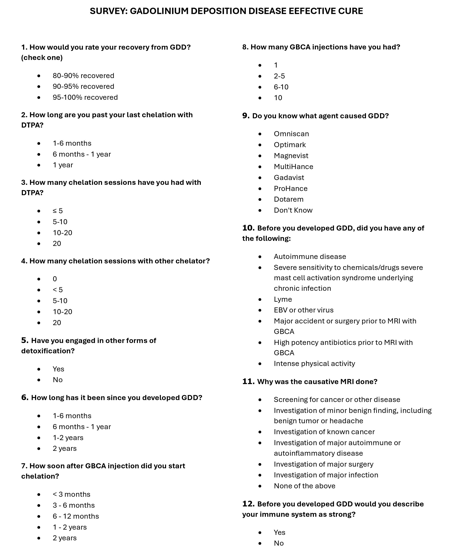
Sixteen patients who self-reported a return to at least 80% were emailed the survey, and 14 completed it (10 females, 4 males; 41.1 ± 11.2 y/o). All subjects were made aware that the survey was intended for publication. This report does not present a comprehensive list of all subjects seen by the primary physician who may have experienced effective cure but represents individuals who self-report to improve by at least 80% and maintained relatively close contact with the primary physician.
Tables 1-3 contain the demographic and the complete survey information on the patients.
|
|
|
|
|
Subjects |
Age |
Gender |
|
1 |
46 |
M |
|
2 |
40 |
M |
|
3 |
57 |
F |
|
4 |
48 |
F |
|
5 |
28 |
F |
|
6 |
29 |
F |
|
7 |
37 |
F |
|
8 |
45 |
F |
|
9 |
45 |
F |
|
10 |
61 |
F |
|
11 |
22 |
F |
|
12 |
38 |
M |
|
13 |
49 |
M |
|
14 |
31 |
F |
|
|
|
|
Table 1 Age and gender of subject
|
|
|
|
|
|
|
|
|
|
|
|
|
|
|
|
|
|
|
|
|
|
|
|
|
|
|
|
|
|
|
|
|
|
|
|
|
Subjects |
How would you rate your recovery from GDD? |
How long are you past your last chelation with DTPA? |
How many chelation sessions have you had with DTPA? |
How many chelation sessions with other chelator? |
Engaged in other forms of detoxification? |
How long has it been since you developed GDD? |
How soon after GBCA injection did you start chelation? |
How many GBCA injections? |
Do you know what agent caused GDD? |
|
|
1 |
80-90% |
6 months- 1 year |
5 to 10 |
0 |
no |
> 2 years |
6 - 12 months |
1 |
MultiHance |
|
|
2 |
80-90% |
1-6 months |
5 to 10 |
5 to 10 |
yes |
> 2 years |
1-2 years |
6 to 10 |
MultiHance |
|
|
3 |
90-95% |
> 1 year |
< 5 |
0 |
no |
> 2 years |
< 3 months |
2 to 5 |
Gadavist and Dotarem |
|
|
4 |
90-95% |
1- 6 months |
> 20 |
0 |
no |
> 2 years |
1 - 2 years |
> 10 |
Optimark and Gadavist |
|
|
5 |
80-90% |
> 1 year |
5 to 10 |
0 |
yes |
> 2 years |
3 - 6 months |
2 to 5 |
MultiHance |
|
|
6 |
80-90% |
6 months - 1 year |
< 5 |
0 |
no |
1 - 2 years |
6 - 12 months |
2 to 5 |
Dotarem |
|
|
7 |
80-90% |
1-6 months |
10 to 20 |
0 |
yes |
1 - 2 years |
6 - 12 months |
2 to 5 |
Dotarem |
|
|
8 |
80-90% |
6 months - 1 year |
< 5 |
> 20 |
yes |
> 2 years |
< 3 months |
2 to 5 |
Magnevist |
|
|
Unknow |
||||||||||
|
9 |
90-95% |
1-6 months |
5 to 10 |
0 |
yes |
> 2 years |
6 - 12 months |
2 to 5 |
Gadavist |
|
|
10 |
80-90% |
1-6 months |
< 5 |
0 |
no |
1-6 months |
< 3 months |
2 to 5 |
MultiHance |
|
|
and |
||||||||||
|
Magnevist |
||||||||||
|
11 |
90-95% |
1-6 months |
< 5 |
0 |
yes |
6-12 months |
3 - 6 months |
1 |
Gadavist |
|
|
12 |
80-90% |
1-6 months |
5 to 10 |
0 |
yes |
6-12 months |
3 - 6 months |
1 |
Gadavist |
|
|
13 |
80-90% |
6 months - 1 year |
< 5 |
0 |
yes |
6-12 months |
6 - 12 months |
1 |
Dotarem |
|
|
14 |
80-90% |
> 1 year |
< 5 |
0 |
no |
> 2 years |
< 3 months |
2 to 5 |
ProHance and Dotarem |
|
|
|
|
|
|
|
|
|
|
|
|
|
|
|
|
|
|
|
|
|
|
|
|
|
Table 2 Findings related to subject's condition and GBCA enhanced study
|
Subjects |
Before you developed GDD, did you have any of the following: |
Why was the causative MRI done? |
Before GDD, would you describe your immune system as strong? |
|
1 |
Major accident, or surgery prior to MRI with GBCA |
Investigation of minor benign finding, including benign tumor or headache |
yes |
|
2 |
Major accident or surgery prior to MRI with GBCA |
Screening for cancer or other disease |
yes |
|
3 |
Autoimmune disease |
Screening for cancer or other disease |
no |
|
4 |
None |
Investigation of minor benign finding, including benign tumor or headache |
yes |
|
5 |
Major accident or surgery prior to MRI with GBCA |
Investigation of major surgery |
yes |
|
6 |
None |
Investigation of minor benign finding, including benign tumor or headache (heart) |
yes |
|
7 |
Other |
Investigation of minor benign findings, including benign tumors or headache |
yes |
|
8 |
Severe sensitivity to chemicals/drugs. Severe mast cell activation syndrome. EBV or another virus. Major accident or surgery prior to MRI with GBCA |
Investigation of major surgery |
no |
|
9 |
MTHFR gene mutation |
Investigation of minor benign finding, including benign tumor or headache |
yes |
|
10 |
EBV or another virus |
None of the above |
yes |
|
11 |
Lyme |
Investigation of major autoimmune or autoinflammatory disease |
yes |
|
12 |
Severe sensitivity to chemicals/drugs, Major accident, or surgery prior to M MRI Ri with GBCA, High potency antibiotics prior to MRI with GBCA |
Screening for cancer or other disease |
yes |
|
13 |
Other |
Investigation of minor benign finding (back pain) |
yes |
|
14 |
Autoimmune disease, severe sensitivity to chemicals/drug |
Investigation of major surgery |
no |
Table 3 Pre-GDD health history and clinical context of GBCA exposure
Most subjects (8/14) received 2-5 GBCA doses, and four subjects received only 1 GBCA.
Twelve subjects initiated chelation sessions in the first year after the causative administration of a GBCA. Four subjects initiated chelation < 3 months after the triggering GBCA, three between 3-6 months, five between 6-12 months, and two between 1-2 years.
Individual (unconfounded) agents alone triggering GDD were seen in 9 nine subjects (MultiHance in 3, Dotarem in 3, and Gadavist in 3).
Two subjects underwent previous chelation with other agents without satisfactory results.
Eleven subjects underwent ≤ 10 chelation sessions with DTPA.
Good health care status prior to MRI was observed in five subjects. Eight subjects engaged in other forms of detoxification. The majority (11/14) described their immune status as strong. Severe physical disability prior to chelation was seen in one.
This report shows that effective cures are attainable with DTPA chelation for GDD. Although the majority who experienced effective cure had 3 or fewer GBCA injections, effective cure was still observed in those with > 5 GBCA doses. This is important, as individuals with other similar diseases, such as fibromyalgia or stiff person disease, can be managed with medical care but not treated to effective cure.19 The second important observation is that most subjects who experience effective cure began chelation < 12 months after the development of GDD.
Not surprisingly, most effective cures occur in individuals who received few lifetime GBCA administrations. Possible explanations include: 1) the total body Gd burden is relatively low, hence easier to remove the bulk of retained heavy metal, and 2) in individuals who have received multiple GBCA injections, each subsequent GBCA injection makes the condition worse, hence the severity of disease in generally worse in those who received multiple GBCAs.6 It is also an expected outcome that individuals who were in general good health prior to GBCA injections (for example, one individual who received multiple GBCA injections to follow a small intracranial meningioma) should also be more likely to return to good health with DTPA chelation.
The term effective cure has been used in this report and not cure. This reflects that GDD is an Immune Mediated Inflammatory Disease that results in Immune System Dysregulation, and therefore persistent deficits in the immune system are expected, and that even with chelation, Gd is not entirely removed due to the durable nature of bone deposition, which is the largest reservoir. In many respects this results in the same circumstance as observed with many viruses, with Herpes as the best example. We anticipate that Flares may still be observed in the future for individuals with effective cure, but this is generally very manageable. This has been observed in our 9 year experience with treating GDD.2
A critical observation with treatment is that individuals successfully treated stay on a schedule of chelation every 1-4 weeks is essential, regardless of whether the Flares are severe. This reflects the pattern of deposition in the body, with the skeleton representing the largest and most durable reservoir. As primary removal from bone is more challenging, even with a high affinity chelator like DTPA, effective bone removal makes use of le Chatelier’s principle, everything strives to be in equilibrium. Therefore step-wise transfer of Gd from bone back to soft tissues occurs between chelation sessions, and generally 5 is the fewest number of chelation sessions to achieve sufficient bone, hence total body, Gd removal.2
Optimistic findings in our report for the larger population of sufferers are that even individuals who received multiple injections or who were significantly disabled at the time of chelation start may also achieve effective cure from the disease. Two such individuals described themselves as > 95% recovered. They underwent a considerable number of chelations (> 10 as reported in the study, but > 50 by personal interview with primary investigator), and severe Flare reactions complicated their treatment course, especially in the early stage of treatment. However, it must be noted that they did not receive concurrent steroid administration for the majority or all of their chelations, which is essential to dampen the Flare reaction.6,14,15,20 The approach we have employed for the last five years is to start chelation at a lower level of volume (2.5 ml of chelator, compared to the standard volume in the marketed product of 5 ml) of just Zn-DTPA combined with 125 mg iv solumedrol with a subsequent oral steroid and antihistamine taper. The volume of the chelator is increased to 1 vial Ca-DTPA day 1 and 1 vial Zn-DTPA day 2, and the amount of steroid decreased, with further chelation, based on the individual's tolerance to Flare reactions.
Limitations of this report include that this is a descriptive work documenting clinical experience and not a controlled research study. However, it has become appreciated in the medical literature that real-world experience is a powerful method to evaluate the success of various treatments.2,21 Nonetheless, an RCT comparison with alternative treatment methods, most appropriately with potent Gd chelators such as HOPO, but including no treatment at all, has yet to be studied, which will be critical. The principal explanation is that treatment for GDD is still in its early stages, and the authors report their clinical experience with a treatment regimen that makes the most empirical sense of available treatments. If a substance is embedded in the body and is making the individual unwell, the primary treatment should be the removal of that substance.2,6,15 Alternative science-supported treatments have not been reported in the literature, so alternative therapies are not used in the treating clinic for patient care. The study also did not use standardized documentation of certain features, such as standard pain assessment. The explanation is that the range of symptoms experienced by patients is so broad (eg: pain, brain fog, fasciculations, instability) that the full documentation would be unwieldy and difficult to convey intelligibly in a single report that the authors requested a global evaluation Global evaluation is commonly performed for other large groups of patients such as those with depression. For the same reason, the term ‘effective’ was employed for the response, as there are so many elements of disability that GDD causes, that ‘effective’ appears to be the most appropriate term to describe the umbrella observation of improvement.
Nonetheless, patients have reported on patient support websites that they have experienced cures with other approaches, including no specific treatment. In our opinion, it is not rare that following just a one-lifetime dose of GBCA injection, recovery without specific targeted therapy beyond support and diet does occur, as described by sufferers in online forums/ support groups and direct communication with the principal author. We postulate that what is occurring in these individuals is that their immune system eventually calms down on its own. In fact, as we perform IV chelation DTPA, we aim to pause chelation when the individual is 80-85% improved to allow for the same effect: self-calming of the immune system despite the persistent presence of at least trace Gd. The advantage of chelation over no Gd removal and pure immune system self-calming is that the effect of chelation results in much less Gd remaining in the body, hence a much smaller quantity to serve as the impetus to inflame the body in the future from either spontaneous Flare or from further GBCA injection. Through discussion with several sufferers, most of whom received just one-lifetime GBCA injection, who opted for no chelation treatment, it appears that effective cure without specific treatment takes approximately two years. Considerable improvement without chelation following multiple GBCA injections appears exceedingly exceptional but can happen. Based on this two-year timeline, we also use this to explain to individuals who have undergone chelation therapy that when they suspend further chelation at their self-perception of 80% recovery, further spontaneous recovery to 95% or greater will eventually take approximately 1-2 years. The beneficial difference for individuals who have undergone chelation compared to those who have not is that their starting point for further recovery is at a much higher level of functioning and symptom relief than those who undergo spontaneous recovery alone, where their status is often at 20-30% of their former self, rather than 80%, as in the post-chelation group.
A further limitation of this report is that it was not designed to determine the percentage of individuals undergoing DTPA chelation therapy going on to effective cure. The explanations are several: many patients who come to the primary author's clinic travel from some distance, and our standard practice is to facilitate the patient receiving further chelation care, after their second chelation at our center, at a practice closer to where they live. The primary reasons are cost and convenience. Many individuals opt to stop chelation at a lower level of their perception of return to pre-GDD status; 70% is a level many describe, and the primary explanations appear to be the cost of treatment and convenience. Thirdly, some individuals do not continue to communicate with their treating centers, and a primary explanation is that when they are feeling better, they prefer to avoid the subject of GDD. Fourthly, individuals being chelated at other centers for further care may receive different treatment types. Hence, their status may not reflect the effect of DTPA chelation. Considering these limitations, we believe that most individuals experience substantial benefits from DTPA chelation for their care, and the primary impediment to obtaining sufficient chelation to achieve 80% recovery appears to be the cost of the treatment. In general terms, though, the findings from our clinic experience should provide hope to patients that the disease is highly treatable.
It should be emphasized that this population of patients reported herein does not represent the total number of patients who have achieved effective-cure or will achieve effective cure; many patients have started chelation whose trajectory will likely accomplish that goal. A final point is that even those who have received multiple GBCA injections will still show substantial improvement with chelation, even if they do not achieve the goal of 80% recovery. A few patients were requested to enter this report because of their considerable improvement. However, they declined because although their recovery was substantial, they felt they did not hit the mark of 80% recovery.
Since GDD is often an “invisible disease” defined almost entirely by symptoms, doubts remain even to this day as to whether it is a real clinical condition (23-26). The most crucial evidence arguing in favor of its existence is the findings of causation from GBCA administration: i) in the present and prior reports, patients described that GDD onset occurred shortly after administration of a GBCA, ii) Gd has been demonstrated in the urine of GDD patients some months after GBCA injection,1,3-5 iii) removal of Gd with DTPA chelation has been shown on pre- and post-DTPA chelation 24 hour urine samples,4,14-17 iv) patients have shown improved symptoms following chelation.14 v) with continued chelation, individuals can experience effective cure (this present report). In contrast, with Nephrogenic Systemic Fibrosis, this level of proof was never attained, as removal of the purported causative agent of disease was never shown, nor, more importantly, with continued removal of the causative agent effective cure achieved; and vi)1most patients in this report underwent ≤ 10 chelations. Our extended clinical experience is that to achieve effective cure generally requires 5 chelation sessions for each GBCA administration.2.
In summary, subjects with GDD can experience effective cure with IV DTPA chelation. The most likely to achieve this are those with few GBCA injections, those who start chelation in the first year, and those without significant pre-existent disease of various causes. This emphasizes the imperative for healthcare workers to recognize GDD as soon as it arises, such as after the first GBCA injection, as these individuals are the most likely to recover completely.
None.
Drs. Semelka and Ramalho serve as unpaid board members of GadTTRAC, a nonprofit organization supporting patients with Gadolinium Deposition Disease (GDD). No salary, research funding, or financial benefit was received from GadTTRAC, and the organization had no involvement in the study.

©2025 Semelka, et al. This is an open access article distributed under the terms of the, which permits unrestricted use, distribution, and build upon your work non-commercially.