International Journal of
eISSN: 2577-8269


Research Article Volume 9 Issue 6
 Álvarez Almeyra Julian, Rodriguez Lucila Serena, Walter Lucas Martin, Frydman Judith, Di Yelsi Sergio Osvaldo
Cátedra de Anatomía de la Licenciatura de Kinesiología y Fisiatría de la Universidad de Buenos Aires, Argentina
Correspondence: Martín Dante, Cátedra de Anatomía de la Licenciatura de Kinesiología y Fisiatría de la Universidad de Buenos Aires, Argentina
Received: December 15, 2025 | Published: December 31, 2025
Citation: Martín, Álvarez, Rodríguez, et al. Reduced thenar muscle development: hypoplasia or atrophy associated with the presence of an anomalous flexor carpi radialis brevis muscle. A case report. Int J Fam Commun Med. 2025;9(6):165-169. DOI: 10.15406/ijfcm.2025.09.00401
Introduction: The thenar eminence is a topographic region composed of the muscles responsible for providing movement to the thumb. Insufficient development of these muscles may be caused by atrophy or hypoplasia. They differ in that, in the former, the decrease occurs in the size of a tissue or organ due to cellular reduction, and in the latter, the origin is associated with different genetic syndromes. The flexor carpi radialis brevis is a supernumerary muscle located in the forearm that has been subject of study because of its ability to cause compressive neuropathies, such as carpal tunnel syndrome.
Objectives: Provide a complete description of the anatomical varieties discovered and discuss their possible causes and atrophic or hypoplastic nature.
Case presentation: During a cadaveric dissection, the presence of an anomalous muscle, called flexor carpi radialis brevis, was observed in the distal part of the forearm, which descends through the carpal tunnel and inserts distally into the carpus. Insufficient development was also noted in the thenar muscles abductor pollicis brevis, opponens pollicis, and flexor pollicis brevis, which are innervated by the median nerve.
Conclusion: Insufficient development of the thenar musculature can commonly occur in the presence of numerous genetic syndromes, such as Cavanagh syndrome, or in the setting of neural and vascular alterations. Furthermore, in the same cadaveric specimen, the finding of an infrequent muscle called flexor carpi radialis brevis is observed; its presence has the potential to generate compressive neuropathies such as carpal tunnel syndrome. This work presents, in addition to the description of the variants found, the possibility that this anomalous muscle generated chronic carpal tunnel syndrome, producing thenar atrophy due to neural alteration and not hypoplasia in the strict sense.
Keywords: carpal tunnel syndrome, dissection, flexor carpi radialis brevis, thenar eminence, thumb, anatomic variation, muscular atrophy, median nerve neuropathy
APB, abductor pollicis brevis; OP, opponens pollicis; FPB, flexor pollicis brevis; FCRB, flexor carpi radialis brevis; CTS, carpal tunnel syndrome
The thenar eminence is a topographic region of the human body located on the lateral side of the palm of the hand. It is composed of muscles responsible for providing mobility to the thumb, namely the abductor pollicis brevis (APB), opponens pollicis (OP), flexor pollicis brevis (FPB) with its two heads, superficial and deep, and the adductor pollicis.1 The innervation of these muscles is provided by two terminal branches of the brachial plexus: the median and ulnar nerves. The APB, OP, and the superficial head of the FPB are innervated by the median nerve, while the remaining muscles are innervated by the ulnar nerve. The vascular supply to these muscles is guaranteed by the deep palmar arch and by a collateral branch of the radial artery.1 Hypoplasia, or congenital underdevelopment of these muscles, is considered a relatively rare variation in humans. The literature associates this anomaly with different genetic syndromes, the most frequent being Cavanagh syndrome, which includes alterations that affect the ulnar and median nerves, especially their motor branches.2,3 Additionally, such hypoplasia may present with vascular variations and also genetic mutations in the coding of the SALL4 gene.4–7
In contrast, atrophy is defined as a decrease in the size of a tissue or organ due to cellular reduction, which originates from the loss of organelles, cytoplasm, and proteins.8 The innervation of skeletal muscle fibers by motor neurons is essential for the maintenance of muscle size, structure, and function.9
The proper formation and development of the thenar region is highly significant, since many daily activities depend on the intervention of the thenar musculature, whose involvement is evident in the execution of manual grips that allow the individual to grasp, manipulate, and release objects, enabling them to independently perform vital daily activities such as eating and personal hygiene. The presence of a supernumerary muscle has been reported in the distal third of the forearm, of considerable size, whose location and extension coincide with the descriptions given by the French anatomist J.L. Testut, who named it radiocarpian, currently known as flexor carpi radialis brevis (FCRB), as designated by Wood in 1867.1,10 This anomalous muscle has been the subject of numerous studies due to the symptomatology it may cause, including edema and radial wrist pain, as well as its potential to provoke compressive neuropathies due to its proximity to the median and anterior interosseous nerves.11,12
The reduction in the development of the thenar muscles should be taken into account when diagnosing carpal tunnel syndrome (CTS) due to nerve compression, as motor symptoms resulting from such a reduction in motor development may be confused with this syndrome.13 At the same time, the presence of the FCRB is of particular interest to health professionals, both during surgical procedures in distal radius fractures and during carpal tunnel release surgeries, due to its location.14 Taking into account these findings, two main objectives are established. First, to provide a complete description of the anatomical variants discovered by the dissection team of the School of Kinesiology and Physiatrics of the University of Buenos Aires. Second, to discuss the possible causes of the aforementioned anomalies and hypothesize whether their nature is atrophic or hypoplastic.
At the Department of Anatomy of the School of Kinesiology and Physiatrics at the University of Buenos Aires, a routine proximal-to-distal dissection was performed on a right upper limb of an adult human, of unknown sex and cause of death. During this procedure, the skin, subcutaneous cellular tissue, and muscular fasciae were removed to observe the deep structures. Two muscular variations were noted: a supernumerary muscle in the anterior region of the forearm and reduced development of certain thenar muscles. The cadaver showed no signs of previous surgical interventions, and it is unknown whether the subject was aware of the anomalies found or whether they produced any symptoms.
Muscular variation in the anterior region of the forearm
A supernumerary muscle was observed in the forearm, identified as the FCRB. This muscle presents a proximal insertion in the distal third of the anterior and lateral surfaces of the radius, between the insertion sites of the flexor pollicis longus and the pronator quadratus muscles. Upon recognizing the significance of this finding, the team decided to continue the dissection by making additional incisions, allowing for a more detailed examination of the anatomical variant. A vertical incision was made along the transverse carpal ligament to access the carpal tunnel and observe the muscle in its full extension, making it possible to precisely identify its distal insertion site. From its proximal origin, the muscle descends almost vertically, lateral to the tendon of the flexor carpi radialis muscle and medial to the tendon of the brachioradialis, entering the lateral compartment of the carpal tunnel (Figure 1, 2). Approximately at the level of the scaphoid bone, the tendon bifurcates unevenly, giving rise to two tendinous slips of different sizes: one ulnar/medial and one radial/lateral, the latter being larger, similar to the description by Wesley Calhoun et al.14 The ulnar slip inserts into the superolateral part of the deep surface of the transverse carpal ligament, and the radial slip inserts mainly into the anterior surface of the trapezium bone and partly into the scaphoid. In addition, an abnormal bony projection of the trapezium was observed at the site of the distal insertion of the FCRB muscle. This bony structure is located anterior to the tendon of the FCRB.
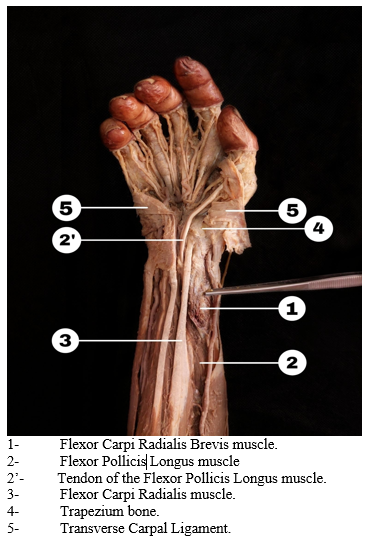
Figure 1Flexor carpi radialis brevis in situ.
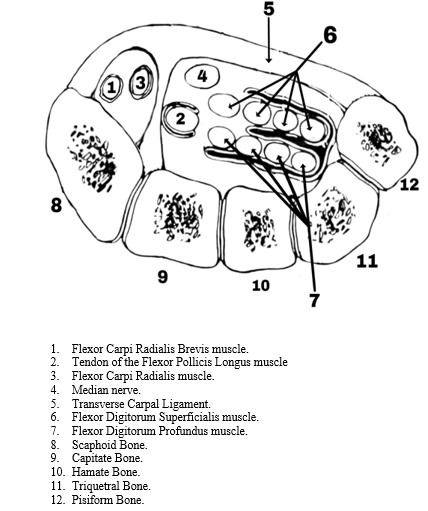
Figure 2Diagram of a transverse section of the hand modified from Bouchet.
Muscular variation in the thenar eminence
In the thenar eminence, the APB, OP, and the superficial head of the FPB were observed to be poorly developed and composed of fibrotic tissue. The remaining muscles of the hand showed no particular features (Figure 3). No vascular variations were identified, and the metacarpal and phalangeal bones were within normal size limits.15,16 Regarding neurological variations, the recurrent branch of the median nerve was not visualized, however, it is not possible to ascertain whether its absence was the result of the dissection approach.
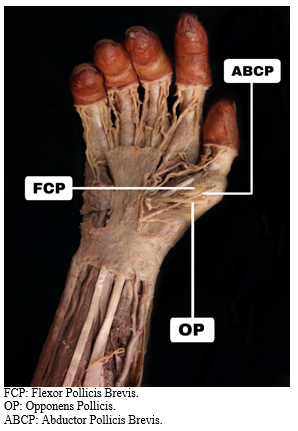
Figure 3Underdeveloped Thenar Muscles.
The discovery of muscular variations over the years has promoted the dissemination of numerous significant studies. The FCRB is a very rare muscular anomaly, with a reported prevalence between 2–8%, and no significant difference regarding side or sex.11 It is usually encountered as an incidental finding during surgical procedures for distal radius fractures, CTS, and routine dissections.17,12 Wood described the presence of a muscle extending from the radius to the transverse carpal ligament, which he named FCRB.10 Later, Akkoc RF et al.11 conducted a study involving the Turkish population. Through this analysis, they observed the presence of a muscle originating in the distal third of the anterior or anterolateral surface of the radius, between the insertions of the flexor pollicis longus and the pronator quadratus. From there, the muscle extends to its distal insertion, which may be located on the anterior surface of the trapezium, trapezoid, capitate, or at the base of the second or third metacarpal bones. A more in-depth study showed that the muscle in question was innervated by the anterior interosseous nerve, while its vascular supply came from the radial artery. Additionally, it was stated that muscle contraction could produce wrist flexion. Finally, Kang L et al.18 classified the muscle according to its distal insertion as radiopalmar, radiocarpal, radiometacarpal, or mixed, the latter being the most common variant.
Symptomatology associated with the development of this muscle is rare. However, studies show that in cases where the muscular variation is accompanied by symptoms, these are described as radial pain, edema, or compression of neighboring structures such as nerves, vessels, or tendons. These symptoms have a wide range of differential diagnoses including tendinopathies, tendon ruptures, ligamentous injury or instability, fractures, degenerative arthritis, and ganglion cysts.11 Lee YM et al.12 also associate the presence of the FCRB with compressive neuropathies, such as anterior interosseous nerve compression or CTS. The FCRB muscle is of particular interest to surgeons who perform procedures on distal radius fractures or carpal tunnel release surgeries, as the location of this muscle belly may represent an unforeseen obstacle, as well as to health professionals involved in rehabilitation.14 Case reports suggest that surgical removal of the muscle, combined with physical therapy, can improve the quality of life in patients with CTS related symptoms or overuse injuries.17
When reviewing the literature on reduced development of the thenar muscles, a wide variety of possible origins and causes is found. If its etiology is congenital (i.e., hypoplasia), the possible causes include Cavanagh, Okihiro, and/or Holt-Oram syndromes.3,1,6 In Cavanagh syndrome, thenar hypoplasia presents in isolation. However, when the muscular variation occurs together with ocular and vascular anomalies, it is attributed to Okihiro syndrome, while its association with heart disease corresponds to Holt-Oram syndrome.19,2 These latter two syndromes are caused by mutations in the SALL4 gene, which plays an important role in the development of the limbs, kidneys, neural tissue, and heart. Thenar hypoplasia may also appear secondary to other conditions, such as congenital absence of the radial artery, without skeletal deformities, and with instability in the thumb metacarpophalangeal joint.4,5
Conversely, when reduced development of these muscles is atrophic in nature, it may originate secondarily from neural alterations, such as lesions affecting the recurrent branch of the median nerve or chronic CTS.3,20–22 The fact that the latter causes sensory symptoms makes it possible to distinguish it from insufficient development of congenital origin (hypoplasia).23 Regarding its classification, Blauth established ten types of thenar hypoplasia, based on morphological characteristics, the status of anatomical structures, thumb functionality, congenital causes such as hand deformities and thumb hypoplasia, and therapeutic approaches (Table 1).24 Considering this classification, it is not possible to include the present case within any of the defined types, as the muscles affected do not match those identified by the author, and the skeletal parameters are within standard limits.15,16
|
Type I |
Minor Hypoplasia |
|
Type II |
Moderate Thumb Hypoplasia with Thenar Muscle Hypoplasia and/or Hypoplasia of the Extensor Pollicis Brevis and Flexor Pollicis Brevis |
|
Type III |
Severe Thumb Hypoplasia and/or Severe Hypoplasia of the Dynamic, Supportive, Stabilizing, and Morphological Structures of the Thumb |
|
Type IV |
Severe hypoplasia with floating thumb |
|
Type V |
Thumb Absence and Thumb Hypoplasia |
|
Type VI |
Thumb Absence and Thumb Hypoplasia with Polydactyly |
|
Type VII |
Thumb Absence and Hypoplasia with Syndactyly, Polydactyly, or Cleft Hand Deformity |
|
Type VIII |
Hypoplasia of the Entire Hand |
|
Type IX |
Thumb Hypoplasia with Cleft Hand |
|
Type X |
Thumb Hypoplasia with Constriction Ring Syndrome |
Table 1 Blauth classification24
Regarding thumb functionality in patients with underdevelopment of the thenar musculature, a degree of variability has been observed depending on the muscles involved. Sahin C et al.25 present a case report in which the patient demonstrated normal grip strength despite the absence of the APB and OP muscles, with only minimal functional impairment. This patient never experienced limitations in daily life, as minimal thumb opposition could be achieved through the FPB, which was sufficient to perform normal activities. In contrast, Kumbhare D et al.26 describe thenar hypoplasia involving the APB, OP, and both heads of the FPB, confirming reduced grip strength and impaired hand function. Parsa A et al.2 report an eight-year-old patient with complaints of fatigue, weakness, and difficulty performing fine motor tasks due to OP hypoplasia.
As our case differs from that presented by Sahin C et al.25 due to the additional underdevelopment of the superficial head of the FPB, we estimate that the thumb in the cadaveric specimen of our report was incapable of performing opposition, a movement considered to be the result of coordinated contraction of all the thenar muscles, meaning that its deficiency likely led to difficulty in executing fine motor functions, affecting activities daily activities. Magnetic resonance imaging, ultrasonography, and electromyography are the most commonly used methods to detect anatomical variations. Through inspection and palpation, such abnormalities may also be suspected, for example, flattening of the thenar region may indicate a muscular anomaly, or the presence of a firm, immobile mass that does not resemble a typical ganglion cyst and is located at the distal forearm, potentially indicating the presence of the FCRB muscle.17 Certain functional assessment techniques, such as the Kapandji test, may also be used to evaluate thumb performance.2
Regarding the poor development of the thenar eminence, we observed that the affected muscles correspond to those innervated by the recurrent branch of the median nerve. This collateral branch was not identified in the present cadaveric specimen, which could be attributed to either congenital absence or a dissection artifact. A similar case was described by Cavanagh NPC et al.,3 who also associated the absence of this nerve branch with thenar hypoplasia. Since only the isolated right upper limb of the cadaver was available for study, it was not possible to assess for additional anomalies in other parts of the cadaver that might suggest the presence of Okihiro or Holt-Oram syndromes. Additionally, no vascular abnormalities such as absence of the radial artery were found that could indicate a potential cause for the thenar hypoplasia, as reported by Fernandez D et al.4 and Hay-Man et al.5
Finally, we propose the following hypothesis regarding the association between the anatomical variations observed, namely, the presence of the FCRB muscle and the underdevelopment of the APB, OP, and superficial head of the FPB. The presence of the FCRB, along with previously cited studies by Lee YM et al.,12 Iyer VG20 and Boskovski MT et al.,21,22 suggests that this muscle may be capable of inducing compressive neuropathies. Therefore, if CTS had developed during the lifetime of this cadaveric subject, and in the absence of any surgical signs, it is possible to consider this hypothetical neuropathy as chronic. This, in turn, may have led to thenar atrophy, as described by Boskovski MT et al.,21,22 rather than a case of true hypoplasia.
The FCRB represents a rare muscular variant that seldom presents with symptoms. However, when it does, these may range from radial pain and edema to compression of adjacent structures, such as peripheral nerves, among others. Moreover, due to its particular anatomical location, it should be taken into account during surgical procedures involving the radial region of the wrist and distal forearm. The other muscular variant presented in this study, the underdevelopment of the APB, OP, and the superficial head of the FPB, has a wide range of potential causes. It may be a characteristic feature common to several genetic syndromes, such as Cavanagh syndrome, as well as the result of neural or vascular abnormalities. When one or more thenar muscles are affected, certain motor functions of the thumb will be impaired, depending on which muscles are involved, such as grip and opposition. Furthermore, according to the research carried out by the team responsible for this study, this report is the only one to describe the presence of the FCRB in association with underdevelopment of the thenar eminence in the same cadaveric specimen. Finally, the possibility was raised that the FCRB muscle may have been capable of producing chronic CTS, which ultimately resulted in true thenar atrophy rather than hypoplasia, considering the definitions and distinct etiological nature of each condition.
None.
The authors declare that there is no conflict of interest.

©2025 Martín,, et al. This is an open access article distributed under the terms of the, which permits unrestricted use, distribution, and build upon your work non-commercially.