International Journal of
eISSN: 2577-8269


Research Article Volume 9 Issue 5
 Hugo Machado Sanchez2
1Student of the Physiotherapy course at the Federal University of Jataí, Jataí, Goiás, Brazil
2Professor of the Physiotherapy course at the Federal University of Jataí, Jataí, Goiás, Brazil
Correspondence: Hugo Machado Sanchez, Professor of the Physiotherapy course at the Federal University of Jataí, Jataí, Goiás, Brazil
Received: September 01, 2025 | Published: September 24, 2025
Citation: Souza TA, Sanchez EGM, Sanchez HM. Musculoskeletal pain in manicure/pedicure: integrative review. Int J Fam Commun Med. 2025;9(5):119-123. DOI: 10.15406/ijfcm.2025.09.00392
Introduction: Work enables individuals to develop skills and apply them based on what they have learned, in order to receive compensation in return. Over the years, it has become clear that work has been causing physical and psychological strain on many professionals, leading them to adopt inappropriate postures and increase tension levels, leading to the development of musculoskeletal injuries and pain, which can be observed in the work of manicurists and pedicurists.
Objective: To identify the predominant musculoskeletal pain and conditions in manicurists and pedicurists, and their impact on their quality of life.
Methods: This is an integrative literature review, in which the bibliographic survey was conducted from July to October 2023, searching for studies in the electronic databases: US National Library of Medicine National Institutes of Health (PubMed), Latin American and Caribbean Literature (LILACS), and Google Scholar.
Results: Complaints of musculoskeletal pain were observed in various regions of the body, with complaints in the cervical region, wrist, hands, and lower back, as well as the presence of RSI and WMSDs.
Conclusion: Manicures and pedicurists present a predominance of pain in the cervical spine region, followed by pain in the wrists and hands. Furthermore, long working hours are observed, which is directly linked to socioeconomic issues, adopting inadequate postures and thus favoring the onset of pain, thus generating negative impacts on quality of life and greater well-being
Keywords: manicure, pain, musculoskeletal diseases, quality of life
Work enables the individual to develop skills and exercise them based on what has been learned. In this process, the human being performs a function of their choice that composes their identity and receives remuneration in return.1 Over the years, there has been a realization that work has been causing physical and psychological wear and tear in many professionals, leading them to adopt inappropriate postures and increase tension levels, leading to the emergence of musculoskeletal injuries and pain.2
The International Association for the Study of Pain (IASP) defines pain as "an unpleasant sensory and emotional experience associated with, or similar to, actual or potential tissue damage".3 Therefore, pain is a particular experience that varies in intensity due to biological, psychological, and social factors. Although the individual can adapt to the pain, in the long term there is a potential for it to lead to functional impairments and impaired quality of life.3
Manicure and pedicure professionals care for clients' fingernails and toenails, cutting, polishing, and painting them throughout the workday, with few breaks between appointments.1,4 These professionals can work independently in their own homes, go to the client to provide home care, or choose to work in beauty and aesthetics centers, which is more common, thus being subject to physical and mental exhaustion due to the long working hours.1
Furthermore, the positioning of workers in this area is represented by a sitting posture, performing flexion of the trunk, hips, and knees, noting that the upper limbs present slight abduction and internal rotation of the shoulder, elbow flexion, as well as the cervical spine.2 According to Garcia et al.,5 manicures and pedicures differ in the adoption of positioning during the execution of the technique, this is because due to the smaller toenails and the angulation of the lower limbs, it is necessary for the pedicure professional to perform excessive cervical and trunk flexion, for better visualization of the nails and better execution of the techniques.
Given the physical positioning of these professionals, Jorge, Dario, and Belletti1 state that such postures adopted during work and for long periods can cause greater damage to joint structures than muscle damage. Caldas and Marques4 explain that remaining seated can lead to postural changes due to muscle disharmonies, a factor that predisposes to the emergence of musculoskeletal pain.
In the study carried out by Marques et al. (2010), it is evident that the sitting posture is a dynamic activity, considered good when the dissemination of body weight occurs to the ischia and lower limbs over the seat and the ground. According to Garcia et al.,5 the posture adopted by manicurists and pedicurists resembles a kyphotic posture. In view of this, in a kyphotic sitting posture there is retroversion of the pelvis and a decrease in the curvature of the lumbar spine, where remaining in this position for long periods can lead to a reduction in the height of the intervertebral discs, due to the increase in intradiscal pressure, which may be one of the factors that can lead to pain in the spine (MARQUES et al., 2010). Therefore, the work in question aimed to carry out an integrative review in order to identify the predominant musculoskeletal pains and conditions in manicure and pedicure professionals, and their impact on their quality of life.
To prepare this study, an integrative literature review was conducted. Integrative reviews are a research tool widely used by health professionals because they are based on evidence-based practices, leading them to develop critical reasoning on the proposed topic.6,7
The study was carried out in 6 stages, following the model used by Souza, Silva and Carvalho,7 which consisted of 1) elaboration of the guiding question for research; 2) establishment of inclusion and exclusion criteria and literature search; 3) definition of the information to be extracted from the selected studies; 4) evaluation of the included studies; 5) interpretation of the results obtained and 6) presentation of the review.
The bibliographic survey was carried out during the months of July to October 2023, searching for studies in the electronic databases: US National Library of Medicine National Institutes of Health (PubMed), Latin American and Caribbean Literature (Lilacs) and Google Scholar. To obtain a more assertive search for articles, Health Sciences Descriptors (DeCS) in Portuguese, English and Spanish (Table 1) were used, and the keywords Manicure, Pedicure, Manicurist, Pedicurists, Nail Work, associated with the Boolean operators AND and OR, in the combinations “manicure” or “manicurist ” or “ nail work ” and “pedicure” or “ pedicurist ' and “cumulative trauma” and “musculoskeletal disorders” and “pain” and “quality of life”.
|
Portuguese |
English |
Spanish |
|
|
Descriptors |
Traumatic Cumulative Trauma |
Low Back Pain |
Accumulated trauma disorders |
|
Musculoskeletal Diseases |
Musculoskeletal disorders |
Musculoskeletal Diseases |
|
|
Pain |
Pain |
Pain |
|
|
Quality of life |
Quality of life |
Quality of Life |
Table 1 Descriptors used in the search
To select eligible articles for the study, inclusion and exclusion criteria were followed. The inclusion criteria were: articles available electronically in full, articles published in the last 10 years, and articles published in Portuguese, English, or Spanish. The exclusion criteria were articles that did not address the topic addressed by this review and duplicates.
After searching the databases, a total of 304 articles were obtained, which, when subjected to thorough analysis, remained 12 articles eligible for the study. Table 2, Figure 1, 2 presents the findings of the main painful areas in the articles filtered in the search.
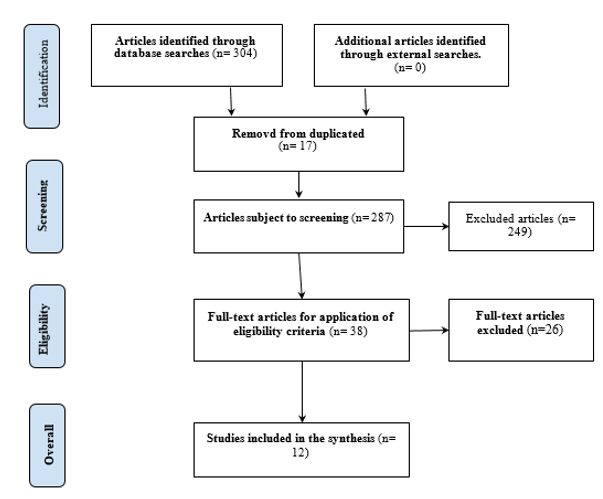
Figure 1 Article selection flowchart.
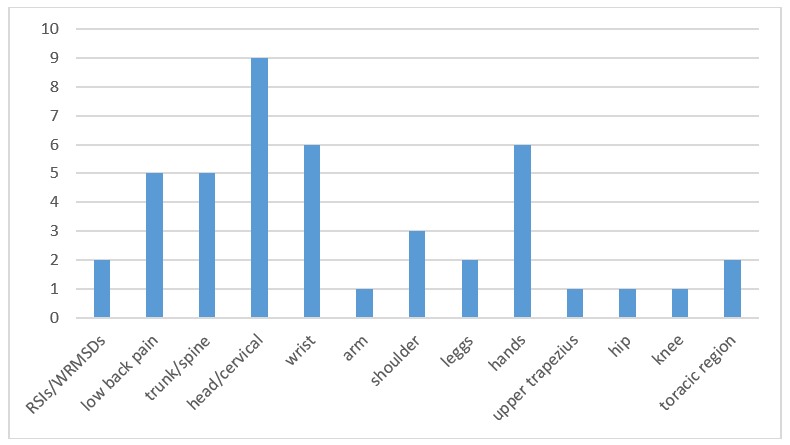
Figure 2 Findings of the main painful areas according to the articles filtered in the search.
|
Title |
Year/Country |
Study model |
Objective |
Main findings |
|
Risk analysis of physical ergonomics of the manicurist/pedicurist workstation in a beauty studio: Case study |
2023 Brazil |
Case study |
Analyze the ergonomic risks relevant to Physical Ergonomics in manicure/pedicure activities |
Discomfort was identified predominantly in the hands and neck of the worker's dominant side of the body. |
|
Health, work and quality of life conditions of workers in beauty services and complementary and aesthetic therapies |
2018 Brazil |
Descriptive study with a quantitative approach |
Identify the health, work and quality of life conditions of workers in beauty services and complementary and aesthetic therapies and assess their quality of life |
Presence of RSI/ WMSD , musculoskeletal pain (mainly low back pain) that impacts workers' quality of life |
|
Identification of painful body regions in manicurists in the West Zone |
2021 Brazil |
Cross-sectional study |
Identify painful body regions in manicurists working in the West Zone of Rio de Janeiro |
The predominant painful regions were the spine , upper trapezius muscle, wrist, head and lumbar spine |
|
Quality of life at work: a report on manicurists |
2018 Brazil |
Quantitative, exploratory, descriptive and cross-sectional study |
Identify the quality of life of manicure and pedicure professionals |
It was identified that manicurists have a deficient quality of life, and it was found that the work interferes with other areas of their occupation. |
|
Ergonomics in manicures and pedicures: identifying the physical risks of the activity |
2017 Brazil |
Field study |
Identify musculoskeletal complaints perceived by manicure and pedicure professionals, and analyze the main physical risks of the activity |
The main pains identified were in the wrist, cervical and trunk regions, which can lead to an inability to perform work. |
|
Occurrence of spinal pain and its relationship with the quality of life of manicurists and pedicurists |
2013 Brazil |
Quantitative, cross-sectional and descriptive study |
Analyze the occurrence of spinal pain in manicurists and pedicurists and verify its relationship with quality of life |
A high incidence of musculoskeletal pain in the spine was identified backbone of manicures and pedicures |
|
Work-related musculoskeletal symptoms in manicurists and pedicurists |
2016 Brazil |
Cross-sectional field study, with a descriptive approach and quantitative nature |
Analyze the main musculoskeletal symptoms related to work in manicurists and pedicurists in the city of São Luís |
The most affected areas self-reported by manicurists and pedicurists were: cervical region, lumbar region, wrist, shoulder and leg |
|
Detailed analysis of the workplace and proposal of an ergonomic product : A case study in the aesthetics sector |
2018 Brazil |
Case study |
Analyze the ergonomic risks inherent to the workstation of manicurists and pedicurists, their consequences on health and quality of life at work, as well as propose an ergonomic product to assist in the development of their activities. |
The greatest discomfort felt was in the neck and spine, back (from the neck to the coccyx), legs, hands, wrists, pelvis and knees |
|
Quality of life at work among manicurists in a municipality in Minas Gerais, Brazil |
2023 Brazil |
Quantitative, descriptive and exploratory study |
Analyze the quality of life at work of manicurists in a municipality in Minas Gerais, Brazil |
The main areas reported were back pain, hand or wrist pain, spine and neck pain |
|
Beauty Salon: A Look at the Physical and Mental Health of Hand Care Workers |
2018 Brazil |
Exploratory qualitative study |
Identify the perception of quality of life at work, reflect on the physical and psychological health of manicurists, understand the work routine, as well as analyze what quality of life means for these professionals. |
It was concluded that manicurists manage their work routines according to their financial and physical needs, such as lunch breaks and rest. The responses revealed that professionals sometimes work excessively to meet their needs, exceeding their own limits and, on many occasions, not taking breaks between appointments. |
|
Sociodemographic profile and assessment of quality of life, bodily discomfort and physical disability in manicurists |
2013 Brazil |
Cross-sectional descriptive study |
To describe the sociodemographic profile and assess the quality of life, bodily discomfort and physical disability of manicurists. |
It was identified that manicurists are affected by bodily discomfort in several regions, with the most prevalent location being the lumbar spine, followed by the cervical spine and upper limbs. |
|
Health and safety in beauty salons: a cross-sectional survey |
2021 Canada |
Cross-sectional research |
Get to know nail technicians, their work, and their health and safety practices |
The most commonly reported musculoskeletal symptoms were neck pain (44%) and back pain (38%), and of the professionals who presented symptoms, arm pain (84%) and hand/wrist pain (64%) were more likely to be related to manicure work. |
Table 2 Table with the studies included according to title, year, country, study model, objective and main findings
The work performed by manicurists and pedicurists is of great importance, promoting greater well-being and customer satisfaction. However, many professionals report physical discomfort and fatigue after working.8 These professionals are directly susceptible to occupational hazards in the workplace, which involve physical, chemical, and biological exposures, compromising their safety.9 In this context, this review aims to identify the predominant musculoskeletal pain and conditions in manicurists and pedicurists, considering that these professionals work an average of 8 to 10 hours a day in the same position, with periods of greater customer flow, which favors physical and emotional exhaustion.10
This integrative review included 12 studies in total, observing similarities between the main musculoskeletal regions cited, considering as possible causes long working hours without breaks during care, biomechanical misalignment adopted by the worker, the execution of repetitive and precise movements by the upper limb, the absence of physical activity practices and the age group associated with the predominance of female professional.11,8,2,9 A widely used instrument, translated into different cultures and languages, is the Nordic questionnaire, in which the respondent indicates the location of the pain (on the body), its intensity and frequency.12
In the study carried out by Silva, Silveira and Robazzi (2018), 28.77% of the 73 professionals who participated in the study reported the presence of repetitive strain injuries (RSI) and work-related musculoskeletal disorders (WMSDs), the presence of musculoskeletal pain with a predominance of low back pain (31.63%) and a small number of neck pain (11.24%). These findings are in line with the study by Pereira et al.,10 where 99% of the manicurists who participated in the research had some type of RSI/WMSDs, which are considered by the vast majority to be frequent in daily life. Among the conditions mentioned, there is a prevalence in the cervical region (71%), lower back and wrist region (11%), shoulder and leg (3%).
Silva et al.13 conducted a case study in a beauty salon and used the Corlett and Manenica painful area diagram, on-site observation, and the professional's report as evaluation methods . The study by Garcia et al.5 demonstrated that the most affected areas were the wrist, cervical, and trunk, reinforcing what was found in other studies. Similarly, Caldas and Marques (2021) observed that 99.93% of the 20 manicurists in the sample reported some type of pain, with the spine being cited by 27.02% of participants, followed by the upper trapezius muscle (13.51%), wrist, head, and lumbar spine (8.1%), respectively.
A cross-sectional study conducted in Canada investigated the main complaints reported by 155 manicurists and pedicurists. The most frequent complaints were neck pain (44%) and back pain (38%), with neck pain being more prevalent than back pain among professionals who worked more than 30 hours per week. Arm pain (84%) and hand/wrist pain (64 %) were also reported by professionals, associated with the meticulous work they perform with the upper limb.9
According to Kinonte et al.,2 in their study that investigated the occurrence of pain in the spine and its relationship with the quality of life of manicurists and pedicurists, it was noted that of the 30 professionals that made up the sample, 23 manicurists reported the existence of pain, where the most reported location was the lumbar spine (63.3%), followed by the cervical spine (36.7%), dorsal spine (20%), hands (13.3%), shoulders (10%) and legs (3.3%). For Silva et al.11 in their study, the regions in which professionals reported the most discomfort were the neck (25%) and lumbar spine (25%), followed by the spine (from the neck to the coccyx) with 18.75%, legs (5%), hands (5%), pelvis (5%) and knee (5%).
In the quantitative, exploratory and descriptive research carried out by Lopes et al.,8 which investigated musculoskeletal complaints and the perception of quality of life and work, it was observed that manicurists are prone to WMSDs, citing a predominance of back pain, hand and wrist pain. In their study, Jorge, Dario and Belletti1 observed that most manicurists worked with pain, indicating that 32.0% reported back pain and used medication (32.02%).
It is also observed, in the study by Carvalho and Penha,14 that the areas where there was a predominance of discomfort and pain were in the lower back (54%), shoulder and cervical (34%), neck (27%), left shoulder (26%), right hand (23%), upper back (22%) and right wrist (21%). For Bevilaqua and Berni,15 physical exhaustion is directly linked to financial needs, because the professional sees the need to work more, not respecting the limits of the body.
In the studies included in this review, more than one complaint was reported by professionals. The most frequently cited musculoskeletal conditions were the cervical region, mentioned in nine studies, followed by the wrist and hands in six studies. The lumbar region and trunk were reported in five studies, and the shoulder was cited as a painful area in three studies. RSI/WMSDs were cited in two studies, as was pain in the chest and legs. Fewer reported cases were the arms, hips, knees, and upper trapezius muscles, mentioned in one study.
Pain in the cervical region occurs because professionals keep their head flexed for long periods to amplify the visualization of the nails, especially when doing toenails. This continuous positioning in isometry overloads the posterior neck muscles and joint structures, generating pain.13,10,11 Similar to what happens in the cervical region is observed in the lumbar region, where the positioning adopted by professionals and muscle weakness may be related to the prevalence of pain in the lumbar spine.14 It is also noted that the onset of muscular imbalances is linked to sitting posture, as it favors the emergence of shortening and changes in muscular strength, which results in changes in the physiological curvatures of the spine and consequent musculoskeletal pain.4,14
Furthermore, trunk pain was cited in five studies as one of the main complaints. This pain may be related to the inclination of the trunk associated with a non-physiological rotation, requiring muscular activity. This action, often involuntary , is performed with the aim of improving visual focus due to the perfect execution of the technique.5,11 In many cases, professionals experience discomfort during work hours because the acquired positioning causes acute pain that in the short term is not considered uncomfortable. Therefore, in the long term, this pain can become chronic, directly impacting work and quality of life.10
Pain in the wrist and hand region was reported in 6 studies, with the main cause being considered constant rotations and deviations, combined with the use of force to handle the pliers. These precise and repetitive movements performed in cuticle trimming, enameling, picking, and nail cleaning are repeated frequently during the workday.11,13 This population of professionals is part of the risk group for the development of RSI/WMSDs, and may develop symptoms such as pain, numbness, tingling, and also discomfort in the hands, wrists, and arms, which can also be observed in other regions of the body.10,11
Studies show that leg pain is closely related to posture adopted during work. This is due to sitting in low chairs and not providing proper support, creating pressure on the thighs and inner legs. Clients also place their feet on their knees, creating a harmful overload, as it is necessary to maintain this position.11 This overload on the knee, imposed by the weight of the client's lower limb, causes pain for professionals, but does not prevent the performance of the service. It is also observed that some salons already use leg support devices to reduce overload, but not all professionals have them.11,16,5
Therefore, hip pain in this population is also influenced by the factors mentioned above; however, incorrect positioning is the main factor.5,11 During consultations, the shoulders are elevated, generating tension in the upper trapezius muscle responsible for this action. The arm and forearm are also targets of musculoskeletal pain due to repetitive and isometric movements, promoting freedom for the wrist and hands.4,5 Furthermore, pain in the thoracic region was reported in two studies and is mainly due to the fact that professionals adopt a kyphotic posture during the workday.5,11,2
Given the above, ergonomics applied to the work environment has the function of minimizing the musculoskeletal impacts to which professionals are exposed. In all the studies analyzed, it was found that professionals do not have an ergonomic work environment that provides comfort.5,9,8,16 Therefore, for Garcia et al.,5 the creation of ergonomic work environments that improve the professional's positioning will positively reflect in the reduction of fatigue and musculoskeletal pain, reducing the number of absences and WMSDs .
The conclusion, based on the proposed method and objective, is that manicurists and pedicurists are exposed to various risks during their workday, with a predominance of complaints of pain in the cervical spine, followed by pain in the wrists and hands. Furthermore, these professionals work long hours, adopting inadequate postures, thus favoring the onset of pain. It is also noted that long workdays are directly linked to socioeconomic issues and emerge as a way to increase income, generating negative impacts on quality of life. Regarding other areas of the body, there was a negligible number of complaints, which suggests investigations into possible causes. Given this, taking breaks during consultations and making postural and ergonomic corrections are seen as ways to minimize the impacts these professionals are exposed to. According to these findings, it is interesting that the multidisciplinary team, especially physiotherapists, occupational therapists and researchers, raise awareness among manicurists and pedicurists about the risk of improper postures for long periods, exposing the importance of ergonomic actions in the location, thus aiming to promote greater knowledge and well-being of this population, avoiding RSI and WMSDs.
None.
The author declares there is no conflict of interest.

©2025 Souza, et al. This is an open access article distributed under the terms of the, which permits unrestricted use, distribution, and build upon your work non-commercially.