International Journal of
eISSN: 2381-1803


Research Article Volume 18 Issue 6
 Beate Leinberger,1 Thilo Hinterberger,1 Arno Mohr2
1University Hospital Regensburg, Germany
2InnKlinikum, Mühldorf, Germany
Correspondence: Thomas Horst Loew, University Hospital Regensburg, Franz Josef Strauss Allee 11, Bavaria, Germany
Received: December 01, 2025 | Published: December 16, 2025
Citation: Loew TH, Leinberger B, Hinterberger T, et al. O Christmas tree - does inhaling fresh pine scent for 5 minutes activate nasal NO release? a RCT with “humming” as a control condition. Int J Complement Alt Med. 2025;18(6):212-214. DOI: 10.15406/ijcam.2025.18.00751
Introduction: In the context of SARS-CoV-2 infections, the significance of NO production in the nasal mucosa as an endogenous activator of immune function is in discussion, especially how the endogenous metabolism can be empowered. E.g., humming is been discovered to increase NO release. From another point of view, forest bathing seen as a source of relaxation for body and soul, may have an influence on nasal NO levels, due to the aerosols produced by the trees. In this trial interested, whether the exposition to a fresh felled pine induces endogenous NOx production. As control condition, humming having a verifiable emission of NO was chosen.
Methods: In a RCT 16 volunteers in a randomized cross over design either inhaled fresh pine scent or were humming each for 5 min. Nasal fractional exhaled nitric oxide was measured before and after the exposition respectively the control procedure. A simply subjective relaxation test was taken in parallel.
Results: Before-after comparison revealed an impressing increase of NO concentrations, but were not significant, just as intra-individual differences (pre-post) between the two groups (Wilcoxon Test). Positive changes with the scent of the felled tree were observed in 44% of the subjects, with humming 48%. Almost 70% of the study participants could profit at least from one of the both stimuli, only 25% showed no increase.
Discussion: The old Germanic/Celtic tradition to put trees in the living rooms and light candles which was transferred to Christian customs could have a more serious background than only a pleasant scent and lights to modulate moods in a positive manner. Unconscious knowledge about the immunomodulatory effects could be another important aspect.
Conclusion: Perhaps this may be the reason why singing/humming nearby the Christmas tree is so common: So there's something for everyone! Happy holidays!
Keywords: nitric oxide, essential oils, pine scent, humming, randomized controlled trial
Nitrogen oxide (NO) is a widely distributed signaling molecule that plays essential roles in numerous physiological processes, e.g. within the cardiovascular system and it`s improvement could be seen as an improvement marker1–3 for the innate immune response. Its involvement in empowering the immune system has been thoroughly studied4 and newly discussed in connection with SARS-Cov 2.5–7 During many viral infections—including those targeting the respiratory tract—NO production in the mucus-producing cells of the upper and lower airways increases early in the immune response. This rise results from the upregulation of inducible nitric oxide synthase (iNOS), an enzyme that generates high levels of NOx to help eliminate viral pathogens. Because of this antiviral capacity, NOx has become a promising target for therapeutic development.—such as disrupting viral replication or enhancing the immune response.4,8,9
In cultural based health prevention e.g the Finnish sauna with its tradition of infusions with ethereal oils have a long tradition and medical potential,10 or picking up the trend to forest bathing.11 But it seems, that the agents are not the oils but the tannins in a more complex manner. On one hand they inhibit the inflammation and so the activity of inducible NO synthase, on the other hand they have an antioxidant effect and can reduce oxidative stress, which helps keep NO more stable. However, this does not mean increased production, only reduced breakdown.12,13
It was shown, that humming increases significantly NOx synthesis in the nasal endothelium.14–16 Also known is that, Pine needles release essential oils into their environment17 but to keep it complex, some ingredients are strengthening, other reducing NO related intracellular metabolism and therefore secondary depending nasal NO concentrations. Nevertheless we focused on the direct effects of the short term effects of increasing levels of NO in the upper airways in the sense of at least a temporarily improved immune response.
So our research question was: Does a 5 minutes exposure to the scents of a freshly cut Christmas tree in a warm, closed room (standing there for approximately 24 hours) of 25 square meters activate nasal NOx production comparable to the effect of 5 minutes of humming? . Why humming? During the pandemic we observed alongside, that humming can increase FeNO in minutes in individuals up in an impressing manner.
Ten female and six male healthy adult volunteers (age span from 20 to 63, Median age 40 years), all professionals in the health care system, underwent after informed consent a nasal fractional exhaled nitric oxide measurement and a simple test of the actual relaxation level (visual analog scale: 0-10, no relaxation up to very good relaxation). FeNO usually is the only biomarker for airway inflammation whose results are immediately available at the point of care. Each test took less than 2 minutes, and the results are accurate and reliable (NIOX VERO®). In a next step they were assigned randomly or to the study (Christmas trees scent inhalation) or the control group (Humming Christmas songs - because it was easy for our participants to hum Christmas songs in Christmas time). If the FeNO level remained low, the different approach was chosen. After 5 minutes, measurements were repeated.
There were no significant difference between the two study groups at the baseline (Christmas tree: mean 42.7 ppb, SD 28.54, (range 7 to 102); humming: mean 41.1 ppb SD 24.19 (range 5 to 85). In both groups was an increase visible after the intervention (Christmas tree: mean 46.1 ppb, SD 31.27 (range 5 to 98); humming mean 48.3 ppb SD 32.58 (range 7 to 120), but not significant (Wilcoxon-Test. p=0.23 respectively p=0.4). Excluding the subjects with levels over 50 ppb, figure 1 (for humming) and 2 (for the effect of Christmas tree scent) show impressing changes. To compare, we calculated post-pre ratios which did not differ significantly in comparison of the two groups, a comparable approach to other experiments (15) comparing our mean ratio in the Christmas tree group (2.15 with a SD 2.62) and in the humming group (2.97 with a SD 4.7) (14, 15, 16, 17) The results for the pine scent induced FeNO levels developed positively in 44%, in 25% remained on the same level in 31% declined,. Humming led to an increase in 43%, 19% remained the same level, 38% sunk slightly. 69% of the tested subjects showed an intensification of endogenous NO production in at least one of the conditions, only 12% had a profit from both, when referring to the measured FeNO concentrations, in 25% of the volunteers there was no effect seen. Over the course of the experiment, more than 50% of the participants improved their level of relaxation (VAS, 0-10), while for the others it was already at a high level from the start (8/10). There was no correlation between the observed changes of NO concentrations and the improvement of relaxation (Figure 1, 2).
Well know, wintertime is a period when the supply of vitamins and trace elements by nutrition is difficult, viral infections are increasing and the lack of daylight brings down the mood. So this situation could have led to rituals like putting the green nature from the cold outside into the houses and decorate them with candles and to sing Christmas ballades together. But, perhaps there could be other than religious psychological motives, too.18 For this reason we performed this experiment. As the main result, an acute increase of nasal NO, which could certainly be interpreted as a physical improvement in the body's ability to fight infections, in one or the other condition already after 5 min, is seen in more than two thirds of the participants. The observed ratios (post-pre) are similar to those observed in other humming experiments. In general, in this study only a quarter of the participants showed no positive reaction. Perhaps, more precise control of the conditions (breathing rhythm during measurement, 5 minutes of rest before the first measurement) would have yielded different results. The fact, that not all participants (10 out of 16) were non-smokers may have biased the success. All response patterns were observed: A) both procedures had an effect, B) humming has an effect, pine scent did not, or C) vice versa, or D) no effects at all. However, we were unable to identify a pattern (smoker/non-smoker; with or without effect, man/woman, elder/younger). A larger sample size would certainly be beneficial. In case of a response to the stimulus, the effect is good. (Figures 1 and 2). There might be a genetic predisposition how intensive the cellular NO production is stimulated.19–21 For sure, there are other influencing factors, too.
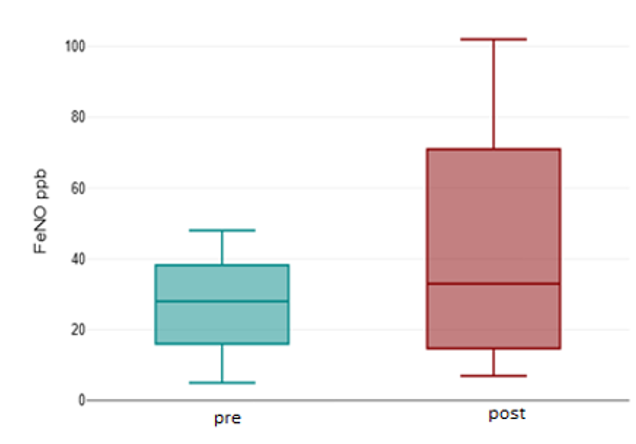
Figure 1 Humming, pre-post comparison.

Figure 2 Christmas tree: pre-post comparison.
We hope that this study has been able to shed some light on the mysteries surrounding the Christmas season and the cultural treasures of this period: There is some evidence that there is more behind than some rituals, religion or psychology but a kind of biological wisdom. In other words, could this be the reason why both - singing/humming and the custom to take freshly felled Christmas trees in our houses - became established? If yes, there is a gift more for every immune system at Christmas, beside healthy chocolate, apples nuts and almond kernels!
We would like to thank all employees of the Clinic Donaustauf, Bavaria, Germany, since august 2024 Caritas-Hospital Saint Mary, Donaustauf, who took ½ hour of time for the experiment two days before Christmas Eve 2023. We are very grateful to the NIOX Group who provided us with the measuring device for various experiments.
Maybe with some grinches little green creatures hating Christmastime.22

©2025 Loew, et al. This is an open access article distributed under the terms of the, which permits unrestricted use, distribution, and build upon your work non-commercially.