International Journal of
eISSN: 2574-9862


Research Article Volume 9 Issue 3
 Shaoli Majumder,2 Debdeep Pramanik,3 Debjani Ghosh,3 Koustav Mukherjee,3 Agnish Ganguly,3 Arunachal Chatterjee4
1Department of Zoology, Asutosh College, 92, S. P. Mukherjee Road, Kolkata – 700 026, West Bengal, India
2 Department of Zoology, Vivekananda College, 269, Diamond Harbour Road, Thakurpukur Kolkata – 700063, West Bengal, India
3Department of Zoology, University of Calcutta, 35, Ballygunge Circular Road, Kolkata – 700019, West Bengal, India
4Department of Zoology, Acharya Jagadish Chandra Bose College, 1/1B, Acharya Jagadish Chandra Bose Road, Kolkata – 700 020, West Bengal, India
Correspondence: Dr. Arunachal Chatterjee, Acharya Jagadish Chandra Bose College, Department of Zoology, Kolkata – 700 020, West Bengal, India, Tel 9836969215
Received: September 22, 2025 | Published: November 17, 2025
Citation: Chakraborty DC, Majumder S, Pramanik D, et al. Avifaunal diversity of Mahananda wildlife sanctuary and ecological specializations at an elevational continuum. Int J Avian & Wildlife Biol. 2025;9(3):101-107. DOI: 10.15406/ijawb.2025.09.00240
Mahananda Wildlife Sanctuary (MWLS) is placed at an elevational gradient of Eastern Himalayan landscape on the west bank of Teesta River of northern West Bengal. The site offers diverse ecological niches across varying altitudes and vegetation types. The sanctuary offers retreat to the birds that are coming down from higher alpine quarters for dietary and nesting resources, while some of the birds of the plains climb up to escape temperature escalation. Thus, the species composition and richness vary over altitudes. Spring-time avifaunal assemblage of MWLS was explored for two successive years at two elevation distinct study points. Overall, 98 avifaunal species belonging to 40 families were recorded, while the family Muscicapidae was found to be the most speciose (N=11). Elevation-restricted and non-restricted families showing only 16 common-place species between two sites indicating limiting effects of bio-climatic conditions on distribution of birds. Ecological specialization in response to luxurious supply of foraging options and habitats showed the highest species abundance of insectivores (N=49) in both sites, Broadleaf-conifer forests document highest number of species (N=63) while out of five foraging strata, canopy supports almost 62% of birds. Further investigation on seasonal diversity is required to determine their altitudinal movement patterns at MLWS.
Keywords: avifauna, altitude, dietary guilds, diversity, eastern Himalaya
Indian Himalaya and its foothill system offer diverse ecological niches across varying altitudes, vegetation types and supports one of the greatest avifaunal diversities ever documented.1,2 Seasonal changes across elevation are an additional prominent characteristic of mountain ecosystems that can influence the temporal dynamics of bird species richness during March to May (pre-monsoon season) and winter migration starts during the post-monsoon season in September.3,4,5 The late-winter and the spring (November to March) together at the lower Eastern Himalayan landscape offers refuge to birds that are coming down from higher alpine quarters in search of dietary supplies and nesting purposes; while some of the birds of plains also climb up to escape temperature rise.
Change in species richness over geographical variability such as latitude, altitude, temperature, precipitation, etc. have always determined the global patterns of biodiversity.1,6,7 These geographical variability influences the vegetation profiles, availability of microhabitats and underlying processes that are crucial for conservation plans.
Eastern Himalaya is listed among the “Global Biodiversity Hotspot” and one among the “Global 200 Ecoregion”.8 Eastern Himalaya in comparison to western parts supports greater species diversity and is considered to be the most species diverse region in the world.9,10 Northern West Bengal experiences the climatic and vegetational peculiarities of eastern Himalayas and flood plains of the Teesta River system. The Mahananda Wildlife Sanctuary (MWLS) characterized by undulating terrain of Kurseong hills located at the west bank of River Teesta in the southern part of Darjeeling district is a unique landscape where elevational gradient and sizable avifaunal assemblage are evident. Bird life of MWLS receives ecological influences of two biomes i.e. Sino-Himalayan Subtropical Forest (Biome-8) between 1000 to 1800 m and Indo-Chinese Tropical Moist Forests (Biome-9) below 1000 m with a small portion of Indo-Gangetic Plain.11 MWLS (IBA Site Code: IN-WB-07) lies within the Eastern Himalayas Endemic Bird Area (EBA 130) and under IBA categories A1, A2 and A3.12
Presently, a lot of developmental activities around the sanctuary had led to increased biotic pressure in some parts of the sanctuary, but unfortunately, no systematic attempt has been made to determine the range and extent of the present floral and faunal diversity of the region. Mahananda Wildlife Sanctuary considered the fourth most affected human-wildlife conflict (HWC) hotspot in the transboundary Eastern Himalayan landscape.13 Thus, this paper attempted to address the avifaunal richness at two different elevational strata chosen along the MWLS during spring season, also to discuss the conservation and dispersal status with various ecological attributes of birds such as dietary guild preference, microhabitats and ecological role played by them. This study also explores ecosystem-species interrelationship – a fundamental force that facilitates the forest to sustain and regenerate continuously. Therefore, the study on the avifauna assemblage along the elevational gradients on selected slopes of Himalayan and adjacent landscapes is of high priority in figuring out the growing impacts of ecosystem modifiers such as habitat fragmentation due to deforestation, urbanization and climate change.
Study site
MWLS in Darjeeling district of West Bengal, India (Figure 1) was established as a game park in 1955 and got the status of a sanctuary in 1959 mainly to protect the Indian Bison and Royal Bengal Tiger, which were facing the threat of extinction. With Mahananda River flowing through it, the Sanctuary is bounded by Teesta River in the East and Hill Cart Road in the West. It has covered little more than 158 sq.km forest area. The altitude varies from 150 m at the southern area near Sukna and rising up to 1300 m towards the northern area near a village called Latpanchar.
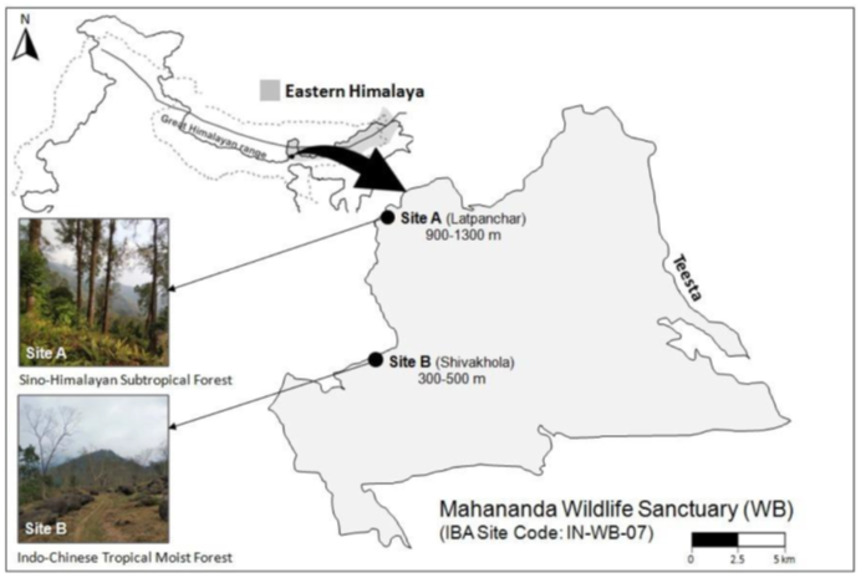
Figure 1 Geographical Location of the Mahananda Wildlife Sanctuary (MWLS) on the Eastern Himalaya landscape and position of the study sites (A. Shivakhola-Rongtong stretch and B. Latpanchar. The site wise forest profiles are shown in the inset (on left).
The sanctuary falls in the transition zone between the Peninsular Indian Sub-region and Indo-Malayan Sub-region of Oriental region. The terrain is undulating, with moderate to steep slopes and high ridges towards the north and almost flat stretches of the terai, and alluvial plains towards the south. As Mahananda extends across hills as well as plains, the forest types are quite varied, from riverine forests to dense mixed-wet forest due to the difference in altitude. The variation in altitude and forest types helps the existence of a large number of species of mammals, birds and reptiles.
The seasonality of MWLS features three equally important seasons - summer, winter and monsoon. In winter it is quite chilly; temperature goes below 3°C where in summer it rises beyond 39°C with an average temperature ranging from 10°C to 30°C. MWLS belongs in heavy rainfall zone (monsoonal width - May to October) with an average annual rainfall of 300 cm.
Two study sites chosen for early spring avifaunal assemblage: Site A: Shivkhola-Rongtong stretch (26.863N& 88.311 E) and Site B: Latpanchar (26.916N & 88.403E) were placed 25 km apart and set at different elevational strata.
Site A: Shivkhola is a pristine hilly village located at an elevation range of 300-500 m above the sea level, surrounded by tea gardens. The village is characterized by a stream of the same name flowing through the valley. The riverine valley consists mainly of open forests and tea plantations, housing a variety of avifauna.
Site B: Latpanchar is another little hamlet, which is the highest point in the sanctuary, located within 900-1300 m above sea level in the Kurseong hills. It is a prominent birding destination characterized by pine dominated broadleaf forest.
Survey method
Bird survey conducted at two study sites following standard fixed-radius point count method by the same team of volunteers in two time slots (morning – 06.00 am to 12.00 pm and afternoon – 03.00 pm to 06.00 pm).14,15 Study was replicated twice at each of the sites during the spring season between March to May (since spring in Himalayas records maximum altitudinal movements). Observation points were randomly placed considering habitat heterogeneity and unobstructed view. Movement rate of the observers depends on bird activity. All bird species heard or seen within a 50 m radius of each of the points count stations for the duration of 20 minutes were recorded. In addition, opportunistic observations of birds seen on transit were included in order to produce a comprehensive checklist of the avifauna of the study area. Line Transect Method (LCM) has been followed in case of denser habitats with poor visibility and to avoid double counting.14 Elevations (m) were recorded using a Digital Barometer Altimeter (HTC AL-7010) for each bird spotted at two study sites. We used two field guides,4,16 binoculars (Olympus 10×50, Nikon Aculon 10×42), and a digital camera (Nikon Coolpix P900 with 83Xzoom) for identification and documentation. The taxonomy and nomenclature have been followed as per recent references available, particularly for species which found not to be at par the references.4 The movement status of birds (resident, summer visitor, winter visitor and altitude migrant), IUCN conservation status and global population trend were noted referring to eBird India database.
Data analysis
After the field survey, relative density index (RDi) were analyzed using the formula RDi = (Number of bird species in a family/Total number of species) × 100. Ecological attributes such as dietary guilds, foraging strata and habitat strata of each species were noted in order to delineate ecosystem-species interrelationships.
Dietary guilds: Dietary guilds are the groups of birds with specific dietary preference(s) named after nature of food consumed by them.
Foraging strata: The foraging strata are the structure or substratum from which a food item is collected by the birds.
Habitat strata: These are the primary forest or habitat features with which the bird species remain closely associated for purposes like nesting, foraging, perching etc.
Dietary guilds were commonly classified based on the dietary descriptions available.4,17 Some of the recorded species were placed under the mixed-dietary guilds to explain differing foraging strategy in adult and juvenile.18Foraging ecology of birds has been used to explain the community structure, resource use and competition or co-existence in a particular habitat.19 Foraging data (dietary guilds and foraging strata) were collected along the point and line transects from each study site. Direct foraging observations were made whenever a foraging event of a bird was recorded, for rests local birding guide and field guides were also referred. Two study sites were further segregated into three habitat strata such as broadleaf conifer, open forest and river bed; with unique ecological resources for avian communities. Habitat strata were assigned exclusively as per sighting records.
Baseline database (checklist) and conservation status of birds
In a short-term (spring or/and post-winter) study on avifaunal assemblage of MWLS was set at two study points, Shivkhola-Rongtong and Latpanchar, along an elevational gradient. 98 avifaunal species belonging to 40 families were observed. Details of bird species, their ecological attributes such as dietary guilds, foraging stratum, habitat strata, IUCN status, global trend were documented in Table 1. Passerine birds dominated the diversity with 73 species (74.48 %) compared to non-passerines (25 species, 25.51%) (Table 1). The highest bird diversity was found at Latpanchar (Site 2) with 69 species distributed in 31 families compared to Shivakhola (Site 1) with 45 species comprising 27 families. Only 16 species and 18 families of birds were common in both sites (Figure 2b).
Among all avian species observed during the study, only two species Rufous-necked Hornbill and Great Hornbill) fall under the vulnerable and one species (Himalayan Griffon) belong to the near-threatened (NT) category of IUCN, while the remaining species are categorized as least concern (LC) species (Table 1). No endemic species were recorded during this survey.
The species composition and diversity of bird species
Family Muscicapidae represented highest number of species (11 species) followed by family Pycnonotidae (6 species), Nectariniidae, Phylloscopidae and Dicruridae (5 species each) and Accipitridae and Picidae (4 species each) respectively (Table 1). The Table 2 represents the relative abundance of different avian families at both the study sites. Analysis of relative density index (RDi) revealed that Muscicapidae was the most abundant (15.56 in Shivkhola and 8.7 in Latpanchar) avian family in both the study areas. RDi of Muscicapidae was followed by Laniidae, Corvidae, Dicruridae and Pycnonotidae families (3 species per family RDi = 6.67) and have greater relative abundance than other rest of the families in Shivkhola, while 18 families were poorly represented in the study area, with single species from each family (Table 2). In Latpanchar avian families like Phylloscopidae (5 species, RDi = 7.25) and Accipitridae, Pycnonotidae, Nectariniidae (4 species per family, RDi = 5.8) have more relative abundance than other families while 11 families were represented with single species.
|
Family of Birds |
Shivkhola |
Latpanchar |
||
|
Number of bird sp in each family |
RDi |
Number of bird sp in each family |
RDi |
|
|
Phasianidae |
1 |
2.22 |
--- |
--- |
|
Columbidae |
1 |
2.22 |
2 |
2.9 |
|
Cuculidae |
1 |
2.22 |
--- |
--- |
|
Apodidae |
1 |
2.22 |
1 |
1.45 |
|
Charadriidae |
1 |
2.22 |
--- |
--- |
|
Phalacrocoracidae |
1 |
2.22 |
--- |
--- |
|
Ardeidae |
1 |
2.22 |
--- |
--- |
|
Accipitridae |
1 |
2.22 |
4 |
5.8 |
|
Strigidae |
1 |
2.22 |
--- |
--- |
|
Bucerotidae |
1 |
2.22 |
1 |
1.45 |
|
Alcedinidae |
1 |
2.22 |
--- |
--- |
|
Meropidae |
--- |
--- |
1 |
1.45 |
|
Megalaimidae |
1 |
2.22 |
2 |
2.9 |
|
Picidae |
2 |
4.44 |
3 |
4.35 |
|
Eurylaimidae |
1 |
2.22 |
--- |
--- |
|
Vangidae |
1 |
2.22 |
2 |
2.9 |
|
Campephagidae |
1 |
2.22 |
2 |
2.9 |
|
Laniidae |
3 |
6.67 |
1 |
1.45 |
|
Vireonidae |
--- |
--- |
1 |
1.45 |
|
Oriolidae |
--- |
--- |
1 |
1.45 |
|
Dicruridae |
3 |
6.67 |
3 |
4.35 |
|
Corvidae |
3 |
6.67 |
2 |
2.9 |
|
Stenostiridae |
--- |
--- |
1 |
1.45 |
|
Paridae |
--- |
--- |
3 |
4.35 |
|
Pycnonotidae |
3 |
6.67 |
4 |
5.8 |
|
Hirundinidae |
--- |
--- |
1 |
1.45 |
|
Phylloscopidae |
--- |
--- |
5 |
7.25 |
|
Cisticolidae |
1 |
2.22 |
1 |
1.45 |
|
Timaliidae |
--- |
--- |
1 |
1.45 |
|
Leiothrichidae |
--- |
--- |
3 |
4.35 |
|
Zosteropidae |
--- |
--- |
3 |
4.35 |
|
Sittidae |
1 |
2.22 |
2 |
2.9 |
|
Sturnidae |
2 |
4.44 |
2 |
2.9 |
|
Turdidae |
--- |
--- |
2 |
2.9 |
|
Muscicapidae |
7 |
15.56 |
6 |
8.7 |
|
Chloropseidae |
2 |
4.44 |
1 |
1.45 |
|
Nectariniidae |
2 |
4.44 |
4 |
5.8 |
|
Passeridae |
--- |
--- |
2 |
2.9 |
|
Motacillidae |
1 |
2.22 |
--- |
--- |
|
Fringillidae |
--- |
--- |
2 |
2.9 |
|
40 |
45 |
69 |
||
Table 2 ComparativeAnalysis of Relative Density Index (RDi) between Shivkhola and Latpanchar. Relative Diversity index = (Number of bird species in the family/Total number of species) × 100.
Among the avifauna of our study area, 71% were resident (R), 18% altitude migrant (AM), 8% winter visitor (WV) respectively and 3% belonged to summer visitor (SV) category (Figure 2a).
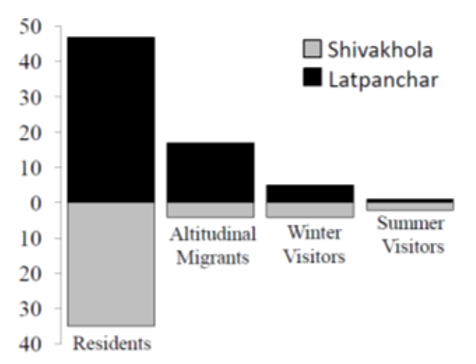
Figure 2a Dispersal status of birds at two sites .
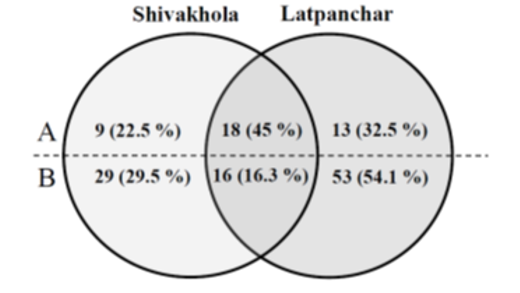
Figure 2b Number of bird family (A) and species (B) observed in two regions.
Elevation range profile
The distribution of bird species and families over elevation (m) ranges were shown in the Figure 3. It shows that some species and families are elevation restricted (Figure 3, box A and box C) and rests were reported at multiple elevations encompassing two study sites (Figure 3 box B). Few families such as Accipitridae, Corvidae were observed at elevations between 300 m to 1300 m of the Eastern Himalayas. Species that belong to Columbidae family also shows presence in wide altitude range (300 m to 1300 m); whereas birds of few families were observed along very narrow distribution range in Eastern Himalayas. Among the residential birds, eight species were observed at elevations from300 m through 1300 m.
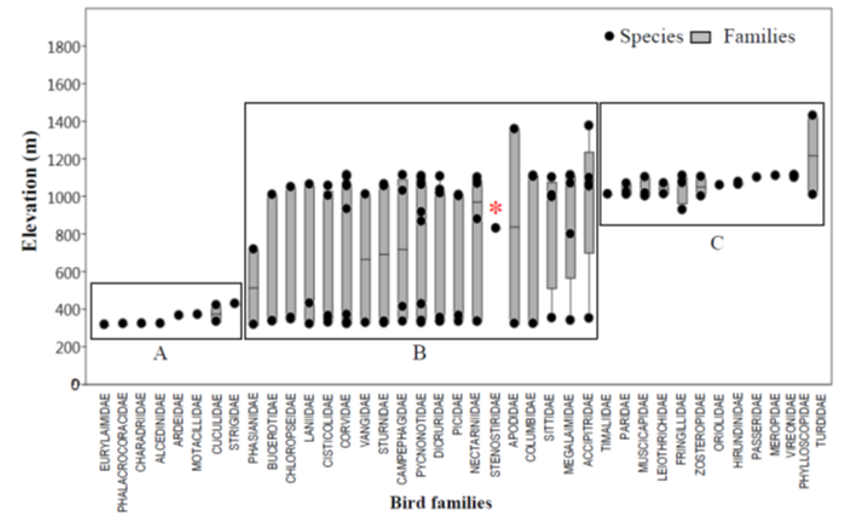
Figure 3 Elevational distribution of species and families of birds recorded at Mahananda Wildlife Sanctuary. Two Sites were selected at two elevational ranges: Site 1 - Shivakhola within 300-500 m and Site 2 - Latpanchar 700-1300 m above sea level. Species and families that are elevation restricted (box A = lower & C = upper) and box B elevation non-restricted except the Grey-headed Canary-flycatcher (*Family- Stenostiridae).
Ecological specialization
Among the ecological attributes thirteen dietary guilds were used to describe all the dietary preferences of the bird community found here. Analysis of the feeding guilds of the 98 species revealed that 49 species (41.2%) were insectivore, 29 (24.4%) were carnivore, 22 (18.5%) were omnivore, 9 (7.6%) were granivore, 4 species (3.4%) each were frugivore and herbivore, and 2 (1.7%) were nectarivore. There were few mixed-dietary guilds reported which shift diet as per availability of resources or between juvenile and adult stage (insectivore-carnivore, insectivore-granivore, insectivore-frugivore, insectivore-nectarivore and frugivore-granivore) (Table 3 and Figure 4a, 4b). Out of five foraging strata, the canopy layer supports as high as 62% of species (Figure 4c). Among foraging groups, the bird community of insectivores dominated, representing more than 72% of the species and 65% of the individuals. Omnivores and granivores comprised of around 10% of the species and 22% and 8% of the individuals, respectively. Examining species richness by foraging stratum, there were no significant differences on species richness for understory birds, but those foraging at the canopy and intermediate heights showed a significantly higher species richness at the plantation).
|
Niches |
Dietary guilds |
Foraging strata |
Habitat strata |
|
|
Categories |
Carnivore Frugivore Granivore Insectivore Nectarivore Omnivore Piscivore |
Scavenger Frugivore-Granivore* Insectivore-Carnivore* Insectivore-Granivore* Insectivore-Frugivore* Insectivore-Nectarivore* |
Ground Canopy Bark Aerial Aquatic |
Open forest Broadleaf conifer River bed
|
Table 3 Ecological specializations that influence distribution pattern of bird community
*juvenile insectivory is common in most forest birds which later on shifts to different dietary guilds
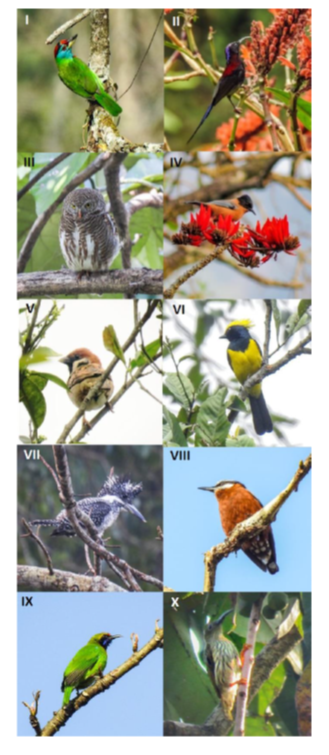
Figure 4a Species representative from different Dietary Guilds I. Frug. – Blue-throated Barbet; II. Nec. – Black-throated Sunbird; III. Car. – Asian Barred Owlet; IV. Ins.-Frug. – Rufous Sibia; V. Gran. – Eurasian Tree Sparrow; VI. Ins. – Sultan Tit; VII. Pis. – Crested Kingfisher; IX. Ins.-Gran. – Chestnut-bellied Nuthatch; X. Omn. – Golden fronted Leafbird; XI. Ins.-Nec. – Streaked Spiderhunter; Ins.-Car. – Common Green Magpie (NP); XII. Frug.-Gran. – Scarlet Finch (NP); & XIII. Scv. – Himalayan Griffon NP = not photographed
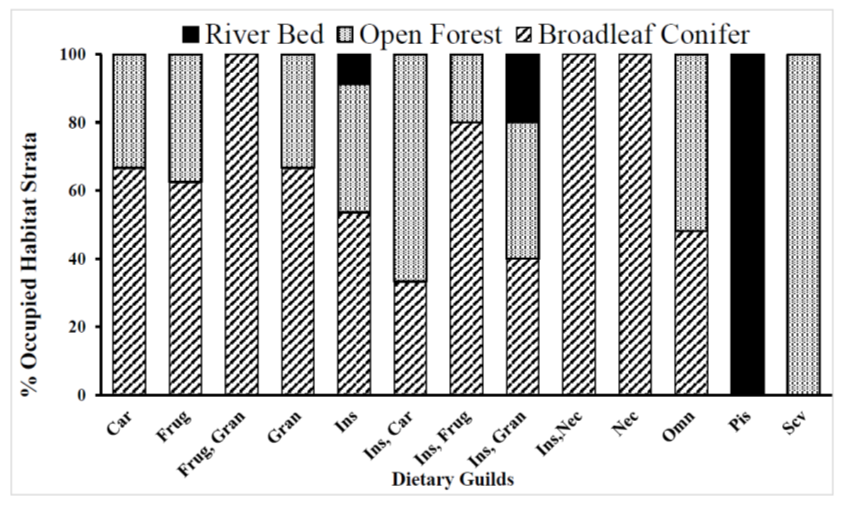
Figure 4b Bar diagram showing percentage (%) occupied habitat strata (of both Shivkhola and Latpanchar) of birds with different dietary guild.
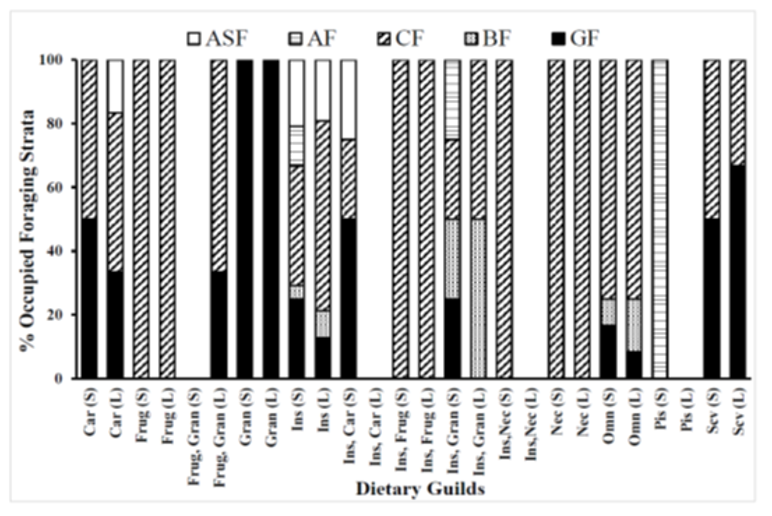
Figure 4c Bar diagram showing comparative percentage (%) occupied foraging strata of birds of Shivkhola and Latpanchar with different dietary guild.
As a mark of rich avifaunal diversity of Eastern Himalaya, the present study records 97 avifaunal species within two study locations during a peak altitudinal migration period. While compared to similar regions of Himalayan foothills, Mahananda Wildlife Sanctuary demonstrates comparable or overall higher avifaunal richness in terms of residential and migrant species. Although the dominant vegetation type of the Mahananda Wildlife Sanctuary and surrounding areas is dry mixed evergreen forest, the core and ridge-top forests exhibit characteristics of the moist semi-evergreen forest of intermediate zone. Such mosaic habitat structure across the landscape may contribute to a highly diverse bird community in and around the area. In many studies, similar tropical dry habitats have suggested that landscape heterogeneity may lead to increased species diversity.20,21,22 Despite small in size, this protected landscape supports diverse bird community and 10.89% of total avian species of this state (N = 937) are recorded here. Although we did not record the relative abundance of each species, still the avian diversity is comparable with many other protected areas of this state. For instance, researchers have studied avifaunal diversity in three different national parks and reserve forest in North Bengal and recorded 117 bird species belonging to 42 families, 29 bird species of 20 families from Kulik Bird Sanctuary Raiganj, and 86 bird species belonging 10 orders and 35 families in Digha coast of West Bengal and so on.23,24,25,26
Habitat complexity and availability various microhabitats determines the species composition and diversity in a particular area. Luxurious food supply play key role in attracting residential and migratory bird species to the sanctuary. In this short-term record we saw that the area found to harbor 19 migratory species which include 15 winter visitors and 3 summer visitors. Rich and undisturbed habitats with considerable complexity provide wide array of dietary options and other resources to sustain lives. Parameters such as abundance and relative abundance of bird species might be associated with nature of habitat, abundance of food, and breeding season of the species.27 Availability of wild berries and other fruiting trees, high to moderately dense Himalayan vegetation having higher canopy variation and structural variation creates greater micro-climate provisions. This complex nature enables most of bird species to forage efficiently.
Two study sites represent two sampling zone at a continuous habitat slope lying at 300-500 m (Shivakhola) and 900-1300 m (Latpanchar) respectively. Two sites shared only 16 bird species suggests bio-climatic differences and variation in foraging resource availability due altitude change. Our study revealed considerable differences in elevational distributions of birds in the MWLS that varied with migration type, feeding guild and species identity. Elevation-restricted and elevation non-restricted are the two groups were recorded from our study which may indicate some species are having foraging resources only around localized patches such as the piscivores confined only near to Mahananda river and its tributaries while others like nectarivores with narrow preference for flower species too restrict at small patches (e.g. Mrs. Gould Sunbirds at the edges of forest-village transition). It seems the asynchronous flowering and fruiting phenology along the altitude gradient had a strong role to play in case of species distribution.28
Birds at the lower altitudes (e.g. Great Hornbill, Crimson Sunbird) move to higher patches in search of food and mates in spring and summer while during winter they return back as the environment becomes suitable. Similarly, many species (e.g. Broad Bill, Black Baza) come down at lower altitudes to avoid harsh winter climb up for pleasant summer.29 Moreover, ecological specialization in terms of foraging practice is essential in maximizing diversity in avifaunal community and also influences their distribution pattern. Many mixed-dietary guilds were recorded here such as Insectivore-Nectarivore, Insectivore-Carnivore, Insectivore-Granivore, Insectivore-Omnivore and Frugivore-Granivore as the bird species often exploits foraging resources broadly to optimize nutritional requirements and to minimize niche overlaps. Insectivores solely and in mixed-dietary guilds utilize most of the habitat strata and foraging strata, while nectarivores and the frugivores are mostly restricted to the forested habitats and specifically to the canopy. An overall close network between habitat strata, dietary strata and dietary guilds creates an undisturbed ecological homeostasis suitable for forest regeneration and resource turn-over.
More to mention, the Mahananda river and its tributaries feed the forested landscape to ecological prosperity and the tourism and agro-based lifestyle have kept the fine balance compared to the neighboring Sikkim part of the eastern Himalayas where the development of pharmaceutical hubs for crude drugs has caused serious impact on the ecosystem.30 Thus, in view of ecosystem modifiers such as habitat fragmentation due to deforestation, urbanization and climate change.
In this study we have been able to document the glimpse of ornithological diversity of Mahananda WLS as well as their ecological complexity, habitat preference through foraging guild analysis. The study documents phenomena of the spring-time altitudinal migration in the pristine mountainous terrain of Eastern Himalaya. Mahananda WLS represents relatively stable forest ecosystems and can be considered as a heaven for avifaunal communities. Being a crucial part of himalayan biodiversity, altitudinal migration of birds requires prolonged survey to identify ecological intricacy that keeps the phenomena functioning. Beside that changing land use creating forest edges, human ecological footprints introducing habitat fragmentation into this otherwise pristine landscape. Moreover, gradual climate change needs to be analyzed for further understanding of landscape and species conservation.
None.
Authors would like to thank local people for their support during the survey. Authors would also like to thank Rajmita Chatterjee for her encouragement during the study.

©2025 Chakraborty, et al. This is an open access article distributed under the terms of the, which permits unrestricted use, distribution, and build upon your work non-commercially.