eISSN: 2576-4497


Case Report Volume 9 Issue 2

1Department of Palliative Medicine, The Galway Clinic, Ireland
2Department of Palliative Medicine, Portiuncula Hospital, Ballinasloe, Ireland
3Department of Palliative Nursing, Portiuncula Hospital, Ireland
4Department of Palliative Medicine, Galway University Hospital, Ireland
5Department of Neurology, Galway University Hospital, Ireland
6Mayo Hospice and Palliative Care Centre, Ireland
7St Francis Hospice, Blanchardstown, Dublin North, Ireland
8Department of Palliative Nursing, Galway University Hospital, Ireland
9School of Medicine, University of Galway, Ireland
Correspondence: Waldron D, Department of Palliative Medicine, Galway University Hospital, Saolta Hospitals Group (SHG), Ireland, Tel +0876889768
Received: April 17, 2026 | Published: May 4, 2026
Citation: Cronin K, Ely H, Gaffney L, et al.Central pontine myelinolysis; a rare condition for palliative care reflecting importance of integration with other specialities. Hos Pal Med Int Jnl. 2026;9(2):30-32. DOI: 10.15406/hpmij.2026.09.00287
Background: Palliative care receives referrals of most patients perceived to be dying in acute hospitals. Occasionally, patients with rare and complex conditions are referred and this requires a rapid learning curve for the palliative care team to ensure correct decisions are made. Central pontine myelinolysis is a type of osmotic demyelination syndrome that is characterised by damage to areas of the brain following rapid correction of hyponatremia.
Methods: This case describes the presentation of a 39-year-old female admitted to an acute hospital with reduced level of consciousness and hyponatremia on a background of on-going excessive alcohol intake. Despite gradual correction, the sodium levels rose dramatically from 97mmol/L to 116mmol/L over 12 hours. Patient’s neurological condition deteriorated rapidly requiring escalation to intensive care unit and intubation. Initial CT scans of the brain did not report any intracranial abnormalities.
Results: A subsequent MRI scan of the brain confirmed diagnosis of central pontine myelinolysis. Patient continued to receive supportive care but unfortunately made no neurological recovery and died as result of complications from central pontine myelinolysis.
Conclusions: This case outlines the complex ethical decisions faced by a Specialist Palliative Care team while dealing with rare conditions, which require rapid learning, integration with other specialities to empower correct decisions on End-of-Life or not. The importance of how to communicate in positive versus negative language at End-of-Life is also addressed. All actions of making correct medical decisions and how these decisions are imparted matters.
When faced with rare and complex conditions and as in this case a young person, it is imperative the correct diagnosis of dying or not is made. Cassel writes,1 “Palliative Medicine is medicine…. A prognosis is not a social function arrived at by the consensus of doctors, nurses, and social workers, to which an attending physician “defers.” It is a sophisticated judgement based on experience and medicine’s knowledge base and is the responsibility of the attending physician.” Making a firm diagnosis of dying and explaining this diagnosis rationally backed up with facts to defend the diagnosis may be the most pivotal influence on how a patient and their family come to terms with the dying phase. When the dying phase is clearly identified, and accurately diagnosed, End-of-Life (EOL) plans of care should be based on appropriate goals that focus on comfort and palliation and not on medically aggressive treatments that offer no meaningful benefit. In medicine, it is important that all health care professionals can make a diagnosis of dying.
A 39-year-old female was admitted to the hospital with persistently low level of consciousness for 2 days on a background of alcohol intake. The patient was found in the same position as the previous day by her next of kin. Past medical history included alcohol dependence syndrome, depression, history of self-harm and previous episodes of hyponatremia. Examination revealed reduced level of consciousness with Glasgow coma scale (GCS) of 13/15 but no focal neurological deficit. Lab investigations revealed hyponatremia at 96mmol/L and hypokalaemia at 1.7mmol/L. Toxicology screen was negative for drugs other than alcohol. Liver function tests were also abnormal and in keeping with history of alcohol intake. Computerised tomography (CT) brain on admission showed no significant intracranial abnormality. Patient was treated for alcohol withdrawal. The sodium levels were carefully monitored and unfortunately rose to 116mmol/L after 12 hours of admission. The following day, there was an initial improvement in the GCS to 14/15 however there was an acute deterioration on day two with a drop in GCS to 10/15.
The patient was transferred to intensive care unit (ICU), intubated and began to receive supportive treatment. Sodium levels remained stable for the next 48 hours. A repeat CT brain was performed which again showed no significant abnormalities. A lumbar puncture was completed and was normal. On Day 5 post admission, patient had an episode of tonic-clonic seizures and was commenced on phenytoin. COVID-19 test was performed and was negative. A neurologist completed a detailed neurological examination when there was failure to show responsiveness after the initial acute deterioration. At this point, the working diagnosis included central pontine myelinolysis (CPM) or extrapontine myelinolysis. This was supported by history of alcohol intake, low sodium levels on admission and the rapid correction of same within 12 hours. Interestingly, an old CT brain from 2018 had appearance of CPM. However, CT scans from current admission appeared normal. Electroencephalogram (EEG) was performed which revealed profound changes. It showed a feature called “BIPLEDs” (Bilateral independent periodic lateralising epileptiform discharged). These are features of significant brain injury from a wide range of different conditions and would be consistent with a significant cerebral injury/insult. Magnetic resonance imaging (MRI) scan was profoundly abnormal. There was evidence of profound central pontine myelinolysis. The basal ganglia including the thalamus, the caudate and putamina were also profoundly affected (Figure 1).
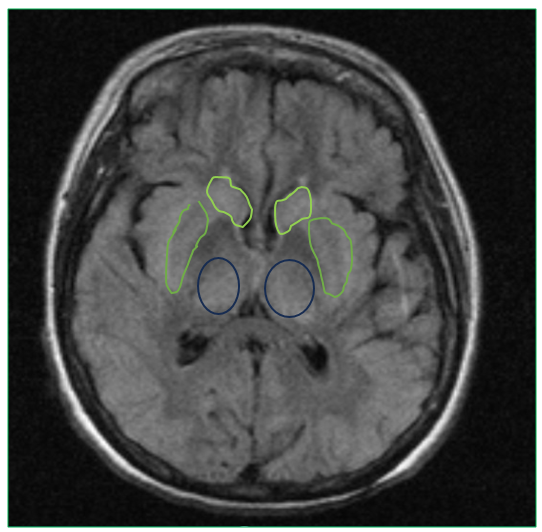
Figure 1 MRI scan of the brain of our patient showing signal abnormalities and diffusion restriction in the basal ganglia in keeping with osmotic demyelination syndrome; Thalami: Caudate nuclei; Putamina.
At this stage prognosis was indeterminate and guarded as outcomes in such cases can be extremely variable. It can range from patients making remarkable neurological recovery to significantly poor outcome with complications including death. In this case, the patient continued to receive supportive care, assisted ventilation and naso-gastric feeding, in the ICU. She developed a lower respiratory tract infection due to aspiration and was commenced on antibiotics. After a number of weeks, a decision was made to have a trial off sedation. The patient was observed for the next 72 hours to assess neurological condition. There was no neurological recovery, and the patient had a non-resolving aspirational pneumonia due to copious oral and respiratory secretions compounded by naso-gastric feed. The patient began to approach EOL. At this point a decision was made between all specialists involved, to withdraw active management. Specialist palliative care (SPC) input was sought for advice prior to extubating. At this point, the SPC questioned the benefit of the naso-gastric feeding with the wider medical multidisciplinary team, discussing the complex ethical implications of this intervention at the deteriorating phase in the patient’s care. A discussion occurred with the family regarding the risk/benefits of naso-gastric feeding based on the level of symptom burden it was causing. The patient had profound respiratory distress which was multifactorial: due to excessive oral secretions, inability to clear respiratory secretions, and aspiration of naso-gastric feed. All required deep suctioning.
A joint decision, between medical staff and family, was made to stop the naso-gastric feed. The family was counselled prior to extubation. Prior to extubation and based on the patient’s symptom needs, two continuous subcutaneous infusion (CSCI) 24-hour syringe infusion drivers were commenced. The first CSCI contained levetiracetam 1000 mg, to replace intravenous levetiracetam. The second CSCI contained oxycodone 45 mg, glycopyrronium 2.4 mg and midazolam 50 mg. All as required (PRN) drugs to address pain, dyspnoea, nausea, agitation, restlessness, and excessive respiratory secretions were also prescribed. The second CSCI was subsequently adjusted over the next few days in response to patient’s symptoms of respiratory distress and agitation, as reflected by PRNs required and effectiveness. The Palliative Care team consulted closely with the family, reassuring them that the patient’s symptomatic needs were being actively addressed to ensure comfort. The patient died a week after extubating and the final CSCI included oxycodone at 90 mg, midazolam at 55 mg and glycopyrronium 2.4 mg.
Central pontine myelinolysis is a form of osmotic demyelination syndrome that was first described by Adams et al,2 in 1959 as a disease affecting alcoholics especially those who are malnourished with the concept extended in 1962 to include lesions occurring outside the pons known as extra-pontine myelinolysis (EPM).3 A new name was given to CPM/EPM, namely, osmotic demyelination syndrome (ODS). CPM/ODS, commonly presents as a complication of treatment in patients with profound life-threatening hyponatraemia. This condition is classically related to rapid correction of hyponatremia.4 Pathologically, it presents as an area of myelin disruption in the centre of the basal pontis. In EPM, lesions are predominantly found in the in the basal ganglia, thalami, subcortex, cerebellum, lateral geniculate bodies and the cerebral cortex.3 These osmotic-driven neurological sequalae are caused by rapid correction of hyponatremia which causes large shifts in intra cellular fluids leading to demyelination of neurons.3 Risk factors which pre-dispose to CPM include chronic alcoholism, causing metabolic deficiencies, malnutrition and hypokalaemia. More recently CPM has been reported in cases of severe burns, liver transplantation, hyperemesis gravidarum and hyperglycaemic states.5 Clinical course often consists of a biphasic phase, the first phase reveals the underlying predisposing condition and the second phase reflects osmotic demyelination syndrome with pontine/extra-pontine dysfunction and neurological abnormalities.5 MRI scan has a higher sensitivity for earlier detection of characteristic hyperintense central pontine lesions and is therefore superior to CT scan.6 Prevention of CPM/ODS involves identifying patients most at risk and formulating a management plan to moderate correction of sodium levels. Rate of correction of sodium should not exceed 4-6 mEq/L in a 24-hour period.7 Prognosis which was once thought to be poor has improved due to earlier detection by MRI; but osmotic demyelination syndrome can still be fatal. Poor prognostic features on presentation include low GCS, severe hyponatraemia (≤115mEq/L), low potassium (≤ 2.4mEq/L), and involvement of the pons.6
This case was complex and challenging for the family and all teams involved. Everything a doctor does originates from knowledge of the underlying disease process, the diagnosis, and the nature of the sick person.1 The cornerstone of prognostication in clinical medicine is an accurate diagnosis based on agreed-upon objective criteria. Accuracy in prognostication may be dependent on experience, speciality, or level of acquaintance with the patient; however, no specific speciality has been proven evidentially to be more accurate when it comes to prognosis.8 It is important the SPC team listen to the specialist who understands the larger context of the patient’s illness in addition to their own clinical knowledge and experience. When nearing EOL, patients with a Palliative Performance Score levels of 10%,20%,30% have a median survival rate of 2,4 and 13 days respectively.8 A correct, firm diagnosis of dying being made, by all the appropriate medical specialists, including SPC, is essential to ensure that goals of care are patient focused.8
A therapeutic communication approach was employed to support discussion with the family at EOL. Communicating to the family that future care planning will be aligned with these goals and regularly reassessed to address the needs of the patient to ensure comfort. On dealing with such a distressing scenario, if we think of using words in communicating our plans like, “we will hold fluids today as the fluids are going into the wrong spaces, the arms, legs and lungs, therefore fluids are causing more harm than good at this time”, rather than saying “we will withdraw/discontinue fluids”, this can only be reassuring for the family. This communication should be followed by another reassuring message, “We will however check hydration each day and if fluids are deemed necessary for presumed uncomfortable dehydration, we can give a small amount of sub-cutaneous fluid for a few hours.” Giving this message conveys that we are not giving up on a family's loved one. It is also important that each team member does check this daily, so the family knows that this sentence is meaningful.
Discontinue implies withdrawing or giving up what they may perceive as a vital source of their loved one getting more time. Everything could be explained in the context of ‘At all costs do no harm”, using and imparting the mental image of the ‘Weighing Scale of Justice’ can be very informative for all. (Figure 2) If the intervention causes more harm than good, it should not be considered. How messages are imparted to patients and families is vital, especially if dealing with such a young patient with a very complex condition.

Figure 2 ‘Lady Justice’ “At all costs do no harm”; Describing the ‘image’ of Lady Justice weighing scale helps import message of ‘balance’ to patients and families.
Doctors involved in the care of the dying are as much beholden to the fundamental rules of the medical profession as when looking after any other patient group.9 Everything a doctor does originates from knowledge of the underlying disease process, the diagnosis and the nature of the sick person.9 The importance of SPC being guided by the specialist with the larger context of the patient’s illness is also vital. The cornerstone of prognostication in clinical medicine is an accurate diagnosis based on agreed-upon objective criteria. In its absence physicians are rudderless. A prognosis is a sophisticated judgement based on experience and medicine’s knowledge base and is the responsibility of the doctor in charge of the patient’s care’.9 The fourth of Dossetor’s five principles explores the need to recognize ‘When a person is no longer suffering from a pre-terminal illness and has entered the dying phase’.9
None.
The authors declares that there are no conflicts of interest.

©2026 Cronin, et al. This is an open access article distributed under the terms of the, which permits unrestricted use, distribution, and build upon your work non-commercially.
