eISSN: 2469-2794


Mini Review Volume 13 Issue 4

Department of Social Sciences, Universidad Nacional de Luján (UNLu), Argentina
Correspondence: Mariano Sergio Ramos, Postgraduate Professor, Department of Social Sciences, Universidad Nacional de Luján (UNLu), Faculty of Philosophy and Letters, Universidad de Buenos Aires (UBA), Director of ProArHEP, Member of CEAH, Faculty of Humanities and Arts, Universidad Nacional de Rosario (UNR), Argentina
Received: November 17, 2025 | Published: December 3, 2025
Citation: Ramos MS. Research: some observations on the application of inference resources in archaeology and criminology. Forensic Res Criminol Int J. 2025;13(4):180-182. DOI: 10.15406/frcij.2025.13.00456
In this brief paper, I address theoretical and epistemological perspectives on research in specific fields of knowledge, such as historical archaeology. Within these themes, I propose an approach to a research problem and discuss some possibilities that arise from the implementation of certain resources. Furthermore, I connect the 19th-century evidentiary paradigm with the studies of criminology and archaeology. Both disciplines seek clues and evidence; the latter, in particular, with the archaeology of battlefields, which are nothing more and nothing less than large crime scenes. Finally, I offer some reflections.
Keywords: epistemology, archaeology and criminology, “crime scene”
The evidential paradigm and its influences
During the last quarter of the 19th century, forensic science and archaeology followed relatively similar investigative procedures, those referenced in the evidentiary paradigm generated by Sigmund Freud, Giovanni Morelli and Arthur Conan Doyle.1–3 All of them had academic training in medicine and based their work on criteria of medical symptomatology, within the framework of 19th-century positivism. How did archaeology and forensic science inspire each other? Some related questions are considered, for example, in the publication entitled Investigación de la escena del crimen.
“Scene assessment allows for the development of a plan to coordinate the identification, collection, and preservation of physical evidence and the identification of witnesses.”4
Every crime—like every human activity—is committed in a specific and particular space.5–11 In a contemporary crime scene, there were perpetrators; in the past, our ancestors were also perpetrators. They are no longer here; neither are they. The Spanish archaeologist González Ruibal15 said that archaeologists lament having only objects in their excavations, since human beings—and their hominid ancestors—are no longer there. Detectives also lament the absence of the perpetrators of a crime; but, like archaeologists, they must answer the questions that arise when faced with the static materiality they encounter at the crime scene. The cited manual adds:
“Walking the scene provides the investigator(s) in charge with an overview of the entire scene. The walkthrough offers the first opportunity to identify valuable and/or fragile evidence, and to determine the initial investigative procedures leading to a systematic examination and documentation of the scene.”4
Theoretical and epistemological perspectives of research
In the late 1990s, from our role as academic professionals in Archaeology, we presented the project entitled "Interdisciplinary Research on the Battle of Vuelta de Obligado" (UNLu/SO/235) at the Universidad Nacional de Luján. At that time, there were no archaeological studies on battlefields in Argentine. The theoretical perspective of the project then placed it within the field of Historical Archaeology,13–17 a field that is now more developed.18–21
A few years before the presentation of the first Argentine project on a battlefield, two American archaeologists22 proposed three possibilities for the study of historical sites.23–25 They considered that historical archaeology could deal with: 1. the study of a period, 2. a method of investigation, and 3. the study of the Modern World.
Taking these approaches into account, we oriented our studies from epistemological perspectives; that is, we considered historical archaeology as an opportunity to address a research problem. This was in line with what we began to argue between 1999 at the Guaminí Conference in the Province of Buenos Aires13,15 during the Second National Congress of Argentine Historical Archaeology in Río Grande, Tierra del Fuego.15 During those years, we clarified this reasoning and, currently, we have given greater precision to the concept; thus, the
“Historical archaeology is the field of science that addresses problems of the human past located in times considered as historical and that can use for its resolution, at a minimum, information from the archaeological record and written documents. The data that come mainly, although not exclusively, from the composition of the archaeological record and from direct and indirect documentary sources, can be convergent and oriented to answer the same question.21
This is an epistemological perspective, focused exclusively not on collateral issues such as the existence or non-existence of written documents, or the perspective of a particular period, or the view of the heterogeneous and imprecise modern world outside of self-proclaimed Western Europe or “the West.” None of those conceptions were satisfactory, since they did not capture the core of the issue. That core lay in the formulation of the problem or the research questions. That was the focus where we had to place our perspective, and that is what we aimed for from the beginning.14,15 It is also worth recalling that several years ago the American archaeologist Lewis Binford pointed out:
“We have, therefore, three important fields of research to develop: the study of contemporary peoples, the creation of experimental situations that allow us to control the causes in order to study the effects, and the use of historical documents of different kinds, all of which are fields of research that contemporary archaeology is beginning to develop in a significant way.”26
All these avenues of research—and currently, several more—by having more than one source of information, could become resources that allow us to refine methods of inference. Consequently, I believe that historical archaeology is an opportunity to refine the methods or logics that lead us to propose certain deductions and interpretations regarding a particular problem from the past.
The research problem and some possibilities
Let us then turn to the treatment of a particular research problem where we can observe how data from different sources of information function. In a simple outline, and faced with the problem of determining the chronology of a historical site, our perspective would work as follows:
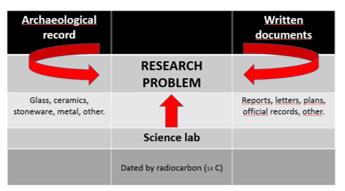
In summary, the research problem or question is posed for a specific site supposedly located in "historical times." Several sources of information are used, providing convergent data that, from different perspectives, answer the question. The data are compared with each other. From this, three possibilities can arise:
It is also possible that each of these sources may not contain the necessary information, since existence and content are two different things. That is, a source may have "gaps" in this sense and, moreover, may not be truthful or reliable; for example, a written document generated by a particular political sector that is biased.20 Regarding the archaeological record of a site considered historical, it may occur that there is:
All scientific research within the field of so-called historical archaeology, to be considered as such, must have:
These observations inform our perspective on any type of problem we investigate. They also highlight the limitations of each of the sources of information or objects of analysis that we study and analyze during the course of this type of research.
Information is used following specific research procedures. On the one hand, the context in which it was generated is evaluated,20 as well as its veracity and reliability.27–29 For data to be considered evidence -something irrefutable- it must meet the criteria of authenticity, reliability, relevance, and sufficiency. On the other hand, information obtained through different means is compared, and finally, a comprehensive synthesis is performed in relation to a problem and a historical event. Archaeology and Criminology can apply similar procedures to a “crime scene” from both the past and the present.
None.
The author declares there is no conflict of interest.

©2025 Ramos. This is an open access article distributed under the terms of the, which permits unrestricted use, distribution, and build upon your work non-commercially.