eISSN: 2469-2794


Perspective Volume 14 Issue 3

Director of the Program in Historical Archaeology and Multidisciplinary Studies, DCS, Universidad Nacional de Luján (UNLu), Argentina
Correspondence: Mariano Sergio Ramos, Director of the Program in Historical Archaeology and Multidisciplinary Studies, DCS, Universidad Nacional de Luján (UNLu), Faculty of Philosophy and Letters, University of Buenos Aires (UBA), Graduate Professor, Department of Social Sciences, UNLu, Center for Historical Archaeology Studies, FHyA, National University of Rosario (UNR), Argentina
Received: August 01, 2026 | Published: August 13, 2026
Citation: Ramos MS. A theoretical and epistemological approach to battlefield archaeology. Forensic Res Criminol Int J. 2026;14(3):142-145. DOI: 10.15406/frcij.2026.14.00481
Research into battlefield and conflict archaeology has increased during the 21st century. In this paper, I will briefly discuss certain scientific milestones in the archaeological research process that, in my view, have already become part of the history of science. I will address these topics drawing on experiences in the field. Finally, I will present various considerations and reflections regarding the subject matter, focusing on epistemological and theoretical perspectives as well as research procedures.
Keywords: battlefield and conflict archaeology; epistemology and theory; research procedures.
One of the themes that has gained momentum during the 21st century is battlefield archaeology—also referred to from various perspectives as the archaeology of conflict, the archaeology of violence, and other variants. Furthermore, this line of research applies not only to "historical" battlefields but also to "prehistoric" ones; in the former case, the existence of written documents can expand the range of available information sources. As is well known, research problems can be approached from multidisciplinary perspectives (whether multi-, inter-, or transdisciplinary), resulting in more comprehensive and accurate accounts of past events.
It is worth noting here that, over the past few centuries, Europeans and their descendants developed the sciences—broadly defined—and divided them into specific fields in an effort to understand what is meant by "reality." In Ancient Greece, between the 6th and 5th centuries BCE, philosophers questioned the nature of "reality" and whether it could be understood through reason. For the Pre-Socratics, there were two possibilities regarding reality: 1) what things actually are, and 2) what they appear to be. These reflections acknowledged that if knowledge were based solely on the senses, it would be impossible to attain solid, unequivocal understanding.
During the 19th century, certain philosophers in the so-called Western world revisited the concept of reality based on the principles of 19th-century Positivism: reality is defined as that which exists and is perceived through the senses. Scientists—particularly those in the exact and natural sciences—relied on observations made during laboratory experiments. In such cases, a direct witness is present, unlike in the social sciences, which seek to understand humanity's past—a realm where no direct witness exists. There is no time machine that allows archaeologists or historians to see exactly what happened in the past we are investigating. In this regard, and in a relatively recent study, it is noted:
“The implication of the confrontation between processual structural-functionalism, Marxism, and historical narratives lies in the problem of translatability—or the observable/unobservable antinomy regarding the past or human behaviors—and in the determination exerted by material culture over the societies that produce it.1
Mid-19th-century science—structured and compartmentalized in a manner roughly similar to how we know it today—was intended to address specific research problems in order to "unveil" various aspects of reality. Consequently, scientific disciplines could each take on a specific area and address a particular facet of reality; thus, science and reality were intrinsically linked. Structure, paradigms, theories, and beliefs always formed the backdrop to the relationship between science and reality. The argument that the senses provided an account of reality influenced the construction of the materialist dogma and its ten vital principles.2,3 That belief system has remained in force since the mid-19th century.
On the other hand, the structuring of science into compartments with little communication between them fragmented the perception of reality. During the final decades of the 20th century, this 19th-century conception began to fracture, as reality is not compartmentalized or divided in the way scientific structures view it. This gave rise to multidisciplinary relationships,4 in which different disciplines can collaborate to address a specific problema.3,5,6 Such is the case with so-called historical archaeology and, indeed, many instances of battlefield archaeology.
Perspectives
In short, reality—whether past or present—is singular, yet its study can be approached from various compartments that share the same research questions, objectives, and hypotheses or expectations. The key is to recognize that a research problem can be shared, while the reasoning applied to it involves distinct perspectives—epistemological and theoretical in nature—that incorporate significant elements of academic training, ties to specific dogmas and belief systems, entrenched disciplinary stances, and ideological content.
When discussing the approaches and procedures used to investigate events at archaeological sites—such as battlefields—I believe research problems can be viewed from two perspectives:
With these perspectives in mind, let us review some background information directly or indirectly related to the field of archaeology.
Some research procedures
During the 1980s, Lewis Binford highlighted the epistemological and theoretical role of three research avenues involving the materiality studied by archaeologists: ethnoarchaeology, experimental archaeology, and historical archaeology.8–10 Their use allows for the refinement of inference procedures—thereby sharpening explanations or interpretations, depending on the theoretical stance adopted—aiming to bridge the gap between the material remains left by our ancestors' activities and our own objective: to explain or interpret those materials and other traces in order to understand how those people moved through space, what they did at specific times, and how they developed their ways of life. In the work titled *In Pursuit of the Past: Decoding the Archaeological Record*, Binford outlines what we recognize as aspects of Middle-Range Theory. He does so as follows:
“My goal was to study statics and dynamics in a contemporary context. If we could come to understand them in all their nuances, we would possess a sort of Rosetta Stone: a system for ‘deciphering’ the static—moving from the stone tools found at an archaeological site to the lives led by the people who left them there. The links between what we find and the conditions that gave rise to their production can only be studied through contemporary peoples”.
The image of the Rosetta Stone—a stele inscribed with the same text in three different scripts: Egyptian hieroglyphs, Demotic, and Ancient Greek—illustrates a form of mediation that allows us to interpret or "decipher" something that otherwise appears "indecipherable." The stone contains a known element that acts as the mediator. When Binford refers to "contemporary peoples," he demonstrates his keen interest in the path opened up by what he termed *ethnoarchaeology*—a novel concept during the 1970s and 1980s, as Binford was shaping his ideas and proposals based on his fieldwork. It is worth noting that, since the 19th century, various archaeologists had championed the argument for ethnographic analogy as a means of interpreting prehistoric tools. Throughout the 20th century, European scholars in particular (such as Bordes or Leroi-Gourhan) persisted in this approach to better interpret archaeological artifacts. They all focused on reports produced by ethnographers, believing these could aid in better understanding the objects and residues of past activities found in the present. However, their perspective differed from Binford’s; he proposed that the archaeologist should personally observe and study ethnographic groups, bypassing the mediation of ethnographers and their field reports. A figure published by the English archaeologist Matthew Johnson11—a drawing (Figure 1) that depicts material evidence found in the present alongside the corresponding interpretation or explanation of past events—eloquently illustrates the point Binford was making:
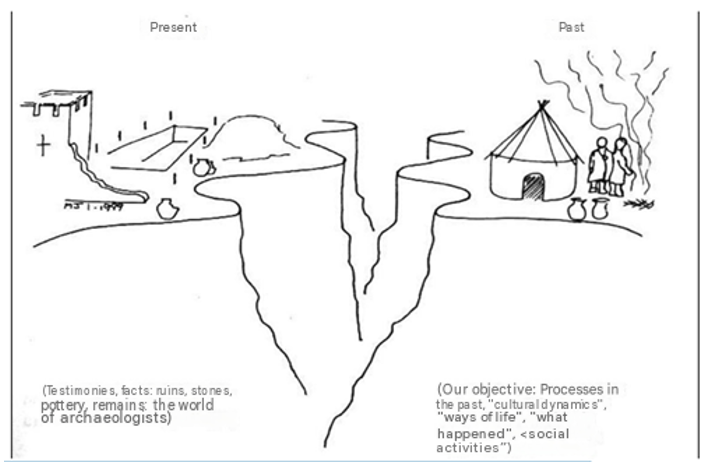
Figure 1 “The abyss between present and past” (Johnson 2000: 31).
In reality, the three possibilities proposed by Binford represent an attempt to generate a middle-range theory bridging the gap between the remains of the past (the object of analysis) and the unfolding of human life in the past (the object of study). There is a substantial epistemological and theoretical difference within the discipline of archaeology between the object of study—the philosophical and symbolic perspective within the realm of knowledge—and the object of analysis—the materiality that must be transcended in order to explain or interpret what occurred in the past. Regarding the object of analysis, archaeological research examines the components and structure of a material record that is, of course, three-dimensional, tangible, and—above all—observable, while being almost invariably unique.
“Let us recall that the concept of middle-range theory was put forward by the sociologist R. K. Merton in the 1950s in his book *Social Theory and Social Structure*; its aim was to explain a limited area of human behavior, and it occupied an intermediate position between minor working hypotheses and the sweeping speculations that attempt to explain human social behavior”.12
Some maintain that Binford sympathized with and subscribed to that middle-range epistemological perspective, thereby attempting to distance himself from the so-called "social archaeologists" by leveraging the data provided by the material record.
“However, as we have already noted, it seems to us that Binford—despite his efforts—chooses, in his analysis of the archaeological contexts he studies, to arrive at theoretical conclusions that do not merely serve those specific contexts but are extended to other archaeological contexts. In other words, he cannot help but generalize, albeit with better scientific arguments than the ‘social philosophers.’ His epistemological problem likely stems from his search for universal behavioral models; although he acknowledges differences, he tends to interpret them through ethnoarchaeological methods, thereby bridging the temporal divide (ethnological present vs. prehistoric past)”.12
Despite the theoretical criticisms leveled against Binford, I believe he took a reflective step with significant epistemological implications toward the development of what is known as Middle-Range Theory.10–15 Furthermore, Binford adopted a theoretical framework—Merton’s—that originates not in the exact or natural sciences but in the social sciences, making it applicable to human societies.
Research procedure
The approach to addressing issues related to humanity's past—whether unknown or not fully understood—involves formulating research questions followed by a procedure that may engage professionals from diverse academic backgrounds. The current epistemological framework surrounding the social sciences—and science in general—allows for the use of multidisciplinary procedures6,7,16 to seek answers to research problems. Often, issues concerning the human past cut across multiple disciplines (multidisciplinary problems), although some can be resolved—for instance, through documentary archives or archaeological fieldwork (monodisciplinary or unidisciplinary problems).
In historical archaeology—as well as in the archaeology of conflict, violence, or battlefields—there is an opportunity to utilize various sources of information (the archaeological record, written documents, epigraphy, visual arts, laboratory data, etc.). It is important to distinguish between research procedures and the theories and paradigms surrounding the research itself. Thus, we must acknowledge that we operate within diverse social and cultural contexts that influence knowledge production;9 however, this does not mean the scientific method should be discarded or its application relaxed:
“…European experience shows that we can readily accept that the past and archaeology are socially determined, while simultaneously maintaining a rigorous commitment to the scientific method…”17
Below, I present a schematic of the research procedure (Figure 2) that cross-references information from the various sources we have employed in our historical archaeology studies over the past twenty years.18
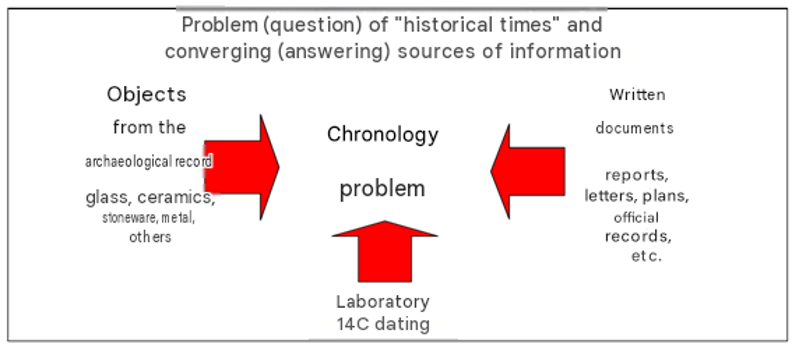
Figure 2 An example of a problem (a question regarding the chronology of a historical site) and the potential to use various sources of information (in this case, artifacts from the archaeological record, written documents, and chemical laboratory dating). The information is cross-referenced (Ramos 2005).
General remarks
In this paper, I highlighted the importance of the history of science by mentioning key milestones that contributed to the development of archaeology in its theoretical and epistemological aspects (for instance, certain perspectives put forward by Binford and Hodder). I then addressed historical archaeology and thematic groupings related to battlefield archaeology, outlining the methodological approach we have been employing for several years. Furthermore, it is important to note that our interpretation or explanation of archaeological findings is not direct—unlike an eyewitness account—since the protagonists and witnesses who lived in the past are no longer present; instead, we proceed through the materiality that endures within what we term the archaeological record. In doing so, we analyze material elements, traces, and the relationships between these components, while taking into account the formation and transformation processes of archaeological sites. Surrounding this are other issues essential to the various perspectives or approaches we adopt regarding scientific themes and problems. I refer here to specific worldviews, concepts, beliefs, and arguments of a theoretical-epistemological nature that can influence interpretations or explanations within the discipline of archaeology—whether in its historical or prehistorical dimensions. All these issues, along with our resulting approaches and perspectives, are "filtered" through certain belief systems, such as established frameworks or dogmas. Another set of ideas and arguments—including theories, paradigms, and the contexts that shape knowledge production9—influences how we analyze material assemblages. All these factors exert influence from a variety of scientific perspectives.
Regarding epistemological and theoretical aspects:
Regarding research methodology perspectives:
Currently, the field known as historical archaeology is viewed as a means to refine research procedures. I understand historical archaeology to be a scientific field that addresses issues concerning the human past within periods considered "historical," and which—to resolve these issues—can draw upon information from the archaeological record and written documents, at the very least. Data derived primarily (though not exclusively) from the composition of the archaeological record and from direct and indirect documentary sources can converge to address the same research question. Conflict archaeology—including battlefield archaeology and similar subfields—falls within this thematic scope, where diverse sources of information are employed to resolve problems.
The social sciences differ significantly from disciplines that rely on laboratory experiments, where the aim is to control all variables; instead, social science disciplines are shaped by specific contexts—historical, social, and personal or individual—that influence the generation of knowledge.9
None.
The author declares that there is no conflict of interest.

©2026 Ramos. This is an open access article distributed under the terms of the, which permits unrestricted use, distribution, and build upon your work non-commercially.