Advances in
eISSN: 2377-4290


Research Article Volume 15 Issue 3
 Zunaira Nasir,2 Syeda Seerat Zahra,3 Maryam Fatima,4 Mehreen Muhammad javed,5 Khushbakht Nasir6
1Optometrist at Fatima Jinnah institute of chest disease Quetta, Pakistan
2Medical Officer SMBZAN ICQ, Pakistan
3M Phil optometry
4Senior Lecturer Allied health sciences Bakhtawar Amin medical and dental college, Pakistan
5Bs Optometry, The University of Faisalabad, Pakistan
6MBBS Qims Quetta, Pakistan
Correspondence: Amara Nasir, Optometrist at Fatima Jinnah institute of chest disease Quetta, Pakistan
Received: November 29, 2025 | Published: December 12, 2025
Citation: Nasir A, Nasir Z, Zahra SS, et al. Choroidal thickness in different degrees of myopia. Adv Ophthalmol Vis Syst. 2025;15(3):112-114. DOI: 10.15406/aovs.2025.15.00497
Purpose: The purpose of the study was to measure the effect of dioptric power on choroidal thickness in myopic subjects.
Methods: A comparative cross sectional study design was conducted in myopic subjects. Fifty-one patients were included (20 female and 31 male). Purposive sampling technique was used to collect the data. Data was gathered by using instruments Optical coherence tomography and data was analyzed by using statistical test one-way anova in SPPS version 22.
Result: Fifty-one myopic patients were examined. Out of which17 individuals were mild myopic with dioptric power of (-1 to -2D), 17 was moderate myopic with dioptric power of (-3 to-4D) and 17 were high myopic with dioptric power of (-5to -6D). Choroidal thickness was measured by enhanced depth optical coherence tomography. There was a statistically significant correlation between choroidal thickness and dioptric power. Choroidal thickness at fovea with decreased significantly (p value 0.001) with the increase in dioptric power.
Conclusion: While calculating the retinal choroidal thickness, dioptric power has been considered as an important variable. There is a significant decrease in the choroidal thickness as dioptric power increases.
Keywords: myopia, choroid, choroidal thickness, OCT, dioptric power
Myopia is one of the refractive defects that are common in children globally. It is estimated that one billion myopes across the globe will face the threat of suffering complications by the year 2050 because of their condition.1,2,3 Choroid, the term is based on the old Greek: korio-aydez, korio (khorio): a membrane enwrapping the fetus, and aydez (eides): that looks like. This word in Latin translates to network. The choroid receives more than 95 percent of the ocular blood supply and takes about 70 percent of the blood supply, compared to the retina.2 The choroid is the main supplier of metabolic exchange to the avascular fovea and the outer retina, retinal pigment epithelium (RPE), and perhaps the prelaminar optic nerve. The inner parts of photoreceptors are full of mitochondria and are the tissues that necessitate the greatest amount of oxygen per weight unit.4 The choroid is the most vascular part of the body which underpins the retina, the most metabolically active tissue. Due to this aspect, choroid is an essential part of the visual system which is highly susceptible to alteration and contraction in severely short-sighted eyes. The chapter begins by providing an introduction to embryology, anatomy and physiology of the choroid. Procedures of imaging choroid are discussed. Two conditions of the choroid associated with the extreme myopia and which can be viewed and measured using these imaging techniques are myopic choroidal thinning and myopic choroidal atrophy. Additional abnormalities are mentioned, such as focal choroidal excavation and peripapillary intrachoroidal cavitation. Prospects for future research are suggested.5
As modern optical coherence tomography modalities have been developed, specifically the development of depth imaging and swept-source OCT, it has become substantially easier to study the choroid in vivo on a fine scale. The choroidal thickness is also becoming recognized as an effective measure of structural and vascular alterations of the myopic eye. Research findings indicate that in the progression of myopia with an increment of the axial length, the choroid becomes increasingly thinner.6 The recent literature shows that in addition to the thinning of the choroid, myopia is associated with the changes in the choroidal blood flow and vascular density, which potentially can diminish the level of metabolic support to the outer retina.7,8 In addition, the posterior part of the highly myopic eyes has undergone notable structural alterations, which impact the choroid, sclera, as well as the retina.9 According to comparative studies, choroidal thinning begins at an early stage during myopia, and becomes increasingly severe with the increase of refractive error, and the length of the axial.10,11 Recent research also provides some evidence that retinal and choroidal thickenings decrease significantly with severity of myopia, which is why the observation of the choroidal changes is crucial in a patient with myopia.12,13,14
Though there is accumulating evidence, there is still no data that directly compares choroidal thickness under varying levels of myopia in the same population. This is why the current study will aim at measuring the choroidal thickness in the eyes with different levels of myopia and also to determine how it relates to the refractive error and axial length (Figure 1).15,16
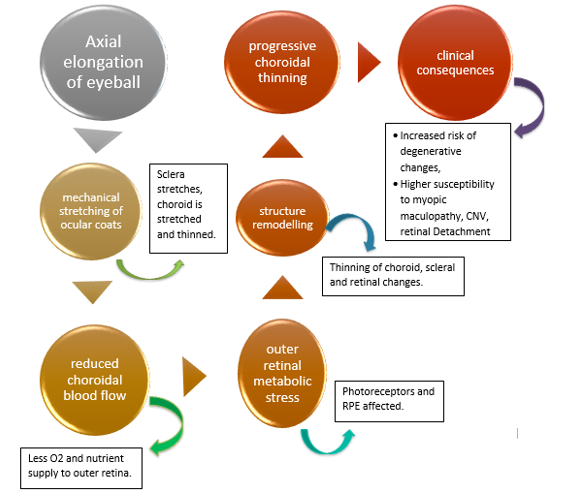
Figure 1 Flow chat.
This comparative cross-sectional study was conducted over nine months. A total of 51 patients diagnosed with 17 mild, 17 moderate, and 17 high myopias. They were selected through purposive sampling techniques. Informed consent was obtained from all participants prior to enrollment. Patients were excluded if they had any ocular surface disease pathological myopia and different age groups. Other exclusion criteria included the use of other medication and anterior or posterior eye abnormalities and surgery. Data was gathered by using instruments Optical coherence tomography and data was analyzed by using statistical test one-way anova in SPPS version 22.
Fifty-one myopic patients were examined in which 31 male and 21 female was included. Out of which17 individuals were mild myopic with dioptric power of (-1 to -2D),17 was moderate myopic with dioptric power of (-3 to-4D) and 17 were high myopic with dioptric power of (-5 to -6D). Choroidal thickness was measured by the enhanced depth optical coherence tomography. Choroidal thickness and the degree of myopia were compared and analyzed by one way anova statistical test. There was a statistically significant correlation between choroidal thickness and dioptric power. Choroidal thickness decreases in different degree of myopia with mean (302,266,216 respectively). Choroidal thickness at fovea with decreased significantly (p value 0.001) with the increase in dioptric power (Table 1) (Table 2) (Figure 2).
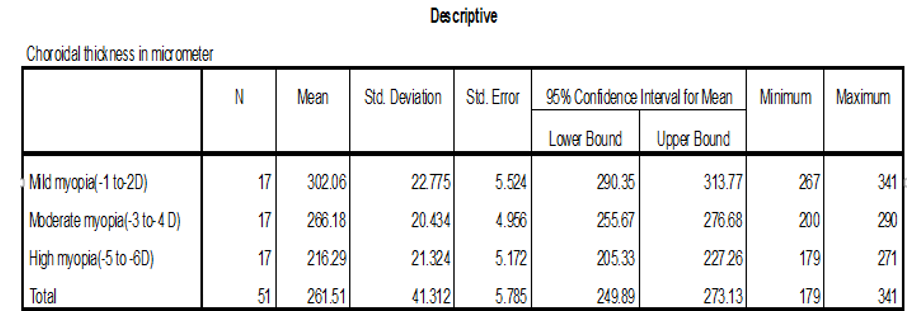
Figure 2 Descriptive of choroidal thickness in micrometer.
|
Number of patients |
Male |
Female |
|
51 |
31 |
21 |
Table 1 Demographic data between male and female
|
Number of patients |
Mild (-1 to -2) |
Moderate myopia (-3 to -4) |
High myopia (-5 to -6) |
|
51 |
17 |
17 |
17 |
Table 2 Demographic data of mild, moderate myopia, and high myopia
This study showed that the with increase in dioptric power of eye corneal thickness decreased. In previous study only high myopic eyes choroid thickness compared with normal eyes at all locations of macula(all P < 0.001).comprehensive meta-analysis, of study showed that in the Chinese individuals, thickness in high myopic eyes was decreased than that of normal eyes.12 In this study mild moderate and sever myopic patients were included Choroidal thickness decreases in different degree of myopia with mean (302,266,216 respectively).Choroidal thickness at fovea decreased significantly (p value 0.001) in high myopes. In previous study the thickness of the choroid decreases with an increase in degree of myopia and axial length. There was a significant relationship between the choroidal thickness with high mypoes (p < 0.05) and high axial length (p <0. 05).17 This work give us clues for further investigation of the pathophysiological changes of myopic eyes and provide us a scientific basis for early detection of disease and treatment of myopia progression. Others investigating the correlation between city scan and myopia can also form a reference for developing myopia treatment plans. All these early detection and treatment plans will help slow down myopia’s progression.18 In this study by measuring the choroidal thickness we can control the myopia earlier. Early treatment can reduce the chance of choroidal damage because choroidal layer of eye is very important to nourish the eye. So in further studies we should compare the choroidal thickness in different degree of myopia, different age group, different axial length and also compare with normal age groups. All of these comparisons will help us to manage the myopia progression and early treatment plans (Figure 3).
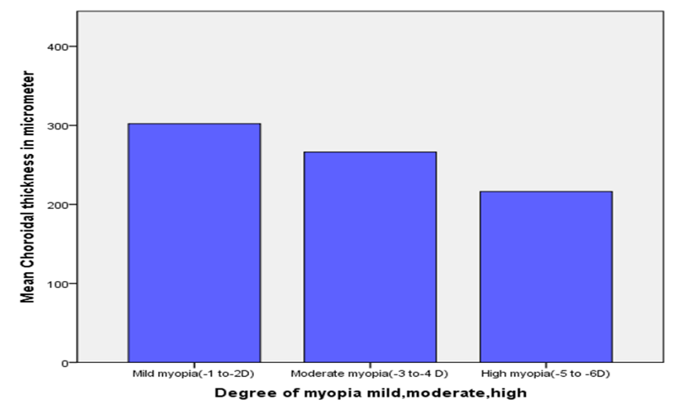
Figure 3 Graph between mean choroidal thickness in micrometer and degree of myopia mild, moderate, high.
While calculating the retinal choroidal thickness, dioptric power has been considered as an important variable. There is a significant decrease in the choroidal thickness as dioptric power increases. Earlier detection of choroidal thickness in myopic patients can decrease the risk of progression of disease.
None.
The authors declare that there are no conflicts of interest.
No funding or sponsorship was received for the conduct of this study.

©2025 Nasir, et al. This is an open access article distributed under the terms of the, which permits unrestricted use, distribution, and build upon your work non-commercially.