eISSN: 2576-4500


Literature Review Volume 10 Issue 1
 Asha Asfana Hossain, MA Guorong
Department of Mechanical & Aerospace Engineering, International Islamic University, Malaysia
Correspondence: Sher Afghan Khan, Department of Mechanical & Aerospace Engineering, Faculty of Engineering, International Islamic University, Kuala Lumpur, Malaysia
Received: January 09, 2026 | Published: January 19, 2026
Citation: Khan SA, Hossain AA, Guorong MA. Experimental investigation of base pressure using micro jets at low supersonic Mach numbers with sudden expansion. Aeron Aero Open Access J. 2026;10(1):12-20. DOI: 10.15406/aaoaj.2026.10.00243
This exploration shows the consequences of an effort to regulate base pressure inside the recirculation sector. The study focuses on the efficacy of stream regulators in controlling base pressure in a duct with abrupt expansion. Tiny jets of 1 mm in diameter are placed at a period of ninety degrees at a pitch circle diameter of 13 mm. The Mach numbers considered range from 1.25 to 1.6. Circular brass pipes were employed with the nozzles, and the diameter ratio of the tubes was 1.6, 1.8, 2.2, and 2.5. The L/D ratio considered was from 1 to 10, and the nozzle pressure ratio used ranged from 3 to 11. The base pressure varies with the expansion level and the nozzle's inertia levels. In establishing the base pressure, the nozzle pressure ratio plays a vital part in setting its scale. While the flow was released into the duct with the area ratios, it remained connected to the duct at all inertial levels and at the NPRs assessed in the present study. Further, it is observed that the nozzle pressure ratio is a vital parameter that significantly influences base pressure and control capability.
Keywords: skin- friction drag, L/D ratio, inertia levels, wall pressure, wave drag
In today's technologically advanced world, aerodynamics plays a crucial and continually expanding role in both engineering and scientific research. The principles of aerodynamics are not only confined to the aerospace and automotive industries but also have significant applications in various aspects of technology in daily life. One of the most prominent components in the practical use of aerodynamic knowledge is the nozzle. Nozzles are integral devices that convert high-pressure fluid into high-speed jets, and their performance is crucial in numerous systems that require accelerating gases or liquids. Depending on the design and function, there are three main types of nozzles utilized in fluid mechanics and propulsion systems. The converging nozzle is the first type of nozzle, in while the cross-sectional area decreases from the inlet to the outlet. This design is ideal for accelerating subsonic flows toward sonic speeds.
The most significant type, particularly in aerospace applications, is the converging-diverging nozzle, commonly acknowledged as the De Laval nozzle. This nozzle combines the functions of both the converging and diverging shapes and contains a narrowest region known as the throat. In this configuration, the subsonic flow is accelerated to Mach unity at the throat and later to supersonic speed in the downstream section. These nozzles are fundamental in high-speed jet applications, such as rocket engines and jet propulsion systems, as well as in various industrial uses, including fuel injectors, spray nozzles, water jet cutters, and other high-efficiency fluid delivery systems. Converging nozzles are effective for reaching sonic speeds (Mach number M ≤ 1). In contrast, converging-diverging nozzles are essential when the objective is to achieve and sustain supersonic velocities (Mach number M > 1), particularly for generating the thrust required by aircraft and space vehicles.
Furthermore, a crucial aspect of supersonic flow from a nozzle is the behaviour of the base flow, located at the nozzle's downstream section or the rear end of a bluff body. The flow in this region can be split into two primary zones by the shear layer. This shear layer acts as a boundary between the supersonic jet and the surrounding stagnant fluid. It is a volatile region where strong vortices form due to velocity gradients, thereby contributing significantly to aerodynamic drag. The total drag force acting on the system is a combination of skin friction drag (resulting from surface contact), wave drag (caused by shock formation), and base drag (resulting from pressure differences in the separated region). Among these, base drag is notably influenced by the base pressure—the static pressure measured at the blunt base. Importantly, base pressure and base drag share an inverse relationship, meaning that as base pressure increases, base drag reduces, and vice versa. Lowering base drag is of great significance because it directly translates into improved overall system efficiency and performance, whether it's an aircraft, a projectile, or any fluid-dynamic structure subjected to high-speed flow.
To optimize flow behaviour and reduce drag, flow control methods are employed, particularly in the nozzle duct or wake regions. These methods are primarily categorized into dynamic and passive control techniques. The dynamic control method involves deliberately manipulating the flow using mechanisms such as blowing and suction, typically implemented via micro jets or actuators. Active systems offer the advantage of being adjustable—they can be switched on or off as needed, depending on operational requirements. However, this flexibility comes at the cost of increased complexity, higher energy consumption, and more stringent maintenance requirements.
On the other hand, passive control methods are more straightforward and more cost-effective, relying solely on geometric modifications to influence flow behaviour. Examples of passive devices include ribs, cavities, splitter plates, and boat tailing. These are designed to disrupt or modify the base flow characteristics, aiming to improve base pressure and reduce drag without requiring external energy inputs. Passive control systems, once integrated into the geometry, provide permanent, reliable solutions for consistent flow improvement in high-speed regimes (Figure 1).
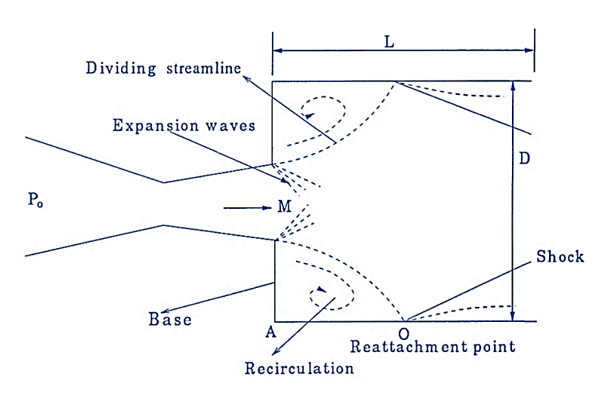
Figure 1 Flow field with sudden expansion.
Numerous studies explore sudden expansion problems, typically focusing on specific flow and geometric conditions. Reviewing all relevant literature in one chapter would be time-intensive. Therefore, only the most pertinent data for this investigation are discussed here. A few studies directly related to the current research are highlighted. Sudden expansions at Mach M = 1 and at Mach numbers greater than unity pose intricate challenges, particularly regarding flow partitioning, rotational zones, and base pressure dearth, which drastically increase drag. Investigators have primarily focused on passive flow techniques, such as adding ribs, cavities, and additional shape alterations, to alleviate these concerns and increase base pressure resurgence. For example, Khan et al.,1 studied the use of semi-circular ribs in flows with abrupt expansion at in cooperative sonic and supersonic speeds. They likened experimental findings to estimates, as single-layer and DNN methods established that ribs efficiently improved base pressure and diminished stream partition.
Khan et al.,2 investigated how ribs function as passive control mechanisms that impact base pressure at Mach M = 1. The outcomes showed that ribs extensively raise base pressure by disrupting the recirculation zone and promoting earlier flow reattachment. The farthest research by Khan et al.,3 explored numerous rib shapes in a flow with sudden expansion at Mach unity. This research demonstrated that a specific rib structure and settings can enhance base pressure recovery, underscoring the role of geometry in control approaches. Moreover, numerical replications have portrayed a crucial role in recognizing the dynamics of streams. Khan et al.,4 simulated flows from converging nozzles with abrupt expansion at Mach 1, providing insight into velocity profiles and modifications to base pressure. The results emphasized the influence of nozzle shape and NPR on stream properties.
Advances in computational fluid dynamics have enabled extra detailed analysis. Khan et al.,5 investigated a CFD study of base-pressure manipulation using a quarter-circle rib configuration for an abrupt expansion tube at Mach 1. Their results showed that quarter ribs can successfully alter the flow area, increasing base pressure and decreasing drag. Khan et al.,6 investigated ribs with semi-circular geometry over a range of inertias. They highlighted the ribs' ability to control base pressure efficiently within specific Mach-number ranges.
Nurhanis et al.,7 studied base-pressure alteration at large Mach numbers in flows with abrupt expansion, focusing on how passive devices can influence shock-boundary-layer interactions. Their results showed that well-designed control devices could reduce adverse pressure gradients and stabilize the flow. Fakhruddin et al.,8 investigated base pressure regulation at M = 1.2 through numerical simulations, highlighting the role of ribs in modifying flow structures and improving pressure distribution. This research highlights the effectiveness of passive control methods in managing supersonic flow.
Khan et al.,9 investigated velocity spreading and base pressure for a nozzle with favourable pressure at a Mach number of 1.0. Their findings provided essential data on flow behaviour under these conditions, supporting the development of effective control strategies. Mishra et al.,10 examined shock standoff distances for wedges in supersonic flow, enhancing understanding of shock-wave interactions in high-speed flows.
Chaudhary et al.11 examined base pressure regulation with one-fourth of the ribs in an abruptly expanded pipe at Mach numbers (M = 1.8). Their study demonstrated that these ribs can help mitigate screech effects and enhance flow stability. Mahaboobali et al.,12 explored passive control of base flows, analysing how the radius and placement of quarter-ribs affect flow at Mach unity. Their findings highlighted the crucial role of rib geometry and positioning for effective flow control. Additionally, Chaudhary et al.,13 investigated flow regulation using quarter ribs in a 22 mm-diameter duct at M = 2. Their research underscored the importance of area ratios in designing successful passive control methods. Khan et al.,14 conducted an extensive CFD investigation of supersonic flow control using quarter ribs, providing detailed insights into their effectiveness under various conditions. Shetty et al.,15 investigated a comprehensive CFD simulation of base pressure management applying quarter ribs at Mach 1.3, confirming their efficacy across a range of Mach numbers. Bellary et al.,16 studied, using numerical models, the alteration in base pressure during an instant enlargement of the tube at M = 1.6 with quarter-circular ribs. Their outcomes facilitated optimized rib geometry for proper flow regulation.
Bellary et al.,17 investigated the thrust generated by CD nozzles at different diverging angles. Their results gave important insights into improving nozzle designs for supersonic flow. Anuar et al.,18 investigated the impact of cavity shape and placement on base pressure in abruptly expanded flows at Mach M = 2.0, with an area ratio of 3.24. Their examination highlighted the importance of cavity design in passive flow control techniques. Makwana et al.,19 presented a study of passive stream regulation at Mach M = 1, commencing with a converging nozzle employing a D-shaped rib. They supposed that the base pressure is a decisive factor in determining the NPR, the area ratio to the flow, the tube dimensions, the rib site, and the rib profile. Baig et al.,20 examined the management of base flows employing microjets, determining the ability of active techniques to regulate base pressure and reduce drag. Rehman et al.,21 aimed to regulate base pressure using microjets, giving insight into the development and operation of dynamic flow management.
Faheem et al.,22 studied the average stream attributes of a high-speed multiple-jet, thus enhancing the interpretation of intricate jet interfaces at high speeds. Sajali et al.,23 studied a supervised investigation of the stream near a spherical cylinder, providing data on flow management around non-streamlined bodies. Khan et al.,24 explored passive flow-control strategies to reduce base drag at low speeds by using numerous cavities, demonstrating the efficacy of cavity arrangements in lowering drag. Khan et al.,25 studied a computational fluid dynamics (CFD) investigation of a human-powered submarine designed to reduce drag by employing flow-control techniques for underwater vehicles. Rathakrishnan26 studied the base pressure in a rapidly prolonged tube with five ribs, having w/h ratios of 3:1, 3:2, and 3:3, at various levels of expansion. Experimental data show that the control reduces base pressure for ribs with small w/h ratios, such as 3:1 and 3:2. However, base pressure increased when ribs with a w/h ratio of 3:3 were used. The results of Rathakrishnan26 serve as reference information for authenticating the CFD outcomes. The authors suggest that a single rib may be sufficient to produce the desired effects, rather than five.
The literature summary features meaningful advancements in base pressure regulation and turbulence modeling. Based on the above review, the authors believe that, to date, control of base pressure through V-shaped ribs has not been attempted. In experimental studies, researchers have employed rectangular ribs to manage base pressure in circular pipes and square ducts. Another investigation explored semi-circular ribs for controlling base flows, but they proved less effective.
Hence, in this research, an effort is made to regulate the base pressure at various Mach numbers (1.25-1.6) for duct diameters ranging from 16 mm to 25 mm by placing the flow control device at the base at multiple levels of expansion to assess the consequences of the flow regulation mechanism.
Experimental facility
The study was conducted using the test setup shown in Figure 2 at Beary's Institute of Technology, Mangalore, Karnataka, India. The figure shows that the nozzle exit has eight holes; 4 (marked c) were used for blowing, and the remaining 4 for base pressure measurement. These orifices help to control base pressure by blowing and using the control tank pressure, drawing a pipe to the tank, and using the pressure through the control chamber. Figure 3 shows a view of the air storage tank. The facility consists of two air storage tanks capable of storing air up to 15 bar. Figure 4 shows the laboratory setup used to experiment, consisting of a settling chamber, a model holder, a 3-D traverse, and a control chamber. Figure 5 shows the nozzles and ducts used for the experiments.
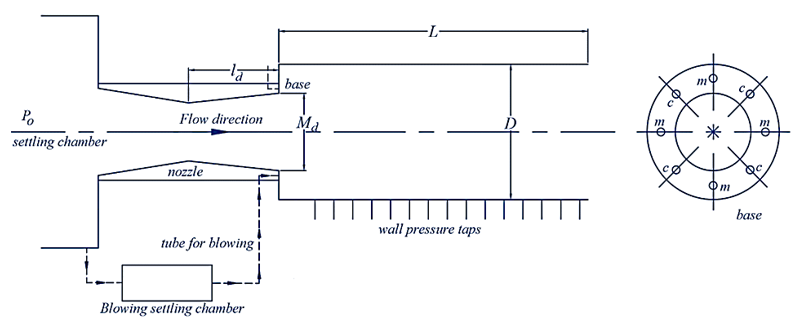
Figure 2 Experimental setup.
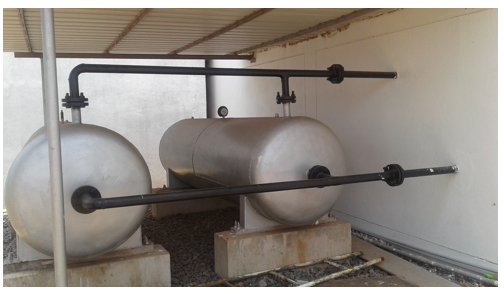
Figure 3 A view of the storage tank.

Figure 4 A view of the laboratory.
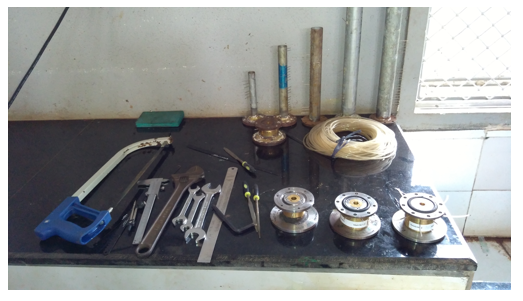
Figure 5 A view of the nozzle and duct.
This research aims to investigate the ability of dynamic control via microjets placed at the base region of axisymmetric ducts for modifying base-zone pressure. The factors considered in the existing investigation are the duct area, L/D ratio, inertia levels, and expansion levels. The assessed base pressures are standardized by dividing them by the backpressure. Results of base pressure with and without control are compared. The NPRs needed for the correct expansion are 2.57, 2.77, 3.57, and 4.25. The level of expansion for Mach 1.25 for the NPRs tested is (i.e., Pe/Pa = 1.16, 1.93, 2.7, 3.5, and 4.3). For Mach 1.3, the (Pe/Pa) are 1.1, 1.8, 2.5, 3.3, and 3.9. Similarly, for Mach 1.48 (Pe/Pa), they are 0.84, 1.4, 1.96, 2.5, and 3.1. Lastly, for Mach 1.6 (Pe/Pa), they are 0.71, 1.2, 1.7, 2.1, and 2.6.
At Mach 1.25 and 1.3, the control is effective at higher NPRs once the nozzles are highly under expanded, as shown in Figure 6 and Figure 7. For lower duct diameters (16 mm & 18 mm) at lower NPRs, the base pressure assessments are low; for duct diameters 22 mm and 25 mm, the pressure magnitudes are high. The reason is that, for a smaller duct radius, the reattachment length is shorter than for larger ones. Since the vortex strength is the same, the vortex can create more suction than for larger duct diameters.
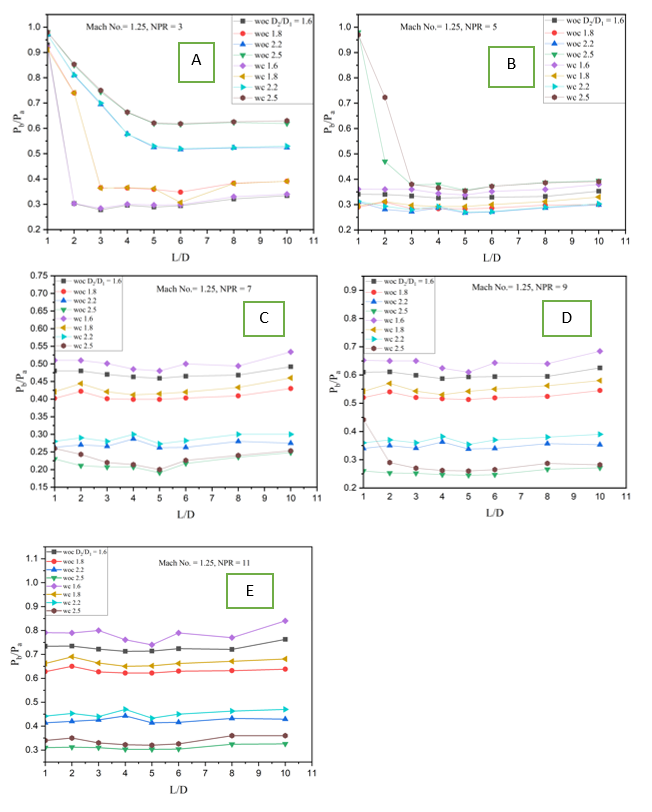
Figure A6–AE Base Pressure Vs. L/D Ratio at Mach 1.25 for numerous NPR and Ducts.
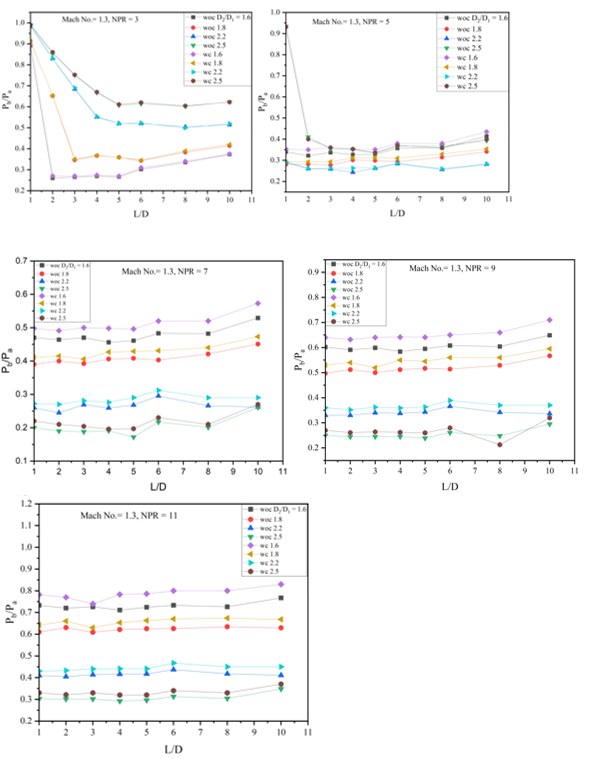
Figure 7 Base Pressure Vs. L/D Ratio at Mach 1.3 for numerous NPR and Ducts.
For Mach 1.48 and 1.6, the flow is over-expanded at the lowest NPR (3); for the remaining NPRs, the nozzle is under-expanded (Figure 8) (Figure 9). Due to the over-expanded flow, the base pressure is higher. This tendency is owing to the presence of an oblique shock wave; when the shear layer passes it, the base pressure abruptly increases. The lowest duct dimensions required for the stream to remain attached to the tube are L/D = 2 for Mach 1.25 and 1.3. Whereas for Mach 1.48 and 1.6, the minimum duct length required seems to be L/D = 3.
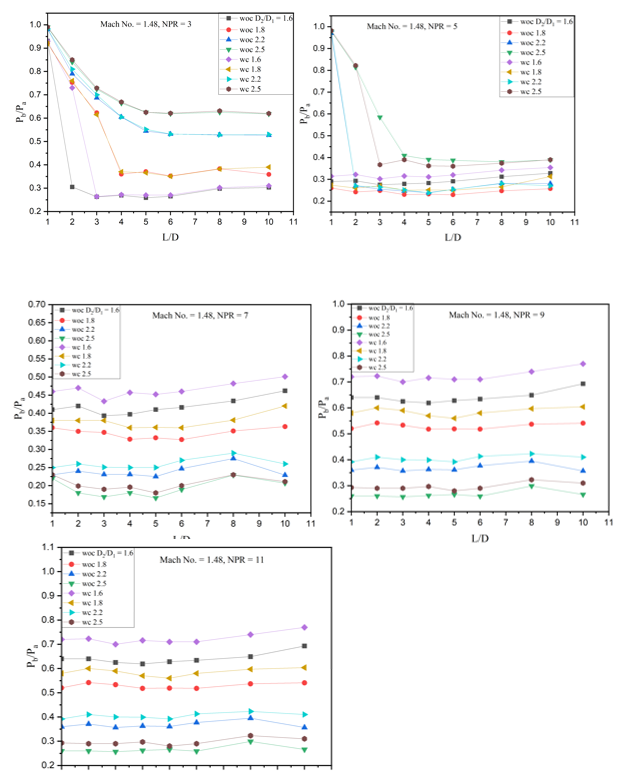
Figure 8 Base Pressure Vs. L/D Ratio at Mach 1.48 for numerous NPR and Ducts.
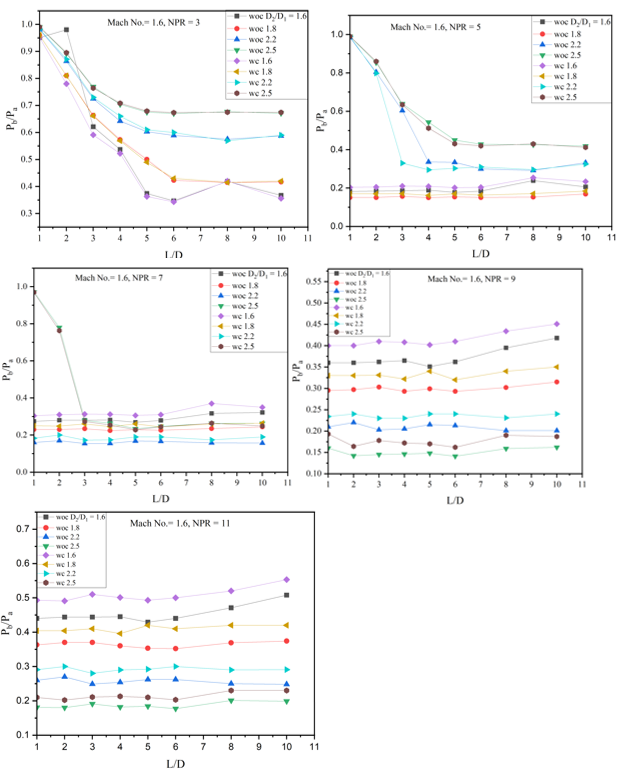
Figure 9 Base Pressure Vs. L/D Ratio at Mach 1.6 for numerous NPR and Ducts.
The base pressure varies with the NPR, inertia level, the relief to the flow, and the L/D ratio. For Mach 1.25 and 1.3, the flow continues under-expanded across all the tested NPRs. These findings show that, in the supersonic scheme, the Mach number strongly influences the base pressure. For a fixed Mach number, the NPR, which influences expansion levels, plays a decisive role in the control effectiveness of micro jets. It is also observed that as NPR increases, the control becomes more efficient at improving the base pressure across all Mach numbers from 1.25 to 1.6. This trend may be due to the shock at the nozzle exit, which deflects the flow away from the base region, reducing the base vortex effectiveness. That increases base pressure because the weak vortex in the base section interacts with the mass stream from the tiny jets. It might be that as NPR rises, overexpansion declines; hence, the shock at the nozzle exit becomes less effective than at lower NPRs. Consequently, the tendency to turn away the entering flow decreases, and the vortex exits nearly unbroken. In this condition, when micro jets are employed, they may spread without ricocheting, thereby drawing mass from the standing vortex and convecting it away from the base, causing the base pressure to exceed that without control.27–29
Established on the above debates, we may draw the following inferences:
None.
Author has no conflicts of interest.
None.

©2026 Khan, et al. This is an open access article distributed under the terms of the, which permits unrestricted use, distribution, and build upon your work non-commercially.