eISSN: 2572-8474

Definition
yellow discoloration of the skin and the mucosa is caused by accumulation of excess of bilirubin in the tissue and plasma (serum bilirubin level should be in excess 7mg/dl. 30-50% of term newborn and more of preterm newborns develop clinical jaundice.1
Physiological jaundice
Jaundice usually appears on 2nd and 3rd day and disappears by 7th -10th day.
Pathological jaundice
Jaundice appearing in the first 24 hours or greater than 14 days of life. Increases in the level of total bilirubin by more than 8.5 μmol/l (0.5 mg/dL) per hour or (85 μmol/l) 5 mg/dL per 24 hours.
Clinical manifestation
Examination of baby should be done in natural day light the color of the nails, sclera, mucous membrane and skin including the palms and soles is observed. Jaundice can come on suddenly, but it often develops over a period of weeks. Symptoms of jaundice include:2
Diagnostic evaluation
Diagnostic testing may include:
Medical management
The goal of treatment of physiologic jaundice is to prevent the level of serum bilirubin from rising. Two type of therapy can be used for infants with physiologic jaundice; phototherapy and exchange transfusion.
Phototherapy: the main form of therapy for infants with physiologic jaundice is phototherapy, the use of intense fluorescent light on the infant exposed skin it is belived that this light in the blue range acts to decompose bilirubin by the process of photo oxidation, phototherapy is effective in preventing or reducing an increase in bilirubin levels. The infant must be unclothed during treatment Figure 1. In order to prevent chilling, maintaining normal body temperature. The vital signs are taken at least every 4 hours to monitor the infant temperature.3
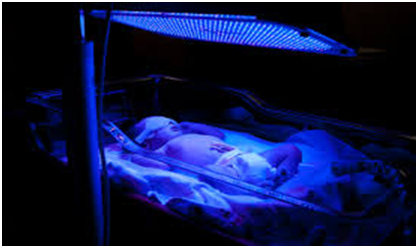
Figure 1 Child in phototherapy.
Certain precaution must be taken to prevent injury to the infant during phototherapy; the infant’s eyes must be shielded by an opaque mask. When infant is placed so that the testes are exposed to the light, a small folded diaper covers the area to prevent damage to these organs. A cap may be used to prevent heat loss from the head during phototherapy, bilirubin is checked at least daily, serum bilirubin levels usually fall 1 to 3 mg/per dl after 8 to 12 hours of treatment. The phototherapy unit is turned off and the eye shields are removed for parenteral visiting and feeding. The treatment regimen using phototherapy may heighten parenteral anxiety during the infant first few days of life. When bonding usually occurs.
Phenobarbital therapy: Increased concentration of ligandin in liver cells. It induces hepatic microsomal enzymes and increases bilirubin conjugation and excretion. A loading dose of 10mg/kg on day 1 and maintenance dose of 5-8mg/kg/day for next 4 days is given. It takes 3-7 days to be effective.4
Exchange transfusion: Double volume exchange replacement 85% of circulating red blood cells and reduces bilirubin level by 50%. Bilirubin can be removed from the blood most rapidly with exchange transfusion. It is used in full term infants with a hypebilirubinemia approaching 20 mg per dl and in premature infants with bilirubin level approaching 10 to 15 mg/dl. Exchange transfusion is rarely needed by infants having physiologic jaundice and is usually used for the treatment of hyperbilirubinemia due to blood group incompatibility (Figure 2).
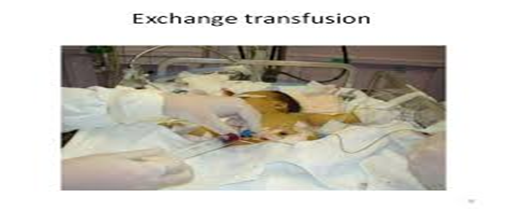
Figure 2 Exchange transfusion.
Nursing diagnosis
Assess fluid volume status of child by intake and output chart
None.
The author declares no conflict of interest.

© . This is an open access article distributed under the terms of the, which permits unrestricted use, distribution, and build upon your work non-commercially.