MOJ
eISSN: 2574-9935


Mini Review Volume 9 Issue 2
Physical Rehabilitation, Siguatepeque Metropolitan Center Clinic, Honduras
Correspondence: Raydel Pérez Castillo, Sports Medicine and Physical Rehabilitation Specialist & Department Cuban Sports Research Center, Siguatepeque, Comayagua, Honduras
Received: June 20, 2026 | Published: July 7, 2026
Citation: Perez-Castillo R. BPC-157 in sports medicine: regenerative potential, clinical evidence and anti-doping challenges. MOJ Sports Med. 2025;9(2):56‒59. DOI: 10.15406/mojsm.2025.9.00200
Therapeutic peptides have emerged as potential adjuncts in regenerative sports medicine, with Body Protection Compound-157 (BPC-157) receiving particular attention due to its reported effects on tissue repair. This narrative review summarizes current evidence regarding the biological mechanisms, therapeutic potential, clinical limitations, and anti-doping implications of BPC-157. Preclinical studies suggest that BPC-157 may promote angiogenesis and tissue regeneration through modulation of VEGFR2 signaling, FAK-paxillin pathways, and stabilization of BACH1 via FBXO22. However, human evidence remains limited and insufficient to establish clinical efficacy or safety. Furthermore, the WADA still prohibits BPC-157, and it is not currently undergoing any regulatory testing for therapeutic use.
Keywords: sports medicine, athletes, tendons, ligaments, biological products, therapeutics, doping in sports, peptides, process optimization
Musculoskeletal injuries represent a significant burden in sports medicine. Traditional therapeutic strategies, including physical rehabilitation and surgical intervention, often fail to fully restore the injured tissue's original biomechanical properties. This persistent gap in clinical outcomes has fueled an intense search for bioactive agents capable of restoring the molecular environment necessary for successful regeneration.1 Within this landscape, therapeutic peptides have emerged as a promising frontier.2,3
BPC-157, a synthetic 15-amino-acid fragment originally derived from human gastric juice, has attracted particular interest due to its exceptional biochemical stability and reported ability to promote healing across multiple organ systems. However, the rapid adoption of these compounds in athletic circles has outpaced the available clinical evidence, leading to a complex intersection of medical innovation and regulatory prohibition. This review aims to synthesize the current preclinical evidence for BPC-157, analyze the molecular pathways of its action, and address the ethical and regulatory challenges posed by its inclusion in the WADA Prohibited List.3
This narrative review was conducted to summarize current evidence regarding the biological mechanisms, therapeutic applications, safety profile, and anti-doping implications of Body Protection Compound-157 (BPC-157) in sports medicine. A structured literature search was performed in PubMed/MEDLINE and Scopus databases from database inception through June 2026.
The search strategy combined Medical Subject Headings (MeSH) and free-text terms including: “BPC-157”, “Body Protection Compound”, “Sports Medicine”, “Athletes”, “Regenerative Medicine”, “Musculoskeletal Injury”, “Tendon Healing”, “Ligament Injury”, “Peptide Therapy”, and “Anti-Doping”. Boolean operators (“AND”, “OR”) were used to optimize retrieval.
Studies were eligible if they: (1) evaluated BPC-157 in experimental, translational, or clinical settings; (2) investigated musculoskeletal tissue repair, angiogenesis, regeneration, or sports-related injuries; or (3) addressed regulatory, safety, or anti-doping considerations. Narrative reviews, original studies, animal investigations, pilot clinical studies, clinical trial registrations, and official regulatory documents from the World Anti-Doping Agency (WADA)[4] and the U.S. Food and Drug Administration (FDA)5 were included. Studies were excluded if they:
(1) were unrelated to sports medicine or tissue regeneration; (2) consisted solely of conference abstracts without full-text availability; (3) were duplicate publications; or (4) were published in languages other than English.
The regenerative potency of BPC-157 is primarily mediated through its ability to modulate key angiogenic and fibroblastic cascades.6,7 Preclinical research has consistently shown that BPC-157 activates the vascular endothelial growth factor receptor 2 (VEGFR2) pathway, which triggers the phosphorylation of akt and endothelial nitric oxide synthase (eNOS), thereby enhancing endothelial cell proliferation and vascular tube formation.1,7–9 This pro-angiogenic effect is crucial during the proliferative phase of wound healing, as it ensures the adequate delivery of nutrients and oxygen to the injury site.10 Beyond angiogenesis, BPC-157 engages the FAK-paxillin pathway, which is essential for the migration and adhesion of tendon fibroblasts.11 By increasing the phosphorylation of these signaling proteins, the peptide promotes the outgrowth of tenocytes and facilitates more organized collagen type I deposition, reducing the risk of suboptimal scar formation.11,12 (Figure 1).
Recent breakthroughs in molecular biology have further elucidated the intracellular mechanisms of BPC-157. Investigations utilizing mass spectrometry have identified FBXO22, an E3 ubiquitin ligase adaptor protein, as a direct cellular binding partner of the peptide.13,14 It has been demonstrated that BPC-157 binds to FBXO22 specifically via its proline residue at position three, effectively suppressing the ubiquitination and subsequent proteasomal degradation of the transcription factor BACH1.14 The stabilization and subsequent accumulation of BACH1 protein lead to the upregulation of critical pro-angiogenic factors and their receptors, including PDGFB, EGFR, and FGFR1. This newly described BPC-157-FBXO22-BACH1 signaling axis provides a solid mechanistic foundation for the observed vascular and tissue repair actions of the compound, reinforcing its status as a potent signaling initiator rather than a mere structural peptide14 (Figure 1).
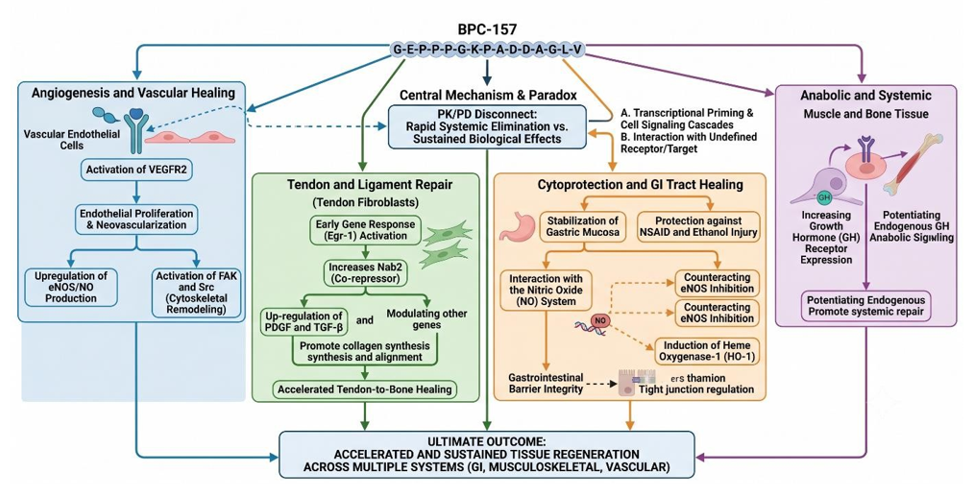
Figure 1 Molecular pathways involved in the angiogenic, anti-inflammatory, and regenerative effects of BPC-157. Proposed mechanisms of action of BPC-157. This peptide promotes angiogenesis and vasodilation through activation of the VEGFR2, PI3K/Akt, eNOS, and nitric oxide signaling pathways, thereby enhancing tissue perfusion and modulating inflammatory responses. At the neuromuscular and central nervous system levels, it contributes to synaptic stability and neurotransmitter regulation. In addition, BPC-157 stimulates regenerative processes in the endothelium, tendons, ligaments, skeletal muscle, and bone tissue through the activation of multiple cellular signaling pathways, promoting tissue repair, structural integrity, and functional recovery.
Despite the compelling molecular evidence, the clinical application of BPC-157 in sports medicine is fraught with significant regulatory and ethical hurdles.2,10,11 In 2022, WADA added BPC-157 to its prohibited list under section S2 as a non-approved substance with potential growth factor-like effects. WADA’s criteria for prohibition involve the potential for performance enhancement, risks to athlete health, and the violation of the spirit of sport.3 In 2026, BPC-157 is currently prohibited by WADA under Section S0 (Non-Approved Substances) rather than being classified as a conventional growth factor. This designation reflects the absence of regulatory approval and the insufficient clinical evidence supporting its safety and efficacy in humans, irrespective of its proposed biological mechanisms. The inclusion of BPC-157 in this category effectively always prohibits its use, both in and out of competition. This creates a profound ethical dilemma for the sports medicine physician, who may see a biological rationale for using the peptide to treat severe musculoskeletal trauma but is bound by the principle of strict liability, where the athlete is held responsible for any substance found in their organism.15,16
However, as noted in the current literature, evidence in humans has historically been limited to retrospective case series and pilot studies with small samples and absence of control groups. This translational gap between animal models and evidence-based clinical practice is beginning to be addressed with the development of recent clinical protocols, such as the randomized placebo-controlled Phase 2 clinical trial NCT07437547 (BPC-HAMSTR). This study prospectively evaluates the efficacy of daily subcutaneous administration of BPC-157 in acute Grade II hamstring tears by means of double-blind assignment, using return-to-play time and quantification of injury volume by Magnetic Resonance Imaging (MRI) as objective variables.17
Furthermore, the lack of high-quality human clinical data remains the most significant barrier to medical acceptance. Currently, human evidence is limited to small case series and pilot studies, which lack the statistical power and methodological rigor of large-scale randomized controlled trials.19 Although preclinical studies have consistently demonstrated regenerative and angiogenic effects, clinical evidence is restricted to a small number of exploratory investigations.
In a retrospective chart review involving 12 patients with chronic knee pain, intra-articular administration of BPC-157, frequently used as part of combination therapy, was associated with subjective pain improvement.18 Likewise, a pilot study including 12 patients with interstitial cystitis reported symptomatic and pain relief following intravesical administration of 10 mg BPC-157, with no adverse events observed during the study period.19 Additional safety data originates from an ethics committee-approved study in two healthy adult volunteers, in which intravenous doses up to 20 mg demonstrated a favorable short-term safety profile and rapid elimination kinetics without reported adverse effects.20 Nevertheless, these studies are limited by small sample sizes, absence of control groups, short follow-up periods, and the lack of objective functional outcome measures, preventing definitive conclusions regarding efficacy, optimal dosing, or long-term safety. While a few retrospective reports suggest subjective pain relief in patients with chronic knee pain, these studies do not measure objective functional outcomes or long-term safety. The absence of Phase III clinical trials makes it impossible to establish standardized dosing protocols or to accurately assess the risk of adverse effects, such as potential pro-tumorigenic activity due to sustained VEGF activation (Table 1).21,22
|
Study |
Design |
Sample Size |
Intervention |
Main Findings |
|
Lee & Padgett (2021)[18] |
Retrospective review |
12 patients |
Intra-articular BPC-157 |
Subjective improvement in chronic knee pain |
|
Lee et al. (2024)[19] |
Pilot study |
12 patients |
Intra-articular BPC-157 |
Symptomatic improvement in interstitial cystitis |
|
Lee & Burgess (2025)[20] |
Safety study |
2 healthy volunteers |
Intravenous BPC-157 |
Favorable short-term safety profile |
|
NCT07437547 (2026)[17] |
Phase II RCT |
Ongoing |
Subcutaneous BPC-157 |
Results pending |
Table 1 Summary of clinical studies evaluating BPC-157 in humans
Importantly, the currently available human evidence remains insufficient to establish definitive clinical recommendations. Most published studies involve fewer than 15 participants, lack randomization, and do not include placebo or active-control groups. Additionally, outcome assessment frequently relies on subjective measures such as pain improvement rather than objective functional recovery or imaging-based endpoints. These methodological limitations increase the risk of selection bias, placebo effects, and overestimation of treatment benefits. Therefore, current clinical findings should be interpreted cautiously until validated by adequately powered randomized controlled trials.
The growing demand for BPC-157 among athletes has unfortunately led to a thriving underground market where compounds are often sold as "research chemicals" not intended for human consumption. This lack of regulatory oversight poses extreme health risks, as products sourced through these channels are not subject to quality control, leading to potential issues with purity, sterility, and accurate dosing. In 2023, the FDA designated BPC-157 as a Category 2 compounding substance, citing significant safety risks due to insufficient human data [1,5]. This classification further limits the legal avenues for obtaining the peptide for therapeutic use. Sports medicine practitioners have a critical responsibility to educate athletes about these dangers and to emphasize that "regenerative" marketing claims often lack scientific validation. The path forward requires a transition from anecdotal enthusiasm to rigorous clinical investigation, where transparent, peer-reviewed human trials can finally bridge the translational gap between rodent success and clinical safety.
Despite the compelling preclinical findings, caution is warranted when extrapolating these results to clinical practice. Animal models provide controlled experimental environments that may not adequately reflect the biological complexity of human musculoskeletal injuries. Differences in metabolism, immune responses, tissue remodeling dynamics, and dosing regimens may significantly influence therapeutic outcomes. Furthermore, many experimental studies employ standardized injuries and short-term follow-up periods, whereas sports-related injuries in humans frequently involve heterogeneous patient populations, comorbidities, and variable rehabilitation protocols. Consequently, the regenerative effects consistently observed in animal models should be interpreted as hypothesis-generating rather than definitive evidence of clinical efficacy.
From a practical perspective, athletes should be aware that the use of BPC-157 may result in anti-doping rule violations regardless of therapeutic intent. Given its classification as a prohibited substance, athletes remain subject to the principle of strict liability and may face sanctions even when exposure occurs through products marketed as regenerative therapies. Sports medicine physicians, team clinicians, and rehabilitation specialists should therefore carefully evaluate treatment alternatives and ensure that athletes receive evidence-based counseling regarding the regulatory status, potential health risks, and legal consequences associated with BPC-157 use. Educational initiatives aimed at preventing the use of unregulated peptide products may represent an important component of athlete protection programs (Figure 2).
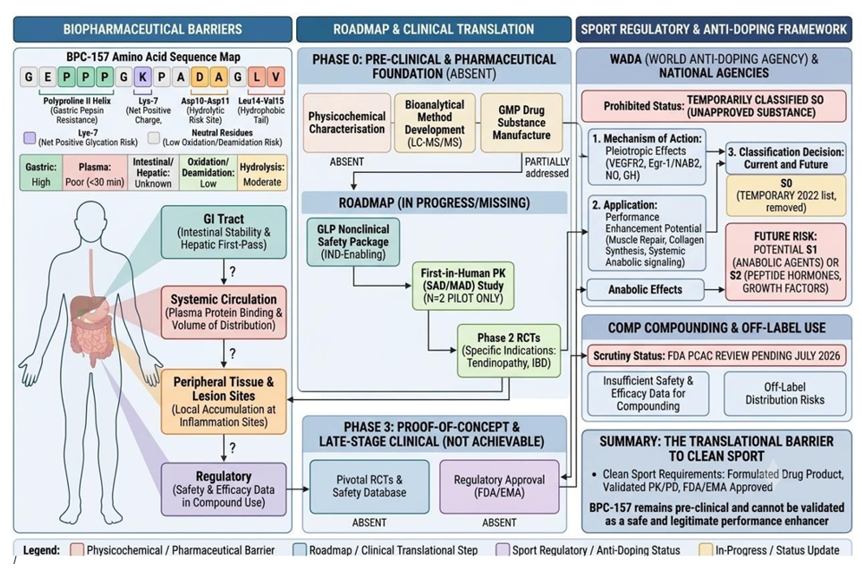
Figure 2 Biopharmaceutical barriers, translational development roadmap, and sport regulatory frameworks for BPC-157.
The multi-tier diagram outlines the critical hurdles for clinical translation and anti-doping compliance. (Left Panel) Sequence-specific liabilities of the pentadecapeptide, including the polyproline II helix (gastric stability), Lys7 (glycation risk), and the Asp10–Asp11 junction (hydrolytic risk), mapped against systemic pharmacokinetic barriers. (Central Panel) Translational roadmap highlighting the complete absence of Phase 0 foundational chemistry (cGMP manufacture), GLP-compliant nonclinical safety packages (IND-enabling toxicology), and randomized controlled trials (RCTs). (Right Panel) Multi-jurisdictional regulatory frameworks, emphasizing WADA anti-doping criteria—including its historical S0 status and future classification risks as an S1/S2 anabolic or growth agent—alongside the pending U.S. FDA PCAC safety review scheduled for July 2026. The schema underscores that robust pharmaceutical and analytical characterization is mandatory before validating any legitimate human clinical or clean-sport application.
Future investigations should prioritize large-scale, multicenter randomized controlled trials evaluating the efficacy and safety of BPC-157 in specific musculoskeletal conditions commonly encountered in sports medicine. Particular attention should be directed toward standardized dosing protocols, routes of administration, pharmacokinetic characterization, and long-term safety monitoring. Additional research is also required to clarify potential risks associated with sustained angiogenic stimulation, including theoretical pro-tumorigenic effects. Furthermore, future clinical studies should incorporate objective outcome measures such as imaging-based tissue healing, return-to-play timelines, functional performance assessments, and patient-reported outcome measures. These efforts will be essential to determine whether the promising biological effects observed in experimental models can be translated into clinically meaningful benefits for athletes.
BPC-157 represents a promising experimental peptide within the field of regenerative sports medicine. Preclinical investigations suggest that it may influence tissue healing through multiple molecular pathways involved in angiogenesis, cellular migration, and tissue remodeling. Nevertheless, the current body of evidence is largely derived from animal and laboratory studies, while high-quality clinical data in humans remain scarce. In addition, peptide is currently prohibited by the World Anti-Doping Agency and lacks regulatory approval for therapeutic use. At present, available evidence is insufficient to support the routine clinical use of BPC-157 in athletes or the general population. Future well-designed randomized controlled trials are essential to establish its safety, efficacy, optimal dosing strategies, and potential role in musculoskeletal rehabilitation.
None.
The author declares that there are no conflicts of interest.

©2026 Perez-Castillo. This is an open access article distributed under the terms of the, which permits unrestricted use, distribution, and build upon your work non-commercially.