MOJ
eISSN: 2374-6939


Case Report Volume 18 Issue 1
 Radhwen Maroueni,1 Ons Mansouri,1,2 Nejmeddine Ouanes1,3
1Department of Internal Medicine. Military Polyclinic of Kasserine, Tunisia
2Sfax Faculty of Medicine. University of Sfax, Tunisia
3Monastir Faculty of Medicine. University of Monastir, Tunisia
Correspondence: Prof. Salem Bouomrani, MD, PhD, Department of Internal Medicine, Military Polyclinic of Kasserine, Kasserine 1200. Tunisia, Tel +00216 98977555
Received: December 16, 2025 | Published: January 8, 2026
Citation: Bouomrani S, Maroueni R, Mansouri O, et al. Rhupus syndrome: an exceptional and often overlooked overlap syndrome. MOJ Orthop Rheumatol. 2026;18(1):1-2. DOI: 10.15406/mojor.2026.18.00730
Rhupus syndrome is an extremely rare and often overlooked entity in routine medical practice. It’s an overlap syndrome characterized by the coexistence of systemic lupus erythematosus (LES) and rheumatoid arthritis (RA) with a prevalence estimated at 0.01 to 1.2% of all patients with rheumatic diseases. The majority of cases are reported sporadically as case reports or limited case series, and it presents a significant diagnostic challenge for healthcare professionals. It is primarily a sequential disease with a clear female predominance. Rhupus syndrome in men, as well as the simultaneous diagnosis of both conditions defining this entity is extremely rare. We report an original case of Rhupus syndrome characterized by its occurrence in a young man and the simultaneous diagnosis of SLE and RA.
Keywords: rhupus syndrome, rheumatoid arthritis, systemic lupus erythematosus, overlap syndrome
Rhupus syndrome is an overlap syndrome characterized by the coexistence of systemic lupus erythematosus (SLE) and rheumatoid arthritis (RA).1–3 This syndrome was first described by Toone EC et al in 1960,4 and the term Rhupus syndrome was first proposed in 1971 by Peter Schur.5–7 It presents a significant diagnostic challenge for healthcare professionals.1,8 We report an original case of Rhupus syndrome characterized by its occurrence in a young man and the simultaneous diagnosis of both conditions.
A 38-year-old Tunisian man with no prior medical history was admitted to our department because of fever and polyarthritis (bilateral and symmetrical painful and swollen joints (hands, wrists, elbows, and ankles) with morning stiffness persisting for more than one hour. These complaints had been evolving for three months with progressive worsening and were not improved by symptomatic treatment.
The physical examination revealed a fever of 38°C and bilateral and symmetrical polyarthritis with synovitis of the wrists, hands, elbows and ankles. Hands examination revealed synovitis of both wrists, proximal interphalangeal and metacarpophalangeal joints of both hands, and multiple specific rheumatoid arthritis deformities of the fingers: Boutonniere and Swan neck deformities (Figure 1). No other physical abnormalities were noted.
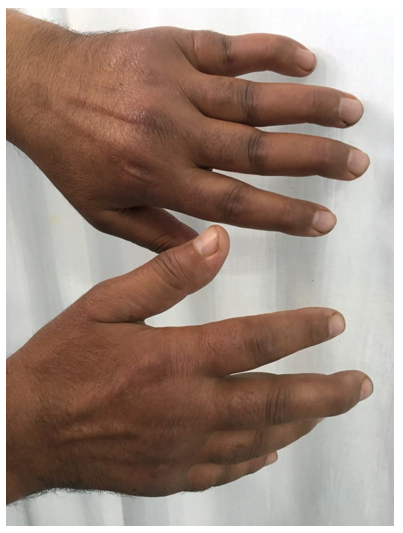
Figure 1 Hands of our patient Multiple specific Rheumatoid Arthritis deformities of the fingers of both hands (Boutonniere and Swan neck deformities).
Laboratory tests revealed a marked inflammatory syndrome with an erythrocyte sedimentation rate at 130 mmH1 and a C-reactive protein at 86 mg/L, leukopenia at 3800/mm), lymphopenia at 1200/mm³, and normochromic normocytic anemia with hemoglobin at 11 g/dL. Other basic laboratory tests were normal (blood glucose, creatinine, uric acid, lipid profile, transaminases, thyroid function, calcium, plasma protein electrophoresis, and urinalysis). X-rays of the hands revealed debutant bilateral carpal fusion.
Immunological tests revealed positivity for anti-nuclear autoantibodies at 1.4, anti-native double-stranded DNA autoantibodies at 28 IU, rheumatoid factor at 9.4 IU/ml, anti-Smith autoantibodies (anti-Sm), and anti-Cyclic Citrullinated Peptide (anti-CCP) antibodies at 189.4 IU/ml. Investigations for systemic involvement specific to SLE and RA were negative. Thus, the diagnosis of Rhupus syndrome was made, and specific treatment was initiated consisting of systemic corticosteroids at 30 mg/day with phosphocalcic supplementation, hydroxychloroquine at 400 mg/day, methotrexate at 15 mg/week, and folic acid at 5 mg/week. The patient's complaints improved rapidly, with the disappearance of pain, joint swelling, and morning stiffness in few days, as well as the normalization of laboratory tests after two weeks of treatment. At one month, the corticosteroid therapy was gradually tapered to the maintenance dose of 7.5 mg/day, maintaining complete remission of the disease.
Rhupus syndrome is an extremely rare and often overlooked entity in routine medical practice.1,3,6,8 Its prevalence is estimated at 0.01 to 1.2% of all patients with rheumatic diseases.1,2,7,9 The majority of cases are reported sporadically as case reports1,7,10 or limited case series.2,9
A systematic review of the medical literature by Antonini L et al, which included all cases of lupus syndrome published between 1980 and 2019, identified only 287 cases.8 This entity is clearly predominant in women: 84% to 100% of cases reported in the literature are female,1,2,7 and in the systematic review by Antonini L et al, 93% of the identified cases of Rhupus syndrome were female.8
Rhupus syndrome in men is extremely rare.10 Indeed, only one man was noted in the series of ten cases of Rhupus syndrome reported by Salvador Maicas L et al.2 Similarly, only one man was noted in the nine cases of Rhupus syndrome reported by Fenniche I, et al.11
This entity can occur at any age but is most often seen in young adults.1,3,8 The average age in the systematic review by Antonini L et al was 35 years at the time of the first symptoms and 45 years at the time of diagnosis.8 More rarely, pediatric12,13 and elderly14 forms have been reported.
The clinical presentation of Rhupus syndrome is characterized by the predominance of joint and cutaneous manifestations, while severe systemic involvement of SLE or RA is much rarer.2,3,6–9,15 Biologically, the concomitant positivity of anti-native double-stranded DNA, anti-Smith (anti-Sm), and anti-Cyclic Citrullinated Peptide (anti-CCP) autoantibodies is highly specific for diagnosis.6,8,9
Rhupus syndrome is primarily a sequential disease.8 In two-thirds of cases, rheumatoid arthritis appears first while in nearly 20% of cases, the diagnosis of systemic lupus erythematosus precedes that of rheumatoid arthritis.3,8
The simultaneous diagnosis of both conditions, as in our patient, is much rarer.2,6,8,15 Indeed, in only 12.2% of cases in Chen X et al series, the diagnosis of the two conditions defining Rhupus syndrome was made simultaneously.3 The prognosis is usually favorable compared to that of SLE or RA, and Rhupus syndrome responds very well to treatment combining systemic corticosteroids and hydroxychloroquine or methotrexate.6,8,9
Rhupus syndrome is a rare and poorly understood condition. Its etiopathogenesis remains a subject of debate, with autoimmune involvement and genetic predisposition playing a leading role. A better understanding of this condition is recommended given its specific therapeutic and prognostic implications. Our observation is distinguished by its male sex and by the simultaneous occurrence and diagnosis of both components of Rhupus syndrome.
None.
The authors declare that there are no conflicts of interest.

©2026 Bouomrani, et al. This is an open access article distributed under the terms of the, which permits unrestricted use, distribution, and build upon your work non-commercially.
