Journal of
eISSN: 2373-4426


Case Report Volume 15 Issue 3

Instituto Nacional de Perinatologia, Mexico
Correspondence: Dr. Giovanna Ivette Zanatta Ramírez, Neonatologist with high specialization in neonatal critical care, Instituto Nacional de Perinatologia, Lomas – Virreyes, Mexico City, 11000, Mexico, Tel +525510486401
Received: October 23, 2025 | Published: November 13, 2025
Citation: Zanatta Ramirez GI. Neuroblastoma with opsoclonus-myoclonus syndrome in the context of SARS-CoV-2 infection: case report with recent review. J Pediatr Neonatal Care. 2025;15(3):170-172. DOI: 10.15406/jpnc.2025.15.00604
Introduction: Neuroblastoma is the most common extracranial solid tumor in childhood, derived from neural crest cells. Neurological manifestations involving the brain or meninges are rare and usually indicate disseminated disease with a poor prognosis. Opsoclonus-myoclonus syndrome (OMS) is a rare paraneoplastic presentation associated with neuroblastoma in a small percentage of cases. Its coexistence with SARS-CoV-2 infection is almost unknown and raises questions about viral mechanisms that could modulate tumor progression or immune response.(1,2)
Clinical case: We describe a 1-year-old girl with progressive OMS symptoms for two months, severe anemia, and fever. During her hospitalization, SARS-CoV-2 infection was confirmed, and radiological findings of mediastinal mass and retroperitoneal infiltration were observed. Upon admission, there were no relevant findings on physical examination.
Discussion: Hypotheses about the interaction between SARS-CoV-2 and neuroblastic cells (possible viral tropism, inflammatory modulation, effects on the tumor microenvironment) are discussed. Previous reports of WHO post-COVID or coexisting with viral infection are reviewed, as well as recent data on the course of COVID-19 in pediatric oncology patients. Although most children with cancer have mild COVID, the overlap of immunosuppression and malignant tumor could favor more aggressive dissemination or progression. A systematic series reports that, in pediatric cancer patients infected with SARS-CoV-2, approximately 11% developed severe COVID, with higher morbidity and mortality. (1,2)
Conclusions: This case reinforces the need for close monitoring of pediatric cancer patients during the pandemic, especially when they present with atypical neurological symptoms. The possibility that SARS-CoV-2 acts as a "second hit" that accelerates tumor progression should be explored with larger research and clinical studies.
Keywords: neuroblastoma, opsoclonus-myoclonus, SARS-CoV-2, COVID-19
Neuroblastoma accounts for 8–10% of childhood tumors and is responsible for a significant proportion of pediatric cancer mortality. It typically presents in the adrenal glands or paravertebral chains, with manifestations such as abdominal mass, pain, paraneoplastic syndrome, or metastatic spread.1,2
Opsoclonus-myoclonus syndrome (OMS) is a rare neurological manifestation associated with neuroblastoma—approximately 2–3% of cases—involving eye movements (opsoclonus) and multiple myoclonic jerks. This condition usually has an autoimmune component, with variable response to immunotherapy, and can leave chronic neurological sequelae.1,2
Since the COVID-19 pandemic, cases of post-COVID OMS or OMS triggered by SARS-CoV-2 have been reported in patients with no evidence of malignant tumor, suggesting a possible post-infectious effect or facilitator of autoimmune expression. For example, Ishaq et al., reported a case of post-COVID-19 SLE in Pakistan.1,2
Wiegand et al., described a similar case with sensitivity to immunotherapy during active infection.2
However, the documented coexistence of neuroblastoma and SARS-CoV-2 in childhood is extremely rare. One report noted asymptomatic reactivation of SARS-CoV-2 in a girl with neuroblastoma.1 Furthermore, the literature on COVID-19 in children with cancer suggests that while most have a mild course, there is a risk of complications, therapeutic interruption, and mortality, especially in resource-limited settings.1,2
This report aims to provide a "sentinel case" of neuroblastoma with rapidly aggressive progression in the context of SARS-CoV-2 infection and to discuss possible biological and clinical mechanisms that may support this association.
A 1-year-old female patient, previously healthy, presented with two eye traumas secondary to opsoclonus-myoclonus syndrome, which had been evolving for two months, in addition to fever spikes that were difficult to control. She was admitted to a tertiary hospital, where a complete blood count revealed severe anemia (Hb <7 g/dL). PCR for SARS-CoV-2 was positive. Thoracoabdominal X-ray revealed a mediastinal mass and retroperitoneal extension. During hospitalization in the COVID ward, she presented with a highly progressive onset of retrocular infiltration with ecchymosis and raccoon eyes at 3 days, which she had not presented upon admission, as well as deviation of the tongue to the left side due to infiltration. An orbital and bone biopsy was performed, with a diagnosis of undifferentiated neuroblastoma in orbital tissue and bone marrow.
Given the advanced stage of the tumor and the systemic and neurological deterioration, the patient was treated with chemotherapy. However, despite supportive therapies, the disease progressed rapidly in a short period of time, suggesting unusual aggressiveness in the presence of infection (Figures 1–4).
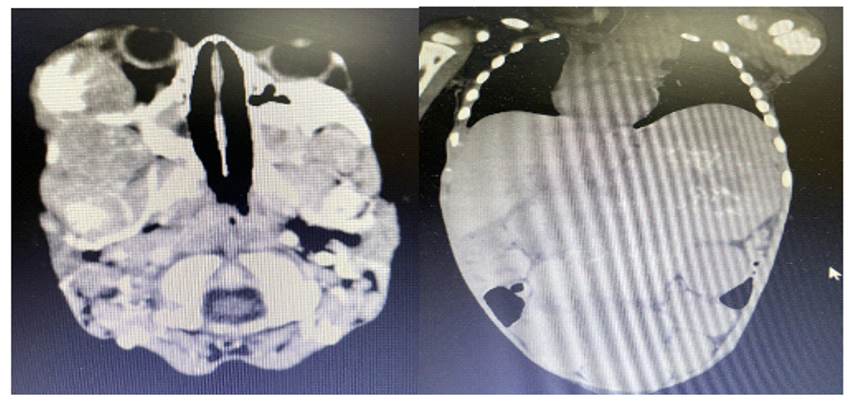
Figures 1 and 2 CT scan of the skull and abdomen and pelvis showing neuroblastoma infiltration.
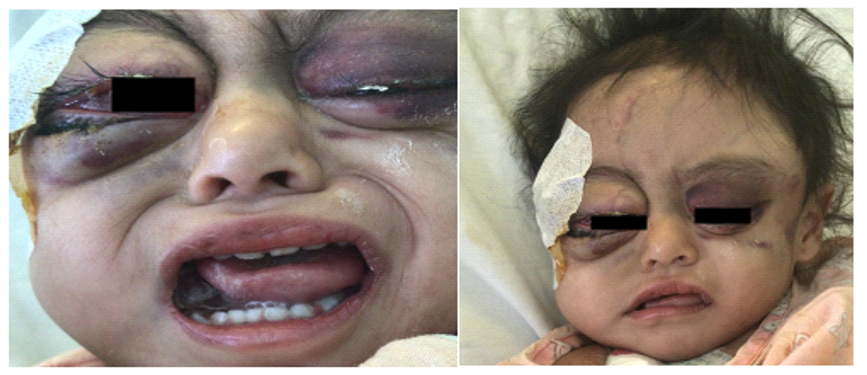
Figures 3 and 4 Retro-orbital infiltration with ecchymosis and raccoon eyes.
Potential mechanisms of SARS-CoV-2/neuroblastoma interaction
COVID-19 in children with cancer: clinical implications
Comparisons with other WHO post-COVID reports
Although the literature is scarce, there are reported cases of SLE triggered after SARS-CoV-2 infection without a detectable tumor:
Our case is distinguished by the combination of active tumor, viral infection, and fulminant neurological progression, making it an extreme case and possibly representative of synergistic interaction between virus and malignancy in pediatrics.
As this is a single case, causality cannot be established; the viral infection may have been incidental or in addition to other predisposing factors.
The absence of serological data, cytokine profiles, or immunological studies limits mechanistic interpretation.
Similar cases need to be collected, and collaborative multicenter surveillance and experimental studies in SARS-CoV-2-infected neuroblastoma cell models are required.
The coexistence of SARS-CoV-2 infection with pediatric neuroblastoma may be associated with aggressive progression and unusual neurological manifestations such as opsoclonus myoclonus syndrome. This is because SARS-CoV-2 could exert effects on the tumor microenvironment, promote inflammation, and modulate the antitumor immune response, although this requires more extensive studies. The pandemic caused delays and interruptions in the timely diagnosis and management of childhood cancer, disproportionately affecting low- and middle-income countries. This review is therefore vitally important to prevent future interruptions in the care of pediatric patients, reinforcing neurological and oncological surveillance during viral episodes, and the appearance of atypical cerebral signs should raise suspicion.
It is important to promote reports of similar cases in order to continue conducting multicenter research on tumor-virus mechanisms.6–9
None.
The case report was prepared in accordance with the principles of the Declaration of Helsinki. The anonymity of the patient and the confidentiality of clinical data were ensured.
The author declares no conflict of interest.
This work did not receive external funding.

©2025 Zanatta. This is an open access article distributed under the terms of the, which permits unrestricted use, distribution, and build upon your work non-commercially.