Journal of
eISSN: 2373-4345


Case Report Volume 17 Issue 3

Professor, Department of Pediatric and Preventive Dentistry, Jamia Millia Islamia, India
Correspondence: Dr Vivek Mehta, Professor, Department of Pediatric and Preventive Dentistry, Faculty of Dentistry, Jamia Millia Islamia, New Delhi, India
Received: February 26, 2026 | Published: July 10, 2026
Citation: Mehta V. Conservative management of congenitally missing permanent mandibular central incisors: a case report with review of literature. J Dent Health Oral Disord Ther. 2026;17(2):80-83. DOI: 10.15406/jdhodt.2026.17.00674
Dental agenesis is a common developmental anomaly in humans. It is defined as the developmental absence of teeth, excluding the third molars. Compared to primary dentition, it is more commonly seen in permanent dentition. The most frequently occurring congenitally missing teeth in permanent dentition are the mandibular second premolars after the third molars. This paper aims to report a case of non-syndromic bilaterally missing permanent mandibular central incisors and its management in a 9-year-old female patient.
Keywords: Developmental anomaly, congenitally missing teeth, mandibular region, permanent, central incisors.
Dental agenesis is the most common developmental anomaly in humans.1-3 Several terminologies have been associated with developmental alterations in the number of teeth. Hypodontia denotes the lack of development of one or more teeth, oligodontia refers to six or more missing teeth, and anodontia refers to the complete absence of teeth.4 True anodontia, also known as the congenital absence of teeth, can be classified as total and partial.5 Hypodontia is common in permanent dentition (2-10%), compared to primary dentition (0.1-0.9%), and may present unilaterally or bilaterally.6
According to Graber, the overall frequency of patients with congenitally missing teeth, excluding the third molars, ranges from 1.6% to 9.6% in various studies from different countries.7 According to Glenn,8 and Grahnen,9 the most frequently missing permanent teeth in children are the mandibular second premolars, maxillary lateral incisors, and maxillary second premolars. Similar findings have been reported by Shahrani et al, who have reported the respective frequency of congenitally missing teeth as mandibular second premolars (41%), maxillary lateral incisors (23%), maxillary second premolars (21%), and the mandibular incisors (6%).10
Females are more often affected than males, with a predominance of 1.4:1.11 The mean prevalence of congenitally missing teeth was 6.42 ± 2.76% in males and 7.55 ± 2.67% in females. The higher prevalence in females was found only in epidemiological samples, as compared to the orthodontic or dental patients.12
A close correlation has been found between congenitally missing primary teeth and their permanent successors.9 It is also associated with the frequency of hypodontia in other parts of the dental arch, the rate of dental development, and the size of the remaining teeth.13
There was no significant predominance of maxillary or mandibular involvement for congenitally missing teeth, although the analysis suggests that the anterior segment is affected more commonly.12 The missing teeth can be categorized as common, less common, and rare.14 Mandibular central incisors fall in the less common category with a percentage prevalence of 0.1 to 0.3%. A review of the literature shows that congenitally missing permanent mandibular incisors have not been well documented. It was first reported by Newman in 1967.15 The data from several populations regarding tooth agenesis in the mandibular region shows marked variation. It is more common in Asians than in Caucasian populations, ranging from 3.4% prevalence in a Hong Kong cohort to 0.6% in Icelandic children.16,17
Documentation of such case reports is essential for reviewing this condition, which helps clinicians not only in diagnosing such cases but also in providing a conservative approach to treating patients with missing teeth. Several management options for bilateral agenesis of mandibular incisors have been discussed in the recent literature.18-22 The present article aims to report a case of conservative management of congenitally missing bilateral mandibular permanent central incisors in a female patient.
A nine-year-old girl reported to the Department of Pedodontics and Preventive Dentistry with the chief symptom of missing teeth in the lower front teeth region. The patient was concerned about the inability to chew properly in the anterior region, along with an unesthetic appearance. The family and medical history of the child patient was insignificant regarding the missing teeth. The parents of the child patient gave no history of extraction, trauma in the anterior region, dental anomalies, or consanguineous marriage. A thorough general physical examination was conducted to rule out any associated syndrome.
Intraoral examination showed the presence of spacing between the right and left permanent mandibular lateral incisors, with missing left and right permanent mandibular central incisors (Figures 1 & 2). The other teeth were of normal size, color, and shape. Panoramic radiograph (OPG) revealed the radiographic absence of mandibular right and left central incisors, along with the absence of tooth buds of 18, 28, 38, and 48 (Figure 3).
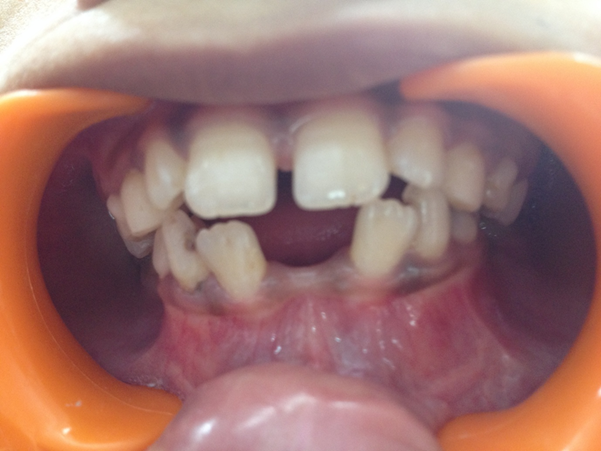
Figure 1 Clinical photograph showing missing permanent mandibular central incisors.
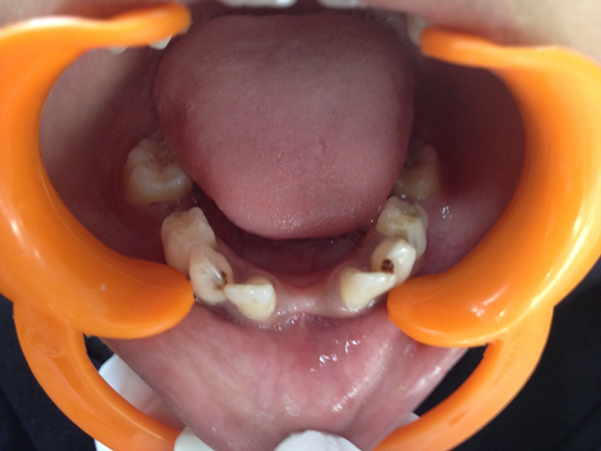
Figure 2 Clinical image showing occlusal view of missing permanent mandibular central incisors.
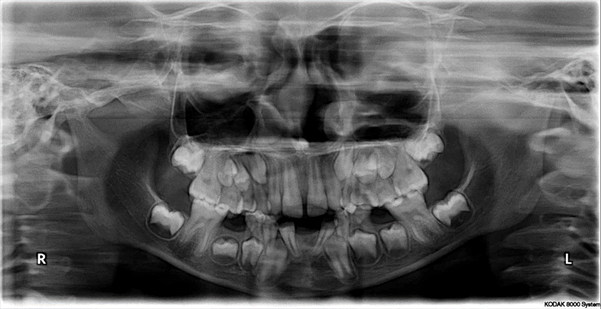
Figure 3 Orthopantomogram X-ray showing agenesis of permanent mandibular central incisors.
The final diagnosis of congenitally missing mandibular central incisors was made. A removable partial denture was fabricated to restore compromised dental and facial aesthetics (Figures 4 & 5). The occlusion of the patient was checked, and post-operative instructions were given. The patient was instructed to report every six months for routine follow-up.
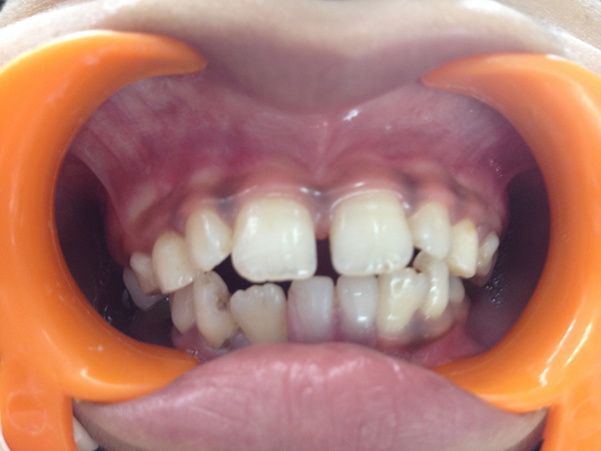
Figure 4 Postoperative anterior view of restored mandibular central incisors.
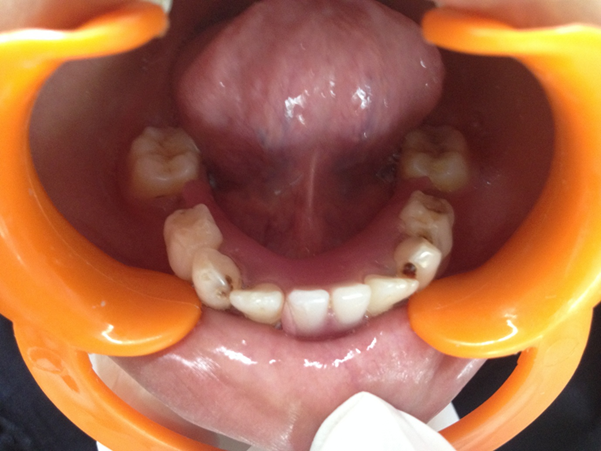
Figure 5 Postoperative occlusal view of restored mandibular central incisors.
Congenitally missing teeth can be found in almost any region of the dental arch and may involve both the primary and permanent dentitions. In a recent study to assess the prevalence of congenitally missing permanent teeth in patients of Caucasian origin, it was found that 4-5% of the studied population had congenitally missing teeth, with a female predilection, and the most commonly missing tooth was the mandibular second premolar, followed by the maxillary lateral incisors.23 Few cases of congenitally missing teeth in the mandibular arch have been reported in the literature, but this case report presents a unique case of conservative management of bilaterally missing central incisors in the mandibular region.
According to the most accepted theory, hypodontia is multifactorial and results from a combination of genetics, epigenetics, and environmental influences, with the former having more influence.10,24,25 Regulatory homeobox genes found to be associated with tooth agenesis are MSX-1, PAX-9, EDA, TGFA, AXIN-2, and the gene encoding low-density lipoprotein receptor-related protein (LRP6).26 A rare case has been reported in literature with concordant expression of bilateral agenesis in two girl siblings, aged 11 and 13 years.27 A case of nonsyndromic familial occurrence of congenitally missing mandibular incisors in three generations has also been reported recently.25
Dental anomalies associated with hypodontia include enamel hypoplasia, taurodontism, short crowns and small roots of the teeth, and conical crown shape.28 Congenitally missing teeth are also associated with endocrine disturbances, chemotherapeutic medications, and severe intrauterine disturbances.7 Hypodontia has also been associated with syndromes like Leopard syndrome, Goldenhar syndrome, Marshall-White syndrome, and Turner and Wilkie syndrome.29
The treatment of congenitally missing mandibular central incisors poses a challenge for the clinician. Several treatment options are available, but the selection of an appropriate treatment plan is imperative for the long-term benefit of the patient. The currently available treatment options documented in the literature to replace congenitally missing teeth include resin-bonded retainers, fixed and removable prostheses, closing the space with orthodontic treatment, and single-tooth implants.30 A patient with bilateral congenital agenesis of permanent incisors and retained primary incisors has been successfully aesthetically managed using direct composite restorations by Zarow et al.20 Zirconia-based resin-bonded prosthesis constitutes a conservative and viable treatment option for the replacement of missing teeth in young patients, in which fixed prosthesis or implant therapy are currently contraindicated.31
Dental implants are considered suitable treatment options nowadays. However, there is little literature supporting the use of dental implants in edentulous growing child patients. The use of implants in edentulous growing child patients is determined by the patient's overall health, the number of missing teeth, the stage of jaw growth, and the anatomic features of soft and hard tissues.32
In the present case, a removable partial denture was fabricated to restore esthetics and function, as the complete occlusion was not established and the growth was not completed. However, implants can be placed successfully in later stages with proper treatment planning by the phase of growth. The child patient was kept under follow-up to observe the pattern of eruption of permanent anterior teeth.
Congenitally missing teeth are a dental anomaly with multi-factorial etiology, occurring with greater predilection for females and in permanent dentition, and can occur in both the maxilla and the mandible. Congenitally missing mandibular incisors often lead to compromised dental and facial aesthetics and function; appropriate treatment should be rendered. Replacing lower anterior teeth with removable partial dentures can be a viable and conservative treatment option in child patients where complete occlusion has not formed, and fixed partial dentures and implant therapy are currently contraindicated. As few cases have been reported in the literature regarding the risk factors and severity of congenitally missing teeth in the lower anterior region, cases with variable treatment options are recommended. Long-term follow-up of such patients would establish the reliability of this treatment option in the pediatric population.
Nil.
Obtained.
None.
The author declares that there are no conflicts of interest.

©2026 Mehta. This is an open access article distributed under the terms of the, which permits unrestricted use, distribution, and build upon your work non-commercially.