Journal of
eISSN: 2373-6437


Research Article Volume 18 Issue 2
1Burns and Plastic Surgery, Department Universitary Hospital, General Calixto García, Cuba
2Urology Department, Hospital Universitario, General Calixto García, Cuba
Correspondence: Dayamí Zaldívar, Burns and Plastic Surgery, Department Universitary Hospital, General Calixto García, La Habana, Cuba
Received: October 27, 2025 | Published: February 26, 2026
Citation: Zaldívar- Castillo D, Bueno- Valiente AS, Duarte-Pérez A, et al. Reconstructive surgery for tissue defects following fournier’s gangrene: our experience. J Anesth Crit Care Open Acce. 2026;18(1):26-28. DOI: 10.15406/jaccoa.2026.18.00646
Background: Fournier's gangrene is a serious condition caused by a multibacterial infection, developing a necrotizing fascitis of the soft tissue of genital and perineal area, with a high mortality rate. An appropriate therapeutic approach includes antibiotics, surgical debridement and reconstructive surgery. With the aim to describe the results of plastic surgical procedures in patients suffering from Fournier’s disease, the present study was performed.
Methods: An observational, descriptive, cross-sectional and prospective study was carried out at the Plastic Department of Calixto García Hospital, La Habana, from January 2018 to January 2022. All patients referred from the Urology Department with the diagnosis of Fournier Gangrene in recovery phase, with a proper granulation tissue, normal Complete Blood Counts values and negative bacteriological culture were included. A characterization of the sample was performed according to demographics parameters, reconstructive surgical techniques and the incidence of complications.
Results: Of a total of 21 referred patients, 15 were included. Male were predominant (93,3%), skin grafting and local flaps the main surgeries performed, and the incidence of complications was unremarkable (13,3%). Diabetes Mellitus the main associated condition found (80 %).
Conclusion: Skin Grafting and local flaps were the main reconstructive techniques performed with a low incidence of complications. In spite of several reconstructive techniques described, the combination of them was the roule.
Keywords: Grafts, Necrosis, Reconstruction, Surgical Flaps
Fournier gangrene is an unfrequent multibacterial infection, affecting the skin and soft tissue of genital and perineal zones, causing a necrotizing fascitis with a quick and fatal evolution.1 Male patients aged between 50th and 70th years old seems to be the most affected although female population can equally suffer from this condition.2,3 Bacteriological findings report that isolated microorganisms in Fournier fascitis belong to germs from the natural flora of urogenital and anorrectal zones (aerobics and anaerobics): (Klebsiella, Proteus spp, Staphylococco, Streptococco, Clostridium spp).4 Physiopathological changes described are: skin damage, microtrombosis of the subcutaneous vessels, bacteriemia, colagenasas enzimes production, systemic mediators releasing and tissue necrosis. Acute inflammation symptoms and signs appear: Pain, erythema, edema, local heat and tumor, lymphadenopaty and crepitation caused by anaerobics bacterias.5 Clinical evolution depends on the germ virulence and patient's immune response. In spite of medical advances, the incidence of complications and mortality remains elevated.6
Several comorbidities have been considered as risk factors for the development of Fournier Fascitis: Diabetes Mellitus, poor nutrition, alcoholism, peripheral vascular disease, obesity and immunodeficiencies conditions.7 A multidisciplinary medical approach includes: Fluids resuscitation and hemodynamic support, metabolic control, systemic antibiotics, nutritional support, a sequencial and early surgical debridement, an appropriate reconstructive surgical technique.8 A proper reference of patients to the Plastic Department is important to obtain a definitive closure of the affected soft tissue, in order to preserve the anatomic and functional integrity of the urogenital zones and to prevent the retractions and hypertrophics scarring.9 At the Universitary Hospital ¨¨Calixto García¨, the Reconstructive and Plastic Department and Urology Department have been working closely for several years treating patients suffering from Fournier Disease and its sequels. With the aim to describe the results of reconstructive surgical techniques in patients affected by this condition, the present study was performed.
An observational, descriptive, cross-sectional and prospective study was carried out at the Plastic Department of the Universitary Hospital ¨¨General Calixto García¨¨, La Habana, Cuba, from January 2018th to January 2022nd, to describe the results of the reconstructive surgical procedures for the coverage of tissue defects secondary to Fournier fascitis. All patients referred from the Urology Department with the diagnosis of Fournier Gangrene in recovery phase for the definitive closure of the remaining wound, who accomplished the following criteria were included.
Inclusion criteria
Exclusion criteria
Data collection
Information were obtained from medical records. A characterization of the patients were done according to age, gender, risk factors, anatomic zones affected, surgical reconstructive procedure performed and incidence of complications. Reconstructive Surgical procedures were performed at the Operating Theatre of Plastic Department and were admitted and evaluated daily for 7 days. A post operative evolution took place at the outpatient clinic the days 10th, 15th, 30th and 60th searching for the presence of complications. Of a total de 21 patients received, 15 were included.
Statistical analysis
Information were collected using Microsoft Excel and SPSS software versión 21.0 for Windows with 95 % IC. For the descriptive analysis of the qualitatives values, absolutes frequencies (n) and percentages (%) values were calculated
Ethics aspects: The investigation was performed following the standard ethics issues according to the Helsinki Declaration, Fortalezza, Brasil, 2013.The signature of the consent was confirmed by the medical team. The research protocol was evaluated by the Ethic Staff of the Hospital.
The sample included 15 patients. Male the most affected: 14 (93,3%). A female diabetic patient was admitted: n=1 (6,7%), with a previous history of a complicated gynecological surgery as the cause of the fascitis (Table 1).
|
Ages |
Male |
Female |
Total |
|||
|
n |
% |
n |
% |
n |
% |
|
|
20-39 |
1 |
6,7 |
1 |
|||
|
40-59 |
5 |
33,3 |
1 |
6,7 |
6 |
|
|
60-79 |
5 |
33,3 |
5 |
|||
|
80 + |
3 |
20 |
3 |
|||
|
Total |
14 |
93,3 |
1 |
6,7 |
15 |
100 |
Table 1 Demographic Aspects
Some comorbidities were found to be associated with the condition studied: Diabetes Mellitus 80 % (n=12), peripheral arterial insufficiency n=1 (6,7%), and a previous history of trauma related with the development of Fournier necrosis was confirmed in 2 patients (13,2%). Figure 1 shows the distribution of anatomic zones affected. Perineum and scrotal region the most damaged.
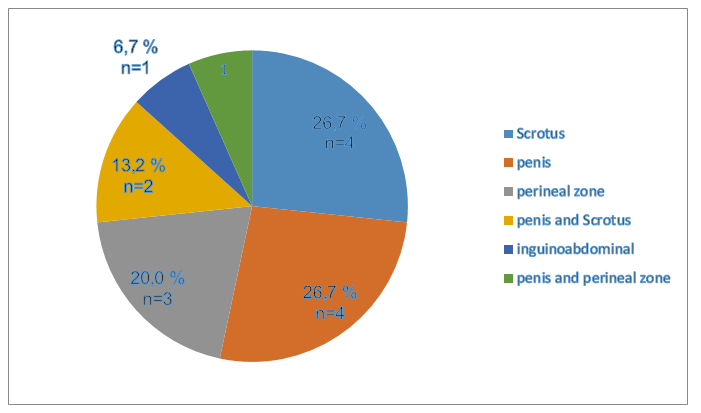
Figure 1 Anatomic Zones Affected.
Skin Grafting was the main surgical procedure carried out (n=7; 46,7 %) (Figures 2 and 3) followed by local flaps: n=4 (26,7%) divided as: (2 local frontal advancement flaps and 2 transposition local flaps). A combinated techniques were selected in 2 patients and a primary closure of the wound was carried out in the other 2 (13, 3%) because of the small size of the defect. About he postoperative evaluation, only 2 patients (13,3%) developed complications: 1 partial lisis of the skin graft and 1 partial dehiscense of the wound with no need for a second reconstructive time.
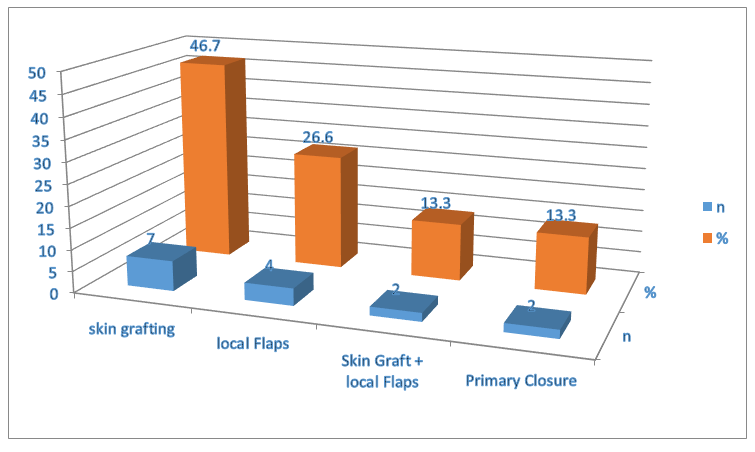
Figure 2 Reveals the reconstructive techniques performed.
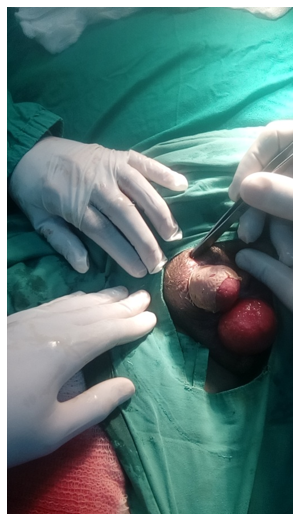
Figure 3 Bilateral Scrotal Skin Grafting secondary to Fournier Gangrena (from author).
Several surgical techniques have been described for the reconstructive treatment of the sequels following a Fournier necrotizing fascitis, condition also known as Periurethral Phlegmon.8,10 There is not a consense about the most effective surgical reconstructive procedure. It depends on several parameters: size and deepness of the affected zone, anatomical region damaged, viability of the surrounding tissue, and patients general physical and immune condition.11,12 In the present investigation the main surgical repairing procedure performed was Skin Grafting (46,7%), and local flaps procedures as the second reconstructive option selected. Bravo Gálvez et al.13 coincidently confirmed the benefits of skin grafting in their patients as the first option for the closure of the granulation tissue secondary to Fournier fascitis.
Skin Grafting are considered an advantaged surgical option because of the possibility of repairing extended open wounds with a minor incidences of complications, mainly in scrotal zones, preserving the color and skin texture of the genital area and the proper temperature of the testicles.10 Tian et al.14 promote the possitive effects of applying a negative suction therapy before the final repairing procedure in order to obtain a high quality granulation tissue, specially when the perineum is affected, equally Guerra et al.6 published the advantages of this method. In the present study, the viability of the granulation tissue was obtained applying a 1% Silver Sulfadiazine change of dressing before the surgery. La Cruz et al.15 described the use of Silver Sulfadiazine dressing as well.11
Delgado Cuevas et al.16 report the utility of también confirman la utilidad de combinar injertos de piel con transposición de colgajos para resultados más favorables. La combinación de colgajos locales e injertos fue utilizada en 2 (13,3%) de los pacientes de nuestra muestra. Local flaps advancement have been informed to be usefull repairing techniques for the treatment of perineal and inguinal soft tissue deffects, attending to its properties to provide a safer blood supply.10 Afroza17 in a 2 years retrospective study, reports 15 patients treated with local flaps advancement techniques and skin grafts for the healing of opened genital wounds secondary to Fourniers necrosis, similar to Sandoval et al.18 results, who in correspondence with our findings informed the presence of Diabetes Mellitus as the first comorbiditie affecting patients.3,4,7
A combination of several reconstructive surgical techniques have been suggested for Larsson et al.,19 one of the repairing methods performed in our patients. The use of dermal dressings appears to support the surgical treatment.19 Chabak et al.20 report the use of the miocutaneous Gracilis flap as the first repairing technique in perineal and scrotal defects when mucles and fascials tissues are involved in the necrosis.10,21 In order to avoid the contamination of surgical flaps or grafts, the need of cistostomies or colostomies depends on the urologist or general surgeon criteria.8 The presence of postoperative complications after reconstructive surgeries of Fourniers sequels have been published, including infections, hematomas, dehiscences, flaps necrosis.13,17,18,21 In the present investigation a lower incidence was found. (1 partial wound dehiscense and 1 partial graft lisis). A short investigation period of time have been signaled as a limitation of the present study, with a reduced sample number. Further futures studies most be done to obtain more efficients results.
Skin Grafting and local flaps were the main reconstructive techniques performed with a low incidence of complications. In spite of several reconstructive techniques described, the combination of them was the roule, because of the special anatomic and functional characteristics of genitoperineal zone.
None.
None.

©2026 Zaldívar-, et al. This is an open access article distributed under the terms of the, which permits unrestricted use, distribution, and build upon your work non-commercially.
