Journal of
eISSN: 2373-6437

Introduction: The use of enteral nutrition in septic shock is controversial during periods of significant hypotension due to concern of possible metabolic stimulation of an ischemic gastrointestinal system. In this study, using a piglet model of endotoxic shock, we tested the hypothesis that full enteral feeding during shock would not adversely affect gastrointestinal microcirculation.
Methods: Yorkshire cross pigs were either fed or non-fed during endotoxic shock and compared against controls. Severe hypotension was induced by administration of E. coli. Hemodynamics and microcirculatory blood flow (measured via colored microspheres) were compared throughout the experiment. Post-mortem biopsies of the stomach, small bowel, and large bowel were examined from representative pigs in each group.
Results: Despite a sustained decrease in MAP with ETX exposure, regional blood flow (RBF) to the stomach was maintained throughout the experiment. RBF to the small intestine dropped, and remained low, with lowered MAP. The large intestine followed the small intestine pattern but with consistency issues within the data. Post-mortem biopsies revealed normal stomach tissue in both groups. Both fed and non-fed ETX animals showed mild to moderate erosion in the small and large bowel but there was no significant effect of feeding compared to not feeding.
Conclusion: While this study is limited in duration, it does appear that initially there is no harm to the microcirculation or integrity of the gastrointestinal tract with addition of feeding during severe septic shock. Results indicate that feeding during severe hypotension, which would help maintain nutrition, should be considered.
While the use of enteral nutrition in septic shock during periods of hemodynamic stability is generally accepted practice, it is controversial during periods of significant hypotension. This is due to concern of possible metabolic stimulation of an ischemic gastrointestinal system (GIS), which may result in tissue damage, subsequent bacterial translocation, and continued release of endotoxin (ETX). Subsequently, this causes stress-sensitive protein kinases to activate pro-inflammatory genes which in turn activate inflammatory enzymes, cytokines, and chemokines amongst others agents. This cascade can then further a pro-inflammatory response, expediting or exacerbating multi-organ failure (MOF). It is further proposed that the use of total parenteral nutrition (TPN) rather than enteral nutrition further intensifies this progression to MOF.1,2 The crux of the matter is that parenteral nutrition is not a benign entity. Due to its hyperosmolar makeup, total parenteral nutrition (TPN) must be given via central venous access. With this persistent need for central access comes side effects such as thrombophlebitis and infection (with possible sepsis).3,4 In some patient subsets, such as those with abdominal trauma, this can lead to a statistically significant increase in infection.5 In rats with E. Coli induced peritonitis, TPN leads to a higher mortality rate than those rates fed enterally.6 The lack of stimulation to the gastrointestinal tract (GIT) can then cause changes to its structure and function. One of the most feared, potentially fatal, side effects is progression to cholestasis leading to fulminant liver failure.7,8
Some suggest that even minimal enteral nutrition may help increase effective intestinal blood flow and maintain mucosal integrity. The evidence for bowel infarction with enteral feeding appears anecdotal.9,10–14 Interestingly, when intestinal permeability was analyzed in patients undergoing major upper gastrointestinal cancer surgery, baseline intestinal permeability did not correlate with increased risk of sepsis. All patients had a post-operative increase in intestinal permeability but there was no significant difference between those who developed sepsis and those who did not.15
In this study, using a piglet model of endotoxic shock, we tested the hypothesis that enteral feeding during shock would not adversely affect gastrointestinal microcirculation. Additionally, we did post-mortem biopsies of gastrointestinal tissue to address the question of tissue destruction in sepsis in the setting of enteral feeding versus no feeding.
This study was approved by the Institutional Animal Care Use Committee at Tripler Army Medical Center. Investigators complied with the policies as prescribed in the USDA Animal Welfare Act and the National Research Council’s Guide for the Care and Use of Laboratory Animals. Animals were handled in accordance with the National Institute of Health (NIH) guidelines in facilities fully accredited by the American Association for Accreditation of Laboratory Animal Care International.
Yorkshire cross pigs (weight 7-10kg) were either fed (n= 6) or non-fed (n= 8) during endotoxic shock and compared against fed (n = 7) and non-fed (n = 7) controls. Hemodynamics were measured via continuous measurement of pulmonary artery pressure (PAP), pulmonary artery wedge pressure (PAWP), cardiac output (CO) via thermodilution, and core temperatures were assessed. Microcirculatory blood flow was measured via colored microspheres. Urine collection and assessment of resuscitative efforts was obtained by placing a 4-5 Fr. Foley catheter directly into the bladder via a low midline mini laparotomy. An orogastric tube was placed to provide enteral nutrition. Body temperature was maintained using a heated operating table, Bair Hugger, and heat packs as needed. Severe hypotension was induced by administration of E. coli endotoxin (ETX, lipopolysaccharide purified from Escherichia coli serotype 055:B5, cat no. L-2637, lot no. 062K4098 15000-4000 units/kg; Sigma, St. Louis, MO). Thirty to 180 minutes were allotted to achieve a state of septic shock, defined by a drop of at least 20% in mean arterial pressure (MAP). To achieve this drop, additional injections of 2500-5000U of ETX were injected intravenously, if necessary. Once the goal drop of MAP was achieved, the piglets were observed for an additional 30 minutes to reach a steady-state of septic shock. Enteral feeding with Oxepa (Abbott Nutrition, Columbus, OH) at a rate of 10ml/hr began in the control group and the ETX group assigned to feeding.
Arterial and venous blood gases were measured at baseline, steady state, endotoxic (or control) state, and two one hour treatment period of feeding or not feeding. Blood sampling was used to evaluate electrolytes and glucose levels. Colored microsphere injections were used to assess microcirculatory blood flow. Each microsphere is approximately 15 um in diameter and was injected at each appropriate period in 1 ml of normal saline. Animals were euthanized following the treatment periods with intravenous Euthanasia (Schering-Plough Animal Health Corp, Kenilworth, NJ). Necropsy was performed and organs were harvested. After organ harvest, portions of the stomach, small intestine, and large intestine were sectioned from each treatment arm and set with formalin. The samples were then prepared with hematoxylin and eosin stains and placed in tissue blocks. A board certified pathologist examined the tissues. The pathologist was blinded to the different treatment groups. After organ harvest, tissues were evaluated for microsphere implantation at an outside laboratory (Interactive Medical Technologies, Ltd., Irvine, CA). Regional microcirculatory blood flow was expressed in ml/min per gram of tissue.
Two-way ANOVA with repeated measures over time was used to compare the interaction effect of treatment and time, followed with post-hoc with Tukey’s Test (JMP 4.0.4 program) with a p<0.05 chosen to indicate statistical significance.
Endotoxin induced a significant and maintained decrease in MAP and cardiac output in both fed and non-fed animals (Figure 1). Despite a sustained decrease in MAP, regional blood flow (RBF) did not decrease in the stomach (Figure 2). The small intestine showed a significant decrease with ETX exposure that was maintained throughout the remained of the experiment. No difference in fed and non-fed animals was seen (Figure 3). The large intestine appeared to mirror the small intestine but due to significant consistency issues within the data, no conclusions can be drawn on the large intestine at this time (Figure 4). Post-mortem biopsies revealed normal stomach tissue in all groups. The control (no ETX) group overall had normal appearing small bowel mucosa, with some coincident findings of patchy crypt abscesses and diverticulosis in the large intestine (Figure 5). The ETX non-fed group had evidence of mild to moderate erosion of both the small and large bowel (Figures 6). The ETX fed group also had evidence of mild to moderate erosion of the small and large bowel, with one incidence of marked sloughing (Figure 7).
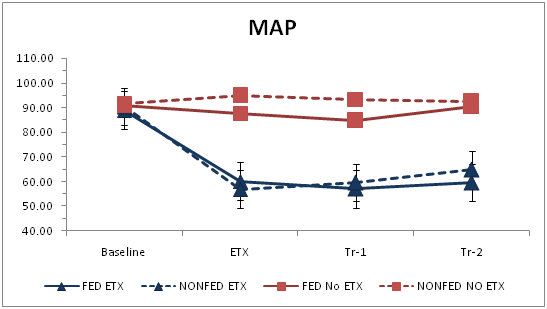
Figure 1 Mean Arterial Pressure (MAP) throughout the experiment, comparing fed and non-fed animals in both ETX and non-ETX exposed groups. Note that ETX exposed animals maintained their decreased MAP throughout the experiment.
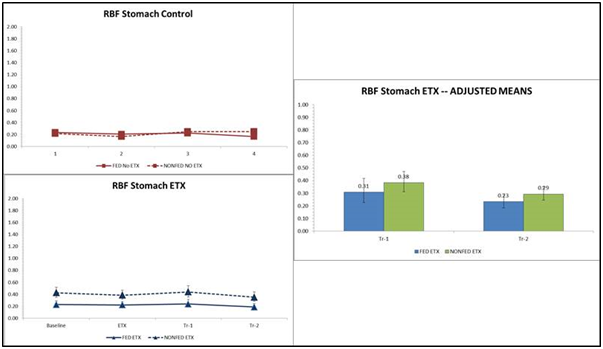
Figure 2 Stomach Regional Blood Flow (RBF) throughout the experiment, comparing fed and non-fed animals in both ETX and non-ETX exposed groups. The stomach maintained RBF despite a drop in MAP in the ETX group. The slight differences between fed and nonfed groups were not statistically significant after controlling for the small baseline difference between the groups.
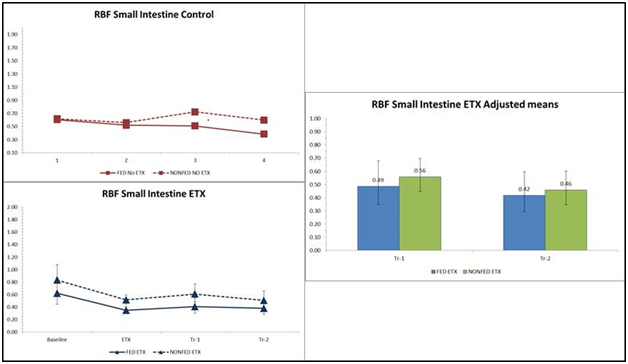
Figure 3 Small Intestine Regional Blood Flow (RBF) throughout the experiment, comparing fed and non-fed animals in both ETX and non-ETX exposed groups. The small intestine showed a concurrent drop in RBF with drop in MAP in the ETX group. The slight differences between fed and nonfed groups were not statistically significant after controlling for the small baseline difference between the groups.
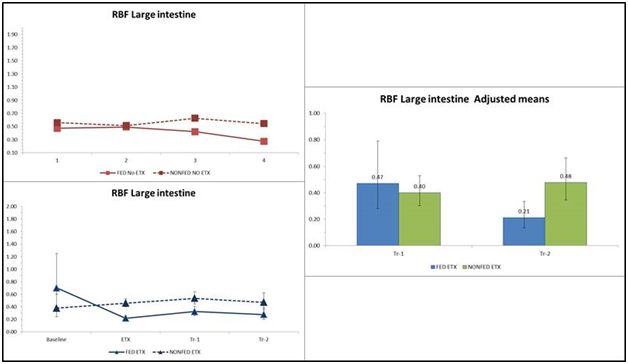
Figure 4 Large Intestine Regional Blood Flow (RBF) throughout the experiment, comparing fed and non-fed animals in both ETX and non-ETX exposed groups. While the trend is similar to the small intestine, the consistency issues are clear during baseline measurements.
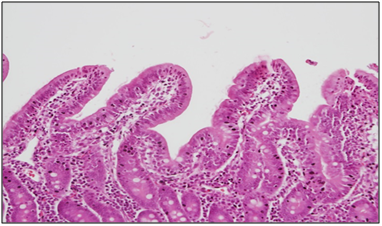
Figure 5 This slide shows normal appearing mucosa from the small intestine of a control (non-fed and no ETX) piglet.
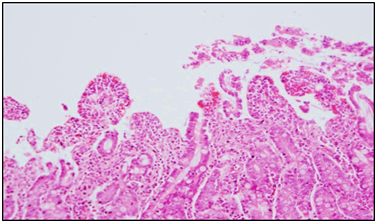
Figure 6 This slide shows mild erosion within the small intestine mucosa in a non-fed ETX exposed piglet.
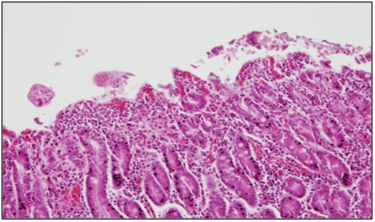
Figure 7 This slide shows mild erosion within the small intestine mucosa in a fed ETX exposed piglet.
Based on this study it does appear that feeding has no significant adverse effects on gastrointestinal tissue mucosa during sepsis despite significant hypotension. The maintained stomach RBF and unimpeded small intestine RBF during the period studied is consistent with previous studies showing maintained or increased splanchnic circulation with early septic shock. This further supports early enteral feeding despite hypotension. Enteral feeding, when compared with parental feeding, has a multitude of biological benefits to include decreased inflammatory markers. There is also a proposed subsequent improvement in cardiac function during septic shock, although this has only been demonstrated in rat models.16 Protocols that strongly advocate for early enteral nutrition in critically ill patients were found to have reduced total hospital length of stay and decreased mortality.13,17 This mortality benefit was actually more significant in patients who were hemodynamically unstable and required the use of vasopressors.14
During enteral feeding splanchnic circulation consumes more oxygen. The increased metabolic demands are not necessarily met ¬with an increase in blood flow; therefore a mismatch may then occur. In septic shock, as opposed to circulatory for instance, there is an initial increase in splanchnic circulation, increase in oxygen extraction, and increase in oxygen¬ ¬¬consumption. These increases then begin to decline approximately 20 hours into sepsis. During these periods of increase however, there appears to be an abnormal distribution of blood flow with a corresponding impaired tissue oxygenation at the capillary level. This possibly results in the same overall effect as decreased perfusion to the GIS.9,18
The previously discussed mechanism of enteral nutrition increasing effective intestinal blood flow and maintaining mucosal integrity may be, in part, causing the mortality benefit. For instance, intestinal microcirculation in a rat model was shown to improve after induction of septic shock with the administration of a glucose solution directly to the intestinal mucosa.19 This relationship between mucosal integrity and overall health benefit is not only seen in septic shock but other severe conditions. For example, in acute pancreatitis it has been demonstrated that mucosal permeability correlates with a higher percentage of septic complications.20 Although as stated above, this was not true for major gastrointestinal cancer surgery.15 The question is whether mucosal integrity is simply a symptom of worse (or impending deteriorating) illness or a contributing factor that can then be modified with enteral nutrition amongst other efforts. The improved patient outcomes with early enteral nutrition suggest the latter. While, as mentioned earlier, it has been demonstrated that early enteral feeding decreases hospital time and improves mortality, other prospective studies have shown no benefit other than improved caloric intake. While reaching caloric goals in and of itself has benefit, it does beg the question as to whether enteral feeding itself is improving patient outcomes versus the avoidance of parenteral nutrition, with its multitude of aforementioned side effects, is the real benefit.4,7,21 It is possible that both answers are correct in different settings and different patient populations. It has also been shown feedings deficient in nutrients, while maintaining adequate protein intake (permissive underfeeding), does not affect 90-day mortality in critically ill patients, suggesting that the content of feeds as well as the mode of feeding may have an effect on overall outcome.22,23 In contrast, it has also been shown that increases in both energy and protein correlate with better outcomes overall, but especially for patients with body mass indexes (BMI) greater than 35 or less than 25. Also, while the European Society for Clinical Nutrition and Metabolism (ESPEN) guidelines seem to be the most accurate in estimating caloric goals for patients, this adds another area of debate. This is especially true with the rate of obesity increasing and patients’ weights varying so much from ideal body weight.24
This study shows that enteral nutrition during hypotension places no significantly increased risk on gastro-intestinal mucosa. Evidence is increasing that patients require some form of nutritional support during critical illness as this has been shown to improve mortality as well as length of hospital stay and enteral nutrition is likely superior to parenteral.14,25 The composition of the feeds, the exact caloric requirements, and enteral nutrition during the use of high pressor doses are areas of further study.
We would like to thank all the members of our laboratory and veterinary staff. Without their assistance this experiment could not be possible.
Disclaimer
The authors have no financial disclosures. The views expressed in this presentation are those of the authors and do not reflect the official policy or position of the Department of the Army, Department of Defense, or the U.S. Government.
Carly Richards, Robert McMurray, and Alexander Malloy performed data analysis and wrote the article. Colby Fernelius analyzed the tissue samples and provided detailed descriptions of each. Shane McEntire and Catherine Uyehara performed the experiments as well as help to interpret the data.
The authors declare there is no conflict of interests.
None.

© . This is an open access article distributed under the terms of the, which permits unrestricted use, distribution, and build upon your work non-commercially.
