Journal of
eISSN: 2572-8466


Mini Review Volume 13 Issue 1
1Professor of Fruit Growing and Plant Propagation, IFES-Campus Santa Teresa, Brasil
2Professor of Plant Physiology, IFES-Campus Santa Teresa, Brasil
3Professor of Fruit Growing, IFES-Campus Santa Teresa, Brasil
Correspondence: Marcus Vinicius Sandoval Paixão, Professor of Fruit Growing and Plant Propagation, IFES-Campus Santa Teresa, Brasil
Received: February 09, 2026 | Published: February 27, 2026
Citation: Paixão MVS, Matiello HN, Fernandes AR. Routes of application of gibberellic acid in the growth of banana, var.Vitória. J Appl Biotechnol Bioeng. 2026;13(1):20-21. DOI: 10.15406/jabb.2026.13.00412
Gibberellic acid (GA3) has a significant effect on plant size by acting on stem cell elongation. In banana cultivation, it delays fruit ripening or reduces bunch compaction by increasing the spaces between fruits and hands, achieved through direct spraying onto the bunch. Treatments were applied to seedlings of the Vitória variety, at the horn stage, 0.70 m tall, previously selected one from each clump. The commercial product Progib® with 10% active ingredient was used. Doses were 0, 100, 200, 300, and 400 mg L⁻¹, diluted in water, applied in a volume of 20 mL, sprayed on the entire aerial part or applied to the pseudostem at 0.20 m above the ground. A plastic syringe with a needle was used to inject the solution into the pseudostem. Sixty days after application, the plant height at the time of first leaf insertion, number of leaves, pseudostem diameter, and height/diameter ratio were evaluated.The injection of GA3 was effective in increasing plant height, diameter, and the height-to-diameter ratio, demonstrating good potential for cost savings and effectiveness of the active ingredient.
Keywords: pseudostem, bunch, injection, plant height, diameter
Gibberellic acid (GA3) has a significant effect on plant size by acting on stem cell elongation.1 In banana cultivation, GA3 is used to delay fruit ripening or to decompact the bunch by increasing the spaces between fruits and clusters, achieved through direct spraying onto the bunch.
Rosseto et al.,2 concluded that immersing fruits in GA3 solutions delayed ripening. The application of GA3 via spraying on the last bunches of the cluster also showed this.did not affect the length and weight of the fruits.3
The method of applying active ingredients in banana cultivation must take into account the high waxiness of the epidermis in different organs, which hinders the penetration of active ingredients diluted in water. The banana pseudostem consists of layered leaf sheaths that allow the injection of liquids with privileged access to the vascular system. Application of GA3 via injection into the pseudostem may affect the growth rate and development of banana plants. This study aimed to evaluate the effect of GA3 applied to the pseudostem, via spraying or injection, on the growth of banana seedlings.
The experiment was conducted in the seedling production nursery, a polyolefin shade cloth with 50% shading, in the nursery sector of the Federal Institute of Espírito Santo (IFES-Campus Santa Teresa), at a height of 2.3 m, located in the Central mesoregion of Espírito Santo, city of Santa Teresa-ES, district of São João de Petrópolis, geographic coordinates 19º56'12”S and 40º35'28”W, at an altitude of 155 m. The region's climate is characterized as Cwa, mesothermal, with a dry season in winter and heavy rainfall in summer (Köppen classification),4 with an average annual precipitation of 1,404.2 mm and an average annual temperature of 19.9 °C, with a maximum of 32.8 °C and a minimum of 10.6 °C.5 The experiment consisted of a completely randomized design with four replications, in a 2x5 factorial scheme, with 10 plants in each experimental unit.
The treatments were applied to seedlings of the Vitória variety, at the horn stage, 0.70 m tall, previously selected one from each clump, in an area without any type of chemical treatment, with manual cultivation practices using agricultural tools. The commercial product Progib® with 10% active ingredient was used. The doses were 0; 100; 200; 300 and 400 mg L-1, diluted in water, applied in a volume of 20 mL, applied to the pseudostem at 0.20 m above the ground. A plastic syringe with a needle was used to inject the solution into the pseudostem.
Sixty days after application, the plant height at the time of first leaf insertion, number of leaves, pseudostem diameter, and height/diameter ratio were evaluated.
The experimental data were subjected to analysis of variance using the F-test, meeting the model assumptions through the Shapiro-Wilk test to verify normality, and the treatment means were compared using Tukey's test at a 5% probability level.
The dose and application method affected height, diameter, and height/diameter ratio, showing significance at a 5% probability level, but not showing a significant effect on the number of leaves (Table 1).
|
Source of variation |
GL |
Height |
Diameter |
Number of sheets |
Height/diameter |
|
Application method (M) |
1 |
3.4105* |
0.04637* |
1,6000ns |
14.0751* |
|
Dose (D) |
4 |
0.8586* |
0.0076* |
0.9700ns |
11.7263* |
|
M x D |
4 |
0.1573* |
0.0037ns |
0.2250ns |
4.8701ns |
|
Residue |
30 |
0.0533 |
0.0032 |
0.6 |
1.9566 |
|
CV% |
|
20.24 |
28.3 |
23.46 |
24.05 |
Table 1 Analysis of variance table
Plant height is affected by both dose and application method, with a pronounced effect of injection into the pseudostem (Table 2), and the sprayed and injected doses showed a linear effect on plant height (Table 3).
|
|
|
Averages |
|
|
|
|
Application method |
Height (m) |
Diameter (m) |
Number of sheets |
Height/Diameter |
|
|
Injected |
1.45 A |
0.2358 A |
3.00 A |
6.40 A |
|
|
Sprayed |
0.87 B |
|
0.1677 B |
3.00 A |
5.22 B |
Table 2 Comparison between the mean characteristics of the GA3 injection and spray treatments on the pseudostem
Means followed by the same capital letter in the column do not differ statistically by Tukey's test (P<0.05).
|
Application method |
Adjusted equation |
R2 (%) |
|
Injected |
Ŷ= 0.621 + 0.001247 * Dose |
99.0 |
|
Sprayed |
Ŷ= 0.894 + 0.0028 * Dose |
85.0 |
Table 3 Regression equations adjusted for plant height as a function of the dose of GA3 injected or sprayed on the pseudostem
The highest dose resulted in a plant height increase of 44.72% and 55.52% via spraying and injection, respectively, with intracauline injection allowing for better absorption of the active ingredient and utilization of the injected dose. Spraying, although quick, causes spray loss and has low efficiency on surfaces with a thick, waxy cuticle.
No phytotoxic effects were observed. The dwarfism characteristics obtained through mutation may be caused by gibberellin deficiency, and this condition can be reversed by its application. The application of GA3 via spraying on somaclones var. Prata-anã and Prata-gigante seedlings was effective in increasing height and used as an early selection characteristic for smaller plants.6
The effect on height in young plants demonstrates effective translocation of the active ingredient. Gibberellin transport occurs from the apex to the base via the phloem,7 and point application via injection was able to promote longitudinal stem growth. In adult plants, the action of injected GA3 may affect the characteristics of the bunch in plants that are already flowering or have immature fruits.8 The appearance of the plants 15 days after application can be seen in Photo 1.
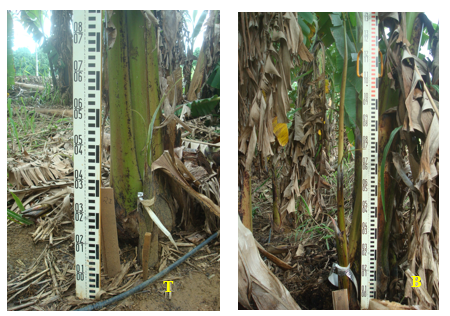
Photo 1 Appearance of seedlings subjected to a dose of 400 mg L-1 via spraying (A) and via stem injection (B) 15 days after application.
The injection of GA3 was effective in increasing plant height, diameter, and the height-to-diameter ratio, demonstrating good potential for cost savings and effectiveness of the active ingredient.
None.
There is no conflict of interest.

©2026 Paixão, et al. This is an open access article distributed under the terms of the, which permits unrestricted use, distribution, and build upon your work non-commercially.