Journal of
eISSN: 2572-8466


Mini Review Volume 12 Issue 5
Associate Researcher, Latin American Center for Agroecological Research (CELIA), Cuba
Correspondence: Luis L Vázquez, Associate Researcher, Latin American Center for Agroecological Research (CELIA), Cuba
Received: August 09, 2025 | Published: September 2, 2025
Citation: Vázquez LL. Redesigning sustainable management of the food chain: from the agroecosystem to the human abdominal ecosystem. J Appl Biotechnol Bioeng. 2025;12(4):184-186. x DOI: 10.15406/jabb.2025.12.00401
Natural resource degradation, food crises, and worsening health problems constitute cumulative problems that pressure the sectors that govern them. Although various studies justify the close relationship between them, paradoxically, they are valued and managed separately. The role of the food route in their exacerbation/suppression is even underestimated. This short article raises awareness about the role of the food chain in people's health and suggests a disruptive redesign that would influence the reconversion of the primary food production model, the transformation of the food access system, and the population's literacy regarding sustainable food.
Keywords: sustainable food, functional food interactions, food remanipulation
Human nutrition has been characterized by acquiring and ingesting whatever is offered: from the earliest populations who hunted animals or gathered fruit within reach, to today's society, where people purchase products sold in nearby markets. This social myopia of depending on what is available has become more sophisticated since World War II, reaching impressive levels in presentation, flavor, and awareness-raising messages that make them highly attractive, even to the point of addiction.
These characteristics have contributed to today's society being composed of population clusters in anthropized habitats, where the quality of food and health status, which are still valued separately, have become important social problems, even in rural areas, where the influences of modernity have eroded food culture and traditional medication.1
Continued human population growth and widespread patterns of overconsumption have been linked to major changes such as the depletion of natural resources and the generation of massive amounts of toxic waste and pollutants, resulting in changes that affect the health of the planet and our health.2
In this regard, planetary health is defined as human health in the environment in which we live;3 which, in turn, is influenced by human biology, the healthcare system, lifestyle, and the environment.4 It is a field focused on the study of human-caused disruptions to the Earth's natural systems and the resulting impacts on public health, with the aim of developing and evaluating evidence-based solutions to protect an equitable, sustainable, and healthy world.5
It is emphasized that the social determinants of health are "the circumstances in which people are born, grow, live, work, and age, including the health care system".6 In this regard, although scientific and statistical evidence on the negative effects of modern nutrition has grown exponentially, human populations remain wedded to food systems that exceed the limits of genetic, metabolic, and environmental tolerance.
The accelerated lifestyle, the population's eating habits, and the increase in diseases typical of the late 20th and early 21st centuries are generating a public health problem in many countries and significant changes in food security worldwide. In search of a solution to these health problems, and thanks to significant scientific advances and technological development, current efforts are being made to promote the consumption of foods that, in addition to basic nutrition, provide additional benefits for the health and well-being of the population, taking into account their genetic, environmental, social, and cultural characteristics.7
Although this issue has been widely documented in the scientific literature, this short article aims to contribute to its holistic approach, particularly the need to redesign sustainable management of the food chain, from the agroecosystem where it is obtained to the abdominal ecosystem where it is ingested by humans.
Food route: Cultivated plants have a life cycle that begins with the seed; as soon as it germinates, the plant develops until it flowers, and then the fruit is obtained. The seed for new plantings can be obtained from the fruit (botanical seed) or other plant organs (roots, stems, buds), among other methods. The fresh produce used for food can be any of the plant's organs: root, stem, branch, leaf, flower, fruit, depending on the species and local food culture. This means that the product people ingest was part of the development of another living being: a plant. Therefore, it also needs nutrients to develop and can be affected by parasites and other disease-causing organisms; it also interacts with other plants, whether cultivated or not.
This synthesis, learned by most people during their educational training, needs to be complemented by the following: on the land where the plant is grown (agroecosystem), it interacts with the soil biota, other non-cultivated plants (auxiliary vegetation), the animals used for work, and the people who grow them (farmers), among others (Figure 1). This means that the plant's microbiota, understood as all its organs, although characteristic of each species, interacts within the agroecosystem and is part of the food product that people ingest.
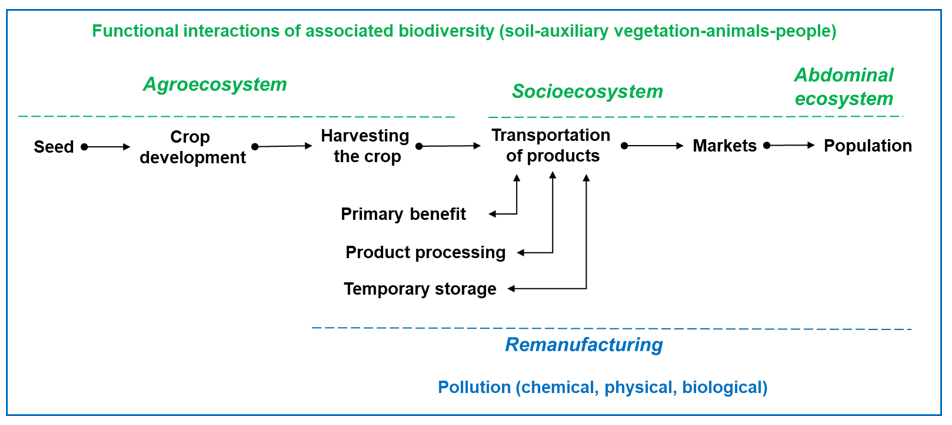
Figure 1 Pathway in food management: from the agroecosystem to the abdominal ecosystem of people.
When agricultural products are harvested, they undergo a process that can be simple (direct transportation to the market) or complex (other processes to add value) until they are sold in different types of markets. The rehandling of fresh produce in the socioecosystem exposes it to potential contamination, which may also be present in the product consumed by people.
On its journey from the agroecosystem to the human abdominal ecosystem, food can be considered a hybrid vector: positive, due to its nutritional and caloric content, as well as an associated biota composed of microorganisms with functions in nutrient assimilation, immunity, and brain function, among others; negative, due to its sensitivity to carrying contaminants (chemical residues, particles, toxins, parasites, and disease-causing pathogens).
Although most countries have regulations on the safety of harvested products and the biosecurity of post-production processes, these are not always enforced or effective. In fact, most related services are designed for conventional food systems (intensive industrial production, specialized transportation entities, large market chains) and do not provide sufficient coverage when food systems are decentralized to communities (urban and rural).
For this reason, during the transition towards sustainable food systems, the field of agroecology considers the following domains:8 (a) governance (policies, regulations, strategies); (b) the environment and natural resources in primary production (agricultural and livestock); (c) complementary services (consulting, training, analytical laboratories, innovation and management of inputs, among others); (d) the different post-production processes (beneficiation of fresh products, processing or transformation, collection, storage, transportation, marketing); and (e) the attitude of families and individuals towards food (education, health, communication).
This suggests that the food supply chain for human populations requires a disruptive redesign, influencing: (a) restructuring the primary food production model to facilitate positive interactions with functional biodiversity; (b) transforming the food access system to reduce risks from the negative effects of remanipulation; (c) educating the population about sustainable food.
The above provides a framework for shifting our approach to governance and management away from essentially sectoral analyses of growth limits that seek to minimize negative externalities, toward estimating the security space for human development.9
Reconverting the food production model: For a long time, agricultural production has faced the dilemma of food safety for human consumption, and this is one of the justifications for the alternative known as "organic agriculture." However, there is a general shortsightedness in this regard, because humans do indeed require fresh foods to be free of toxic residues; however, it is also necessary for them to carry their natural microbiota, so that it interacts with the microbiota of the abdominal ecosystem of people when ingested, mainly due to its importance in food digestion, nutrition, and immunity to certain diseases.10
While denouncing the unsustainability of the globalized food system, there is an attempt to reduce its influence, support resistance processes and propose elements to redesign food systems so that they can achieve ecological, economic and social sustainability of all their components: production, processing, distribution and consumption,11 in order to provide the population with healthy food without degrading the natural resource base and at the same time addressing broader aspects of sustainable rural development such as governance, solidarity markets, access to livelihoods, family planning, management of productive systems, reduction of losses and waste, among others.12
Sustainable nutrition is a dietary pattern that promotes all aspects of human health and well-being, with low environmental pressure and impact, is accessible, affordable, safe, equitable, and culturally accepted. It enables optimal growth and development of people at all stages of life, both for present and future generations, contributing to the prevention of malnutrition in all its forms and reducing the risk of non-communicable diseases.13
Transforming the food access system: Contaminants exist in food handling and are defined as any biological or chemical agent, foreign matter, or other substances not intentionally added that could compromise food safety or suitability.14 Contaminated food is food that contains microorganisms such as bacteria, fungi, parasites, viruses, or toxins produced by microorganisms. Food can also be contaminated by the presence of foreign substances (soil, pieces of wood, hair) or chemical contaminants, such as detergents, insecticides, or chemicals.7
The complex network of actors involved in primary food post-production processes, transporters, processors, marketers, and others, reveals a certain degree of difficulty in reducing the risk of contamination from rehandling. However, bringing primary production closer to local markets, complemented by social education about sustainable food, is a promising avenue.
Educate the population about sustainable nutrition: The relationship between diet and health was recognized by Chinese medicine around 1000 BC. With the phrase "let food be thy medicine and medicine be thy food," proposed by Hippocrates almost 2,500 years ago, there is currently renewed attention in this field.15
Several leading authoritative reviews have shown that dietary diversity is associated with better health outcomes, and that a monotonous diet, even biofortified, is associated with nutritional deficiencies and high rates of chronic diseases.16
As a result of coevolutionary processes, mainly with respect to habitat and nutrition, whether of plants (cropping systems), animals (livestock systems) or people (community), the functions of associated biodiversity play a central role in health, a natural characteristic that has been dismissed with socioeconomic development.17 Health is a continuum from the soil to our bodies, dictated by the interconnection and interrelationship between humans, nature's biodiversity and its systems, determined by the connecting pathways between soil health, plant health, animal health and, therefore, human health.18
The intestinal ecosystem is a complex environment in which dynamic and reciprocal interactions occur between the epithelium, the immune system, and the local microbiota.19 Furthermore, the concept of a nutrient as any assimilable substance contained in food, which allows the body to obtain energy, build and repair tissues, and regulate metabolic processes, has evolved into that of an immunonutrient, which is a substance that, unlike a conventional nutrient, is capable of boosting the immune system.20
Regarding the acquisition and consumption of fresh agricultural products, five characteristics predominate in the personal and social behavior of the majority of the population: supply, quantity, size, appearance, and access. However, there are sectors of the population and places where they also consider them to be free of chemicals and possess nutritional value, attributes that have been promoted by organic agriculture. Furthermore, this agricultural production model has also contributed to the perception of the safety of raw materials and additives used in processed products. Recently, based on the experience of the COVID-19 pandemic, the population is also considering the biosecurity of livestock products, whether live animals or their byproducts.10
It is clear that environmental, nutritional, and health education, which in many cases are managed separately because they constitute different sectors of society, require holistic integration. This must be based on a scientific interpretation to educate families about the positive and negative interactions that must be managed throughout the journey food follows, from the agroecosystem to the human abdominal ecosystem.
Fresh foods follow a pathway that begins in the agroecosystem where they are obtained and continues through socioecosystems until they reach the abdominal ecosystem of the people who ingest them, constituting hybrid vectors, both positive and negative, that are determinants of human health.
None.
Authors declare that there are no conflicts of interest.

©2025 Vázquez. This is an open access article distributed under the terms of the, which permits unrestricted use, distribution, and build upon your work non-commercially.