Journal of
eISSN: 2572-8466


Technical Paper Volume 12 Issue 6
 Sreekala Chellamma, Clint Pilcher
Corteva Agriscience, United States
Correspondence: Steven Cryer, Corteva Agriscience, (Indianapolis, IN), United States
Received: November 22, 2025 | Published: December 5, 2025
Citation: Cryer S, Chellamma S, Pilcher C. Evolution of climate–smart agriculture with perspectives on collaborating with external organizations on agricultural innovation. J Appl Biotechnol Bioeng. 2025;12(5):219-222. DOI: 10.15406/jabb.2025.12.00407
The current world population of 8.2 billion (2025) is anticipated to increase to 10 billion by 2050, and pesticide use is assumed to increase to support population growth since additional food resources will be required. Sustainability has now become a requirement in the way food is produced, or products are created. Emphasis is placed on farming systems that are environmentally, socially, and economically sustainable. Conservation practices on farmland continue to gain traction to preserve the properties of soil, water, and environment. Technological innovations have continued to shape the field of agriculture and the incorporation of advanced technologies such as digital tools not only potentially reduce the total inputs but can prescribe precise ways of managing farms with higher productivity and profitability. This short writeup emphasizes potential synergistic interactions that can occur between agricultural companies whose goals are profit driven and Non-Government Organizations (NGOs) that can be mutually beneficial for all parties.
Keywords: green house gas, agricultural production, copper compounds
Food security is a requirement for human survival on this planet and climate change is a continuous threat to food production as the world’s population continues to grow. The United Nations coined the “Zero Hunger” target in their 2030 Sustainable Development Goals (SDGs). The Food and Agriculture Organization of the United Nations (FAO) first proposed to develop "climate-smart agriculture" to achieve the goals of food security, climate change mitigation and adaptation.1 Food security is the basic principle of climate-smart agriculture since it represents a modern approach to promote food security, climate mitigation benefits and agricultural adaptation to climate change towards the SDGs.
The term climate-smart agriculture is often used when speaking about the relationship between agriculture and climate change. Climate-smart agriculture promotes food security while simultaneously adapting for ongoing climate change. Challenges in promoting climate-smart agriculture include: 1) Green House Gas mitigation in agriculture; 2) carbon storage in agroecosystems; 3) impacts of climate change on agricultural systems (e.g., elevated CO2, warming, altered precipitation patterns) and 4) adaptation of agricultural production to climate change (e.g., adverse effects of warming, alterations of precipitation patterns or extreme weather events such as drought, heatwaves, hurricanes, etc.).2
Crop protection products have evolved dramatically from past to present and provide an avenue to explore climate-smart agriculture and the impact it may have. This work focuses on climate change in agriculture and adaption of ag production via the use of commercial pesticides. We focus on the synergies that can arise when agricultural producers partner with Non-Government Organzations (NGOs) to achieve a common goal and believe significant value exists when doing so.
One of the first reported uses of pesticidal materials is attributed to the ancient Sumerians who used sulfur for insect control around 3000 BC. Oil, ash, and sulfur were mixed with other compounds and used by Greeks and Romans to control insect pests around 600 BC. Pyrethrum, an insecticide made from flowering chrysanthemum plants was used by the Persians around 400 BC. In more recent times, farmers have used nicotine and herbs for insect control in the 1600s, and in the 1800s, sulfur was used with copper compounds (copper sulfate and lime) to protect a variety of different commodities. These events showcase the long-term efforts farmers have had into looking at new ways to curtail pests that impact agriculture.3 Use of organic chemistry to synthesize pesticides became highly effective and more widespread in the 1940s, where many of these compounds targeted entire groups of pests/organisms. Major upheavals to the pesticide industry were brought about by the pioneering book Silent Spring written in 1962 by Rachael Carson who discussed the environmental harm that indiscriminate use of pesticides was having on the environment, Figure 1.4 This book initiated a national debate on the use of chemical pesticides. Who can forget the DDT (dichloro-diphenyl-trichloroethane, an organochloride) impact Carson pointed out in predatory bird eggshell thinning. DDT was highly effective in preventing malaria and insect-borne diseases. At this time routine aerial spraying of DDT was used to control mosquitoes and thus the potential for environmental impact was large. It was later found that DDT reduces a hormone necessary for female birds to lay eggs having a sufficient thickness to survive the normal rigors required for successful hatching. Population declines of predatory birds were clearly observed, and in 1972 the United States Environmental Protection Agency (USEPA) banned DDT use in the United States and predatory bird populations in the U.S. have increased since (DDT still has limited indoor use in Africa against mosquitos in preventing diseases such as malaria).

Figure 1 Carson’s book first published in 1962 that documented the environmental harm pesticides had on the environment.4
The pesticide industry within the United States now falls under the Federal Insecticide, Fungicide, and Rodenticide Act (FIFRA) that governs pesticide registration, distribution, and use. In 1970 FIFRA was transferred from the USDA to USEPA (created by the Nixon Administration) and in 1972 the Federal Environmental Pesticide Control Act amended FIFRA whose primary use is to ensure pesticides will not cause unreasonable risk to humans and/or the environment.
The days of DDT, chlordane (a highly persistent organochlorine compound) and similar pesticides having severe environmental issues would never receive registrations in today’s regulatory environment. Large crop protection companies invest 7-10% of their annual sales into R&D to develop current and next generation agrochemical products in a highly regulated industry. It cost pesticide manufactures approximately $286 million and 10 years of research per molecule in garnering a U.S. pesticide registration such that the product can be sold in the U.S.,5 and further expenses are anticipated for the use of this pesticide in other geographies. These costs for new/novel chemistries brought to market are expensive which has contributed to recent consolidation of pesticide manufactures into several large companies (Corteva and other ag companies) and a handful of smaller businesses.
The United Nations Food and Agriculture Organization (FAO) has stated the world population will reach nearly10 billion by 2050 (currently ~ 8.2 billion in 2025, The World Population Prospects: 2015 Revisions).6 Six countries are expected to exceed a population of 300 million each by 2050; China, India, Indonesia, Nigeria, Pakistan, and the USA. This suggests agrochemical and biological traits will have to significantly increase to meet increased food demand as the world population grows and agricultural capable land diminishes. The only feasible way to meet this demand is through continued pesticide use and other agrochemical/biological solutions. Many current pesticides are biologically active at extremely low rates (i.e., which lowers the amount of organic chemicals in the environment) and are likewise unstable such that rapid degradation under environmental conditions ensue (e.g., pesticide quickly degrades once pest is targeted). The U.S. crop protection industry is poised to grow over the next decade at approximately 3%, Figure 2 (www, grandviewreserach.com).7
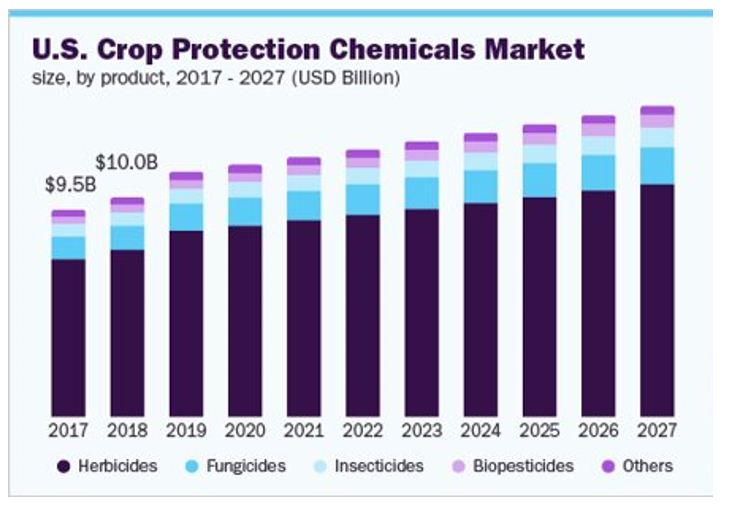
Figure 2 Estimated growth of U.S. crop protection market through 2027, with estimated compound annual growth rate (CAGR) of ≥ 3% growth, www.grandviewreseach.com.7
Employees of agricultural companies often look to improve their connection with their Communications or External Affairs departments to determine how best to tell their stories. One of the greatest opportunities lies in the casual communication between employees in the agricultural industry and their connections with outside resources. Agriculture is a story of constant innovation and improvement. For example, insecticides have evolved from considerably high rates of product per acre to several orders of magnitude lower doses in today’s markets that carry increased efficacy and improved environmental and human safety profiles. Agrochemical company innovation in adapting seeds increases productivity while using fewer resources. A “storyline” is proposed to provide an avenue where connections can begin internally with industrial R&D, followed by dissemination to other internal functions (e.g., commercial, marketing), and eventually leading to interactions with external industry. We believe significant value exists with agricultural pesticide manufactures partnering with Non-Government Organizations (NGOs) such as TNC, WWF, EDF,8 Field to Market Alliance for Sustainable Agriculture, where NGOs are change agents in promoting economic growth, human rights, and social progress.9 NGOs boomed with the establishment of the United Nations in 1945.
In addition to NGOs, food companies such as PepsiCo, General Mills, and Unilever all should be involved in collaborating in this discussion. Both cooperation and influence can become common place in building a story on sustainable agriculture and climate change in the agricultural value chain and developing integrated solutions, Figure 3. Collaboration on communicating the role of agricultural innovation in curbing climate change will be critical. Digital innovations and the ability to promote sustainable outcomes by enhancing ecosystem services is a goal we all play a role in creating success. Opinions, suggestions, and recommendations set forth in this article are those of the authors and do not necessarily reflect that of Corteva Agriscience, its officers, directors, or affiliates thereof.
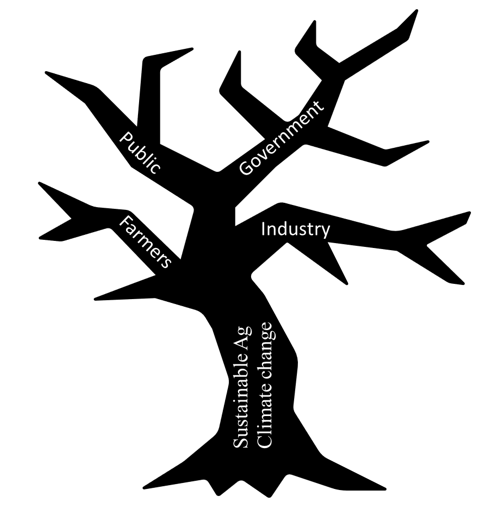
Figure 3 Common Language Tree: Building a Story on Sustainable Agriculture and Climate Change to address Industry, Farmers, Public, and Government officials
NGOs and outside organizations can make essential sustainable contributions to the environment, society, and the world at large, where industry initiatives can likewise address issues such as clean water, soil health, global warming, global hunger, and food security. NGOs can be tremendous advocates, especially in addressing sustainable issues. However, NGOs often work on their own initiatives and facilitate connections between corporations, farmers, and government regulators. We propose working together with NGOs and outside food companies in the food value chain to increase collaboration, productivity, and connectivity among corporations. Corporations and NGO’s can create meaningful non-adversarial partnerships to protect our environment, both today and in the future. Efforts can be focused on creating social awareness of long-term research-based solutions to agricultural challenges.
This summary addresses topics for the ag industry audience to consider that include food and environmental NGOs, food value chain, competitors, etc. all of which will relay their own unique messaging regarding company perspectives on sustainable agriculture and climate change. Thus, the focus herein is on collaborating to change perceptions of company’s society often referred to as “Big Ag”. We propose documentation that focuses on “A journey of agricultural companies’ innovation leading to a ”Climate-positive agriculture” that improves resilience of the land, our environment, and the health of our communities. Example innovation topics include i) history of crop breeding, ii) gene-editing (value proposition, regulatory framework) which has and will continue to contribute to sustainability goals, iii) history and advances of biotech, iv) history of crop protection (emphasized here), v) today’s focus on natural/sustainable products, seed-applied technologies, biologicals, and vi) advancements with digital as a means for deploying integrated solutions to address emerging markets of ecosystem services. Agriculture is part of the solution addressing climate change and various agricultural companies are innovating to lead this transformation since agriculture can provide a sink to various greenhouse gas players. This position paper focuses on “Big Ag” partnering with key NGOs and food companies with continued consultation in building the long-term storyline. Thus, this article can be further expanded considering the respective target audience and subsequently connect with the 2030 sustainability goals developed by the United Nations (2015).10
A question for agrochemical companies is how much value is there in socializing our innovation history and future direction? Can these companies create novel competitive value by interacting with NGOs, embedded academic institutions, and consumer-facing companies better than what agricultural companies bring alone? Agricultural companies should address any misnomers that exist and what points can be made for agriculture to minimize or eliminate them. We need to identify areas where unified messaging from Ag companies could result in a better outcome than individual efforts. For example, many consumers assume that all Crop protection (CP) products fall into the same bucket or that spraying food with any CP product decreases the quality or safety of that food. In addition, many believe that natural products are not as effective as synthetics. Agrochemical companies have solutions to help address many of the value chain’s sustainability goals given by all the recent product launches and healthy publicized pipelines of molecules and traits. Advocacy with the value chain around these products would help the entire industry separate modern solutions from the public relations baggage often associated with legacy products. A common goal is to focus on broader industry in addition to the investment community. There appears to be a gap here with communication material, especially considering agricultural companies have an incredibly good story to tell.
This is a first step in identifying issues for both agrichemical companies and influential NGOs, who can work together in a non-adversarial capacity to improve interactions and understanding, to create solutions that can benefit both. We propose the development of an agrochemical company (Corteva) story from R&D, then expanding to the company at large, followed by working with external organizations to achieve a common language. This joint area has historically been avoided but can grow into multiple collaboration endeavors that can benefit both the agrichemical industry and NGOs. There are significant opportunities for highly engaged scientists/staff at agrochemical companies, NGOs and food companies to engage in productive endeavors in various Advocacy for Agriculture effort focusing on industry. One example of joint interactions for sustainable business practices that benefits both NGO and various companies include sponsorships with The Nature Conservancy (2022).11 Other interactions should follow.
Opinions, suggestions, and recommendations set forth in this article are those of the authors and do not necessarily reflect that of Corteva Agriscience, its officers, directors, or affiliates thereof.
There are no conflicts of interest.

©2025 Cryer, et al. This is an open access article distributed under the terms of the, which permits unrestricted use, distribution, and build upon your work non-commercially.