Journal of
eISSN: 2572-8466


Research Article Volume 13 Issue 1
1Federal Science Center of Physical Education and Sport, Russia
2Department of Computational Mathematics and Cybernetics, Russia
Correspondence: Mikhail Shestakov, Federal Science Center of Physical Education and Sport. Elizavetinsky lane. 10. building 1. Moscow. 105005. Russia
Received: February 02, 2026 | Published: March 5, 2026
Citation: Shestakov M, Abramova T, Korchagin A. Analysis of the influence of sports training in football and hockey for 8-year-old children on the control of postural balance. J Appl Biotechnol Bioeng. 2026;13(1):23-27. DOI: 10.15406/jabb.2026.13.00413
We present an experimental and theoretical analysis of the influence of playing team sports (football, ice hockey) on the control of postural balance in 8-year-old children. The aim of this study was to experimentally test the hypothesis that the characteristics and requirements for performing competitive exercises in children—characteristic of a particular sports specialization—have a specific effect on cognitive manifestations in the control of postural balance. The experiment involved children aged 8.40 ± 0.41 years who had been playing football (n = 76) and ice hockey (n = 56) for 4.07 ± 1.61 years. Using a stabilometric complex, we obtained data characterizing the children's stability. The experimental data showed that the group of hockey players demonstrated systematically worse indicators in controlling the speed of movement, the accuracy of forecasting, and the stability of positioning in the control of postural balance compared to the group of football players. The developed model based on the active inference framework made it possible to quantitatively assess the difference in the hidden causes of the observed data of the two experimental groups. This study showed that an earlier start of training in game sports at the age of 4–5 years had a significant influence of specialization requirements on the main basic quality of a person—postural balance. The results of theoretical analysis indicate the need to take into account during training not only physical but also necessarily cognitive development of the child. This research showed that long-term training in a certain sport forms the corresponding proportions between sensory modalities, determining the features of the internal generative model of athletes of different specializations.
Keywords: children, football, hockey, active inference, modeling, postural balance, motor control
At present, children are being introduced to various sports earlier. It is not uncommon for the development of basic movements in football, ice hockey, fencing, artistic and rhythmic gymnastics, alpine skiing, a number of martial arts, and other sports to begin at the age of 3–5 years. A number of studies have shown that sports training has a positive effect on postural control and/or balance control. Long-term sports activity involves mastering and further improving specific motor skills, in accordance with the goals and objectives of each type of sports specialization.1,2 Targeted sports activities can be considered as a context that influences the development of the ability to control one's body while improving the perception of one's own body.3,4
Postural control plays an important role in a child's development, since it is necessary for achieving both new postures at an early age and more complex motor skills.5–7 Age is a significant factor influencing standing balance.8 The literature describes an age-dependent stability control, measured for example by the decrease in the center of pressure (COP) sway during development.9,10 In typically developing children, postural sway decreases with age under different sensory conditions.11
The central nervous system learns and optimizes proprioceptive and visual information flows during the child's maturation when controlling standing balance.12,13 Somatosensory integration plays an important role in this process.14 Children develop both sensory processing and postural balance control strategies.15,16
Currently, the theory of active inference suggests that the brain controls body movement based on internal probabilistic Bayesian models.17,18 These models allow the brain to flexibly assess the state of the body and the consequences of its movement, despite noise and conduction delays in the sensorimotor apparatus. The mechanism provides for iterative updating based on sensory prediction errors from multiple sources. Body position can be informed by signals from various sources of sensory information, including vision and proprioception. The contribution of each modality to the overall optimal integration of signals is determined by its relative reliability or accuracy depending on the current context.19,20
The aim of the article is to experimentally test the hypothesis that in children, the characteristics and requirements for performing competitive exercises characteristic of a particular sports specialization have a specific effect on cognitive manifestations in the control of postural balance.
The study involved children aged 8.4±0.41 years, who had been playing football (G_F, n= 76) and ice hockey (G_H, n=56) for 4.07±1.61 years. Training in the sports was conducted according to the approved training programs of state sports schools. The weekly training load for football was 4.5–5 hours (3 sessions of 60–75 minutes), with the annual training load being 180–200 hours (based on 40 training weeks per season). The weekly training load for hockey players was 3–4 hours on the ice (3 sessions of 60–75 minutes) + 1–2 hours off-ice (fitness, skills), for a total of 4–5 hours. The annual training load was 200–250 hours (based on ~45 training weeks).
The study was conducted using the Stabilan-01 stabilometric complex with biofeedback (Ritm, Taganrog, Russia).21 This device, also known as a stabiloanalyzer, is a platform with sensors that measure weight distribution and the movement of the center of gravity when the patient is standing. During the test, visual feedback was used, which was provided to the subject on the monitor screen, located at a distance of 1.5 m at an individually adjusted eye level. According to the study conditions, the subject stands barefoot straight on the stabiloplatform according to the European system of foot placement, with his hands excluding their participation in the movement. The subject must hold the marker, which represents the position of his center of pressure (COP) on the stabiloplatform, in the center of the target. The instructions stipulate that the movement must be performed exclusively in the ankle joints. The duration of the testing procedure was 30 s. The following test performance indicators were recorded: R is the average spread (average radius) of the COP deviation from the zero point, V is the average speed of COP movement, X, Y are the initial displacement of COP in the sagittal and frontal directions (the mathematical expectation of the coordinates of the COP position). The distribution of each indicator was tested for normality (Shapiro-Wilk test, p > 0.05).
The subjects had no previous neurological disorders or balance problems. They and their parents were informed about the experimental procedures. All parents of the subjects provided informed consent for the examinations before the experiment. The survey program and methodology complied with the provisions of the Helsinki Declaration and were approved by the Ethics Committee of the Federal Scientific Center VNIIFK (No. 3.23) on October 24, 2023.
Statistical processing of the obtained material was performed in the R-Studio environment using the ggplot2-ru, rstatix, dplyr and caret packages. In recent years, many studies have shown how continuous control of human movement can be explained in terms of the Active Inference Framework (AIF). The idea of AIF is that the brain strives to constantly minimize prediction errors.22 Since AIF is a relatively new field, for a better understanding of the material discussed in the article, below we provide some explanations of key terms:22,23
Free Energy - Integral indicator of the quality of the model: F=Complexity−Accuracy, minimization of F is the main goal of the system according to Friston's theory;
Complexity - a measure of the discrepancy between posterior beliefs (after receiving the data) and prior beliefs (the initial expectations of the model);
Accuracy - expected log-likelihood of sensory data given current beliefs;
Generative Model - it is an internal (Bayesian) probabilistic model that the brain uses to predict sensory inputs (proprioception, vestibular, visual signals) based on states of the world (including body state - posture, joint configuration), Hidden Causes, Prior Beliefs;
Hidden Causes - unobservable factors that cause sensory data;
Prior Beliefs - initial expectations about the states of the world and the body;
Active Inference -the process by which an organism strives to fulfill predictions and minimize Prediction Error;
Fulfill the predictions - the generative model predicts expected sensory inputs;
Prediction Error (PE) - the difference between predicted sensory inputs and actual sensory inputs;
Motor_Command_Efficiency - the ratio of the achieved PE reduction to the magnitude/energy of the motor command.
To conduct a theoretical analysis between the obtained experimental data of performing upright standing with visual control and the reasons underlying the obtained result of the movement, a model based on AIF was developed. The agent model was developed in the Python environment using the pip3, openpyxl packages. The software implementation of the agent model was performed in accordance with the block diagram of external and hidden indicators, presented in Figure 1.
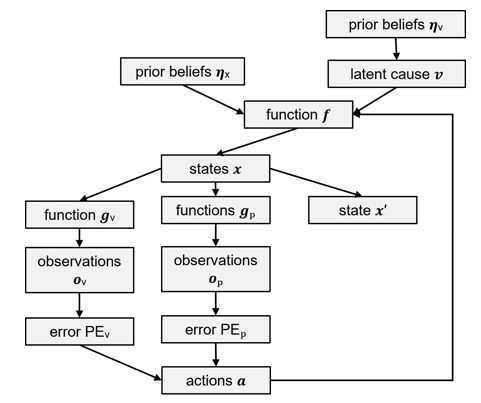
Figure 1 Block diagram of upright posture control based on active inference framework.s
Notations: states (??, ??′, ??), functions (??, ??), beliefs (??), actions (??), indices (?? - vision, ?? - proprioception).
In Figure 1, the latent cause (𝒗) in the form of the target trajectory receives input from prior beliefs (𝜼ᵥ) about the visual target and specifies the goal state for the system. The dynamic function (𝒇) models the physics of the body: 𝒙′ = 𝒇(𝒙, 𝒗), receiving prior beliefs (𝜼ₓ) about the tilt angle of the body and generates latent states (𝒙) of the tilt angle of the body. Two types of observations are generated via likelihood functions: 𝒐ₚ (proprioception) via 𝒈ₚ and 𝒐ᵥ (vision) via 𝒈ᵥ. The derivative of the state (𝒙′), via the change in the COP velocity, links the current state to the future state. Prediction errors are calculated as the difference between predicted and actual observations, expected and actual state, which allows for control actions (𝒂). Control actions (𝒂) affect the system through corrective motor commands, minimizing prediction errors and changing 𝒙. The scheme is fully consistent with the principles of AIF and can be used to model the static balance of a single-joint inverted pendulum.
When comparing children playing football and ice hockey, it is necessary to take into account the differences in these team sports that influence the development of motor control. Hockey differs significantly from football in some of the conditions in which players operate. For example, the surface of the rink - a slippery surface in the form of ice versus grass or another hard, even surface. There is also a significant difference in the players' equipment. Hockey players wear skates and heavy protective equipment, which is especially sensitive in childhood (Table 1).
|
Metrics |
G_F |
G_H |
Δ(G_H - G_F) |
Reliability of differences |
|
Position_error, mm |
9.15 ± 3.38 |
9.31 ± 4.41 |
+1.8% |
>0,05 |
|
Velocity_error, mm/s |
18.41 ± 7.03 |
21.02 ± 8.76 |
+14.2% |
<0,05 |
Table 1 Errors in movement execution
Comparison of COP fluctuation data between football and hockey players (Table 2) shows that with almost the same average positioning accuracy, hockey players demonstrate a 30% greater spread of errors (SD: 4.41 vs 3.38), which indicates less stable positional control with possible episodes of movement destabilization. A critical difference between the groups is the reliable difference (>0.05) in the COP oscillation speed error parameter. Hockey players control the speed of movement significantly worse, and the increased spread (SD: 8.76 vs 7.03) confirms the instability of control. Let us define the ratio (K) between errors in the COP position as visually dependent, and errors in the COP oscillation speed as proprioceptively dependent. Accordingly, hockey players are less dependent on visual information (K=2.26), but at the cost of an increase in the errors themselves than football players (K=2.01).
|
Metrics |
G_F |
G_H |
Δ(G_H - G_F) |
Reliability of differences |
|
Variability of beliefs |
0.574 ± 0.220 |
0.657 ± 0.276 |
+14.5% |
<0,05 |
|
Speed ??of corrections (position) |
13.69 ± 6.81 |
14.88 ± 7.12 |
+8.7% |
>0,05 |
|
Speed ??of corrections (speed) |
157.37 ± 57.39 |
170.41 ± 85.79 |
+8.3% |
>0,05 |
|
Error of representations (speed) |
4.547 ± 1.749 |
5.197 ± 2.171 |
+14.3% |
<0,05 |
Table 2 Belief metrics data
Minimization of uncertainty or free energy F is the main goal of the motion control system according to AIF. Group G_H: 6.58 ± 6.60 demonstrates higher free energy (+11.3%) than group G_F: 5.91 ± 4.22, which indicates greater uncertainty in the system and potentially more active learning process. Significantly greater scatter (SD: 6.60 vs 4.22) in group G_H indicates less stable operation in terms of motion control system accuracy. At the same time, both groups show statistically identical accuracy (G_F: 0.6934 ± 0.0145, G_H: 0.6926 ± 0.0191). In terms of complexity, the G_H group uses a more complex model/strategy than the G_F group in management (G_F: 6.21 ± 0.90 G_H: 6.43 ± 0.87) with an insignificant (p>0.05) difference of +3.5%.
Comparative analysis of the metrics of internal beliefs indicates the prevalence of statistically significant (<0.05) instability of internal representations (belief_change) in the group of hockey players compared to football players. In the group of football players, athletes significantly better than hockey players (<0.05) perceive and evaluate the speed of COP movement. Statistically insignificant, but definitely higher in hockey players, the values of the rate of change of internal beliefs by position (+8.7%) and the rate of COP oscillation (+8.3%). Athletes from the hockey group more frequently correct their a priori ideas about the COP position. Also, in this group, compared to football players, the spread of belief changes by speed is 49% greater, which may indicate a significantly frequent revision of the idea of the oscillation speed.
From the point of view of sports practice, interesting quantitative data are presented in Table 3, characterizing the qualitative assessment of the performance of movements in the experimental groups. It is evident that no significant difference in coordination of movements between the groups (3.8%) was determined. However, the absolute values of this indicator are very low, which is obvious for children of the age under consideration. Also, an insignificant difference (2.8%) is observed between the groups in the motor stability of movement performance. An obvious difference between football players and hockey players is observed in the efficiency and smoothness of movement performance. The group of hockey players spends 10.1% more energy than football players on similar movements. This is partly due to the fact that football players perform smoother movements (7.7%) than the movements performed by hockey players by jerking. In general, the group of hockey players demonstrates systematically worse indicators for speed control, forecasting accuracy, and positioning stability compared to the group of football players. The increase in the complexity of the control model in G_H did not lead to improvements, but aggravated the problems. Active attempts by the system to adjust the belief change rate led to an increase in speed errors, which was reflected in an increase in free energy. A possible reason may be "squeezed" stability due to reduced adaptability. A critical area for hockey players to optimize the process is the speed prediction and control system.
|
Metric |
G_F |
G_H |
Δ(G_H - G_F) |
Reliability of differences |
|
Coordination |
0.0074 ± 0.293 |
0.0071 ± 0.326 |
-3.8% |
>0,05 |
|
Efficiency |
0.0628 ± 0.0249 |
0.0564 ± 0.0252 |
-10.1% |
<0,05 |
|
Smoothness |
-6.57 ± 1.86 |
-7.07 ± 2.89 |
-7.7% |
>0,05 |
|
Stability |
0.831 ± 0.203 |
0.808 ± 0.176 |
-2.8% |
>0,05 |
Table 3 Movement performance assessment data
Our data indicate specific differences in the mechanisms of postural balance control under the influence of the external context. The demands of the sport on the somatosensory system form different ways of postural balance control in athletes. A previous study showed that different dimensions of the COP signal can reflect different information in standing balance control.24
Within the framework of AIF and the concept of Generative Models, the quality of movement control is defined fundamentally differently than in classical biomechanics. Here, the focus shifts from describing stability to the accuracy of the brain's predictions about the state of the body and its interaction with the world, as well as the effectiveness of minimizing surprise. Our computer modeling, simulating postural balance control in the studied groups of 8-year-old athletes in different sports with at least three years of training experience, showed that the groups differ in the balance of visual and proprioceptive accuracy (i.e., an increase in attention to the corresponding modality related to the task) (Figure 2).
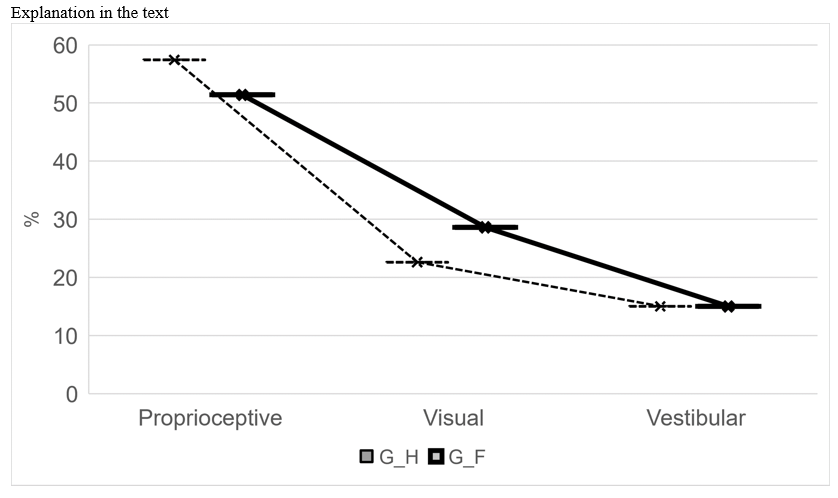
Figure 2 Contribution of sensory systems (in %) to the control of postural balance in experimental groups.
The observed difference in the groups can be explained by different demands on sensorimotor information, which is associated with the performance of the main competitive exercise. Several studies have shown that the dominant modality depends on the context.25–27 In our case, the context means external intervention in the form of a long-term training process. The observed difference in the control of postural balance is determined by the conditions in which training and competitive game situations are performed. The need for hockey players to perform technical actions on ice at higher speeds of movement—compared to football players—places increased demands on stability. Hockey players also have an unusually small support in the form of thin blades of hockey skates. Children who have not yet mastered the stable technical skill of moving on a slippery support on skates but systematically learn this skill form within themselves ideas about possible sensations of stable balance. In other words, our results indicate that the updating of predictions for postural stability control may be mediated by sport specialization.
This study showed that an earlier start of classes at 4–5 years, after at least 3 years of training in team sports (for example, football and hockey), had a significant influence of specialization requirements on the main basic quality of a person—postural balance. The results of the theoretical analysis indicate the need to take into account in the training process not only the physical but necessarily the cognitive development of the child. From a practical point of view, this means compliance between the requirements for mastering complex movements and the development of the corresponding structures of the brain.
Our results indicate that 8-year-old children involved in sports have a close relationship between multisensory integration and action. Ideas about movement are based on a priori knowledge of the dynamics of movement and the predicted sensory consequences of action, formed under the influence of classes in various sports. These reflect the specificity of the requirements for the sensory-motor component inherent in the main competitive exercise. We have shown that behavior in a postural balance task changes in accordance with changes in the internal regulation of the balance of visual and proprioceptive accuracy (i.e., an increase in attention to the corresponding modality related to the solution of the motor task). Our results generally support the formulation of predictive coding of active inference, where visual and proprioceptive cues influence multimodal beliefs that guide action. Long-term practice of a particular sport shapes the corresponding proportions between modalities, determining the features of the internal generative model of athletes of different specializations.
This study has several limitations. One limitation is the development of a simplified agent model related to the control of a single-joint inverted pendulum. This model does not account for multi-joint movements. The cross-sectional nature of the study limits the ability to draw clear causal conclusions about the development of body schema and postural stability with age. However, it should be emphasized that these limitations do not detract from the value of the study, and its results are relevant to real-world research settings.
None.
Declarations
Ethics approval and consent to participate
by the Ethics Committee of the Federal Scientific Center VNIIFK (No. 3.23) on October 24, 2023
Consent for publication
Not applicable.
Competing interests
The authors declare that they have no competing interests.
Authors’ contributions
MS – Methodology. wrote the initial manuscript version
AK and MS Validation. Software. contributed to the data analysis.
All the authors read and approved the final manuscript.
Data availability
The datasets used and/or analyzed during the current study are available from
the corresponding author upon reasonable request.
The research was carried out under State Assignment Project No. 777-00001-24-00 (Kod No. 001-24/1).

©2026 Shestakov, et al. This is an open access article distributed under the terms of the, which permits unrestricted use, distribution, and build upon your work non-commercially.