International Journal of
eISSN: 2577-8269


Review Article Volume 9 Issue 4
 Syed A A Rizvi,1,6 Uzoamaka Nwokorie,1,5 George P Einstein1,2
1University of Science Arts and Technology, Montserrat, Colleges of Medicine and Graduate Studies
2The Einstein Medical Institute, North Palm Beach Florida
3East West College of Natural Medicine, Sarasota FL
4Universidad de Sevilla, Seville, Spain
5National Hospital, Abuja Nigeria
6Larkin Hospital, Miami FL USA
Correspondence: Orien L Tulp, University of Science Arts and Technology, Montserrat, Colleges of Medicine and Graduate Studies, USA
Received: June 20, 2025 | Published: July 4, 2025
Citation: Tulp OL, Rizvi SAA, Nwokorie U, et al. Can trans-3’5’4-trihydroxystilbene (resveratrol) become an effective adjunct in the treatment of sickle cell disease? Int J Fam Commun Med. 2025;9(4):92-97. DOI: 10.15406/ijfcm.2025.09.00387
Sickle Cell Disease (SCD) and 𝛽-thalassemia are among the most common forms of hemoglobinopathy and life-threatening genetic diseases worldwide, necessitating the need for more effective and cost-effective therapies to treat these disorders. SCD occurs due to a single amino acid substitution of Valine for Glutamic acid in the β-chain subunit to form the sickle cell (HbS) variant. Hydroxyurea (HU) is currently the only disease-modifying drug approved for SCD, while advances in gene editing processes have also recently been introduced but their clinical use is not yet widely therapeutically available. HU is a ribonucleotide reductase inhibitor and fetal hemoglobin (Hb F; α2γ2) inducer that can reduce the clinical symptoms and frequency of hospitalizations for SCD, but it falls short of being a curative therapy and must be continued indefinitely in SCD patients. The efficacy of HU in the management of thalassemia and SCD is generally attributed to its limited ability to boost the levels of fetal hemoglobin (Hb F, α2γ2) in RBCs, and provide a partially protective mechanism for the sickle reaction which ultimately damages the blood vessels, thereby contributory to the major pathophysiologic clinical signs and symptoms and decreased lifespan associated with the SCD disorder. Thus, we propose that partial amelioration of SCD hemoglobin (HbS) with fetal hemoglobin via pharmacologic effects of trans-resveratrol (RSV), a naturally occurring phytochemical, may become a benefit to the patient since HbF is not susceptible to the disordered intracellular VO2-linked hemoglobin (HbS) polymerization often referred to as the sickling reaction during HbS deoxygenation. Accordingly, RSV would thereby limit the subsequent vessel damage due to small vessel occlusion which occurs due to HbS and thus should be able to improve patient outcomes by reducing the magnitude of ROS damage in addition to diminishing the ratio of cells that are susceptible to sickling reactions vs. the sickle-protected fetal-hemoglobin containing cells. In addition, RSV may also provide beneficial impacts on the sickle cell anemia (SCA) by prolonging erytrocyte survival that typically accompanies the disorder. Thus, RSV may also be able to partially correct the effects linked to the globin chain imbalance in SCD patients, while at the same time facilitating oxygen transport to myoglobin in peripheral tissues due to a more favorable oxygen-delivering capacity than is observed in adult hemoglobin. Thus, in conclusion, RSV may be a useful and cost-effective phytochemical adjunct in the treatment of SCD and β-thalassemia, the two major heritable hemoglobinopathies of humans.
Keywords: resveratrol, hydroxyurea, sickle cell disease, antioxidants, sirtuins, Nrf2 Activation
The naturally occurring dietary polyphenol resveratrol (cis- or trans-3'5'4-trihydroxystilbene; RSV) depicted in Figure 1 below has been postulated to induce fetal hemoglobin production via a biochemical mechanism similar to that induced by hydroxyurea (HU) in addition to contributing antioxidant actions to reduce the magnitude of inflammatory reactive oxygen species (ROS) generation. Resveratrol (3,4’,5 trihydoxystilbene) is a naturally occurring stilbenoid polyphenol compound. Resveratrol was first identified over 85 years ago by Takaoka (1939) from Veratrum grandiflorum and has now been isolated from over 70 additional plant and yeast species.1,2 Resveratrol has been found to be highly concentrated in the skin of red grapes and likely contributes to the French paradox where red wine and grape juice consumption have been attributed to a lesser prevalence of heart disease.3,4 Lesser concentrations of resveratrol have been found in numerous other natural sources of nutritious foodstuffs including white grapes, grapefruits, tea, pomegranates, nuts, blueberries and other edible berries, and dark chocolate in varying concentrations.1 Naturally occurring resveratrol typically exists as two isomeric forms in nature, cis and trans (Figure 1), but the trans form is the predominant and most widely studied form.5,6 In clinical studies the trans- isomer has been reported to exert the most potent therapeutic benefits likely owing at least in part to the lower steric hindrance induced by its side chain functional groups.5–8 The trans form of RSV can be recombinantly obtained from the extracts of Saccharomyces cerevisiae yeast and is used in the food and cosmetic industries as a food supplement or as a cosmetic ingredient.9,10 Isomerization back to the cis from the trans form can occur when the RSV is inadvertently exposed to excess heat, light, or ultraviolet radiation during manufacture, processing or inappropriate storage thereby decreasing its therapeutic efficacy.8–11 The purpose of this paper is to review the biochemical, pharmacologic and potential toxicologic aspects of trans-resveratrol administration as an adjunct in the treatment of hemoglobinopathies including SCD.
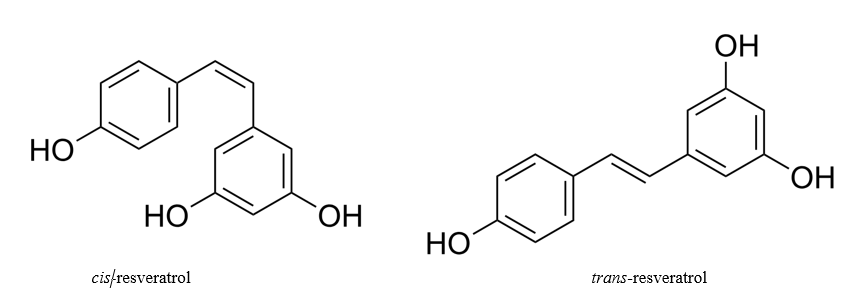
Figure 1 Chemical structures of cis- ((Z)-resveratrol, left structure) and trans-resveratrol ((E)-resveratrol, structure. Preferred IUPAC name is: 5-[(E)-2-(4-Hydroxyphenyl)ethen-1-yl]benzene-1,3-diol. Other common names include trans-resveratrol, cis-resveratrol, trans-3,5,4’-truhydroxystilbene; 3,4’5-Stilbenetriol; (E )-5-(p-Hyroxystyryl)resorcinol, and (E )-5-(4-hydroxystyryl)benzene-1,3-diol. 5,6,10
Proposed biochemical mechanism of action in SCD
The development of SCD occurs due to a single amino acid substitution (Val for Glu) in the β-subunit of hemoglobin A (HbA) to form SCD-hemoglobin (HbS), and which changes the β-peptide from a hydrophilic, negatively charged glutamic acid to a hydrophobic, neutral valine moiety.11,12 The change in amino acid charge alters the protein's hydrophobic structure and function and can result in the abnormal polymerization to form deoxy-HbS and sickling, particularly during physiologic processes that incur high oxygen demand.12 The disorder currently affects approximately 100,000 individuals in the USA, mostly African American or bearing African-American heritage. As a heritable disorder, it has no current curative therapeutic option readily available for global applications, and currently affects 1 in 365 African-Americans born in the USA.14,15 Hydroxyurea is currently the primary pharmaceutical used to treat SCD, where it is attributed to an induction and reactivation of the formation of fetal hemoglobin formation (HbF), a form of hemoglobin that does not undergo the sickling reaction and which can also efficiently transport oxygen to needed tissues.16 The agent primarily works in SCD by increasing fetal hemoglobin (HbF) production, improving red blood cell flexibility and decreasing the potential for erythrocyte aggregation. It does this by suppressing an enzyme called ribonucleotide reductase, which contributes to an essential role involved in DNA synthesis and epigenetic expression of hematopoiesis during cellular erythrocyte replication.12,13 This enzymatic inhibition increases stress on the bone marrow, prompting it to produce more fetal hemoglobin (HbF; Hb F,α2γ2) and proportionately less HbA (Hb α2β2) and HbS. In addition, SIRT1 expression protects against cellular apoptosis by promoting autophagy via actions on the Bcl-2 gene.43 Apoptosis is paramount for cell survival during cerebral I/R.43 As an apoptotic-related gene, the Bcl-2 gene family plays an important role in regulating apoptosis. Bcl-2 protein mainly binds to the outer membrane of the mitochondria, exerting an anti-apoptotic effect by inhibiting the release of cytochrome C and hydrolytic caspases in the the cytosol. The contrary effect of this is exhibited by the pro-apoptotic protein, Bax, and modulating the ratio of the two apopotic regulatory factors.44
The HbF oxygen saturation curve falls to the left of the adult hemoglobin saturation curve and is equally proficient in transporting oxygen to peripheral fetal tissues during gestation and early postnatal growth.12,13 Unlike adult hemoglobin, HbF and HbA resist sickling and decrease the risk of sickle cell aggregates on vascular occlusion events and subsequent anoxic-linked pathophysiology, erythrocyte lysis, and sickle cell anemia (SCA). Additionally, hydroxyurea may affect red blood cell adhesion factors and reduce inflammation, further contributing to its overall benefits.15,16 Resveratrol functions in an analogous manner to hydroxyurea, producing both DNA stress-related HbF formation in red blood cells both in vitro and in vivo. In addition, HbF adds beneficial antioxidant functions capable of decreasing inflammatory ROS activity in peripheral tissues including the cardiovascular epithelium and other tissues during aerobic and anaerobic substrate metabolism. While only minimal tissue concentrations of RSV are attained following typical dosages, the polyphenol enjoys a broad range of therapeutic efficacy with minimal intracellular concentrations and a virtual absence of potential toxicity.17,18
Overview of preclinical resveratrol studies
Preclinical in vitro studies using the human erythroleukemic K562 cell line have suggested that RSV can induce fetal hemoglobin production in a more robust manner than HU.19 Dose-dependent erythroid differentiation and hemoglobin production can be induced in the human erythroleukemic K562 cell line by both resveratrol and hydroxyurea, where RSV at 50 µmol/L induced a higher hemoglobin production than hydroxyurea at 500 µmol/L.19 However, double blind clinical studies designed to confirm the therapeutic efficacy and effectiveness of RSV are limited and conflicting, likely due to differential dosages, genetic and metabolic differences in the subject populations selected, and duration of treatments among other factors including potential hormetic effects of RSV.19–22 In a recent case study, the authors sought to evaluate the clinical efficacy and safety of RSV in managing SCD compared to HU.6 Unfortunately, the study was sadly interrupted by the recent pandemic with only one subject completing the ESV trial. In that subject, a dosage of 1000 mg/day, p.o., prevented recurrence of symptoms, hospitalizations and blood transfusions. In the interim, a systematic literature review with pre-defined eligibility criteria including RSV, HbF and clinical outcomes was conducted in peer-reviewed, published full-text articles investigating RSV in the management of SCD. To be eligible for inclusion, studies were required to report explicitly, including participants diagnosed with β-thalassemia or SCD anemia or cultured cells with the SCD or thalassemia disease and where HU was included in a control group. The analysis included thalassemia, RSV type and dosage, duration of treatment, and outcome, fetal hemoglobin induction and antioxidant activity. Additionally, the referenced pilot study of RSV in the management of adults with SCD who received treatment at National Hospital Abuja, Nigeria, was attempted but interrupted prematurely due to the COVID 19 pandemic.6 In that case study, a single 23-year-old female SCD patient who completed the study and who had been taking trans-resveratrol [1000mg daily p.o.] for more than 6 years was reported. Outcome variables evaluated include number of hospitalization episodes of pain crisis, need for blood transfusion, possible side effects and RBC indices. During the taking of RSV, no hospitalizations or acute episodes were reported, and hematologic indicies also remained within normal ranges. The proportion of HbF vs HbA was not reported, and no clinical evidence of RSV toxicology was noted. Thus, the early results of this metanalysis review suggested that RSV was as clinically effective as HU in inducing production of fetal hemoglobin in adult SCD patients and reducing hospital treatment days post RSV treatment.
Of the 4 four primary treatment and curative therapies that have shown great potential and are currently used to prevent and treat acute and chronic complications in SCD, hydroxyurea (HU) and blood transfusions, in addition to life-style modifications to minimize situations of oxidative stress are the most commonly well-established disease-modifying therapies in current use to prevent and treat complications associated with SCD.13 Other lesser used therapies include stem cell transplantation or the allogeneic hematopoietic stem cell transplant (HSCT), in addition to CRISPER gene editing repair technology, to correct the globin dysfunction if HbS, both of which approaches have recently beed granted approval by the FDA in the United States.41,42 Thus, the investigational gene therapy approach is the only known curative therapy that exists regarding SCD. To date however, reports of effective CRISPR attempts at gene therapy are limited but gaining traction with satisfactory early results. The results of this study indicate that RSV is an effective inducer of fetal hemoglobin production in adults and children and shows promise as a cost-effective and useful adjunct for the treatment of hemoglobinopathies including SCD and thalassemia. Its ready availability and ease of oral administration may offer significant benefits to global populations where thalassemias including SCD are endemic.6 Moreover, at nominal dosages of less than 1,000 mg/day (~ 20 mg/kg BW) in adults, reported adverse events are exceedingly rare.23
Overview of bioavailability, dose responses and molecular pharmacokinetics of resveratrol.
Resveratrol typically has relatively poor in vivo pharmacokinetics in man and animals at least in part due to its limited water solubility as an organic compound.24 One reason for the pharmacokinetics in humans may occur because although RSV is highly absorbed when administered orally (~70%), it’s systemic uptake and bioavailability in peripheral tissues is limited (~0.5% of the administered dose).25 However, once RSV is absorbed and enters the circulation, it readily binds to plasma proteins and is also transported in lipoprotein lipid fractions in circulation, which contribute to an extension of its biological half-life as only the free fraction undergoes cellular absporption.23–26 Once absorbed, RSV can undergo first pass, Phase II glucuronidation and sulfate conjugation, increasing plasma solubility and renal clearance. Residual luminal RSV is readily metabolized by colonic microbiota, producing additional potentially active moieties.25,26 Piceid, a glucose-conjugate of resveratrol also found in plants and fruits, also undergoes luminal and tissue uptake with similar pharmaceutic effects.27 In addition, RSV also demonstrates biphasic hormetic dose-dependent effects in vitro and has been postulated to exert similar hormetic effects in vivo. RSV is stable at acidic pHs but as noted above, becomes less stable at alkaline pHs. Thus, gastric acidifying agents including ascorbic acid may help to enhance its water solubility and thus preserve potential biological activity; in contrast, while alkalizing agents including antacids and gastric H2 inhibitor agents may alter the charge and structural configuration and decrease its luminal bioavailability. The compound is subject to light degradation and is best stored and administered in light protected, cool or room temperature environments to preserve biological longevity.11,18,21
The presence of inflammatory ROS are often a contributing factor in the development of a sickle cell VOC episodes and factors that can reduce the magnitude of inflammation are useful adjuncts in reducing the frequency and magnitude of such episodes. At low concentrations, RSV behaves physiologically as an hormetic antioxidant against cellular ROS formation and survival and which in turn may potentially protect tissues from ROS mediated oxidative stress and oxidation linked DNA damage.1,2 In contrast, at high in vitro concentrations, resveratrol can act as a pro-oxidant thereby promoting DNA damage while increasing the potential magnitude oxidative stress and thus likely may contribute to the development of harmful, reactive oxygen species (ROS). At higher clinical dosages, however the evidence reported in in vitro studies remains unconfirmed. Low and high RSV concentrations in vivo however may contribute to beneficial effects as a chemoprotective nature and may be beneficial in the treatment of cancer via direct cytotoxic effects. Because RSV has been reported to produce biphasic, hormetic dose-related effects, it may contribute to cardioprotective antioxidant effects at lower dosages, and prooxidant effects at higher dosages typically beyond 1000 mg/day in adult humans. RSV is stable at acidic pHs but becomes less stable at alkaline pHs. Thus, gastric acidifying agents including ascorbic acid may help to preserve its biological activity during luminal absorption, while alkalizing agents including antacids and gastric H2 inhibitor agents may decrease its bioavailability.11,18,21 In addition, Nrf2 activators including dimethyl fumarate (DMF), has shown promise in reducing inflammation and vaso-occlusion in SCD in animal studies, and could potentially complement the effects of therapeutic measures by providing additional protection against adverse oxidative stress and inflammation.41
Because of its lipid solubility, like many organic compounds and residues, tissue absorption may be enhanced in the presence of micronized, lipid or liposome-based forms of RSV.27–30 The RSV is metabolized by hepatic, phase II enzymes, producing more water-soluble sulfated and glucoronate forms that may be readily excreted by the kidneys. At nominal dosages, toxicity is uncommon, while greater doses of up to 5 grams/day have been reported to result in gastrointestinal discomfort. In in vitro studies, toxicity has also been demonstrated to DNA and other cytotoxic effects noted, but corresponding effects have not been noted in clinical observations.22,23 Indeed, RSV has been found to be useful in helping to control adverse symptoms linked to excess ROS generation in pre-eclampsia of pregnancy.31 The agent differentially impacts the cell cycle via suppressing the p-53 activity and S-phase of the cell cycle, thereby modulating the progress of cellular replication and apoptosis which at least in theory, can reduce the rate of new tumor growth while potentially increasing its direct impact on tumor cell cytotoxicity. The biochemical actions are consistent with reducing ROS actions and electron scavenging improving mitochondrial respiration, analogous to that which occurs with fullerene compounds.32,33 While no studies appear to have clearly demonstrated an extension of longevity, it has been shown to increase generation of Sirt1 in a manner analogous to caloric restriction, modulation epigenetic aspects of thyroid hormone activation and carbohydrate metabolism.34,35 Sirt1 is a silent cellular based transfer factor that also functions as an antiaging factor that impacts cellular metabolism and is associated with longevity.35,36 Unabsorbed RSV can enter the colon and undergo additional metabolism by colonic microbiota to multiple compounds, some of which may also impart physiological activity, and which modulate the presence of microbial balance and colonic health.25,26
The RSV has long been proposed as a useful cardioprotective agent, although supportive clinical studies have yielded variable results likely due to multiple factors including diet, environmental conditions, comorbidities, and heritable elements that also impact aging and longevity.37–39 The antioxidant effects on lipid metabolism and oxidation have been proposed to reduce the rate of progression of atherosclerotic development in cardiovascular tissues, while in larger doses, RSV can induce prooxidant responses in the same tissues, thus theoretically potentially accelerating the progression of cardiovascular disorders at the higher dosages. Application of RSV in larger daily dosages up to ~ 1000 mg/day has demonstrated beneficial effects in patients suffering with sickle cell disease (SCD).6 In SCD, RSV suppresses the pathophysiologic polymerizarion of HbS heme proteins. In normal adults, approximately 97-99% occurs as HbA (α2β2) and the remaining 1-3 % as HbA2 (α2δ2), thus the addition of HbF decreases the potential for sickle cell formation during painful episodes of hypoxia and oxidative stress.
In this context, RSV has been proposed as a useful adjunct in the clinical treatment and management of SCD, where it would be predicted to reduce the incidence of acute SCD episodes, microvascular damage, need for blood transfusions and intense pain medications, and hospitalizations. Fetal life is relatively protected from the sickle reaction as the oxygen saturation curve since the abundant proportions of HbF falls to the left of the saturation curve of adult Hb (HbA), thereby enhancing oxygen delivery to the fetus while sparing the fetus from the sickle response that is unique to adult hemoglobin (HbA). In addition, RSV and HU both stimulate increased recruitment of fetal hemoglobin (HbF: α2γ2), HbF is normally only present during gestation and occurs in progressively decreasing amounts of HbF α2γ2 as erythrocytes age and are gradually replenished with HbA containing erythrocytes during the first 4 months of life. As the proportion of HbF containing erythrocytes increases, it results in gradually moving the oxygen saturation curve further to the left similar to that which occurs during gestation, thereby improving oxygen delivery to peripheral tissues while exhibiting dose-related protection from the sickling process common to adult hemoglobin Hb A (α2β2) during physiologic episodes of greater oxygen demand.40
Two gene-editing clinical protocols have recently been approved by the FDA for the treatment of the genetic disorders of SCD and β-thalassemia. Casgevy and Lyfgenia protocols utilize CRISPR gene editing-based and vector technology to introduce biologically normal β-globulin peptides, and to increase the hemopoietic production of HbF and decrease the production of HbS. In human trials, both protocols have reported an approximate 90% effectiveness in clinical trials albeit with some as yet unresolved side effects in some subjects.42 Thus, although available, at present they could not be widely implemented on a global basis due to cost and the individualization of patient selection.42 Wide spread addressing the needs of SCD patients may be best achieved via an easy to administer, more cost effective approach. RSV, typically in an oral capsule form, can be mass produced and distributed in pharmaceutical grade, and potentially offers such an option. The effects of RSV on ameliorating the painful symptoms of SCD likely occur to its ability to induce a reintroduction of fetal hemoglobin (HbF), and which physiologically shifts the hemoglobin oxygen saturation leftward, in closer proximity to tissue myoglobin, and thus facilitates more efficient oxygen delivery to the peripheral tissues. As the oxygen hemoglobin saturation curve moves leftward, it thus spares the oxidative impact of SCD hemoglobin (HbS) and subsequent polymerization effects of deoxyHbS during episodes of higher peripheral oxygen demand in peripheral tissues, since the oxygen saturation curve for HbS falls to the right of HbF, more distant from that of myoglobin.
RSV occurs in numerous natural products including wine, berries and other edible foodstuffs, thus like other phytonutrients and phytochemicals, it has likely always formed part of the human diet albeit in more limited quantities when consumed in typical wholesome meals. Toxicity of RSV at nominal dosages has not been reported, while dosages of 5 grams/day or more likely exceed luminal uptake capacity and have been reported to induce gastrointestinal discomfort likely secondary to osmotic or colonic microbiota actions. In several in vitro studies RSV was shown to generate hormetic effects, where it is a beneficial antioxidant at lower concentrations but in vitro, exhibits prooxidant actions at higher concentrations. Tissue accumulations in vivo are limited however, seldom exceeding 0.5% of the ingested dose. Free plasma RSV undergoes Phase II conjugation to sulfate and glucuronide forms, thereby increasing plasma solubility and renal clearance. Moreover, luminal colonic microbiota may generate additional physiologically active metabolites of pieceid and RSV that may further augment the antioxidant actions of the phytochemical.
The use of hydroxyurea remains the standard pharmaceutical approach to ameliorating the symptoms of SCD, and appears to function in a biochemical manner and resulting in clinical outcomes that are remarkably similar to that of RSV, a common phytochemical already present in variable amounts in wholesome fresh foods. However to ensure adequacy and constancy in natural sources of pieceid and RSV, a more concentrated form of RSV is highly desirable, and would facilitate better dietary control in addition to more predictable clinical outcomes. Since SCD is a heritable disorder, with no currently known curative therapy, the more practical approach is to treat it symptomatically to minimize or prevent episodic crises, likely improving the lifespan and quality of life of those individuals impacted by the disorder. The incidence of SCD and sickle cell anemia (SCA) often resulting from the primary disorder is a global healthcare issue, impacting a significant burden on the health care resources of many counties. Cost effective prevention of recurrence of SCD crises is preferable to hospitalizations and to the progression of SCD-related comorbidities, and can likely be achieved with more widespread application of incorporation of maintenance RSV phototherapeutics in the global management of this disorder.
The ease of administration of RSV supports cost effective and clinically improved outcomes in patients with the heritable hematologic disorders of sickle cell disease and their commonly associated comorbidities including sickle cell anemia (SCA). As such, RSV offers economic and therapeutic advantages over other options for the treatment of SCD and its comorbidities. The phytochemical is widely distributed in numerous foods including grapes, berries and other desirable edibles and their juices, and thus likely has always been a healthful component of the human diet. Luminal absorption is enhanced by the acidic properties of the gastric environment, which preserves the redox state and isomeric trans-configuration of the phytochemical, while alkaline conditions contribute to degradation including conversion to the less active cis-stereo configuration of the RSV moiety. The trans-configuration exerts the greatest pharmacological activity, despite the limited tissue concentrations attained during the hours immediately following oral administration. Pieceid, a naturally occurring glucose conjugate of RSV also demonstrates equally effective phytotherapeutic effects. In addition, several luminal metabolites of RSV have also demonstrated varying levels of effectiveness in generating HbF, and are likely additive in the overall effectiveness of RSV.7,8
The proposed mechanism of action is presumed to be linked to its antioxidant activity, in addition to its ability to induce renewed biosynthesis of fetal hemoglobin (HbF), with its favored oxygen saturation curve to the left of that of adult hemoglobin (HbA) or sickle cell hemoglobin (HbS), and diminishing the potential for HbS-mediated polymerization, erythrocyte aggregation and small vessel occlusion. The ease of administration of RSV makes it an attractive and cost-effective substitute for hydroxyurea (HU), currently the only approved pharmaceutical agent to treat the condition, which has few other available therapeutic options. Left untreated, SCD typically results in a 20% decrease in projected longevity, and significant long term strain on available health care resources in many localities. The disorder is prevalent among individuals of African and middle Eastern or Asian descent, who make up the vast majority of cases in the USA and abroad. Toxicity is virtually nil at moderate dosages, due to its rapid Phase-II conjugation and renal clearance within a few hours of administration, while at extreme dosages, transient gastrointestinal discomfort is the primary side effect noted. The colonic microbiota also contributes an ancillary role in RSV phytotherapeutics, as some of the intestinally generated matabolites also appear to augment the primary RSV responses. Thus, RSV may be a useful and cost effective phytochemical adjunct in the treatment of SCD and β-thalassemia, the two major heritable hemoglobinopathies.
The author thanks the University of Science Arts and Technology for the resources to prepare this manuscript, and the animal care staff for assistance with animal husbandry and experimental protocols.
Author(s) hereby declare that NO generative AI technologies such as Large Language Models (ChatGPT, COPILOT, etc.) and text-to-image generators have been used during the writing or editing of this manuscript.
Consent
It is not applicable.
Ethical approval
The study was approved by the Institutional Animal Care and Use Committee of USAT.
Competing interests
Author has declared that no competing interests
Disclosures
The authors have no disclosures.

©2025 Tulp, et al. This is an open access article distributed under the terms of the, which permits unrestricted use, distribution, and build upon your work non-commercially.