eISSN: 2373-6372


Review Article Volume 16 Issue 5
Libreville Teaching Hospital (Centre Hospitalier Universitaire de Libreville – CHUL), Gabon
Correspondence: Itoudi Bignoumba Patrice Emery, Libreville Teaching Hospital (Centre Hospitalier Universitaire de Libreville – CHUL), Gabon, Tel +241 66906639
Received: October 27, 2025 | Published: November 14, 2025
Citation: Itoudi-Bignoumba PE, Engoang AA, Simo KK, et al. Prognosis of severe acute hepatitis according to etiology: experience from the hepato- gastroenterology department of Libreville University Hospital. Gastroenterol Hepatol Open Access. 2025;16(3):152-155. DOI: 10.15406/ghoa.2025.16.00625
Introduction: Severe acute hepatitis (SAH) corresponds to a sudden and widespread impairment of liver functions. It remains a major cause of acute liver failure and hospital mortality worldwide. The incidence is poorly documented in Africa, a region with a high prevalence of viral hepatitis and where the use of traditional brews is very common. Therefore, this study aimed to identify the causes of severe acute hepatitis and analyze the prognosis according to these causes in Gabon.
Patients and methods: This is a descriptive and analytical historico-prospective study conducted from May 30, 2016, to January 31, 2023, in the Hepato-Gastroenterology Department of the Libreville University Hospital. We included patients aged ≥15 years, without known chronic hepatitis, with a disease course of less than 26 weeks, presenting a marked elevation of transaminases > 10× normal, jaundice, and coagulopathy (INR ≥ 1.5 or PT ≤ 50%). Statistical analysis was performed using SPSS software version 25, including the chi-square, Fisher’s, and Student’s t-tests. The significance threshold was set at p < 0.05.
Results: Among the 1,698 patients hospitalized during the study period, 77 developed acute hepatitis, corresponding to a hospital frequency of 4.53%. The mean age was 37.9 years ± 16.92 years. Infectious etiology accounted for 53.73%. Hepatitis B accounted for 44.78% of all severe acute hepatitis cases and 83.33% of infectious causes, including 20% of delta co-infection. The mortality rate was 44.78%, which was higher.
Conclusion: Severe acute hepatitis is a common condition, likely underestimated. Its causes are primarily dominated by hepatitis B and the use of decoctions. Its prognosis is poor, marked by a mortality rate close to 50% regardless of the cause.
Keywords: Severe acute hepatitis; viral hepatitis; toxic hepatitis; Gabon
Severe acute hepatitis (SAH) corresponds to a sudden and widespread impairment of liver functions.1 It manifests as major hepatic cytolysis, associated with a prothrombin rate of 50% or less.1 It remains a major cause of acute liver failure and hospital mortality worldwide. It represents a clinical emergency characterized by sudden and extensive hepatocellular necrosis, leading to jaundice, coagulopathy, and, in severe cases, hepatic encephalopathy.2 Worldwide, its incidence is 1 to 6 cases per year per million inhabitants in industrialized countries.3-5 The causes of severe acute hepatitis vary according to the regions of the world. In the United States and Western Europe, drug-related causes are primarily responsible, whereas viral causes (hepatitis A, B, or E viruses) predominate in countries with poorer sanitation.6 This incidence is poorly documented in Africa, a region with a high prevalence of viral hepatitis and where the use of traditional brews is very common.7 In sub-Saharan Africa, Severe acute hepatitis is a concerning clinical situation due to the risk of progression to fulminant hepatitis, which is fatal in the absence of liver transplantation.2 In addition to viral causes, other etiologies such as drug-induced liver injury, herbal medicine toxicity, and metabolic disorders are increasingly recognized as contributors to severe hepatic injury in the region.8
However, the relative contribution of each etiology and their respective prognostic implications remain poorly defined in Central Africa. In Gabon, where chronic hepatitis B is highly endemic and the use of traditional herbal remedies is widespread, few studies have systematically investigated the etiological spectrum and outcome predictors of severe acute hepatitis in this context. Understanding these local determinants is crucial for improving diagnosis, optimizing management strategies, and guiding preventive health policies.
Therefore, this study aimed to identify the causes of severe acute hepatitis and analyze the prognosis according to these causes. This work aims to provide local data to improve clinical decision-making and strengthen the management of liver diseases in Gabon and in similarly resource-limited settings.
Study period and location
This is a descriptive and analytical historical-prospective study conducted from May 30, 2016, to January 31, 2023. It took place in the Hepato-Gastroenterology Department of the Libreville University Hospital (CHU). The Libreville University Hospital is located in the commune of Libreville, which is the administrative and political capital of Gabon. It is the referral hospital center for medical and surgical specialties in Gabon.
Study population
We included patients aged ≥15 years, without known chronic hepatitis, with a disease course of less than 26 weeks, diagnosed with severe acute hepatitis defined by either: a marked elevation of transaminases (ALT/AST > 10× normal), jaundice, coagulopathy (INR ≥ 1.5 or PT ≤ 50%). We excluded patients on vitamin K antagonists with a PT of 50% or less, and patients with cirrhosis and a PT of 50% or less. The variables studied were:
Statistical analysis
The statistical analysis was performed using SPSS software version 25. Quantitative variables were expressed as mean and standard deviation, and qualitative variables as counts and percentages. The relationship between qualitative variables was assessed using the chi-square test or Fisher's exact test for small counts, and the comparison between quantitative variables was performed using the Student's t-test. The significance level was set at p < 0.05.
Ethical aspects
The administrative approval from the Libreville University Hospital and that from the Faculty of Medicine and Health Sciences have been obtained. Furthermore, the consent of living patients and the confidentiality of data were ensured by the research team.
Demographic Data
Among the 1,698 patients hospitalized during the study period, as shown in Figure 1, there were 77 patients hospitalized for acute hepatitis, representing a hospital frequency of 4.53%. Severe acute hepatitis accounted for 87.01% of hospitalized acute hepatitis cases. Infectious causes, with 36 patients, represented 53.73% and constituted group 1. Non-infectious causes, with 31 patients or 42.27%, constituted group 2.
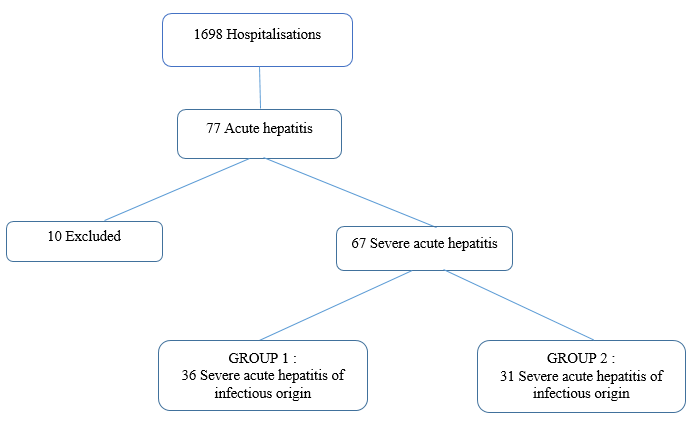
Figure 1 patient recruitment flow.
Infectious causes were predominant before the age of 31 and after 60, while their frequency was similar between 31 and 50 years. This difference was not statistically significant, with a p-value of 0.56.
Identified etiologies
Table 1 reveals that the infectious causes were exclusively viral. Hepatitis B accounted for 83.33% of the infectious causes, with 20% being a co-infection of HDV/HBV. Hepatitis A, making up 16.67% of the cases, represented the other viral etiology observed. The non-infectious etiologies were dominated, at 96.77%, by toxic causes, including traditional decoctions (61.29%) and medication intake (35.48%).Regardless of the type of severe acute hepatitis, hepatitis B was the most frequent cause, accounting for 44.78% of the cases.
|
Number (n) |
Percentage (%) |
|
|
GROUP 1 (n=36) |
||
|
VHA* |
6 |
16 ,67 |
|
VHB** |
24 |
66,66 |
|
VHD/VHB*** |
6 |
16,67 |
|
GROUP 2 (n=31) |
||
|
Auto-immun |
1 |
3,23 |
|
Traditional decoctions |
19 |
61,29 |
|
Drugs intake |
11 |
35,48 |
Table 1 Distribution of severe acute hepatitis according to etiologies
*Viral hepatitis A; ** Viral Hepatitis B; ***Viral hepatitis D
Clinical diagnosis
Signs of hemorrhagic diathesis were the most frequently observed, with no statistically significant difference between the two groups, as shown in Figure 2. Hepatic encephalopathy was found in 19.40% of patients, with no statistically significant difference between the two groups.
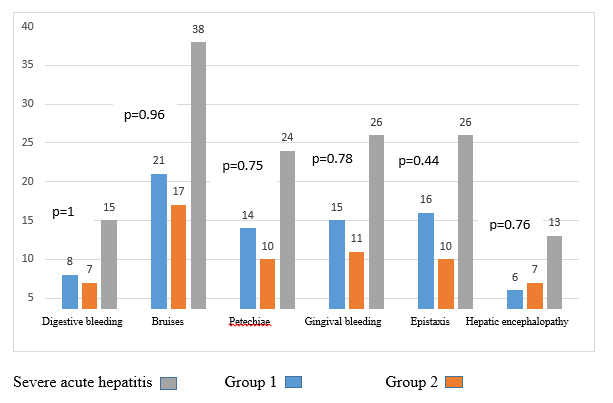
Figure 2 distribution of severe acute hepatitis according to physical signs.
Table 2 shows the various biological abnormalities found. Prothrombin time (PT) ranged between 30 and 50% in 57% of patients, with no statistically significant difference between the two groups. The AST/ALT ratio was greater than 1 in 12% of patients and appeared similar in both groups. Impaired kidney function was found in 4% of patients, with no statistically significant difference.
Evolution
The average length of hospitalization was 17.42 ± 10.77 days. This duration was similar in both groups (p-value 0.52). We observed 30 deaths, representing 44.78%. The mortality rate was 55.56% in group 1, while it was 36.26% in group 2 as showed in table 2. This difference was not statistically significant (p=0.09) (Table 3).
|
Biological exams |
Group 1 |
Group 2 |
Severe acute hepatitis |
P-value |
|
TP <30% |
17 (47%) |
12(39%) |
29(43%) |
0.64 |
|
30%-50% |
19(53%) |
19(61%) |
38(57%) |
|
|
AST* X10-20 |
18 (50%) |
17(55%) |
35(52%) |
0.88 |
|
X 20 |
18 (50%) |
14(45%) |
32(48%) |
|
|
ALT** X10-20 |
21 (58%) |
15(48%) |
36(54%) |
0.56 |
|
X 20 |
15(42%) |
16(52%) |
31(46%) |
|
|
AST/ALT > 1 |
1 |
|||
|
No |
32 (89%) |
27 (87%) |
59(88%) |
|
|
Yes |
4(11%) |
4(13%) |
8(12%) |
|
|
Elevated Urea |
1(3%) |
2(6%) |
3(4%) |
0.89 |
|
Elevated Creatinine |
1 (3%) |
2 (6%) |
3 (4%) |
0.89 |
Table 2 Distribution of severe acute hepatitis according to biological abnormalities
*Aspartate aminotransferase; **Alanine aminotransferase
|
Group 1 |
Group 2 |
SAH |
P-value |
||
|
Death |
No |
16((44,44%) |
21(67,74%) |
37 (55,22%) |
0.09 |
|
Yes |
20(55,56%) |
10(32,26%) |
30(44,78%) |
Table 3 distribution of severe acute hepatitis according to mortality
The hospital frequency of severe acute hepatitis was 4.53%. This frequency appears higher than that reported by Ba A et al.9 in Senegal, who estimated it at 0.2%. This difference is probably related to methodological bias, as our study population consisted exclusively of adults, whereas Ba A et al. included patients from the pediatric department.
The infectious etiology accounted for 53.73%. Hepatitis B accounted for 44.78% of severe acute hepatitis etiologies and 83.33% of those of infectious etiologies, with a HBV/HDV co-infection rate of 20%. These data are consistent with national epidemiological data, which place Gabon in a high endemic area for hepatitis B.10 These data differ from those of Ba A et al.9 in Senegal and Ismail H et al.11 in Morocco, who found a significant proportion of viral hepatitis A, which they attributed to a large number of patients having limited access to drinking water.
Severe acute toxic hepatitis was mainly caused by the consumption of traditional decoctions and medications. These data contrast with those of Zoubeidi H et al.12 in Tunisia and Konaté A et al.13 in Mali, who found a significant proportion of drug-induced hepatitis. This difference could be related to the weight of tradition. Indeed, the use of traditional brews is one of the main alternatives to modern medical care in our country.14,15 From an evolutionary standpoint, the mortality rate was 44.78%. This mortality was higher than that reported by other African authors, where it ranged from 8% to 29%. This difference was probably related to the severity of the clinical presentation in our series, where hemorrhagic syndrome was common. This is especially true considering the delay in seeking medical consultation, and the taboos surrounding viral infectious diseases such as hepatitis, as well as self-medication with traditional decoctions within the context of beliefs and customs in our country, which actively contribute to diagnostic and therapeutic delays. In Senegal, among 728 patients, due to insufficient examination linked to economic constraints, the serological status was undetermined in 252 patients.16 Likewise, the lack of awareness of the disease by patients with chronic HBV and the various circumstances of the disease's discovery contribute to late diagnosis. None of the interviewed individuals were screened on their own initiative; screening occurred during examinations related to prenatal consultations, emergency hospitalizations, or bouts of illness. The care pathway is characterized by doubt and anxiety due to lack of knowledge about the possible disease outcome and concern about the costs of management.17
This work has certain limitations; indeed, the purely hospital-based nature of the study does not allow for the extrapolation of these results to the entire country. However, severe acute hepatitis is a serious condition defined biologically, and its management cannot be conceived outside of a medicalized environment. Thus, its purely hospital-based design is justified. Moreover, there could be an underestimation of the frequency of this condition, which may be encountered in emergency departments, intensive care units, infectious disease departments, internal medicine, pediatrics, or gynecology-obstetrics. For this reason, we plan to continue this work with a prospective approach by including all the aforementioned departments by integrating the role of the anti-aging gene Sirtuin 1 as suggested by Martins’ work.18-21
Severe acute hepatitis at the Libreville University Hospital presents a varied etiological spectrum, dominated by infectious causes. The prognosis differs according to the etiology, with less favorable outcomes for cases related to infection and self-medication. These results call for better prevention, earlier diagnosis, and strengthened etiological monitoring, all of which require active awareness efforts.
All authors have read and approved the manuscript version.
The authors declare that they have no conflicts of interest.

©2025 Itoudi-Bignoumba, et al. This is an open access article distributed under the terms of the, which permits unrestricted use, distribution, and build upon your work non-commercially.
