eISSN: 2373-6372


Research Article Volume 17 Issue 1
1University of medicine of Tunis El MANAR, Tunisia
2Department of gastroenterology, University hospital of Bizerte, Tunisia
Correspondence: E Slama, University of medicine of Tunis El MANAR, Tunisia
Received: November 24, 2025 | Published: April 14, 2026
Citation: Slama E, Hamida SB, Elloumi H, et al. Investigating the association between hepatic steatosis and chronic hepatitis B Infection in a Tunisian cohort. Gastroenterol Hepatol Open Access. 2026;17(1):17-21. DOI: 10.15406/ghoa.2026.17.00629
Introduction: Hepatic steatosis and chronic hepatitis B virus (HBV) infection are major global health concerns, particularly in regions with high HBV endemicity. Both conditions contribute significantly to liver dysfunction, yet their coexistence and potential interaction remain poorly understood. This study aims to investigate the prevalence of hepatic steatosis among patients with chronic HBV infection and to examine the relationship between hepatic steatosis and HBV viral activity.
Methods: A cross-sectional study was conducted at Bizerte’s University Hospital, involving patients with confirmed chronic HBV infection. Data collected included demographic information, metabolic risk factors, body mass index (BMI), liver function tests, HBV DNA levels, and hepatitis B e antigen (HBeAg) status. Hepatic steatosis was assessed using controlled attenuation parameter (CAP) via transient elastography. Statistical analysis was performed using SPSS version 26.
Results: The study included 50 patients (sex ratio M/F = 1.5), with a mean age of 46.2 ± 14.8 years and a mean BMI of 27.0 ± 5.3 kg/m². Of the 50 HBV-positive patients, 90% were found to have hepatic steatosis, with 40% having mild (S1), 30% moderate (S2), and 20% severe (S3) steatosis. Notably, patients with hepatic steatosis had a significantly higher BMI.
Pearson’s chi-square analysis revealed a statistically significant association between hepatic steatosis and HBV DNA levels (χ² (10, N = 50) = 33.25, p < 0.001). Analysis of variance (ANOVA) further showed a significant correlation between the degree of hepatic steatosis and the level of liver fibrosis (F = 5.154, p = 0.009). A linear relationship was identified (p = 0.002), with no significant deviation from linearity (p = 1.000), suggesting that increased fibrosis severity is associated with the presence of steatosis.
No significant association was found between hepatic steatosis and HBeAg status (F = 0.113, p = 0.738). T-tests revealed significant differences in BMI (p < 0.001), Gaj (p = 0.001), and triglycerides (TG) (p = 0.045), with lower average values in patients without steatosis. No significant differences were observed for ALT (p = 0.095), total cholesterol (p = 0.790), or HBV DNA levels (p = 0.169).
Conclusion: Hepatic steatosis is highly prevalent among patients with chronic HBV, particularly in those with metabolic risk factors. The inverse relationship between steatosis and HBV replication suggests a complex interplay that warrants further investigation. These findings underscore the importance of metabolic screening and management as part of comprehensive care for individuals with chronic HBV infection, to improve long-term liver health outcomes.
Keywords: Hepatitis B, Hepatic Steatosis, Metabolic Disorders, Non alcoholic Fatty Liver Disease, Disease Burden, Viral Load, Fibrosis
Chronic hepatitis B virus (HBV) infection and metabolic dysfunction–associated fatty liver disease (MAFLD) are two of the most prevalent chronic liver disorders worldwide. Chronic HBV affects approximately 296 million people globally, with particularly high endemicity in parts of Asia and Africa.1 In Tunisia, the prevalence of chronic HBV infection (HBsAg positivity) is estimated to be around 4–6% in the general population.2 Meanwhile, the prevalence of metabolic syndrome in Tunisian adults is substantial, affecting about 30% in a nationally representative survey (TAHINA study).3 Hepatic steatosis has become the leading cause of chronic liver disease in many countries, largely driven by obesity, type 2 diabetes, and metabolic syndrome.4 Both conditions can progress to liver fibrosis, cirrhosis, and hepatocellular carcinoma (HCC), significantly contributing to global morbidity and mortality. In regions with high HBV endemicity, the coexistence of HBV infection and hepatic steatosis is increasingly recognized but remains poorly characterized.
Although hepatic steatosis is strongly linked to metabolic risk factors, its coexistence with HBV infection has been variably reported. Some studies suggest an inverse relationship between HBV replication and steatosis,5,6 whereas others have found no clear association.7 Mechanistically, hepatic steatosis may influence fibrosis through insulin resistance, hepatic inflammation, and lipotoxicity.5 Understanding the interplay between metabolic liver disease and HBV infection is therefore crucial, as their coexistence may modify disease progression and long-term outcomes. Accordingly, this study aimed to determine the prevalence of hepatic steatosis among patients with chronic HBV infection in Tunisia, and to examine its association with HBV viral activity, metabolic parameters, and liver fibrosis.
A cross-sectional study was conducted at Bizerte’s University Hospital, Tunisia, over a 12-month period.
Inclusion criteria were: Adults aged ≥18 years with chronic HBV infection, defined as HBsAg positivity for >6 months.
Exclusion criteria were:
All participants provided complete clinical and laboratory data.
Data collectionDemographic and anthropometric data, including age, sex, weight, height, and body mass index (BMI), were recorded. Metabolic parameters—fasting glucose, triglycerides, and total cholesterol—were measured, alongside liver function tests (ALT, AST, GGT, bilirubin). HBV virological markers, including HBV DNA and HBeAg, were assessed. Serum HBV DNA levels were quantified using real-time polymerase chain reaction (Shengxiang Biotechnology, Hunan, China; reference <20 IU/mL). HBsAg and HBeAg were measured by chemiluminescence immunoassay (Abbott i2000 and Roche e801, respectively).
Assessment of hepatic steatosis and fibrosisHepatic steatosis and liver fibrosis were evaluated using transient elastography (FibroScan®502, Echosens, France). Controlled attenuation parameter (CAP) values were used to grade steatosis: S0 (no steatosis, CAP <248 dB/m), S1 (mild, 248–267 dB/m), S2 (moderate, 268–279 dB/m), and S3 (severe, ≥280 dB/m). Liver stiffness measurements (LSM) were used to stage fibrosis: F0–F1 (<7.2 kPa), F2 (7.2–9.3 kPa), F3 (9.4–12.1 kPa), and F4 (≥12.2 kPa). Each measurement was performed at least ten times per participant, with the median value recorded.
Statistical analysisContinuous variables were expressed as mean ± standard deviation (SD) and categorical variables as counts and percentages. Differences between groups were evaluated using independent t-tests or one-way ANOVA for continuous variables and Chi-square tests for categorical variables. Pearson’s chi-square test was used to examine associations between hepatic steatosis and HBV DNA levels, while ANOVA was employed to assess the relationship between steatosis grade and fibrosis severity. Linear regression analysis was performed to evaluate the correlation between steatosis and fibrosis, with assessment of linearity. Comparisons of metabolic and biochemical parameters (BMI, GGT, triglycerides, ALT, total cholesterol, HBV DNA) between patients with and without steatosis were conducted using t-tests. A p-value <0.05 was considered statistically significant. Statistical analyses were performed using IBM SPSS version 26.were assessed using t-tests, ANOVA, Mann–Whitney U, or Kruskal–Wallis tests for continuous variables, and Chi-square or Fisher’s exact tests for categorical variables. Correlations between steatosis, fibrosis, and HBV virological parameters were analyzed using Pearson or Spearman coefficients. Univariate and multivariate logistic regression analyses were conducted to identify factors associated with HBV pgRNA below the lower limit of detection (LLD), with odds ratios (OR) and 95% confidence intervals (CI) calculated. A p-value <0.05 was considered statistically significant. Statistical analyses were performed using IBM SPSS version 26 (Figure 1).
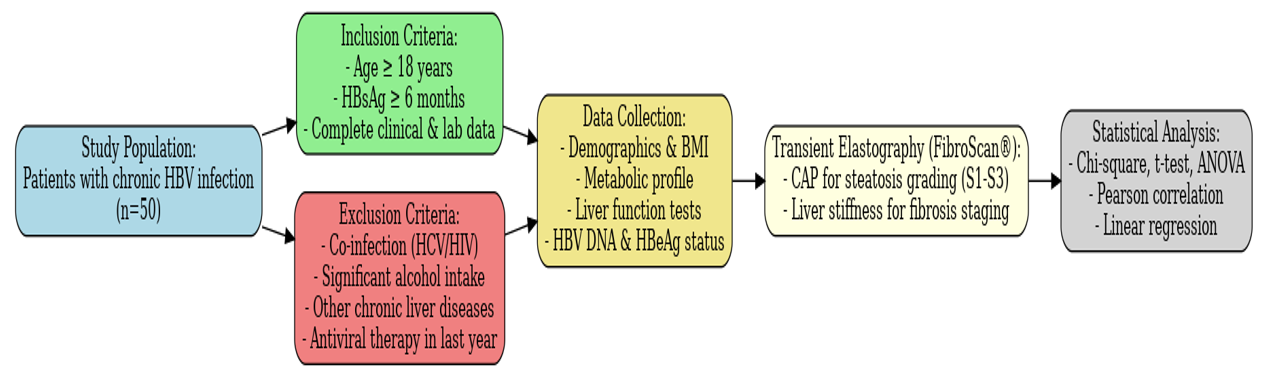
Figure 1 Study design.
Patient disposition of our present study is depicted in Figure 2.
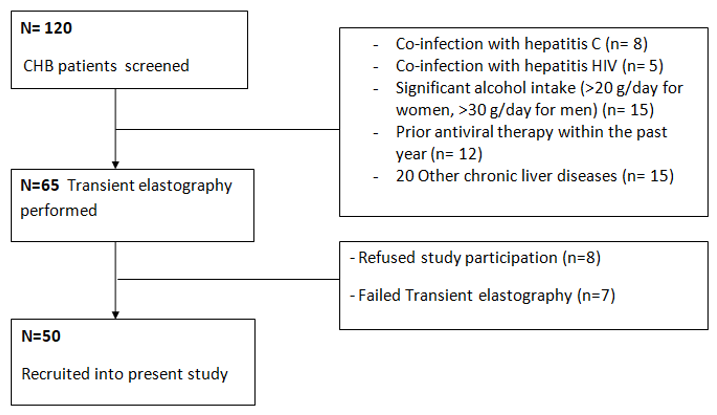
Figure 2 Patient disposition.
Patient demographics and clinical characteristics
A total of 50 patients with chronic HBV infection were included, with a male-to-female ratio of 1.5. The mean age was 46.2 ± 14.8 years. Among our population, metabolic and cardiovascular comorbidities were common. Hypertension (HTA) was present in 13 patients (26.0%), type 2 diabetes (DT) in 8 patients (16.0%), dyslipidemia in 9 patients (18.0%), and a combination of dyslipidemia and diabetes in 12 patients (24.0%). Eight patients (16.0%) had no reported comorbidities. Baseline demographic, metabolic, and biochemical characteristics are summarized in Table 1. The cohort had a mean BMI of 27.0 ± 5.3 kg/m², hemoglobin within normal limits (14.25 ± 0.91 g/dL), and platelets averaging 241.5 ± 46.9 ×10³/µL. Liver enzymes were generally normal, with ALT 20.2 ± 14.1 IU/L and GGT 26.0 ± 9.2 IU/L. Metabolic parameters, including triglycerides (0.93 ± 0.22 mmol/L) and total cholesterol (3.99 ± 0.52 mmol/L), indicated a population at moderate metabolic risk. HBV DNA levels ranged from 0 to 1,100,000 IU/mL, with a mean of 89,058.36 IU/mL and a standard deviation of 301,142.46 IU/mL, reflecting substantial variability within the cohort . All 50 patients had valid viral load measurements.
|
Parameter |
Minimum |
Maximum |
Mean ± SD |
|
BMI (kg/m²) |
21 |
39 |
27.04 ± 5.29 |
|
Hb (g/dL) |
12.1 |
15.6 |
14.25 ± 0.91 |
|
Platelets (PLQ, ×10³/µL) |
166 |
300 |
241.48 ± 46.87 |
|
Gaj (IU/L) |
3.91 |
8.9 |
5.09 ± 1.38 |
|
ALT (IU/L) |
10 |
58 |
20.22 ± 14.08 |
|
AST (IU/L) |
12 |
39 |
19.00 ± 7.71 |
|
ALP (IU/L) |
58 |
107 |
90.32 ± 14.59 |
|
GGT (IU/L) |
16 |
44 |
25.96 ± 9.16 |
|
Total bilirubin (BT, µmol/L) |
4 |
17 |
8.44 ± 3.64 |
|
Conjugated bilirubin (BC, µmol/L) |
2 |
7 |
4.04 ± 1.47 |
|
Triglycerides (TG, mmol/L) |
0.5 |
1.41 |
0.93 ± 0.22 |
|
Total cholesterol (CT, mmol/L) |
3.22 |
5.02 |
3.99 ± 0.52 |
Table 1 Baseline demographic, metabolic, and biochemical characteristics
Prevalence and severity of steatosis and fibrosis
Among the 50 patients with chronic HBV infection, hepatic steatosis (CAP ≥248 dB/m) was highly prevalent, affecting 90% of the cohort. Mild (S1), moderate (S2), and severe (S3) steatosis were observed in 40%, 30%, and 20% of patients, respectively. Severe liver fibrosis (F3–F4) was present in 21.7% of patients, while cirrhosis (F4) was identified in 11.2%. Analysis of variance revealed a significant correlation between the degree of hepatic steatosis and liver fibrosis (F = 5.154, p = 0.009), with a linear relationship indicating that increased fibrosis severity was associated with the presence of steatosis (p = 0.002; no deviation from linearity, p = 1.000). Patients with hepatic steatosis also had significantly higher BMI, Gaj, and triglyceride levels compared with those without steatosis (p < 0.001, p = 0.001, and p = 0.045, respectively), whereas no significant differences were observed for ALT, total cholesterol, or HBV DNA levels. No significant association was found between steatosis and HBeAg status (p = 0.738).
Our study demonstrates a high prevalence (90%) of hepatic steatosis in Tunisian HBV patients, exceeding rates reported elsewhere.4,5 While regional diet and obesity are factors, the molecular basis may involve the anti-aging gene Sirtuin 1 (SIRT1). SIRT1 is a critical regulator of lipid metabolism and cellular senescence; its downregulation is known to promote MASLD and "Type 3 diabetes" metabolic profiles.14,15 In our cohort, the significant correlation between BMI, triglycerides, and steatosis suggests a systemic metabolic failure potentially mediated by SIRT1 deficiency. Furthermore, we observed a significant association between hepatic steatosis and HBV DNA levels (χ² (10, N = 50) = 33.25, p < 0.001$). This "complex interplay" can be explained by SIRT1’s dual role: it not only regulates fat oxidation but also targets transcription factors like AP-1 to modulate HBV replication [17]. The high prevalence of severe steatosis (S3) and its link to advanced fibrosis (F3–F4) in our patients may reflect a state of "cell senescence and apoptosis" triggered by low SIRT1 expression.13 In the current era of nucleoside analogue therapy, where viral suppression is common, the metabolic axis—driven by the SIRT1/MASLD pathway—may become the primary driver of fibrogenesis.8,9 Therefore, identifying Sirtuin 1 activators versus Sirtuin 1 inhibitors is critical to the treatment of liver steatosis in these CHB Tunisian patients.16
These findings align with prior studies demonstrating that severe steatosis, quantified by CAP, is independently associated with advanced fibrosis in both treatment-naïve and on-treatment HBV populations.8,9 As viral suppression becomes more common, traditional viral risk factors may lose prognostic significance, emphasizing the need to evaluate metabolic risk factors, including hepatic steatosis, when assessing fibrosis risk in CHB.8,9 The linear association between CAP values and fibrosis severity observed in our study further supports this concept and suggests that CAP can serve as a practical noninvasive biomarker for identifying high-risk patients.8,10,11
Although other metabolic parameters such as BMI, triglycerides, and Gaj levels were elevated in patients with steatosis, they were not independently associated with fibrosis severity, highlighting steatosis itself as a key modifiable risk factor.4,6 This observation is clinically relevant, as lifestyle interventions, including dietary modification, weight management, and glycemic control, have been shown to reduce hepatic fat content and may have downstream effects on fibrosis progression.12,13 The potential reversibility of steatosis emphasizes the importance of integrating metabolic management into the care of HBV-infected patients. Noninvasive CAP measurement offers several advantages over liver biopsy, including rapid acquisition, repeatability, and patient tolerability.8,10,11 In clinical practice, CAP can be easily implemented to monitor fibrosis risk in stable or asymptomatic HBV patients, particularly in resource-limited settings where biopsy is impractical. Moreover, CAP provides quantitative stratification, allowing clinicians to identify patients with severe steatosis who may benefit most from targeted interventions.8,10,11
Our study has several limitations. Its cross-sectional design precludes causal inference, and the relatively modest sample size may limit statistical power for subgroup analyses. We did not obtain histological confirmation of steatosis or fibrosis, relying instead on CAP and liver stiffness measurements, which, while validated, are imperfect and require standardized quality criteria.10,11 Future studies incorporating longitudinal follow-up and histological validation would strengthen the evidence base regarding the prognostic significance of CAP-defined steatosis in CHB.8, 9,11
Despite these limitations, our study provides valuable insights into the interplay between metabolic liver disease and fibrosis in a North African HBV population. It emphasizes that even in patients with well-controlled viral replication, metabolic factors—particularly severe steatosis—can contribute meaningfully to liver disease progression.4–11 These findings have important implications for clinical practice, underscoring the need for routine metabolic assessment, lifestyle counseling, and potentially pharmacologic interventions aimed at reducing hepatic fat accumulation in CHB patients.12,13
Severe hepatic steatosis (CAP ≥ 280 dB/m) is highly prevalent among Tunisian CHB patients and is independently associated with advanced fibrosis. This relationship persists regardless of viral replication status, highlighting the significant role of metabolic factors and the Sirtuin 1 signaling pathway in the progression of CHB. We propose that plasma SIRT1 levels should be measured early in patients with CHB as a diagnostic protein marker to prevent irreversible advanced liver fibrosis and severe liver disease [Reference D]. Integrating SIRT1-targeted nutrition therapy and metabolic management alongside antiviral therapy may be essential to improving long-term liver health outcomes in this high-risk population.
None.
None.

©2026 Slama, et al. This is an open access article distributed under the terms of the, which permits unrestricted use, distribution, and build upon your work non-commercially.
